
Recursos
Exploren una amplia gama de recursos valiosos en GCED para profundizar su comprensión y promover su búsqueda, incidencia, enseñanza y aprendizaje.
3,435 resultados encontrados
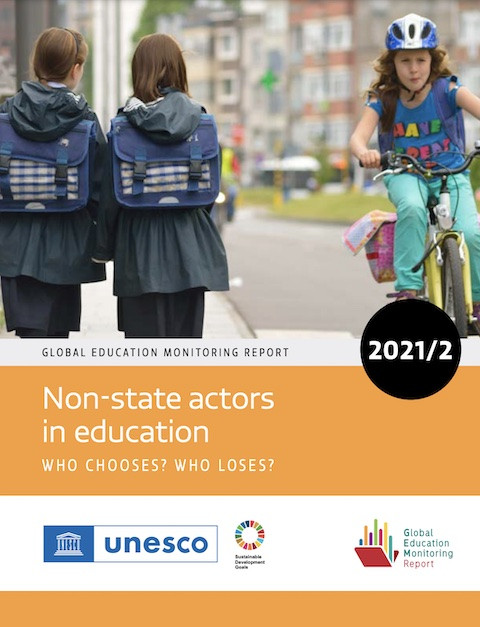 Global Education Monitoring Report 2021/2: Non-state Actors in Education; Who Chooses? Who Loses? Año de publicación: 2021 Autor corporativo: UNESCO Non-state actors’ role extends beyond provision of schooling to interventions at various education levels and influence spheres. Alongside its review of progress towards SDG 4, including emerging evidence on the COVID-19 pandemic’s impact, the 2021/2 Global Education Monitoring Report urges governments to see all institutions, students and teachers as part of a single system. Standards, information, incentives and accountability should help governments protect, respect and fulfill the right to education of all, without turning their eyes away from privilege or exploitation. Publicly funded education does not have to be publicly provided but disparity in education processes, student outcomes and teacher working conditions must be addressed. Efficiency and innovation, rather than being commercial secrets, should be diffused and practiced by all. To that end, transparency and integrity in the public education policy process need to be maintained to block vested interests. The report’s rallying call – Who chooses? Who loses? – invites policymakers to question relationships with non-state actors in terms of fundamental choices: between equity and freedom of choice; between encouraging initiative and setting standards; between groups of varying means and needs; between immediate commitments under SDG 4 and those to be progressively realized (e.g. post-secondary education); and between education and other social sectors. 全球教育监测报告摘要, 2021/2年: 教育领域的非国家行为体:谁能主动选择?谁将错失机会? Año de publicación: 2021 Autor corporativo: 联合国教科文组织 (UNESCO) 本文件是2021/2022年全球教育检测报告的摘要,主要聚焦教育领域的非国家行为体,包括私人办学、宗教办学等力量,并探讨了与非国家行为体对教育的影响与存在问题。
 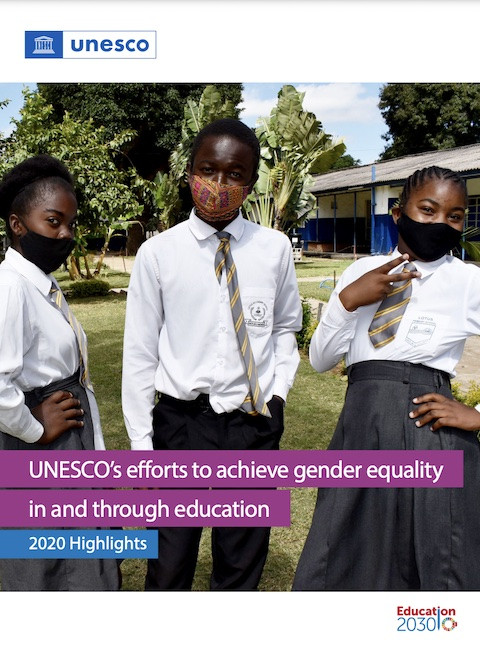 L’action de l’UNESCO en faveur de l’égalité des genres dans et par l’éducation: Points majeurs de l’année 2020 Año de publicación: 2022 Autor corporativo: UNESCO Ce rapport présente les points majeurs de l’action menée en 2020 par l’UNESCO pour faire progresser l’égalité des genres dans et par l’éducation.L’action menée par l’UNESCO dans le domaine de l’éducation et du genre est ancrée dans la stratégie de l’UNESCO pour l’égalité des genres dans et par l’éducation 2019-2025. Cette stratégie repose aussi sur l’initiative Son éducation, notre avenir, lancée en parallèle afin de mobiliser les engagements politiques et financiers et de faciliterla coopération et l’action conjointe en faveur de l’éducation des filles et des femmes.
  Knowledge-Driven Actions: Transforming Higher Education for Global Sustainability; Independent Expert Group on the Universities and the 2030 Agenda Año de publicación: 2022 Autor: Adrian Parr | Agnes Binagwaho | Andy Stirling | Anna Davies | Cheikh Mbow | Dag Olav Hessen | Helena Bonciani Nader | Jamil Salmi | Melody Brown Burkins | Seeram Ramakrishna | Sol Serrano | Sylvia Schmelkes | Tong Shijun | Tristan McCowan Autor corporativo: UNESCO With 2030 less than a decade away, it is paramount to think critically and act urgently if we are to achieve the Sustainable Development Goals.Higher education institutions are uniquely positioned to contribute to the social, economic and environmental transformations that are required to tackle the world’s most pressing issues.This report thoroughly discusses the role of higher education institutions in contributing to the 2030 Agenda, through a focus on three interrelated themes: the need to move towards inter- and transdisciplinary modes of producing and circulating knowledge; the imperative of becoming open institutions, fostering epistemic dialogue and integrating diverse ways of knowing; and the demand for a stronger presence in society through proactive engagement and partnering with other societal actors. The report directs attention to the systemic barriers that have inhibited transformations in these three areas so far, and provides advice and examples on how to achieve this. The report calls on higher education leaders and actors to push for transformations within their institutions, using the report’s recommendations to critically reflect and act on their role for achieving the 2030 Agenda.
 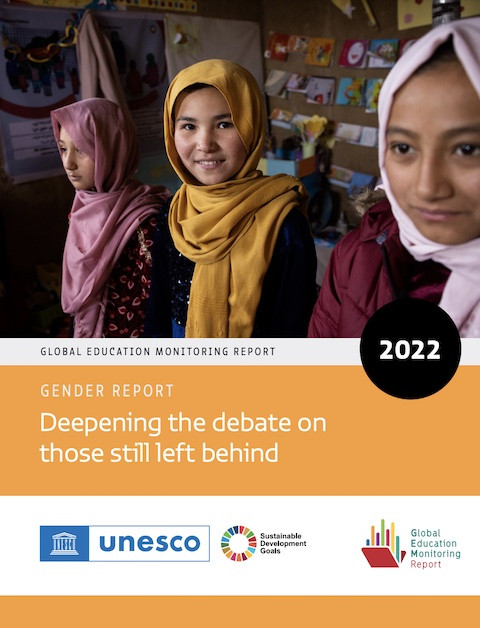 Global Education Monitoring Report 2022: Gender Report; Deepening the Debate on Those Still Left Behind Año de publicación: 2022 Autor corporativo: Global Education Monitoring Report Team | UNESCO The 2022 Gender Report presents fresh insights on progress towards gender parity in education with respect to access, attainment and learning. It showcases the results of new models that provide coherent estimates, combining multiple sources of information, on out-of-school and completion rates. It also reviews the results of learning assessments released over the past 18 months, which present an almost global picture of the gender gap in reading, mathematics and science achievement in lower and upper primary and lower secondary grades. They provide a baseline against which to assess the impact of COVID-19 on inequality when post-pandemic data start being released next year.A companion to the 2021/2 GEM Report, it emphasizes the role of non-state actors in influencing gender inequality in and through education. Non-state actors have filled in provision gaps left by the public education system. The 2022 Gender Report presents evidence on gender gaps in the share of students enrolled in private institutions by sex and what drives these gaps in the various regions. It also provides case studies on the privatization of childcare in high-income countries, the impact of non-state faith-based schools in Asia on gender norms and the role of women’s universities around the world.Some non-state actors have pushed the gender equality agenda forward, while others have undermined progress in order to maintain the status quo. Some have been at the front line for girls’ education in emergencies. Some have lobbied against comprehensive sexuality education. Some champion inclusion of marginalized girls, while others maintain discriminatory gender norms. Depending on the context, it is important not to make assumptions but to look carefully at the data and work together to eliminate all forces that prevent anyone on the basis of gender from fulfilling their potential through education.
  Where Do We Stand on Education for Sustainable Development and Global Citizenship Education: Findings of the 7th Consultation on the Implementation of the 1974 Recommendation Concerning Education for International Understanding, Co-operation and Peace and Education Relating to Human Rights and Fundamental Freedoms Año de publicación: 2022 Autor corporativo: UNESCO The Recommendation concerning Education for International Understanding, Co-operation and Peace and Education relating to Human Rights and Fundamental Freedoms was adopted by the 18th session of UNESCO’s General Conference in November 1974. Every four years, Member States are invited to report on the measures they have taken to implement the Recommendation in all levels and types of education from pre-primary to tertiary, formal, non-formal and adult education. This document summarizes the results of the 7th consultation on the implementation of the 1974 Recommendation, covering the period 2017-2020. It also contains, for the first time, data for the global indicator adopted by the UN Statistical Commission and the UN General Assembly for the monitoring of Target 4.7 of Sustainable Development Goal for Education.
  Guidelines for ICT in education policies and masterplans Año de publicación: 2022 Autor: Fengchun Miao | Juan Enrique Hinostroza | Molly Lee | Shafika Isaacs | Dominic Orr | Fabio Senne | Ana-Laura Martinez | Ki-Sang Song | Alexander Uvarov | Wayne Holmes | Benjamin Vergel de Dios Autor corporativo: UNESCO Countries across the world have been leveraging information and communication technologies (ICTs) to advance education for decades. These initiatives are driven by public institutions and involve commercial technology companies, and have resulted in paradoxes such as increasing digital inequalities and uneven access to high-quality digital learning opportunities. The COVID-19 crisis further exacerbated this trend: At least one third of students globally did not have access to distance learning during the peak of the COVID-19 crisis in 2020.The publication aims to guide policy-makers to ensure that when adopting technology, human rights should be defended; inclusion, equity and gender equality should be at the heart of solutions; and innovations should be considered as a common good. Based on these principles, the publication presents a human-centred view on the potentials of technologies ranging from low-bandwidth technologies to emerging technologies including Artificial Intelligence and Web 3.0 or “metaverse”. It advocates for national policies to protect the digital well-being of teachers and students, to reduce and neutralize the digital emission footprint, and to avoid ‘techno-solutionism’.This publication proposes policy planning frameworks and an iterative roadmap to examine the digital readiness of local education systems, assess needs of learners and teachers, and plan well-resourced national ICT in education programmes. This is followed by a deep dive into examples of national masterplans on the use of ICT in different types of education.
  Challenging Systematic Prejudices: An Investigation into Bias Against Women and Girls in Large Language Models Año de publicación: 2024 Autor: Daniel Van Niekerk | Maria Peréz Ortiz | John Shaw-Taylor | Davor Orlic | Ivana Drobnjak | Jackie Kay | Noah Siegel | Katherine Evans | Nyalleng Moorosi | Tina Eliassi-Rad | Leone Maria Tanczer | Wayne Holmes | Marc Peter Deisenroth | Isabel Straw | Maria Fasli | Rachel Adams | Nuria Oliver | Dunja Mladenić | Urvashi Aneja | Madeleine Janicky Autor corporativo: UNESCO | International Research Centre on Artificial Intelligence (IRCAI) This study explores biases in three significant large language models (LLMs): OpenAI’s GPT-2 and ChatGPT, along with Meta’s Llama 2, highlighting their role in both advanced decision-making systems and as user-facing conversational agents. Across multiple studies, the brief reveals how biases emerge in the text generated by LLMs, through gendered word associations, positive or negative regard for gendered subjects, or diversity in text generated by gender and culture. The research uncovers persistent social biases within these state-of-the-art language models, despite ongoing efforts to mitigate such issues. The findings underscore the critical need for continuous research and policy intervention to address the biases that exacerbate as these technologies are integrated across diverse societal and cultural landscapes. The emphasis on GPT-2 and Llama 2 being open-source foundational models is particularly noteworthy, as their widespread adoption underlines the urgent need for scalable, objective methods to assess and correct biases, ensuring fairness in AI systems globally.
  Global Toolkit on AI and the Rule of Law for the Judiciary Año de publicación: 2023 Autor: Miriam Stankovich | Ivana Feldfeber | Yasmín Quiroga | Marianela Ciolfi Felice | Vukosi Marivate Autor corporativo: UNESCO What is Artificial Intelligence (AI)? How does it work? And more importantly, how does it find its way into the judicial context? Technologies such as AI have been around for decades, but only recently have they begun to be used in a variety of justice and law enforcement settings. While AI has immense potential for the justice system, helping judges make better decisions, improving efficiency, increasing access, and helping to detect and prevent crime, there are also some important issues that justice stakeholders should consider as they prepare for a future in which AI is increasingly used in justice systems.In 2022, UNESCO launched two needs assessments. First, through UNESCO’s Artificial Intelligence Needs Assessment Survey in Africa, 90% of the 32 countries surveyed requested capacity building support for the Judiciary on AI. At the same time, a second global survey of judicial actors in 100 countries underlined the need for better understanding the use of AI in the administration of justice and its wider legal implications on societies.The “Global Toolkit on AI and the Rule of Law” for the Judiciary responds to these needs and provides judicial actors (judges, prosecutors, state attorneys, public lawyers, law universities and judicial training institutions) with the knowledge and tools necessary to understand the benefits and risks of AI in their work. The toolkit will assist judicial actors in mitigating the potential human rights risks of AI by providing guidance on the relevant international human rights laws, principles, rules and emerging jurisprudence that underpin the ethical use of AI.
  Empowering Students for Just Societies: A Handbook to Teach Integrity in Secondary Schools Año de publicación: 2024 Autor corporativo: UNESCO | UN. Office on Drugs and Crime (UNODC) The importance of education lies in its power to shape the values of upcoming generations and equip them with the knowledge to make informed decisions. Contemporary challenges, including corruption must be addressed through education, transparency, accountability and the rule of law, among other efforts. This joint publication by UNODC and UNESCO is a response to this important issue. It is aimed at educators who are striving to inspire and prepare future generations to actively contribute to societies grounded in integrity, ethics and respect for the rule of law. The handbook builds on the first two launched in 2019. This publication highlights the transformative power of education in strengthening the knowledge, skills, attitudes and values necessary for addressing global challenges, especially those that stem from a lack of integrity, like corruption. It underlines the crucial role education plays in nurturing critical thinking, empathy, ethical behaviour, and a commitment to justice and equality among people. The handbook presents a catalogue of educational activities, lesson plans and outside the classroom resources designed to empower youth to reject corrupt practices and become agents of change, promoting integrity and upholding democratic values.