
Recursos
Exploren una amplia gama de recursos valiosos en GCED para profundizar su comprensión y promover su búsqueda, incidencia, enseñanza y aprendizaje.
3,385 resultados encontrados
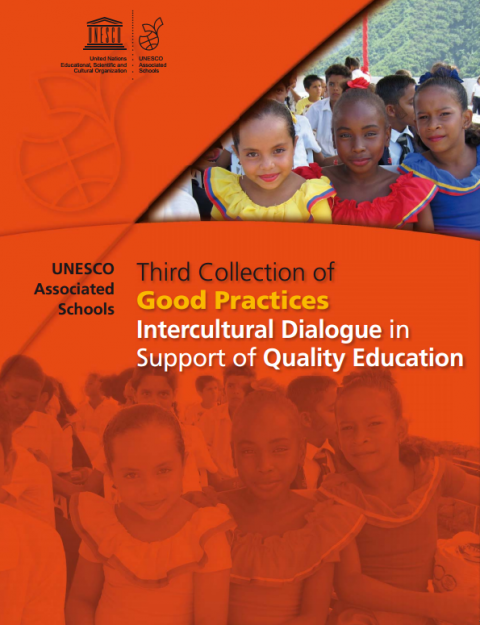 Third collection of good practices: intercultural dialogue in support of quality education Año de publicación: 2013 Autor corporativo: UNESCO Associated Schools Project Network (ASPnet) The UNESCO Associated Schools Project Network (ASPnet) conducts pilot projects aimed at reinforcing the humanistic and ethical principles of UNESCO in school curricula and throughout the learning process, often within the framework of UN and UNESCO International Day, Years and Decades, Promoting intercultural dialogue is thus an ASPnet priority. The initiatives presented in this Third Collection of ASPnet Good Practices were carried out by ASPnet schools and their partner institutions in the context of the International Year for the Rapprochement of Cultures (2010). The selected projects illustrate both multicultural education and intercultural education in action. Troisième recueil de bonnes pratiques: le dialogue interculturel à l'appui de l'éducation de qualité Año de publicación: 2013 Autor corporativo: UNESCO Associated Schools Project Network (ASPnet) Les écoles associées de l'UNESCO (réSEAU) mènent des projets pilotes visant à renforcer les principes humanistes et éthiques de l'UNESCO dans les programmes scolaires et tout au long du processus d'apprentissage, souvent dans le cadre de l'ONU et de la Journée internationale de l'UNESCO, années et décennies, la promotion du dialogue interculturel est donc une priorité Reseau. Les initiatives présentées dans ce troisième Collection de Reseau bonnes pratiques ont été réalisées par les écoles Reseau et leurs institutions partenaires dans le cadre de l'Année internationale du rapprochement des cultures (2010). Les projets sélectionnés illustrent à la fois l'éducation multiculturelle et l'éducation interculturelle dans l'action.
 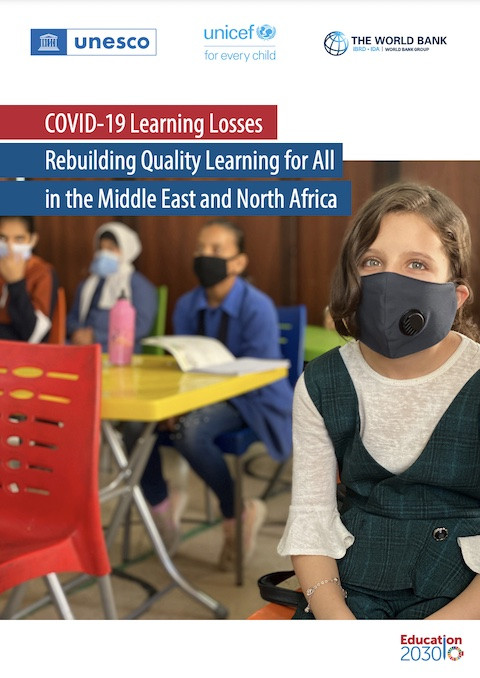 COVID-19 Learning Losses: Rebuilding Quality Learning for All in the Middle East and North Africa Año de publicación: 2021 Autor: Hana Yoshimoto | Jeannette Vogelaar | Brenda Haiplik Autor corporativo: UNESCO | United Nations Children's Fund (UNICEF) | World Bank An entire generation of children in the Middle East and North Africa (MENA) is estimated to be affected by the education crisis determined by the COVID-19 pandemic, with potential impacts that are going beyond the immediate/short term and also well beyond the education domain itself, with consequences on children’s socialisation, mental well-being, and future perspective of being active members of their society, including in the labor market. More information on the impact of the crisis would help countries to put in place strategies to mitigate the impacts. Timely investment and action to prevent extreme impacts of this crisis on education are of paramount importance in MENA, which already tackling a learning crisis before the COVID-19 outbreak.This publication delineates the overall education status in MENA after the breakout of COVID-19 pandemic, by presenting the education responses in MENA, and assessing the potential learning loss through a simulation analysis, recommendations are provided on how to build back better and enhance access and quality learning for all.
 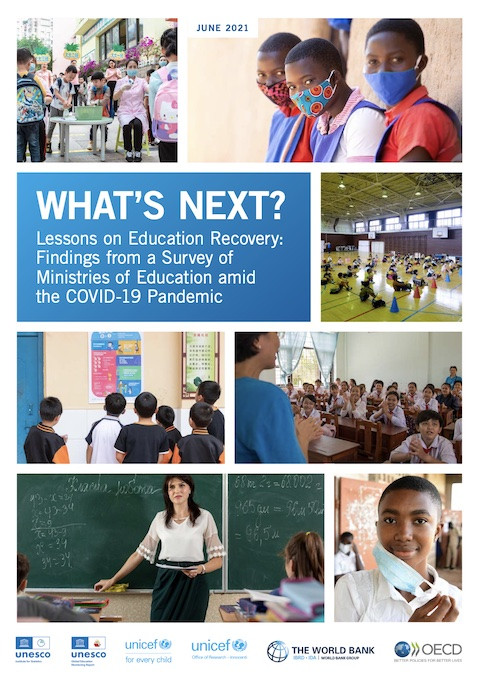 What’s Next? Lessons on Education Recovery: Findings From a Survey of Ministries of Education Amid the COVID-19 Pandemic Año de publicación: 2021 Autor corporativo: UNESCO | United Nations Children's Fund (UNICEF) | World Bank | Organisation for Economic Co-operation and Development (OECD) United Nations Educational, Scientific and Cultural Organization (UNESCO), the United Nations Children’s Fund (UNICEF), the World Bank and the Organisation for Economic Co-operation and Development (OECD) have collaborated in the third round of the Survey on National Education Responses to COVID-19 School Closures, administered by the UNESCO Institute for Statistics (UIS) and OECD to Ministry of Education officials. The questions covered four levels of education: preprimary, primary, lower secondary and upper secondary. While the first two rounds of the survey were implemented during the periods May–June and July–October 2020, respectively, the third round was implemented during the period February–June 2021. In total, 143 countries responded to the questionnaire. Thirty-one countries submitted responses to the OECD (“OECD survey”) and 112 countries responded to the UIS (“UIS survey”). Seven countries responded to both surveys. In these instances, the more complete set responses were used in analysis.
 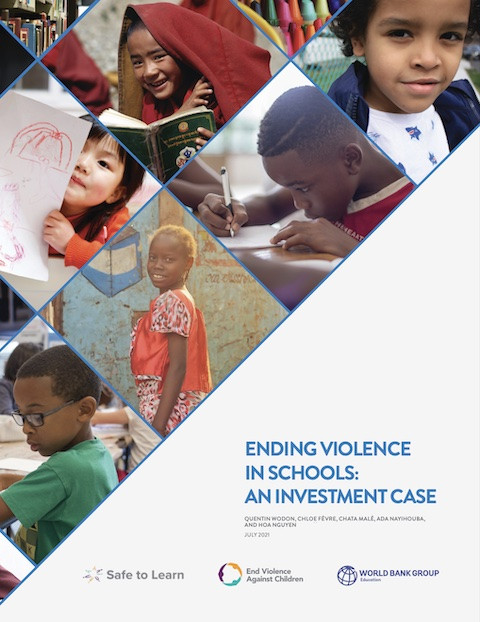 Ending Violence in Schools : An Investment Case Año de publicación: 2021 Autor: Quentin Wodon | Chloë Fèvre | Chata Malé | Ada Nayihouba | Hoa Nguyen Autor corporativo: World Bank Preventing violence in and through school is a prerequisite for girls and boys getting the education they need and deserve, and acquiring the skills, knowledge and values that provide the foundations for strong and inclusive societies. This report demonstrates that violence in and around schools negatively impacts educational outcomes, and society pays a heavy price as a result (with an estimate of $11 trillion in lost lifetime earnings). Cost-benefit analyses suggest that implementing interventions to prevent violence in and through schools from early childhood to secondary education is a smart economic investment. Rigorously evaluated programs and policies aimed at preventing violence at different levels of the education system show that action is feasible. The benefits of investing in preventing violence in and through schools is likely to far outweigh the costs.
 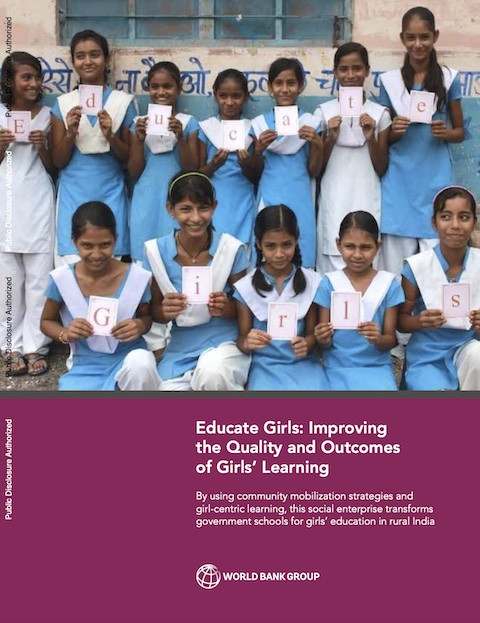 Educate Girls: Improving the Quality and Outcomes of Girls’ Learning Año de publicación: 2017 Autor corporativo: World Bank In India, women and girls, especially in rural areas, are particularly affected by the country’s illiteracy problem, since they face discrimination based on their sex and need for childbearing. In Rajasthan, the north- western Indian state that borders Pakistan, 9 out of 26 districts have the worst gender gap in India for girls’ education.Established in 2007, Educate Girls is holistically tackling issues at the root cause of gender inequality in India’s education system that has helped to ensure over 90% enrollment and significantly higher attendance for all girls as well as improved school infrastructure, quality of education and learning outcomes for all children.As a result of Educate Girls’ efforts to date, an army of “girls champions” has been created to combat cultural issues and support systemic change. More than 150,000 out-of-school girls have been enrolled in school and the program has benefitted around 3.8 million of beneficiaries. Continuing to address the social and cultural barriers in girls’ education can bring about real transformation, such as improvement in health, income levels, and overall livelihoods in rural populations.
  Summary of the World Report on Disability Año de publicación: 2011 Autor corporativo: World Health Organization (WHO) | World Bank The World Health Organization and the World Bank jointly produced this global report on disability, in order to present the evidence needed to develop innovative policies and programs capable of improving the lives of people with disabilities, and to facilitate the implementation of the United Nations Convention on the Rights of Persons with Disabilities that was activated in May of 2008. The World Report provides a definition of disability as an umbrella term that includes under its umbrella various forms of organ impairment/dysfunction, limited activity, and participation limitations. The term disability also refers to the negative features of the interaction between individuals with a health condition (such as cerebral palsy, Down syndrome, or depression), and between personal and environmental factors (such as negative attitudes, lack of access to transportation and public buildings, and limited social support).It then presents suggestions for steps that can be taken by all concerned parties - including governments, civil society organizations, and organizations of persons with disabilities - in order to create enabling environments, develop rehabilitation and support services, ensure adequate social protection, launch comprehensive policies and programs, and activate new standards and legislation List, for the benefit of people with disabilities and society at large. People with disabilities should be the centerpiece of these endeavours. It also sheds light on the various obstacles and barriers faced by persons with disabilities - obstacles related to the attitudes and trends they encounter, and physical and financial obstacles - all of which are easy to deal with and address. It provides recommendations for action at the local, national and international levels, and is thus an invaluable tool. موجز التقرير العالمي حول الإعاقة Año de publicación: 2011 Autor corporativo: World Health Organization (WHO) | World Bank قامت منظمة الصحة العالمية بالاشتراك مع البنك الدولي في إصدار هذا التقرير العالمي حول الإعاقة، من أجل عرض البيِّنات اللازمة لوضع السياسات والبرامج المبتكرة القادرة على تحسين حياة ذوي الإعاقة، وتيسير تنفيذ اتفاقية الأمم المتحدة لحقوق الأشخاص ذوي الإعاقة التي تم تفعيلها في أيار/مايو من عام 2008. ويقدم التقرير العالمي تعريفا عن الإعاقة بوصفها مصطلحاً جامعاً يضم تحت مظلته الأشكال المختلفة للاعتلال/الخلل العضوي، ومحدودية النشاط، والقيود التي تحد من المشاركة. كما أن مصطلح الإعاقة يعود إلى السمات السلبية للتفاعل بين الأفراد الذين يعانون من حالة صحية ما )مثل الشلل الدماغي، أو متلازمة داون، أو الاكتئاب(، وبين العوامل الشخصية والبيئية )مثل المواقف السلبية، وانعدام إتاحة وسائل النقل والمباني العامة، والدعم الاجتماعي المحدود).ثم يقدم اقتراحات بخطوات يمكن أن تتخذ من قبل كافة الأطراف المعنية –ومنها الحكومات، ومنظمات المجتمع المدني، ومنظمات الأشخاص ذوي الإعاقة – من أجل إيجاد بيئات ممكِّنة، وتطوير خدمات التأهيل والدعم، وضمان الحماية الاجتماعية الكافية، وإطلاق سياسات وبرامج شاملة، وتفعيل المعايير والتشريعات الجديدة والقائمة، وذلك لصالح ذوي الإعاقة والمجتمع على نطاقه الأوسع. وينبغي أن يكون ذوو الإعاقة هم المركز الذي تتمحور حوله هذه المساعي. كما يلقي الضوء على العقبات والعوائق المتباينة التي يواجهها ذوو الإعاقة - عقبات تتعلق بما يصادفونه من مواقف واتجاهات، وعقبات مادية، ومالية – وكلها عقبات يسهل التعامل معها والتصدي لها. يقدم توصيات للعمل على المستويات المحلية والوطنية والدولية، ومن ثم فهو أداة لا تقدر بثمن.
 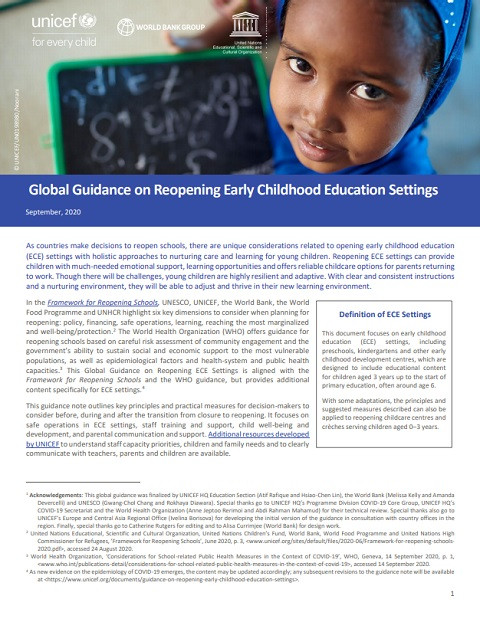 Global Guidance on Reopening Early Childhood Education Settings Año de publicación: 2020 Autor corporativo: United Nations Children's Fund (UNICEF) | World Bank | UNESCO This guidance note outlines key principles and practical measures for decision-makers to consider before, during and after the transition from closure to reopening. It focuses on safe operations in ECE settings, staff training and support, child well-being and development, and parental communication and support.
 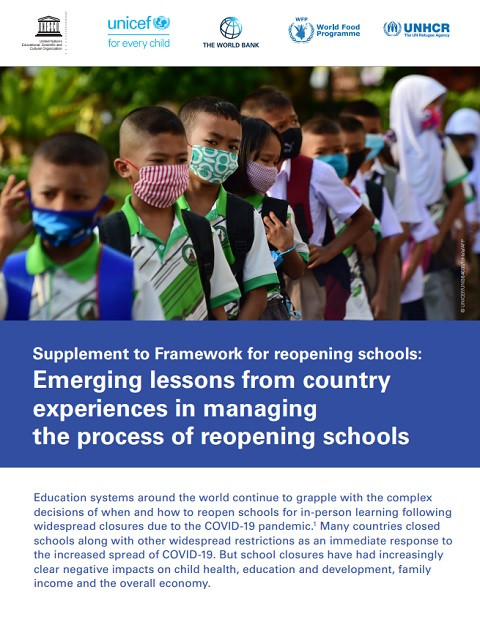 Supplement to Framework for Reopening Schools: Emerging Lessons From Country Experiences in Managing the Process of Reopening Schools Año de publicación: 2020 Autor corporativo: UNESCO | United Nations Children's Fund (UNICEF) | World Bank | World Food Programme | UN. Office of the United Nations High Commissioner for Refugees (UNHCR) Education systems around the world continue to grapple with the complex decisions of when and how to reopen schools for in-person learning following widespread closures due to the COVID 19 pandemic. This supplement to the Framework for reopening schools, originally published jointly by UNICEF, UNESCO, the World Bank, the World Food Programme, and the UN Refugee Agency (UNHCR) in April 2020, summarizes emerging lessons learnt over the past months.The supplement follows the four main dimensions of the Framework (safe operations, focus on learning, wellbeing & protection, and reaching the most marginalized) and highlighting a number of country examples.