
Recursos
Exploren una amplia gama de recursos valiosos en GCED para profundizar su comprensión y promover su búsqueda, incidencia, enseñanza y aprendizaje.
3,385 resultados encontrados
 Rethinking Pedagogy: Exploring the Potential Of Digital Technology In Achieving Quality Education Año de publicación: 2019 Autor: Lorena Alemán de la Garza | Alessandra Anichini | Péter Antal | Aurélie Beaune | Éric Bruillard | Diane Burke | Pedro Henrique Cacique Braga | Ruma Chakravarti | Sriya Chakravarti | Deng Chen | Lidiya Chikalova | Helen Crompton | Ilana De Almeida Souza Concilio | William Cope | Lorenz Denks | Matthew Farber | Giovanni Fonseca | Pintér Gergely | Marcela Georgina Gómez Zermeño | Russell Hazard | Laura Hosman | Mary Kalantzis | Kojanitz László | Xavier Levoin | Kristen Linzy | Arnab Mandal | Yoko Mochizuki | Ariam Mogos | Tünde-Lengyel Molnár | Matthew Montebello | Sadaqat Mulla | Sandra Gudiño Paredes | Christelle Pauty-Combemore | Boyka Parfitt | Réka Racsko | Irais Monserrat Santillán Rosas | Khitam Shraim | Jisoo Song | Avgoustos Tsinakos Autor corporativo: Mahatma Gandhi Institute of Education for Peace and Sustainable Development (MGIEP) With the exponential growth of digitally mediated communication, digital media and gaming, the landscape of what we understand as learning environments is changing significantly. Today the use of digital technology in education is attracting considerable public and policy attention as
well as private investment. With a rise in discourses both heralding and cautioning against the use of digital technology in education, there is a need to pool the expertise and experience on the use of technology in education from around the world to advance public debate and evidence-informed policymaking. Based on the literature review, mapping of digital education resources in circulation, and examples of implementation of digital education initiatives from around the world, this report aims to provide insights that would help lead to the wise, innovative and ethical use of digital technology in education as a new dimension in achieving SDG 4 — inclusive and equitable quality education and lifelong learning opportunities for all. By so doing, it also attempts to contribute to a rethink of teaching and learning in the face of enormous opportunities and challenges brought about by digital technology in the times of change and turmoil.
Rethinking Pedagogy: Exploring the Potential Of Digital Technology In Achieving Quality Education Año de publicación: 2019 Autor: Lorena Alemán de la Garza | Alessandra Anichini | Péter Antal | Aurélie Beaune | Éric Bruillard | Diane Burke | Pedro Henrique Cacique Braga | Ruma Chakravarti | Sriya Chakravarti | Deng Chen | Lidiya Chikalova | Helen Crompton | Ilana De Almeida Souza Concilio | William Cope | Lorenz Denks | Matthew Farber | Giovanni Fonseca | Pintér Gergely | Marcela Georgina Gómez Zermeño | Russell Hazard | Laura Hosman | Mary Kalantzis | Kojanitz László | Xavier Levoin | Kristen Linzy | Arnab Mandal | Yoko Mochizuki | Ariam Mogos | Tünde-Lengyel Molnár | Matthew Montebello | Sadaqat Mulla | Sandra Gudiño Paredes | Christelle Pauty-Combemore | Boyka Parfitt | Réka Racsko | Irais Monserrat Santillán Rosas | Khitam Shraim | Jisoo Song | Avgoustos Tsinakos Autor corporativo: Mahatma Gandhi Institute of Education for Peace and Sustainable Development (MGIEP) With the exponential growth of digitally mediated communication, digital media and gaming, the landscape of what we understand as learning environments is changing significantly. Today the use of digital technology in education is attracting considerable public and policy attention as
well as private investment. With a rise in discourses both heralding and cautioning against the use of digital technology in education, there is a need to pool the expertise and experience on the use of technology in education from around the world to advance public debate and evidence-informed policymaking. Based on the literature review, mapping of digital education resources in circulation, and examples of implementation of digital education initiatives from around the world, this report aims to provide insights that would help lead to the wise, innovative and ethical use of digital technology in education as a new dimension in achieving SDG 4 — inclusive and equitable quality education and lifelong learning opportunities for all. By so doing, it also attempts to contribute to a rethink of teaching and learning in the face of enormous opportunities and challenges brought about by digital technology in the times of change and turmoil. 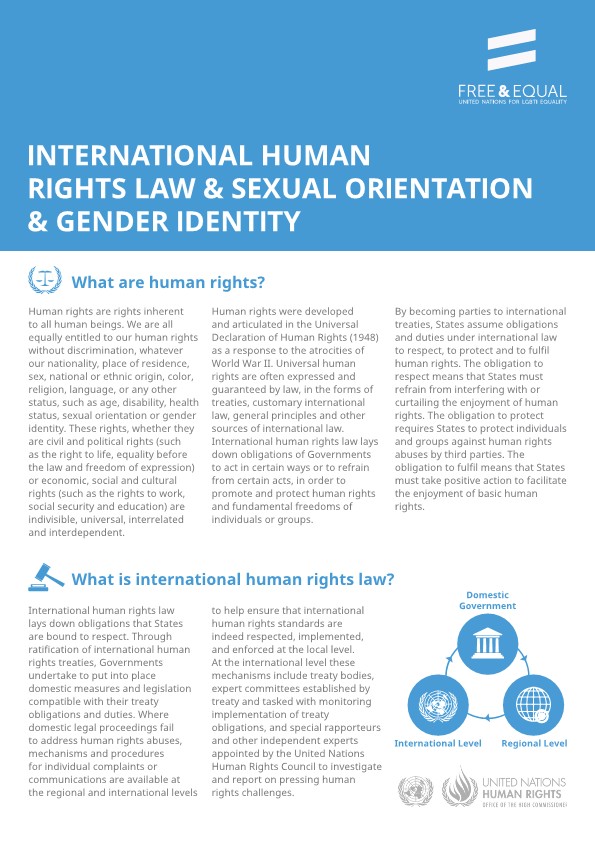 International Human Rights Law & Sexual Orientation & Gender Identity Año de publicación: 2017 Autor corporativo: UN. Office of the United Nations High Commissioner for Human Rights (UN. OHCHR) | United Nations Free & Equal What are human rights?Human rights are rights inherent to all human beings. We are all equally entitled to our human rights without discrimination, whatever our nationality, place of residence, sex, national or ethnic origin, color, religion, language, or any other status, such as age, disability, health status, sexual orientation or gender identity. These rights, whether they are civil and political rights (such as the right to life, equality before the law and freedom of expression) or economic, social and cultural rights (such as the rights to work, social security and education) are indivisible, universal, interrelated and interdependent.Human rights were developed and articulated in the Universal Declaration of Human Rights (1948) as a response to the atrocities of World War II. Universal human rights are often expressed and guaranteed by law, in the forms of treaties, customary international law, general principles and other sources of international law. International human rights law lays down obligations of Governments to act in certain ways or to refrain from certain acts, in order to promote and protect human rights and fundamental freedoms of individuals or groups.By becoming parties to international treaties, States assume obligations and duties under international law to respect, to protect and to fulfil human rights. The obligation to respect means that States must refrain from interfering with or curtailing the enjoyment of human rights. The obligation to protect requires States to protect individuals and groups against human rights abuses by third parties. The obligation to fulfil means that States must take positive action to facilitate the enjoyment of basic human rights.What is international human rights law? International human rights law lays down obligations that States are bound to respect. Through ratification of international human rights treaties, Governments undertake to put into place domestic measures and legislation compatible with their treaty obligations and duties. Where domestic legal proceedings fail to address human rights abuses, mechanisms and procedures for individual complaints or communications are available at the regional and international levels to help ensure that international human rights standards are indeed respected, implemented, and enforced at the local level. At the international level these mechanisms include treaty bodies, expert committees established by treaty and tasked with monitoring implementation of treaty obligations, and special rapporteurs and other independent experts appointed by the United Nations Human Rights Council to investigate and report on pressing human rights challenges.Is it ever legal to discriminate against lesbian, gay, bisexual, transgender or intersex people?No. The right to equality and non-discrimination are core principles of human rights, enshrined in the United Nations Charter, The Universal Declaration of Human Rights (UDHR) and human rights treaties. The opening words of the Universal Declaration of Human Rights are unequivocal: “All human beings are born free and equal in dignity and rights.”The equality and non-discrimination guarantee provided by international human rights law applies to all people, regardless of sex, sexual orientation and gender identity or “other status.” There is no fine print, no hidden exemption clause, in any of our human rights treaties that might allow a State to guarantee full rights to some but withhold them from others purely on the basis of sexual orientation and gender identity.Moreover, United Nations human rights treaty bodies have confirmed that sexual orientation and gender identity are included among prohibited grounds of discrimination under international human rights law. This means that it is unlawful to make any distinction of people’s rights based on the fact that they are lesbian, gay, bisexual or transgender (LGBT), just as it is unlawful to do so based on skin color, race, sex, religion or any other status. This position has been confirmed repeatedly in decisions and general guidance issued by several treaty bodies, such as the United Nations Human Rights Committee, the Committee on Economic, Social and Cultural Rights, the Committee on the Rights of the Child, the Committee against Torture, and the Committee on the Elimination of Discrimination against Women.What are some of the most common forms of human rights violations affecting LGBT people? The UN human rights office has documented a wide range of human rights violations committed against individuals on the basis of their sexual orientation and gender identity.These include:Violent attacks, ranging from aggressive verbal abuse and psychological bullying to physical assault, beatings, torture, kidnapping and targeted killings.Discriminatory criminal laws, often used to harass and punish LGBT people, including laws criminalizing consensual same-sex relationships, which violate rights to privacy and to freedom from discrimination.Discriminatory curbs on free speech and related restrictions on the exercise of rights to freedom of association and assembly, including laws banning dissemination of information on same-sex sexuality under the guise of restricting the spread of so-called LGBT “propaganda.”Discriminatory treatment, which can take place in a range of everyday settings, including workplaces, schools, family homes and hospitals. Without national laws prohibiting discrimination by third parties on grounds of sexual orientation and gender identity, such discriminatory treatment continues unchecked, leaving little recourse to those affected. In this context, lack of legal recognition of same-sex relationships or of a person’s gender identity can also have a discriminatory impact on many LGBT individuals. What have the UN General Assembly and Human Rights Council said on this subject?The United Nations General Assembly, in a series of resolutions, has called on States to ensure the protection of the right to life of all persons under their jurisdiction and to investigate promptly and thoroughly all killings including those motivated by the victim’s sexual orientation and gender identity (see, for example, resolution A/RES/67/168).In June 2011, the United Nations Human Rights Council became the first UN intergovernmental body to adopt a wide-ranging resolution on human rights, sexual orientation and gender identity. Resolution 17/19 expressed the Council’s “grave concern” at violence and discrimination against individuals based on their sexual orientation and gender identity, and commissioned a study on the scope and extent of these violations and the measures needed to address them.The requested study, prepared by the Office of the High Commissioner for Human Rights, was released in December 2011. It pointed to a pattern of violence and discrimination directed at individuals because of their sexual orientation and gender identity. Its findings and recommendations formed the basis of a panel discussion that took place at the Council in March 2012 – the first time a formal intergovernmental debate on the subject had been taken place at the United Nations.
 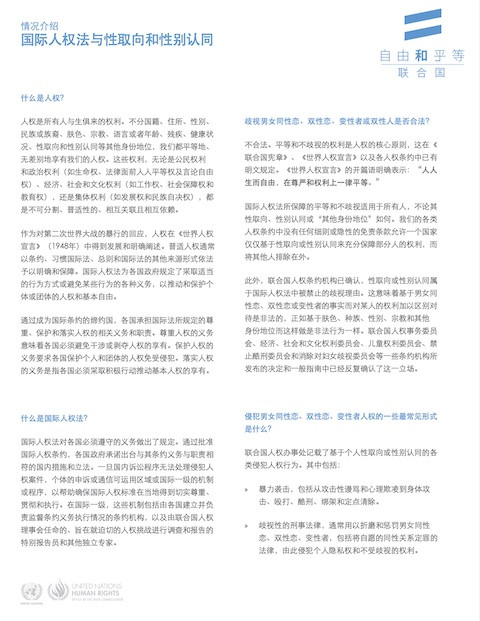 国际人权法与性取向和性别认同 Año de publicación: 2017 Autor corporativo: UN. Office of the United Nations High Commissioner for Human Rights (UN. OHCHR) | United Nations Free & Equal 什么是人权?什么是国际人权法?歧视男女同性恋、双性恋、变性者或双性人是否合法?侵犯男女同性恋、双性恋、变性者人权的一些最常见形式是什么?联合国大会及人权事务委员会对该主题有何表述?各国在尊重男女同性恋、双性恋和变性者方面有哪些法律义务?
  Right to Education and Schooling in Latin America Año de publicación: 2020 Autor: Mariela Alejandra Acevedo | Felicitas Acosta | Myriam Feldfeber | Pablo Imen | María Mercedes Palumbo | Fernanda Saforcada | Soledad Vercellino Autor corporativo: Universidad Nacional de General Sarmiento | Consejo Latinoamericano de Ciencias Sociales (CLACSO) The extension of the right to education in Latin America is part of the contemporary debate about schooling. The educational reforms of the latter part of the 20th century and the beginning of the 21st century in the region accompanied this debate: enactment of new laws, changes in the structure of educational systems, curricular reforms, revision of classroom teaching, modification of the teacher training are some of the ways these reforms take. Changes in education systems are also affected by the emergence of new actors, topics and forms of intervention: from standardized international tests and the participation of civil society and non-governmental organizations, to the introduction of content related to issues of gender and sexuality. This book brings together works that attempt to account for the set of changes mentioned, from different perspectives: historical, political, philosophical and pedagogical. It also brings together the award-winning articles from the CLACSO-UNGS essay contest on the right to education within the framework of the Education Axis of the Democracies in Revolution / Revolutions in Democracy program. Derecho a la educación y escolarización en América Latina Año de publicación: 2020 Autor: Mariela Alejandra Acevedo | Felicitas Acosta | Myriam Feldfeber | Pablo Imen | María Mercedes Palumbo | Fernanda Saforcada | Soledad Vercellino Autor corporativo: Universidad Nacional de General Sarmiento | Consejo Latinoamericano de Ciencias Sociales (CLACSO) La extensión del derecho a la educación en América Latina forma parte del debate contemporáneo acerca de la escolarización. Las reformas educativas de la última parte del siglo XX y comienzos del siglo XXI en la región acompañaron dicho debate: sanción de nuevas leyes, cambios en la estructura de los sistemas educativos, reformas curriculares, revisión de la enseñanza en el aula, modificación de la formación docente son algunas de las maneras que adoptan estas reformas. Las modificaciones en los sistemas educativos también se encuentran atravesadas por la emergencia de nuevos actores, temas y formas de intervención: desde las pruebas internacionales estandarizadas, la participación de la sociedad civil y las organizaciones no gubernamentales, hasta la introducción de contenidos vinculados con cuestiones de género y sexualidad. Este libro reúne trabajos que intentan dar cuenta del conjunto de cambios mencionados desde diferentes perspectivas: histórica, política, filosófica y pedagógica. Reúne también los artículos premiados del concurso de ensayos CLACSO-UNGS sobre el derecho a la educación en el marco del Eje Educación del programa Democracias en revolución/Revoluciones en democracia.