
Recursos
Exploren una amplia gama de recursos valiosos en GCED para profundizar su comprensión y promover su búsqueda, incidencia, enseñanza y aprendizaje.
3,433 resultados encontrados
 Overview of Information Literacy Resources Worldwide Año de publicación: 2013 Autor: Forest Woody Horton Autor corporativo: UNESCO This publication aims to bring together Information Literacy contributions in forty-two languages from all of the different geographic regions around the world in order to provide inclusive and multilingual Information Literacy resources for Library and Information Science professionals, teachers, researchers, and students.
  Seoul Declaration on Media and Information Literacy for Everyone and by Everyone: A Defence Against Disinfodemics Año de publicación: 2020 Autor corporativo: UNESCO On the 10th anniversary of Global Media and Information Literacy Week, stakeholders from all over the world gave a resounding affirmation as to the urgency to strengthen people’s media and information literacy competencies. The number of celebratory events increased from one hundred events in 2019 to over three hundred events in 2020.The outcomes of the deliberations in the Feature Conference and Youth Agenda Forum have been immortalized in the Seoul Declaration on Media and Information Literacy for Everyone and by Everyone: A Defence against Disinfodemics. This Seoul Declaration benefited from a consultation with close to one thousand registered participants.Through the Seoul Declaration, partners and participants called for media and information literacy for all. They:Emphasized that “media and information literacy (MIL) is a core competency for addressing the disinfodemic, and that MIL also contributes to access to information, freedom of expression, protection of privacy, prevention of violent extremism, promotion of digital security and combating hate speech and inequality”.Recognized “UNESCO’s effort to promote a Global MIL Cities Framework to stimulate creative learning about MIL in city spaces and the involvement of non-traditional actors in promoting MIL”.Called on duty bearers at the national to city levels to “commit to advancing ‘Media and Information Literacy for Everyone and by Everyone’ through policy and resource allocation across all relevant areas, including education, health, elections, child protection, climate, gender equality, governance and regulation, to mention some examples”.Urged technological intermediaries to “play an accountable role, through institutionalized multi-stakeholder systems, as part of the social endeavor to tackle disinformation and to build communities that are media and information literate”.Requested UNESCO, in cooperation with other UN Agencies, to “maintain a focus on inclusion of disadvantaged groups in MIL engagements, and to continue to foster gender equality in relation to MIL.” 모두를 위한, 모두에 의한 미디어·정보 리터러시에 관한 서울 선언문: 디스인포데믹에 대한 저항 Año de publicación: 2020 Autor corporativo: 유네스코 2020년 글로벌 미디어·정보리터러시(MIL) 주간 대표회의 및 청년포럼의 결과문서로 채택된 서울선언문이다. 본 선언문에서는 MIL의 중요성을 강조하고, 각각의 이해관계자가 MIL 역량 증진을 위해 실천할 수 있는 구체적인 행동을 담고 있다.
  Supporting Learning Recovery One Year into COVID-19: The Global Education Coalition in Action Año de publicación: 2021 Autor corporativo: UNESCO | Global Education Coalition The Global Education Coalition, launched by UNESCO, is a platform for collaboration and exchange to protect the right to education during this unprecedented disruption and beyond.This is the annual report of the Coalition, which builds on the inaugural report published in September 2020, and covers the activity between March 2020 and March 2021.
  Media and Information Literacy for Knowledge Societies Año de publicación: 2013 Autor corporativo: Interregional Library Cooperation Centre | UNESCO This book includes communications by the participants and other materials of the International Conference on Media and Information Literacy for Knowledge Societies (Moscow, Russian Federation, 24–28 June, 2012), that offered a unique opportunity to identify the key existing challenges in the field, to outline policies and professional strategies for the advocacy of media and information literacy (MIL), to promote best practices and strengthen international cooperation among various stakeholders. It also contains the Media and Information Literacy Competencies Catalogue prepared by The Modern Poland Foundation (Warsaw, Poland).
 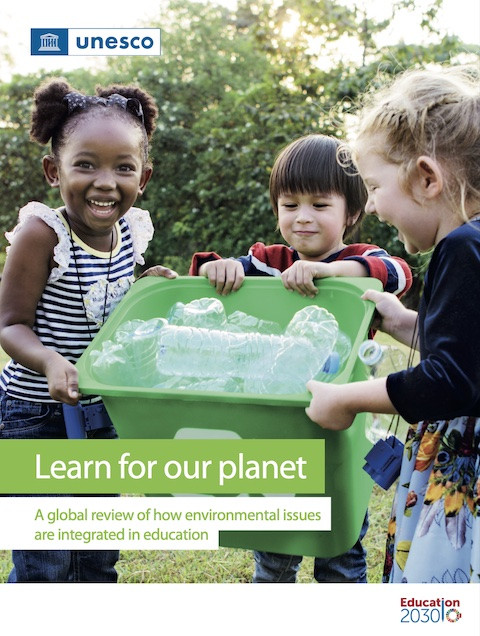 Learn For Our Planet: A Global Review Of How Environmental Issues Are Integrated In Education Año de publicación: 2021 Autor corporativo: UNESCO 2020 was the equal hottest year on record. One million species are at risk of extinction. We use more resources than the planet can generate each year - if we continue to live the way we do today, we will need three earths by 2050. The way we currently live is not sustainable. Urgent change is needed, but lasting change is impossible without education.This publication presents the extent to which environmental issues are integrated in primary and secondary education policies and curricula across 46 UNESCO Member States. Over half of education policies and curricula studied made no mention of climate change. Only 19 per cent made reference to biodiversity. Countries have made progress: 83 per cent of education policies and curricula studied addressed the environment at least once, and 69 per cent mentioned sustainability - but it is clear that more needs to be done to prepare learners with the knowledge, skills, values and attitudes to act for our planet. Governments, education policy-makers, academics, and education and environmental stakeholders need to further commit to Education for Sustainable Development.
  Education Kit on Combating Desertification: Learning to Combat Desertification; A Teacher’s Guide Año de publicación: 2003 Autor corporativo: UNESCO The educational guide contained in this kit is addressed to teachers around the world living in areas affected by or under threat from desertification. For this reason, the guide should be seen as a general presentation to be adapted to the specific realities and preoccupations of each region or country. The guide begins with the different problems of desertification, which the teachers could integrate into lessons (fauna, flora, crop varieties or rearing, methods of land exploitation, socio-economic problems etc.). It presents the major objectives of the Convention and proposes several solutions to combat desertification. Kit pedagógico sobre la lucha contra la desertificación: Aprendiendo a luchar contra la desertificación; Guía educativa para el maestro Año de publicación: 2003 Autor corporativo: Organización de las Naciones Unidas para la Educación, la Ciencia y la Cultura (UNESCO) La guía educativa contenida en este kit va dirigida a los maestros de todo el mundo que viven en zonas afectadas o amenazadas por la desertificación. Por tanto, ha de ser considerada como una presentación general que debe ser adaptada a las realidades y preocupaciones específicas de cada país o región. La guía comienza con la presentación de los diferentes problemas en torno a la desertificación (fauna, flora, tipos de cultivo, cría de animales, formas de explotación de la tierra, problemas socioeconómicos, etc.), los cuales pueden ser integrados en el transcurso de las clases. La guía presenta los principales objetivos de la Convención y propone una serie de soluciones para combatir la desertificación. Kit pédagogique sur la lutte contre la désertification: Apprendre à lutter contre la désertification; Guide éducatif pour l’enseignant Año de publicación: 2003 Autor corporativo: Organisation des Nations Unies pour l'éducation, la science et la culture (UNESCO) Le guide éducatif contenu dans le kit s’adresse aux enseignants du monde entier vivant dans les zones affectées ou menacées par la désertification. Pour cette raison, le guide doit être perçu comme une présentation générale, à adapter aux réalités et aux préoccupations spécifiques de chaque pays ou région. L’ouvrage s’ouvre sur les différentes problématiques de la désertification, que les enseignants doivent intégrer (faune, flore, types de culture ou d’élevage, mode d’exploitation de la terre, problèmes socio-économiques, etc.) ; il présente ensuite les grands objectifs de la Convention et propose quelques solutions pour lutter contre la désertification.
 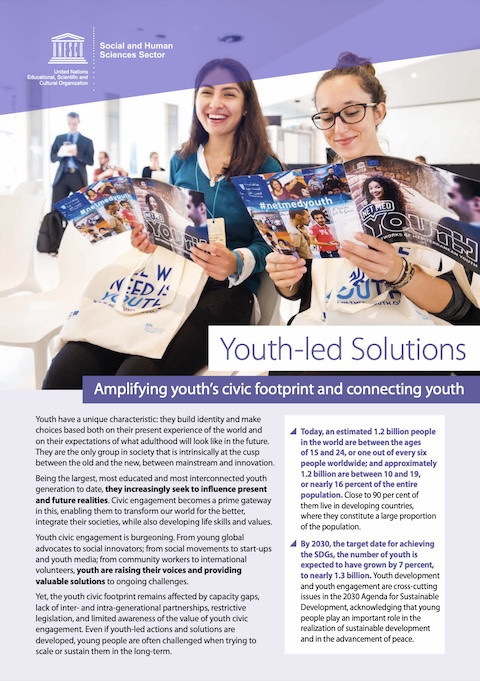 Soluciones impulsadas por las juventudes: Ampliar la huella cívica de las personas jóvenes y ponerles en contacto Año de publicación: 2019 Autor corporativo: Organización de las Naciones Unidas para la Educación, la Ciencia y la Cultura (UNESCO) La Organización de las Naciones Unidas para la Educación, la Ciencia y la Cultura (UNESCO) cree en el valor de la participación cívica de las personas jóvenes y en las soluciones que generan . Con el fin de colaborar de forma productiva con las juventudes, trabajamos con ellas considerándolas generadoras del cambio y socias, no meras beneficiarias, en consonancia con nuestra Estrategia Operacional sobre la Juventud (2014-2021). Aplicamos estrategias y programas de punta que contribuyen a conformar un ecosistema propicio para una participación cívica significativa, eficaz y sostenible de las personas jóvenes.