
Recursos
Exploren una amplia gama de recursos valiosos en GCED para profundizar su comprensión y promover su búsqueda, incidencia, enseñanza y aprendizaje.
3,436 resultados encontrados
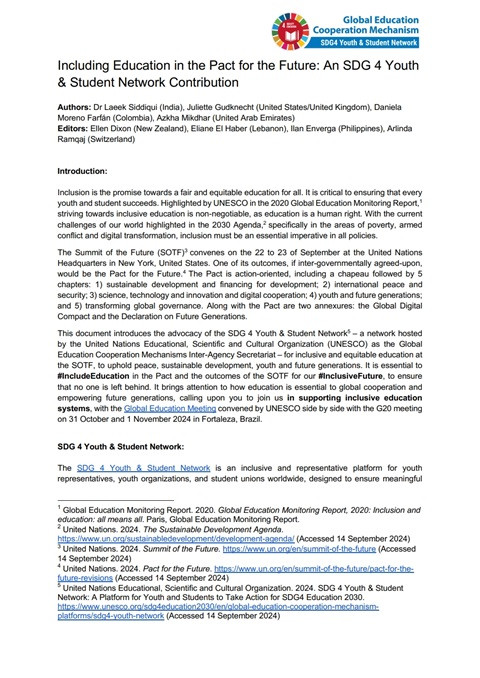 Including Education in the Pact for the Future: An SDG 4 Youth & Student Network Contribution Año de publicación: 2024 Autor: Laeek Siddiqui | Juliette Gudknecht | Daniela Moreno Farfán | Azkha Mikdhar Autor corporativo: SDG 4 Youth & Student Network | UNESCO Inclusion is the promise towards a fair and equitable education for all. It is critical to ensuring that every youth and student succeeds. Highlighted by UNESCO in the 2020 Global Education Monitoring Report, striving towards inclusive education is non-negotiable, as education is a human right. With the current challenges of our world highlighted in the 2030 Agenda, specifically in the areas of poverty, armed conflict and digital transformation, inclusion must be an essential imperative in all policies. The Summit of the Future (SOTF) convenes on the 22 to 23 of September at the United Nations Headquarters in New York, United States. One of its outcomes, if inter-governmentally agreed-upon, would be the Pact for the Future. The Pact is action-oriented, including a chapeau followed by 5 chapters: 1) sustainable development and financing for development; 2) international peace and security; 3) science, technology and innovation and digital cooperation; 4) youth and future generations; and 5) transforming global governance. Along with the Pact are two annexures: the Global Digital Compact and the Declaration on Future Generations. This document introduces the advocacy of the SDG 4 Youth & Student Network – a network hosted by the United Nations Educational, Scientific and Cultural Organization (UNESCO) as the Global Education Cooperation Mechanisms Inter-Agency Secretariat – for inclusive and equitable education at the SOTF, to uphold peace, sustainable development, youth and future generations. It is essential to #IncludeEducation in the Pact and the outcomes of the SOTF for our #InclusiveFuture, to ensure that no one is left behind. It brings attention to how education is essential to global cooperation and empowering future generations, calling upon you to join us in supporting inclusive education systems, with the Global Education Meeting convened by UNESCO side by side with the G20 meeting on 31 October and 1 November 2024 in Fortaleza, Brazil.
  School Leadership Roles and Standards: Observations from the International Study of Teacher Leadership Año de publicación: 2024 Autor: Charles F. Webber | Dorothy Andrews | C.P. van der Vyver | Clelia Pineda-Báez | Janet M. Okoko | Edith J. Cisneros-Cohernour | José Gabriel Domínguez-Castillo | Mohammed Elmeski | Molly P. Fuller | Joan M. Conway | Cristina Moral-Santaella | Gloria Gratacós | Samira Idelcadi Autor corporativo: UNESCO | Global Education Monitoring Report Team This paper was commissioned by the Global Education Monitoring Report as background information to assist in drafting the 2024/5 GEM Report, Leadership in education. This report summarizes the findings of the International Study of Teacher Leadership(ISTL), conducted in 12 countries. The researchers share descriptions of the increasing interest in teacher leadershipas a factor in student learning and school improvement. ISTL researchers focus primarily on classroom-based teachers who—in collaboration with formal school leaders, parents, community members, and colleagues—impact school-wide decision making and pedagogical practices. The report offers insights related to teacher leader behaviours, the complexity of teacher leadership, how teacher leaders learn to lead, and the importance of contextual factors that support and impede teachers who provide informal leadership to schools and the communities they serve. The researchers compare cross-cultural requirements of good leadership and offer contextually situated analyses of leadership visions and goals, the impact of teacher leadership on educational outcomes, necessary preconditions for effective leadership, and policies that develop teacher leadership. The researchers also describe the readiness of school communities to embrace teacher leadership, described variously as parallel leadership, shared leadership, and distributed leadership. The report argues for a shift from considering standards for teacher leadership—too often based on the assumption that leadership is consistent across cultural and organizational settings—to the more flexible and contextualized conceptualization of leadership dimensions such as purpose, self-awareness, intentionality, and culture building. The ISTL researchers also argue that teacher leadership is but one component of an integrated approach to educational governance that addresses the complexities of teaching and learning in relation to rapid socioeconomic change, global migration, political tensions, and the emergence of new technologies. The ISTL also reinforces the ongoing importance of classroom teachers in the achievement of educational objectives. The ISTL team concludes this report with a set of research recommendations.
  Transforming Knowledge and Research for Just and Sustainable Futures: Towards a New Social Imaginary for Higher Education (Education, Research and Foresight: Working Papers; No.33, 2024) Año de publicación: 2024 Autor: Leon Tikly Autor corporativo: UNESCO The paper considers why it is important to transform knowledge and research for just and sustainable futures and discusses the role of higher education in these transformation processes. The paper sets out how knowledge, research, and knowledge systems can be understood and critiques knowledge hierarchies that have emerged in the context of colonialism, leading to the marginalization of the knowledge systems and languages of the colonized. It is argued that there is a need to create new ecologies of knowledge that value and develop synergies between ‘all of the archives of the world’ and that can revitalize and expand the knowledge commons and contribute to more just and sustainable futures. Higher education has a pivotal role to play in the creation of new ecologies of knowledge and a revitalized knowledge commons through promoting socially and ethically engaged research, the decolonization and reorientation of university curricula and pedagogy to foster sustainable futures, and the democratization of universities to better represent historically marginalized groups. Underpinning this role must be a shift from a Western modernist social imaginary of higher education to one based on a new planetary consciousness.
  World Trends in Freedom of Expression and Media Development: Special Digital Focus 2015 Año de publicación: 2017 Autor: Iginio Gagliardone | Danit Gal | Thiago Alves Pinto | Gabriela Martinez Sainz Autor corporativo: UNESCO Given the success of the first World Trends report and the need for additional research, UNESCO led a second edition in the series, focusing in depth on selected digital-era trends. World Trends in Freedom of Expression and Media Development – Special Digital Focus 2015 provides a substantive analysis of key areas identified in the first World Trends as particularly relevant for further study, namely the issues of: online hate speech, protection of journalism sources, and the role of internet intermediaries in fostering freedom of expression, as well as continued focus on the safety of journalists. It also builds on issues raised in the 2015 UNESCO study titled Keystones to foster inclusive Knowledge Societies. Tendencias mundiales en libertad de expresión y desarrollo de los medios: consideración prioritaria del ámbito digital 2015 Año de publicación: 2017 Autor: Iginio Gagliardone | Danit Gal | Thiago Alves Pinto | Gabriela Martinez Sainz Autor corporativo: UNESCO Dado el éxito del primer informe de Tendencias Mundiales y la necesidad de una investigación ulterior, la UNESCO emprendió una segunda edición en la serie, en la que se hace hincapié en determinadas tendencias de la era digital. Tendencias Mundiales en Libertad de Expresión y Desarrollo de los Medios - Consideración prioritaria del ámbito digital 2015 proporciona un análisis significativo de las áreas clave identificadas en la primera edición del informe como de especial relevancia para un estudio ulterior, y en concreto, de la incitación al odio en Internet, la protección de las fuentes periodísticas, y el papel de los intermediarios de Internet en el fomento de la libertad de expresión, así como de la atención prioritaria continuada a la seguridad de los periodistas. Se basa asimismo en los asuntos planteados en el estudio de 2015 de la UNESCO titulado Keystones to foster inclusive Knowledge Societies (Claves para promover unas sociedades del conocimiento integradoras). Tendances mondiales en matière de liberté d'expression et de développement des médias: regards sur le numérique, 2015 Año de publicación: 2017 Autor: Iginio Gagliardone | Danit Gal | Thiago Alves Pinto | Gabriela Martinez Sainz Autor corporativo: UNESCO Étant donné le succès du premier rapport Tendances mondiales et les besoins d’effectuer des recherches supplémentaires, l’UNESCO a lancé une deuxième édition de la série, qui cette fois approfondit son travail sur une sélection de tendances propres à l’ère numérique. Tendances mondiales en matière de liberté d’expression et de développement des médias – Regards sur le numérique 2015 fournit une analyse substantielle des principaux domaines identifiés dans la première édition comme pouvant faire l’objet de recherches complémentaires, notamment les questions du discours de haine en ligne, de la protection des sources des journalistes et du rôle des intermédiaires de l’Internet dans la promotion de la liberté d’expression, et elle s’intéresse également, tout comme la première, à la sécurité des journalistes. Elle traite également des questions soulevées dans l’étude intitulée Des clés pour la promotion de sociétés du savoir inclusives, publiée en 2015 par l’UNESCO. Глобальные тенденции в области свободы выражения мнений и развития средств массовой информации: Цифровые средства информации, 2015 г. Año de publicación: 2017 Autor: Iginio Gagliardone | Danit Gal | Thiago Alves Pinto | Gabriela Martinez Sainz Autor corporativo: UNESCO Учитывая успех первого доклада о глобальных тенденциях и необходимость проведения дополнительных исследований, ЮНЕСКО возглавила работу над вторым изданием в серии докладов, сосредоточив внимание на подробном анализе ряда тенденций цифровой эпохи. В докладе ЮНЕСКО о «Глобальных тенденциях в области свободы выражения мнений и развития средств информации: цифровые средства информации» за 2015 г. содержится глубокий анализ ключевых областей, названных в первом докладе о глобальных тенденциях наиболее важными для дальнейшего изучения, а именно: язык ненависти в интернете, защита журналистских источников информации и роль интернет-посредников в содействии свободе выражения мнений, а также обращается особое внимание на вопрос безопасности журналистов. Доклад также опирается на вопросы, поднятые в проведенном ЮНЕСКО в 2015 г. исследовании под названием «Основные принципы построения инклюзивных обществ знаний».
 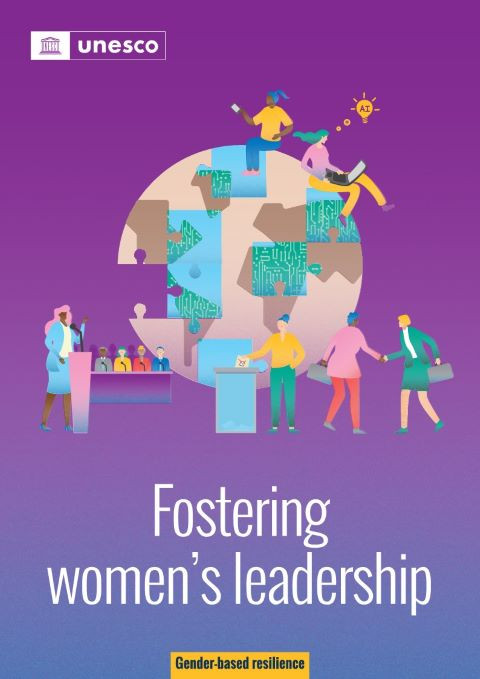 Fostering Women's Leadership Año de publicación: 2024 Autor: Mariagrazia Squicciarini | Anna Rita Manca | Garance Sarlat Autor corporativo: UNESCO No (leadership) share no gain (for societies and economies)! Leveraging UNESCO’s unique Gender-Based Resilience Framework, this report explores the role of women in leadership positions in both decision-making and high-tech, including in artificial intelligence-related innovations. It further highlights progress towards the G20 Brisbane Target, aimed to accelerate progress on gender equality by reducing the gender gap in labour market participation rates by 25% by 2025. Women remain underrepresented in decision-making, holding only about 26% of seats in national parliaments worldwide on average. In the world of work, female labour participation continues to lag behind men’s, at 47% for women against 72% for men on average. Despite progress by G20 members towards the Brisbane Target, a 2% average gap in absolute terms remained to be filled in 2022. In the high-tech world, women make up only 30% of AI professionals, and even less of leaders. Female inventors in AI account for about 37% of patents filed in 2022-23.
  Asia-Pacific Migration Report 2024: Assessing Implementation of the Global Compact for Migration Año de publicación: 2024 Autor corporativo: UN. Economic and Social Commission for Asia and the Pacific (UN. ESCAP) | International Labour Organization (ILO) | International Organization for Migration (IOM) | UN. Office of the United Nations High Commissioner for Human Rights (UN. OHCHR) | United Nations Centre for Human Settlement Programme (UN Habitat) | United Nations Entity for Gender Equality and the Empowerment of Women (UN Women) | United Nations Development Programme (UNDP) | UNESCO | UN. Office of the United Nations High Commissioner for Refugees (UNHCR) | UN. Office on Drugs and Crime (UNODC) | World Bank This report aims to assess the state of GCM implementation in the region, its progress and its challenges since the first Asia-Pacific Regional Review of Implementation of the Global Compact for Migration in 2021, in which a Chair’s summary was adopted. Chapters 2 to 5 each consider clusters of GCM objectives, as presented in General Assembly resolution 73/326 and following the same groupings as in the Asia-Pacific Migration Report (APMR) 2020. These chapters open with a summary of the discussions from the first regional review of the GCM, held in 2021, drawing from the Chair’s summary. Chapter 6 provides overarching recommendations to support and accelerate GCM implementation in Asia and the Pacific. At the end of the report are annexes with information on the GCM objectives and guiding principles, references to migration in Voluntary National Reviews to the High-Level Political Forum on Sustainable Development, and GCM pledges at the level of the State or City, Municipality and Local Authority.
 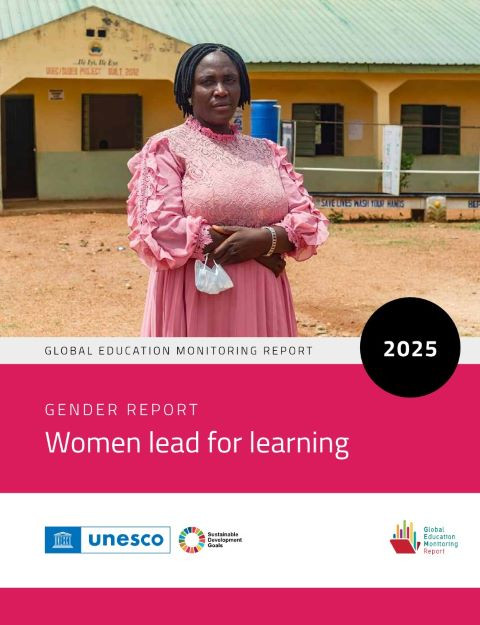 Global Education Monitoring Report 2025: Gender Report: Women Lead for Learning Año de publicación: 2025 Autor corporativo: UNESCO Barriers to gender equality in education leadership positions can and need to be overcome This gender edition, which is part of the 2024/5 Global Education Monitoring Report on leadership in education, addresses the remaining obstacles for women in their efforts to climb up the leadership ladder in education. Although the teaching profession has been feminized, there are considerable gender gaps in school management, education administration and political leadership positions, a situation illuminated in detail with examples from all over the world. Gender disparity in education leadership is the result of entrenched stereotypes and biases – conscious or unconscious – on the one hand and on the other institutional processes or professional development mechanisms that are insufficiently supportive. Research suggests that women leaders display some differences relative to men in their approaches to education leadership, for example the extent to which they emphasize collaboration, build relationships with the community and retain a focus on learning. While there is little to suggest that these differences are universal or immutable, the evidence points to the fact that the lack of equitable opportunities translates to less talent and fewer diverse approaches to leadership, which are a loss to education systems – not to mention the obvious need for equity. This is particularly evident in parts of the world where gender disparities remain large. This gender edition calls on countries to take a much closer look at gender disparity in education leadership and adopt measures to raise awareness, improve mechanisms and strengthen capacities to address discrimination and bias and thus encourage women who aspire to such careers to pursue them. Gender disparity in education leadership is the result of entrenched stereotypes and biases – conscious or unconscious – on the one hand and on the other institutional processes or professional development mechanisms that are insufficiently supportive. Research suggests that women leaders display some differences relative to men in their approaches to education leadership, for example the extent to which they emphasize collaboration, build relationships with the community and retain a focus on learning. While there is little to suggest that these differences are universal or immutable, the evidence points to the fact that the lack of equitable opportunities translates to less talent and fewer diverse approaches to leadership, which are a loss to education systems – not to mention the obvious need for equity. This is particularly evident in parts of the world where gender disparities remain large. This gender edition calls on countries to take a much closer look at gender disparity in education leadership and adopt measures to raise awareness, improve mechanisms and strengthen capacities to address discrimination and bias and thus encourage women who aspire to such careers to pursue them.