
Recursos
Exploren una amplia gama de recursos valiosos en GCED para profundizar su comprensión y promover su búsqueda, incidencia, enseñanza y aprendizaje.
3,780 resultados encontrados
 Human Rights Education: Key Success Factors Año de publicación: 2023 Autor corporativo: UNESCO This study, commissioned by the UNESCO in cooperation with the United Nations Office of the High Commissioner for Human Rights (OHCHR), examines the impact of human rights education (HRE) pedagogies and good practices worldwide, with a specific focus on the primary and secondary levels in formal education. Using a data-driven approach that includes a literature review and surveys and interviews with informants, the study identifies key success factors for impactful HRE and provides recommendations for future research and practice. The study finds that HRE can have a positive impact on learners’ knowledge and understanding of human rights, as well as their attitudes and behaviours related to human rights. It is an essential resource for education stakeholders looking to promote HRE at all levels of society and through a lifelong learning lens.
  Revision Process of the 1974 Recommendation concerning Education for International Understanding, Co-operation and Peace and Education relating to Human Rights and Fundamental Freedoms: Comments from Observers to the Plenary Meetings of the International Expert Group (IEG) Año de publicación: 2023 Autor corporativo: UNESCO Adopted in 1974, the Recommendation concerning education for international understanding, co-operation and peace and education relating to human rights and fundamental freedoms is considered a landmark legal instrument that brings together for the first time peace, international understanding, human rights, fundamental freedoms and education. In line with the Resolution adopted at UNESCO’s General Conference at its 41st Session in November 2021 (41C/Resolution 17), UNESCO launched the revision of the Recommendation and convened an International Expert Group (IEG) to advise the Organization on the changes. The work of the IEG took place between May and June 2022. Though the meetings of the IEG were technical in nature (category VI), in order to ensure an open and transparent process, the Permanent Delegations were invited to listen-in to the deliberations of the IEG online, as observers, along with a select number of non-governmental organizations, intergovernmental organizations, and United Nations entities. At the end of each plenary meeting, observers to the IEG plenary meetings could submit written comments. This document compiles the comments received from observers during this process and submitted to the IEG members for their consideration.
  Re|shaping Policies for Creativity: Addressing Culture as a Global Public Good Año de publicación: 2023 Autor corporativo: UNESCO The Global Report series monitors the implementation of the 2005 Convention on the Protection and Promotion of the Diversity of Cultural Expressions, as well as progress towards achieving the United Nations 2030 Agenda for Sustainable Development, within and with the cultural and creative sectors. Its 2022 edition revolves around two major questions: What is the state of the cultural and creative sectors? What policy changes to promote sustainable, human rights-based systems of governance for culture and equitable access to cultural opportunities and resources have resulted from stakeholders’ implementation and ownership of the Convention? In line with the 2015 and 2018 editions, this third edition of the Report presents the latest policy developments to support creativity and sheds light on current and future challenges in areas such as the digital environment, media diversity, sustainable development, mobility of artists and cultural professionals, gender equality and artistic freedom. The trends, innovative practices, gaps and recommendations that emerge from the 2022 edition provide valuable evidence to inform the policy dialogue leading up to the UNESCO World Conference on Cultural Policies and Sustainable Development – MONDIACULT 2022. With the mission to contribute to the 2030 Agenda, it feeds into a renewed vision of cultural policies based on a better understanding of what impacts the diversity of cultural expressions and the avenues for anchoring culture and creativity in the broader public policy spectrum. 문화정책의 (재)구성: 전지구적 공공재로서의 문화를 바라보다, 2022 Año de publicación: 2023 Autor corporativo: 유네스코 글로벌 리포트 시리즈는 각 국의 <2005 문화적 표현의 다양성 보호와 증진에 관한 협약> 이행상황과 문화·창의분야가 <UN 2030 지속가능한 개발 어젠다>에 어떻게 기여하고 있는지 그 진행 상황을 모니터링 하고 있다. 2015년과 2018년 발간된 보고서와 같이, 이번 제3판은 창의적 활동을 지원하기 위한 최근의 정책 개발 상황을 소개하고, 디지털 환경, 미디어 다양성, 지속가능발전, 예술가와 문화 분야 종사자의 이동성, 양성 평등 및 예술의 자유와 같은 분야의 현재와 미래의 과제를 조명한다. 2022년 발간되는 본 보고서에 소개되는 트렌드, 우수 사례, 국가 간 격차, 그리고 권고사항은 유네스코의 <문화 정책과 지속가능한 개발에 관한 세계 회의(MONDIACULT 2022)>의 정책 토론에서 다룰만한 중요한 자료를 제공하고 있다. 본 보고서는 <2030 어젠다>에 기여하고자 하는 사명을 가지고, 문화적 표현의 다양성에 영향을 미치는 요인을 분석하며, 공공정책 스펙트럼에서 더 넓게 문화와 창의성을 정착시킬 방안에 대해 더 나은 이해와 새로운 문화정책의 비전을 제시하고자 한다.
  Freedom of Expression Toolkit: A Guide for Students Año de publicación: 2013 Autor corporativo: UNESCO Everyone should have all the necessary tools and mechanism to allow the free flow of information. Much has been written about freedom of expression, indeed it is one of the most debated concepts and issues of our times. However, few such publications are written with youth as the main target readers, especially for young women and men still in high schools and pre-university level. This Toolkit is one such tool targeted at high schools and pre-university students. Young women and men must be empowered and literate in the issues and concepts of freedom of expression in order to become a discerning citizen in a democracy.
  الإرشادات التوجيهية لتخضير مناهج التعليم والتعلّم من أجل العمل المناخيّ Año de publicación: 2024 Autor corporativo: UNESCO This Guidance responds to the calls from young people for a holistic approach to climate change and sustainability in the curriculum. It outlines a common language on how quality climate change and sustainability can be reflected in the curriculum by setting expected learning outcomes per age group (from 5-year olds and up to 18+ age group, including a lifelong learning approach).This is crucial for accelerating country-level action and ensuring joint monitoring of progress. The objective is to have 90 per cent of all countries include climate change in their curricula by 2030, as established by the Greening Education Partnership.This Guidance aims to support countries, schools or individual practitioners in reassessing their ongoing practices to adopt a more action-oriented, holistic, scientifically accurate, justice-driven and lifelong learning approach to climate change.
 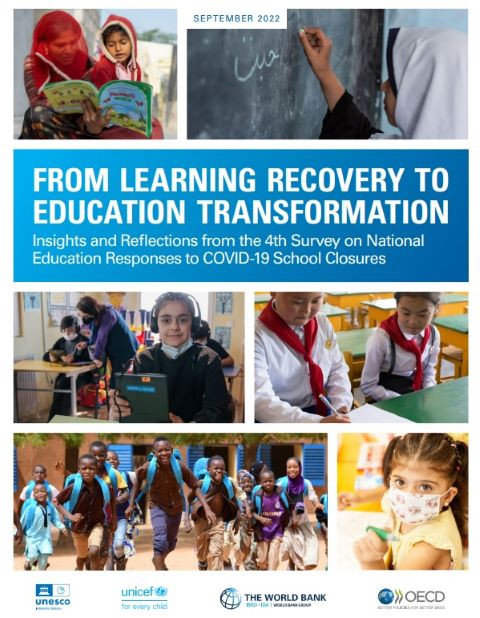 From Learning Recovery to Education Transformation: Insights and Reflections from the 4th Survey on National Education Responses to COVID-19 School Closures Año de publicación: 2022 Autor corporativo: UNESCO | UNESCO Institute for Statistics (UIS) | United Nations Children's Fund (UNICEF) | World Bank | Organisation for Economic Co-operation and Development (OECD) From Learning Recovery to Education Transformation, a new joint report by UNESCO, UNESCO Institute for Statistics (UIS), UNICEF, The World Bank and The OECD, presents findings from the fourth round of the Survey on National Education Responses to COVID-19 School Closures, administered between April–July 2022 with responses from Ministries of Education in 93 countries. It explores how countries are progressing in the RAPID actions to recover learning: Reach every child and keep them in school; Assess learning levels regularly; Prioritize teaching the fundamentals; Increase the efficiency of instruction; and Develop psychosocial health and wellbeing.
  Online Antisemitism: A Toolkit for Civil Society Año de publicación: 2022 Autor corporativo: Institute for Strategic Dialogue (ISD) | B’nai B’rith International | UNESCO This guide looks to build literacy among Jewish professionals, lay leaders and community members at large – as well as wider allies from across civil society – to tackle antisemitism online. Recognising the enormous capacity for positive action that the digital space offers, it aims to consolidate knowledge and provide a wide range of policy and community avenues for action.The guide provides an assessment of the online antisemitism threat landscape, an overview of existing policy responses on an international and national level across a range of European countries, and, importantly, a broad set of recommendations for engagement with governments, platforms and within communities to address these issues.
 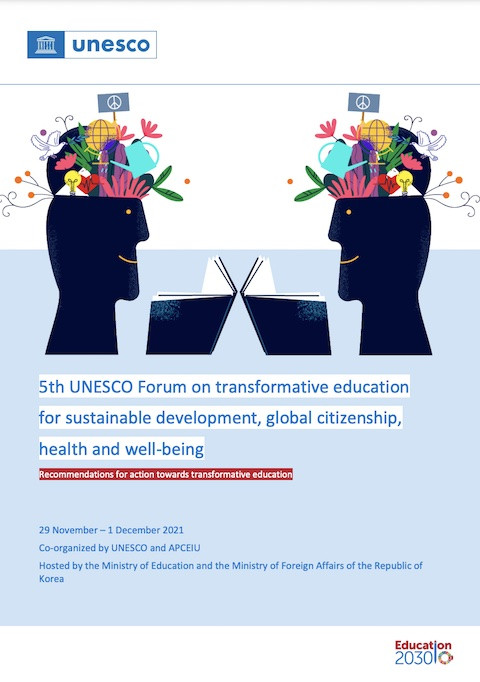 5th UNESCO Forum on Transformative Education for Sustainable Development, Global Citizenship, Health and Well-Being: Recommendations for Action Towards Transformative Education Año de publicación: 2022 Autor corporativo: UNESCO In light of contemporary and emerging challenges such as climate change, violent and hateful ideologies, conflicts and risks of global pandemics, education must teach young people the knowledge, skills, values and attitudes to live cooperatively, be flexible, think critically, respect diversity, care for the environment, and be actively involved in finding solutions, both locally and globally. Transformative education – as enshrined in Target 4.7 of Sustainable Development Goal 4 – is critical in supporting individuals to develop these competencies. Transformative education involves teaching and learning that motivates and empowers learners to make informed decisions and actions at the individual, community and global levels. With a focus on sustainability, global citizenship, health and well-being for all, transformative education implies ensuring that curriculum, pedagogy, learning materials, schools and learning environments are meaningful for the social, political, economic, cultural and environmental contexts. To better understand concrete progress in transformative education, UNESCO and the Asia Pacific Centre of Education for International Understanding (APCEIU) co-organized the 5th UNESCO Forum on Transformative Education for Sustainable Development, Global Citizenship, Health and Well-being (29 November – 1 December 2021).The conference enabled a productive dialogue among a diverse range of actors from the fields of education for sustainable development (ESD), global citizenship education (GCED), education for health and wellbeing under the broader “banner” of transformative education. 5ème Forum de l’UNESCO sur l’éducation transformatrice pour le développement durable, la citoyenneté mondiale, la santé et le bien-être: Recommandations pour l’action en vue d’une éducation transformatrice Año de publicación: 2022 Autor corporativo: UNESCO À la lumière des défis contemporains et émergents tels que le changement climatique, les idéologies violentes et haineuses, les conflits et les risques de pandémies mondiales, l'éducation doit enseigner aux jeunes les connaissances, les compétences, les valeurs et les attitudes nécessaires pour vivre en coopération, être flexibles, penser de manière critique, respecter la diversité, prendre soin de l'environnement et participer activement à la recherche de solutions, tant au niveau local que mondial.L'éducation transformatrice - telle qu'énoncée dans la cible 4.7 de l'objectif de développement durable 4 - est essentielle pour aider les individus à développer ces compétences. L'éducation transformatrice implique un enseignement et un apprentissage qui motivent et habilitent les apprenants à prendre des décisions et des actions éclairées aux niveaux individuel, communautaire et mondial. En mettant l'accent sur la durabilité, la citoyenneté mondiale, la santé et le bien-être pour tous, l'éducation transformatrice implique de veiller à ce que les programmes, la pédagogie, le matériel d'apprentissage, les écoles et les environnements d'apprentissage soient significatifs pour les contextes social, politique, économique, culturel et environnemental.Pour mieux comprendre les progrès concrets de l'éducation transformatrice, l'UNESCO et le Centre Asie-Pacifique d'éducation pour la compréhension internationale (APCEIU) ont co-organisé le 5e Forum de l'UNESCO sur l'éducation transformatrice pour le développement durable, la citoyenneté mondiale, la santé et le bien-être (29 novembre - 1er décembre 2021).La conférence a permis un dialogue productif entre un large éventail d'acteurs des domaines de l'éducation au développement durable (EDD), de l'éducation à la citoyenneté mondiale (ECM), de l'éducation pour la santé et le bien-être sous la « bannière » plus large de l'éducation transformatrice.