
Recursos
Exploren una amplia gama de recursos valiosos en GCED para profundizar su comprensión y promover su búsqueda, incidencia, enseñanza y aprendizaje.
3,385 resultados encontrados
 Plan d’action Programme: mondial en faveur de l’éducation aux droits de l’homme; Première phase Año de publicación: 2006 Autor corporativo: UN Office of the High Commissioner for Human Rights Le Plan d’action pour la première phase (2005-2007) du Programme mondial a été adopté par l’ensemble des États membres de l’ONU en juillet 2005. Il propose une stratégie concrète et des conseils pratiques pour intégrer l’éducation dans le domaine des droits de l’homme dans les écoles primaires et secondaires. Le 10 décembre 2004, l’Assemblée générale de l’ONU a adopté le Programme mondial d’éducation dans le domaine des droits de l’homme (qui est en cours depuis 2005) afin de promouvoir l’exécution des programmes d’éducation en la matière dans tous les secteurs2. S’appuyant sur le travail accompli au cours de la Décennie des Nations Unies pour l’éducation dans le domaine des droits de l’homme (1995-2004), cette nouvelle initiative traduit la reconnaissance croissante par la communauté internationale du fait que l’éducation dans le domaine des droits de l’homme produit des résultats d’une portée considérable. En favorisant le respect de la dignité humaine, l’égalité et la participation à la prise de décisions de façon démocratique, cette éducation contribue à prévenir à long terme les violations des droits de l’homme et les confl its violents. Pour aider à faire des droits de l’homme une réalité dans chaque société, la communauté internationale s’eff orce par le biais du Programme mondial à promouvoir une conception commune des principes fondamentaux et des méthodes d’éducation dans ce domaine, à mettre en place un cadre concret d’intervention et à renforcer les partenariats et la coopération sur tous les niveaux, depuis le niveau international jusqu’à l’échelon communautaire.
 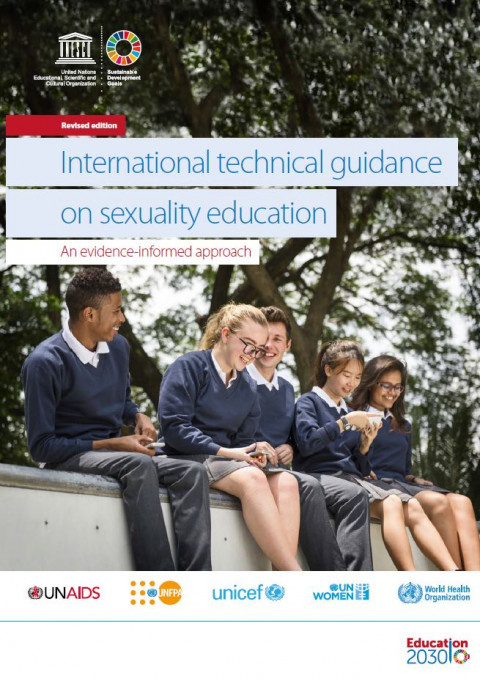 International Technical Guidance on Sexuality Education: An Evidence-Informed Approach Año de publicación: 2018 Autor corporativo: Joint United Nations Programme on HIV/AIDS (UNAIDS) | United Nations Population Fund (UNFPA) | United Nations Children's Fund (UNICEF) | United Nations Entity for Gender Equality and the Empowerment of Women (UN Women) | World Health Organization (WHO) The UN International technical guidance on sexuality education was first published in 2009 as an evidence-informed approach for schools, teachers and health educators.Recognizing the dynamic shifts in the field of sexuality education that have occurred since then, an expanded group of UN co-publishing partners has reviewed and updated the content to respond appropriately to the contemporary needs of young learners, and to provide support for education systems and practitioners seeking to address those needs. The International technical guidance on sexuality education (revised edition) provides sound technical advice on the characteristics of effective comprehensive sexuality education (CSE) programmes; a recommended set of topics and learning objectives that should be covered in comprehensive sexuality education; and, recommendations for planning, delivering and monitoring effective CSE programmes. This revised edition of the Guidance reaffirms the position of sexuality education within a framework of human rights and gender equality, and promotes structured learning about sex and relationships in a manner that is positive, affirming, and centred on the best interests of the young person. It is based on a review of the latest evidence and lessons-learned from implementing CSE programmes across the globe. The revised Guidance reflects the contribution of sexuality education to the realization of multiple Sustainable Development Goals, notably Goal 3 on good health and well-being for all, Goal 4 on quality education for all, and Goal 5 to achieve gender equality.
  Buenos Aires Recommendations Año de publicación: 2007 Autor corporativo: PRELAC II Recognizing that education is a public good and is the key to building a more just and better world for all, the Second Intergovernmental Meeting of the Regional Education Project, PRELAC II, held in the city of Buenos Aires, on the 29th and March 30, 2007, agrees the following recommendations as criteria and lines of action for national policies and international cooperation. Recomendaciones de Buenos Aires Año de publicación: 2007 Autor corporativo: PRELAC II Reconociendo que la educación es un bien público y es la llave para la construcción de un mundo más justo y mejor para todos, la Segunda Reunión Intergubernamental del Proyecto Regional de Educación, PRELAC II, reunida en la ciudad de Buenos Aires, los días 29 y 30 de marzo de 2007, acuerda las siguientes recomendaciones como criterios y líneas de acción para las políticas nacionales y la cooperación internacional.
 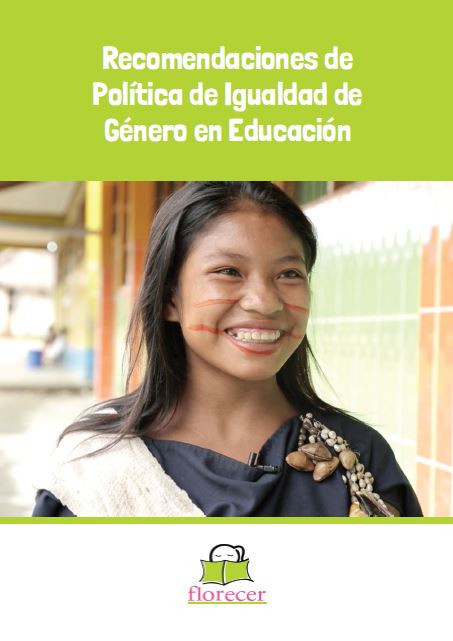 Policy Recommendations of Gender Equality in Education Año de publicación: 2015 Autor: Teresa Tovar Samanez Autor corporativo: United Nations Children's Fund (UNICEF) This document synthesizes the proposals of the Florecer Network to advance in gender equality, because we are convinced that the commitment to a more just and more human world necessarily implies the assumption of equality between men and women. Recomendaciones de Política de Igualdad de Género en Educación Año de publicación: 2015 Autor: Teresa Tovar Samanez Autor corporativo: United Nations Children's Fund (UNICEF) Este documento sintetiza las propuestas de la Red Florecer para avanzar en la igualdad de género, porque estamos convencidas y convencidos de que la apuesta por un mundo más justo y más humano implica necesariamente por la asunción de la igualdad entre hombres y mujeres.
 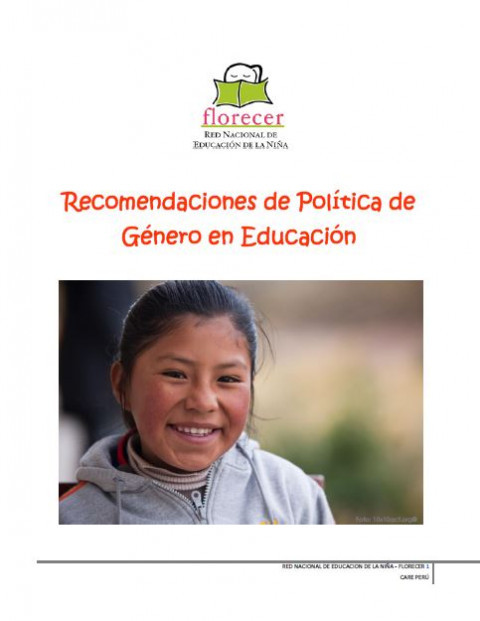 Gender Policy Recommendations in Education Año de publicación: 2015 Autor corporativo: Red Nacional de Educación de la Niña This document synthesizes the proposals of the Florecer Network to advance in gender equality, convinced that the commitment to a more just and more human world necessarily involves the assumption of equality between men and women. The principle that the rights of women and girls are an integral, inalienable and indivisible part of universal human rights has been reaffirmed from the various international forums. Greater equity between men and women is also beneficial for the development of the country. A country with educated girls and women has a lower birth rate, improves their health and productivity conditions. This document synthesizes the main proposals of the Gender and Citizenship Forum: imperative for a quality education, organized by Red Florecer in May 2013 year. We want to put them in the hands of decision-makers and citizens in general to help concretize the mandates of equality between men and women in education. It is time not to give up dreams because they have become possible. Recomendaciones de Política de Género en Educación Año de publicación: 2015 Autor corporativo: Red Nacional de Educación de la Niña Este documento sintetiza las propuestas de la Red Florecer para avanzar en la igualdad de género, convencidos de que la apuesta por un mundo más justo y más humano pasa necesariamente por la asunción de la igualdad entre hombres y mujeres. Desde los diversos foros internacionales se ha reafirmado el principio que los derechos de las mujeres y las niñas son parte integral, inalienable e indivisible de los derechos humanos universales. Una mayor equidad entre hombres y mujeres es además beneficiosa para el desarrollo del país. Un país con niñas y mujeres educadas tiene menor tasa de natalidad, mejora sus condiciones de salud y productividad.Este documento sintetiza las principales propuestas del Foro Género y Ciudadanía: imperativo para una educación de calidad, organizado por la Red Florecer en mayo del 2013 año. Queremos ponerlas en manos de los decisores y de la ciudadanía en general para contribuir a concretar los mandatos de igualdad entre hombres y mujeres en la educación. Es el momento de no desistir de los sueños porque estos se han tornado posibles.
  IX and X Days of Educational Cooperation with Iberoamerica on Special Education and Educational Inclusion Año de publicación: 2015 Autor corporativo: UNESCO Santiago This publication includes the main presentations made by experts in educational inclusion presented at the IX and X Conference on Educational Cooperation with Ibero-America on special education and educational inclusion, held in Cartagena de Indias, Colombia (2012) and Santa Cruz, Bolivia ( 2013), respectively. The workshops have been organized by the Ministry of Education of Spain with the support of the Regional Office of Education for Latin America and the Caribbean (OREALC / UNESCO Santiago). We hope that this publication will contribute to the dissemination of the reflections that RIINEE has developed on critical issues in the field of the educational inclusion of people with disabilities and / or special educational needs, and in this way, constitute a contribution to advance in the guarantee of the rights indicated in the Convention on the Rights of Persons with Disabilities, approved in 2006 by the Member States of the United Nations Organization. IX y X Jornadas de Cooperación Educativa con Iberoamérica sobre Educación Especial e Inclusión Educativa Año de publicación: 2015 Autor corporativo: UNESCO Santiago En esta publicación se incluyen las principales ponencias realizadas por personas expertas en inclusión educativa presentadas en las IX y X Jornadas de Cooperación Educativa con Iberoamérica sobre educación especial e inclusión educativa, realizadas en Cartagena de Indias, Colombia (2012) y Santa Cruz, Bolivia (2013), respectivamente. Las jornadas han sido organizadas por el Ministerio de Educación de España con el apoyo de la Oficina Regional de Educación para América Latina y el Caribe (OREALC/UNESCO Santiago). Esperamos que con esta publicación se contribuya a la difusión de las reflexiones que la RIINEE ha desarrollado sobre nudos críticos en el ámbito de la inclusión educativa de personas con discapacidades y/o necesidades educativas especiales, y de esta forma, constituya un aporte para avanzar en la garantía de los derechos señalados en la Convención sobre los Derechos de las Personas con Discapacidad, aprobada el año 2006 por los Estados Miembro de la Organización de las Naciones Unidas.