
Recursos
Exploren una amplia gama de recursos valiosos en GCED para profundizar su comprensión y promover su búsqueda, incidencia, enseñanza y aprendizaje.
3,777 resultados encontrados
 UNESCO Framework for Culture and Arts Education: Implementation Guidance Año de publicación: 2025 Autor corporativo: UNESCO Culture and the arts are integral to inclusive, equitable and quality education. They nurture creativity, critical thinking, and respect for cultural diversity, empowering learners to engage meaningfully with the world and to build more just, sustainable and peaceful societies. Yet, countries have not systematically incorporated culture and arts education across all levels of education. This Implementation guidance for the UNESCO Framework for Culture and Arts Education is a collective invitation to reimagine education by placing culture and the arts at its heart and advancing a transformative vision of education for all.Through a holistic approach, the Guidance supports the integration of culture and the arts across formal, non-formal and informal education, throughout life. It offers practical orientations to help Member States fulfil the commitment enshrined in the UNESCO Framework for Culture and Arts Education, adopted by Ministers of Culture and Education in 2024. With a global perspective, this Guidance will equip policy-makers, educators and cultural actors in developing inclusive, context-relevant policies, curricula and learning environments.The Guidance is a milestone on a shared journey, inviting countries to harness their cultural strengths, respond to emerging challenges, and work together towards a more inclusive education for all.
  Addressing Violent Pasts through Education: A Policy Guide Año de publicación: 2025 Autor corporativo: UNESCO Teaching about violent pasts and their legacies is a powerful way to foster sustainable peace.Education can build a nuanced understanding of complex histories, raise awareness of the roots and legacies of violence, nationally and internationally, and sensitize learners for their own agency as actors of change for reconciliation and conflict prevention.Educating about violent pasts is a challenging yet critical endeavour for policy-makers globally. It entails tailored approaches and an important support for educators to address traumatic pasts sensitively and to navigate related emotions and narratives successfully.Building on UNESCO’s programme on Global Citizenship Education, this guide offers education policy-makers a set of strategies, principles, and education practices to effectively integrate education about violent pasts into local education systems. It suggests a comprehensive approach that spans formal and informal education and aligns with the 2023 Recommendation on Education for Peace, Human Rights and Sustainable Development, opening new perspectives on history education, dialogue, and conflict transformation.
  International Day of Education 2025: Artificial Intelligence and Education: Preserving Human Agency in a World of Automation Año de publicación: 2025 Autor corporativo: UNESCO International Day for Education 2025 aims to: Examine new possibilities offered by AI, especially for teaching, learning, assessment and educational administration. Promote the development of critical AI literacies by equipping educators and learners with the competencies needed to understand, use and influence AI technologies, in line with the UNESCO AI competency frameworks for teachers and students. Ensure that AI complements, rather than replaces, the essential human elements of learning, including the cultivation of in-person relationships and emotional intelligence. Día Internacional de la Educación 2025: Inteligencia Artificial y educación: preservar la autonomía humana en un mundo de automatización Año de publicación: 2025 Autor corporativo: UNESCO El Día Internacional de la Educación 2025 tiene por objeto: Examinar las nuevas posibilidades que ofrece la inteligencia artificial, especialmente en la enseñanza, el aprendizaje, la evaluación y la gestión educativa. Promover el desarrollo de alfabetizaciones críticas en IA, dotando a educadores y estudiantes de las competencias necesarias para comprender, utilizar e influir en las tecnologías de IA, en línea con los marcos de competencias en IA de la UNESCO para docentes y alumnos. Garantizar que la IA complemente, y no reemplace, los elementos humanos esenciales del aprendizaje, incluyendo la construcción de relaciones interpersonales y el desarrollo de la inteligencia emocional.
  Youth Can Move the World Año de publicación: 2021 Autor corporativo: UNESCO The COVID-19 pandemic brought unprecedented educational disruption with 1.2 billion children and youth impacted by school closures. Yet, despite these challenges, there is hope. This documentary focuses on the power and agency of youth. It is developed under the framework of the long-term partnership between UNESCO's Global Citizenship and Peace Education and UNODC that bridges the justice and education sectors to guide young people towards building strong, just and democratic societies. Youth’s voices are in the forefront with sentiments echoed by world leaders, policy makers, justice actors and educators to deliver a compelling message on the power of youth to move the world.
  وضع تصورات جديدة لمستقبلنا معاً: عقد اجتماعي جديد للتربية والتعليم Año de publicación: 2022 Autor corporativo: International Commission on the Futures of Education | UNESCO تُستشف من أحوال العالم في الوضع الراهن أن البشرية وكوكب الأرض معرضان للخطر. وقد قدمت الجائحة التي حلت بنا في الفترة الأخيرة دليلاً دامغاً على أن العالم الذي نعيش فيه يتسم بالهشاشة وتترابط أجزاؤه ترابطاً وثيقاً. ولا بد لنا الآن من اتخاذ إجراءات عاجلة معاً لتغيير المسار ووضع تصورات جديدة لمستقبلنا. وينطوي هذا التقرير الصادر عن اللجنة الدولية المعنية بمستقبل التربية والتعليم على إقرار بقدرة التربية والتعليم على إحداث تغيير عميق في الأوضاع الراهنة. وثمة تحديان ماثلان أمامنا الآن، أولهما هو الوفاء بالوعد المتمثل في ضمان الحق في التعليم الجيد لجميع الأطفال والشباب والكبار، وهو وعد لم يتحقق بعد، وثانيهما هو تحقيق كامل الإمكانات الكفيلة بإحداث التغيير الجذري المنشود، التي ينطوي عليها التعليم بوصفه سبيلاً إلى بناء مستقبل جماعي مستدام. ولا سبيل إلى بلوغ هذه الغاية إلا بإبرام عقد اجتماعي جديد للتربية والتعليم يتيح إصلاح المظالم والاضطلاع في الوقت نفسه بتغيير المستقبل على النحو المنشود. ويجب أن يقوم هذا العقد الاجتماعي الجديد على حقوق الإنسان وأن يستند إلى مبادئ عدم التمييز، والعدالة الاجتماعية، واحترام الحياة، والكرامة الإنسانية، والتنوع الثقافي. ويجب أن يشتمل على أخلاقيات الرعاية والتبادل والتضامن. ويجب أن يعزز التعليم باعتباره عملاً ومنفعة مشتركة. وينطوي هذا التقرير، الذي استغرق إعداده عامين واسترشد معدوه بعملية تشاور عالمية شارك فيها نحو مليون شخص، على دعوة موجهة إلى الحكومات والمؤسسات والمنظمات والمواطنين في جميع أنحاء العالم لصياغة عقد اجتماعي جديد للتربية والتعليم يساعدنا في بناء مستقبل مستدام ينعم فيه الجميع بالسلام والعدل. وليست الرؤى والمبادئ والمقترحات المعروضة ههنا سوى منطلق لمزيد من العمل، إذ ينبغي بذل جهد جماعي لتجسيد هذه الرؤى والمبادئ والمقترحات بما يتماشى مع الظروف والبيئات التي تندرج فيها. وقد تحقق بالفعل العديد من المنجزات البارزة في هذا الشأن. ويسعى في هذا التقرير إلى استعراضها والارتكاز عليها لبناء صرح جديد. وليس هذا التقرير دليلاً إرشادياً ولا خطة لإيجاد حلول، بل هو فتح لباب التحاور في شأن يتسم بأهمية حيوية.
 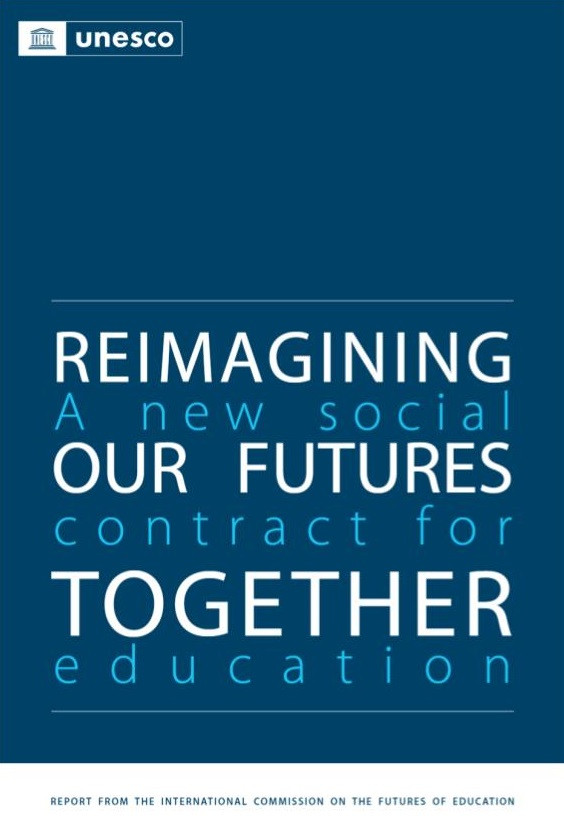 Reimagining Our Futures Together: A New Social Contract for Education Año de publicación: 2021 Autor corporativo: International Commission on the Futures of Education | UNESCO Our humanity and planet Earth are under threat. The pandemic has only served to prove our fragility and our interconnectedness. Now urgent action, taken together, is needed to change course and reimagine our futures. This report by the International Commission on the Futures of Education acknowledges the power of education to bring about profound change. We face a dual challenge of making good on the unfulfilled promise to ensure the right to quality education for every child, youth and adult and fully realizing the transformational potential of education as a route for sustainable collective futures. To do this, we need a new social contract for education that can repair injustices while transforming the future.This new social contract must be grounded in human rights and based on principles of non-discrimination, social justice, respect for life, human dignity and cultural diversity. It must encompass an ethic of care, reciprocity, and solidarity. It must strengthen education as a public endeavour and a common good.This report, two years in the making and informed by a global consultation process engaging around one million people, invites governments, institutions, organizations and citizens around the world to forge a new social contract for education that will help us build peaceful, just, and sustainable futures for all.The visions, principles, and proposals presented here are merely a starting point. Translating and contextualizing them is a collective effort. Many bright spots already exist. This report attempts to capture and build on them. It is neither a manual nor a blueprint but the opening up of a vital conversation.
  Reimaginar juntos nuestros futuros: un nuevo contrato social para la educación Año de publicación: 2022 Autor corporativo: International Commission on the Futures of Education | UNESCO La humanidad y el planeta Tierra están amenazados. La pandemia solo ha servido para demostrar nuestra fragilidad y nuestra interconexión. Ahora es necesario actuar urgentemente, de forma conjunta, para cambiar el rumbo y reimaginar nuestros futuros. Este informe de la Comisión Internacional sobre los Futuros de la Educación reconoce el poder de la educación para provocar un cambio profundo. Nos enfrentamos a un doble reto: cumplir la promesa de garantizar el derecho a una educación de calidad para todos los niños, jóvenes y adultos, y aprovechar plenamente el potencial transformador de la educación como vía para un futuro colectivo sostenible. Para ello, necesitamos un nuevo contrato social para la educación que pueda reparar las injusticias, al tiempo que transforma el futuro. Este nuevo contrato social debe basarse en los derechos humanos y en los principios de no discriminación, justicia social, respeto a la vida, dignidad humana y diversidad cultural. Debe incluir una ética de cuidado, reciprocidad y solidaridad. Debe reforzar la educación como un proyecto público y un bien común. Este informe, que se ha elaborado en dos años y se ha basado en un proceso de consulta mundial en el que han participado alrededor de un millón de personas, invita a gobiernos, instituciones, organizaciones y ciudadanos de todo el mundo a forjar un nuevo contrato social para la educación que nos ayude a construir un futuro pacífico, justo y sostenible para todos. Las visiones, los principios y las propuestas que aquí se presentan deben considerarse simplemente un punto de partida. Traducirlos y contextualizarlos es un esfuerzo colectivo. Existen ya muchos aspectos positivos. Este informe intenta recogerlos y aprovecharlos. No se trata de un manual ni de un modelo, sino de un punto de partida para una conversación fundamental.
  Repenser nos futurs ensemble: un nouveau contrat social pour l'éducation Año de publicación: 2021 Autor corporativo: International Commission on the Futures of Education | UNESCO L’avenir de l’humanité sur la planète est, nous le savons aujourd’hui, compromis. La pandémie a eu au moins le mérite de démontrer combien nos existences sont fragiles et combien nos destins sont inextricablement liés. Il est nécessaire et urgent désormais, d’agir collectivement pour changer de cap et réinventer notre avenir. Dans ce tournant, l’éducation jouera un rôle crucial pour sa capacité, universellement reconnue, à provoquer le changement. Mais pour jouer son rôle, elle devra surmonter un double défi : honorer, d’une part, sa plus vieille promesse, c’est-à-dire d’être effective et d’assurer le droit à une éducation de qualité pour chaque enfant, chaque jeune, chaque adulte partout à travers le monde ; et, d’autre part, assumer entièrement son potentiel transformateur, afin d’ouvrir la voie vers un avenir collectif durable. Pour y parvenir, il convient de s’engager dans un nouveau contrat social pour l’éducation, qui permette de corriger les injustices tout en transformant l’avenir. Ce nouveau contrat social doit être enraciné dans les droits humains et être fondé sur les principes de non-discrimination, de justice sociale, de respect de la vie, de la dignité humaine et de la diversité culturelle ; il doit aussi s’appuyer sur une éthique de la sollicitude, de la réciprocité et de la solidarité ; il doit enfin renforcer l’éducation comme projet public et un bien commun de l’humanité. Le présent rapport, préparé durant deux ans et qui a pu s’appuyer sur une consultation mondiale de près d’un million de personnes, invite les gouvernements, les partenaires et les citoyens du monde entier à élaborer un nouveau contrat social en faveur de l’éducation, pour construire un avenir pacifique, juste et durable pour toutes et tous. Les conceptions, les principes et les propositions avancés ici ne constituent qu’un point de départ. Seul un effort collectif pourra les traduire en actes et les adapter aux situations locales. Il existe en effet de vraies lueurs d’espoir. Ce rapport essaie de les ressaisir afin que l’avenir se construise sur ces fondations. Qu’on n’y voit donc pas un manuel ou un plan directeur : c’est le début d’une conversation vitale.
  함께 그려보는 우리의 미래: 교육을 위한 새로운 사회계약 Año de publicación: 2022 Autor corporativo: International Commission on the Futures of Education | 유네스코 우리 인류와 지구는 위기에 처해 있다. 코로나19 팬데믹은 우리의 취약성과 상호연결성을 동시에 증명해 주었다. 이 경로를 바꾸고 우리의 미래를 다시 구상하기 위해서는 모두 함께 긴급한 행동에 나서야 한다. 국제미래교육위원회의 이 보고서는 교육의 힘이 심대한 변화를 불러일으킬 수 있다고 믿는다. 인류는 이중의 도전과제에 직면하고 있다. 한편으로는 모든 아동, 청소년, 성인들이 질 높은 교육을 받을 권리를 보장하겠다는 미완의 약속을 이행하면서, 다른 한편으로는 모두에게 지속가능한 미래로 가는 경로로서 교육이 갖고 있는 변혁적 잠재력을 완전히 실현해야 한다. 이를 위해서는 정의롭지 못한 부분을 바로잡으면서 미래를 바꿔 놓을 교육을 위한 새로운 사회계약이 필요하다. 이 새로운 사회계약은 인권에 근간을 두고 차별금지와 사회정의, 생명 존중, 인간 존중 및 문화 다양성에 기초해야 한다. 또한 돌봄의 윤리, 호혜주의, 연대를 포괄해야 하며, 공동의 사회적 노력(shared societal endeavours)이자 공동재(common good)로서 교육을 강화해야 한다. 이 보고서는 2년에 걸쳐 약 백만 명이 참여하는 세계적 협의 과정을 통해 작성되었으며, 전 세계의 정부, 교육기관, 단체, 시민들에게 모두를 위한 평화롭고 정의로우며 지속가능한 미래를 건설할 수 있도록 교육을 위한 새로운 사회계약을 맺는 데 참여할 것을 요청한다. 이 보고서가 제시하는 비전과 원칙, 제안은 단지 출발점일 뿐이다. 이를 각각의 상황에 맞게 변혁하기 위해서는 집단적 노력이 있어야 한다. 이미 긍정적인 부분도 많이 있다. 이 보고서는 그런 부분을 포착해 기반으로 삼으려고 노력했다. 이 보고서는 실용적 매뉴얼이나 청사진이 아니라, 역동적인 대화의 시작이다.