
Recursos
Exploren una amplia gama de recursos valiosos en GCED para profundizar su comprensión y promover su búsqueda, incidencia, enseñanza y aprendizaje.
3,777 resultados encontrados
 Input for Report on Disinformation Año de publicación: 2021 Autor corporativo: International Federation of Library Associations and Institutions (IFLA) IFLA responded to a call for inputs about human rights impacts of measures against disinformation, issued by the United Nations Special Rapporteur on the promotion and protection of the right to freedom of opinion and expression. Concerns over – and dialogue about ways to address – the negative impacts of false and misleading information online have remained high on the agenda over the past months, particularly in light of prominent examples of health and electoral dis- and mis-information.Disinformation, uniquely challenging in the increasingly dense and complex digital information environment, interferes with individuals’ ability to make informed decisions and realise their essential human rights. However, the new call for inputs by the UN Special Rapporteur also draws attention to the concerns about human rights impacts of measures which different stakeholders – from states to online platforms, human rights organisations and others – take to combat disinformation.These include, of course, the impacts of broadly- or vaguely-defined “fake news” laws on freedom of expression and opinion; or internet shutdowns that bear a heavy cost on people’s access to information as a driver of development and rights.In light of this, IFLA’s submission highlights the potential of media and information literacy interventions to help address the challenges of mis- and dis-information. Drawing on the global library field’s experiences, it points to some possible good practices and insights from the ongoing work and research in this field – from targeted and tailored outreach initiatives that can help reach those who are not currently in formal education, to scalability and replicability of interventions.Of course, this is an emerging field. Our understanding of how media and information literacy interventions can be effectively leveraged against disinformation, pitfalls to avoid and ways to maximise impact, continues to evolve. That’s why the submission emphasises the need for more research and cross-stakeholder collaboration – and libraries can and do offer valuable practical and theoretical insights for this ongoing discussion.
  Engaging Girls, Boys and Youth as Active Citizens: Plan International’s Position Paper Año de publicación: 2020 Autor corporativo: Plan International Plan International believes that every child and young person has the right to express their views freely and safely; influence decisions and take action on issues that matter to them. However, around the world children and young people – particularly girls and young women – face significant challenges in realising this right. They tend to be wrongly dismissed as insufficiently mature to participate in political and civic processes. They also tend to be stigmatised as potential perpetrators of disruption, not as valued citizens and contributors to society who can lead and drive positive change. Plan International is calling for a paradigm shift in the way the international community talks about, engages and partners with children and young people. Children and young people are not just the future. They are the present. Young people constitute almost half of the world’s population, yet they are dramatically underrepresented – even excluded – in political decision-making. It is critical that their views and needs are taken into account politically, socially, legally and economically. Promoting the voices and views of children and young people – especially girls and women – in all their diversity and supporting them to actively engage in decision-making on issues that affect their lives must be an urgent priority for the world’s power holders. Realising children and young people’s civil and political rights is a prerequisite for building sustainable and peaceful societies, and a gender just world envisioned in international human rights frameworks and the 2030 Agenda’s Sustainable Development Goals (SGDs).Across the 75+ countries Plan International works in, young people have consistently identified the denial of their political and civil rights as a priority issue. In March 2017, Plan International conducted consultations with young women and men aged 14 to 30 from 14 countries. In every country, young people reported a sense of “citizen responsibility” and an interest in public life, yet identified the lack of platforms to meaningfully engage with decision-makers and inability to ensure their opinions are taken seriously as key barriers. Girls and young women in particular have called for the removal of gendered norms that increase those barriers, silence their voices and disproportionately hold them back from leadership and active citizenship. Impliquer les filles, garçons et jeunes en tant que citoyens actifs : Prise de position de Plan International Año de publicación: 2020 Autor corporativo: Plan International Ce rapport expose la position de Plan International sur le droit à la participation à la vie publique, ainsi qu’une analyse : du cadre juridique et politique ; de l’impact des normes sociales et genrées sur la participation ; et des problèmes spécifiques relatifs à l’émancipation politique et à la citoyenneté active. Ce rapport appuie 100 Millions de Raisons, la Stratégie Mondiale 2017-2022 de Plan International, dont la priorité principale est le soutien des filles, des garçons et des jeunes en tant qu’acteurs actifs du changement. Il défend notre travail en relation avec l’Agenda 2030 et les Objectifs de Développement Durable – plus spécifiquement les objectifs 5, 10 et 16. Un certain nombre de recommandations importantes sont incluses afin de guider le plaidoyer. Involucrar a niñas, niños y jóvenes como ciudadanos activos: Documento de Posición de Plan International Año de publicación: 2020 Autor corporativo: Plan International En este documento se expone la posición de Plan International sobre el derecho a participar en la vida pública, así como el análisis del marco jurídico y político; las repercusiones de las normas sociales y de género en la participación; y aspectos específicos relacionados con el empoderamiento político y la ciudadanía activa. Este instrumento apunta a 100 Millones de Razones, la Estrategia Global de Plan International 2017-2022, que define como prioridad apoyar a las niñas, los niños y las/los jóvenes como motores del cambio. También apoya nuestra labor en relación con la Agenda 2030 y los Objetivos de Desarrollo Sostenible, en particular los Objetivos 5, 10 y 16. Para orientar las actividades de incidencia se incluyen varias recomendaciones de alto nivel.
  How Human Rights Shape Social Citizenship: On Citizenship and the Understanding of Economic and Social Rights (Washington University Global Studies Law Review. Vol.13, No.2) Año de publicación: 2014 Autor: Ulrike Davy Autor corporativo: Washington University This Article reconceptualizes citizenship, a notion usually tied to the nation state, as “layered.” Human rights may serve as the international “layer” of citizenship, addressing nationals and non-nationals alike. It took some time, however, for “social” citizenship to emerge as a human rights issue and, hence, for human rights to become an international layer for social citizenship rights granted on the national level. Around 1993, states started to accept a human rights-based obligation toward the poor, requiring social policies to focus on targeted, individual welfare. Nowadays, poverty mitigation is the human rights core of “social” citizenship. Nowadays, poverty mitigation is the human rights core of “social” citizenship.
  Prospects for Ensuring Human Rights and Freedom in Uzbekistan Año de publicación: 2022 Autor: F.F. Khatamov This scientific article analyzes the trends in ensuring human rights and freedoms in Uzbekistan. It is emphasized that the category of human rights is not only a universal human value, but also has national and mental characteristics. The National Strategy of the Republic of Uzbekistan on Human Rights has also been studied and analyzed. Перспективы обеспечения прав и свобод человека в Узбекистане Año de publicación: 2022 Autor: F.F. Khatamov В данной научной статье анализируются тенденции обеспечения прав и свобод человека в Узбекистане. Подчеркивается, что категория прав человека является не только общечеловеческой ценностью, но и имеет национальные и ментальные характеристики. Также изучена и анализирована Национальная стратегия Республики Узбекистан по правам человека.
  Tajikistan 2016-2021 3rd Cycle Universal Periodic Review on Human Rights Prepared by Civil Society Organizations of the Republic of Tajikistan Año de publicación: 2021 Autor corporativo: Bureau of Human Rights and Rule of Law (BHR) The review was prepared by civil society organizations of the Republic of Tajikistan and covers the period 2016-2021. In preparing the review were used: open statistical data, national and international reports, media materials, international standards, national legislation and other open sources. Таджикистан 2016-2021 3-й цикл Универсальный периодический обзор по правам человека, подготовленный организациями гражданского общества Республики Таджикистан Año de publicación: 2021 Autor corporativo: Bureau of Human Rights and Rule of Law (BHR) Обзор подготовлен организациями гражданского общества Республики Таджикистан и охватывает период 2016-2021 годы. При подготовке обзора были использованы: открытые статистические данные, национальные и международные отчеты, материалы средств массовой информации, международные стандарты, национальное законодательство и другие открытые источники.
 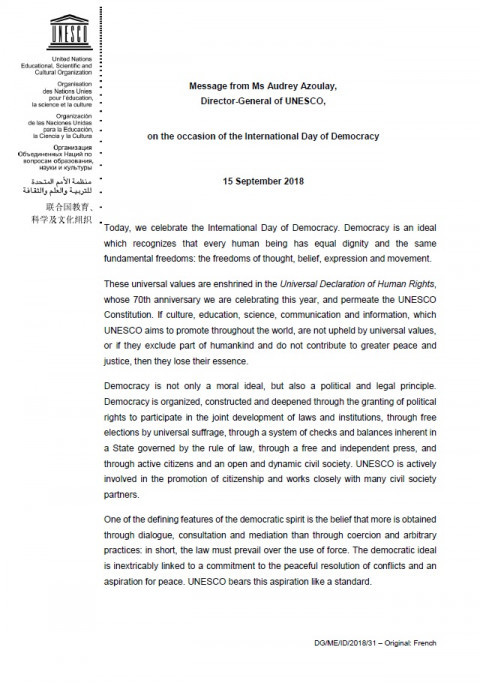 Message from Ms Audrey Azoulay, Director-General of UNESCO, on the occasion of International Day of Democracy, 15 September 2018 Año de publicación: 2018 Autor corporativo: UNESCO. Director-General, 2017-2025 (Azoulay, A.) This message was delivered by Audrey Azoulay, Director-General of UNESCO, on the occasion of the International Day of Democracy, on 15 September 2018.