
Recursos
Exploren una amplia gama de recursos valiosos en GCED para profundizar su comprensión y promover su búsqueda, incidencia, enseñanza y aprendizaje.
661 resultados encontrados
 [Résumé] Rapport mondial des Nations Unies sur la mise en valeur des ressources en eau 2019: ne laisser personne pour compte; résumé Año de publicación: 2019 Autor: Richard Connor | Stefan Uhlenbrook | Engin Koncagül Autor corporativo: UNESCO World Water Assessment Programme (WWAP) Le fait que des personnes de différents groupes soient « laissées pour compte » s’explique par plusieurs facteurs. La discrimination, l’exclusion, la marginalisation, des rapports de force asymétriques et les inégalités matérielles figurent parmi les principaux obstacles à la réalisation des droits de l’homme à l’eau potable et à l’assainissement pour tous et aux objectifs du Programme 2030 relatifs à l’eau. En outre, la mauvaise conception des politiques et leur application insuffisante, l’utilisation inefficace et inadéquate des ressources financières, ainsi que les lacunes politiques, alimentent les inégalités dans l’accès à l’eau potable et à l’assainissement. Si l’exclusion et l’inégalité ne sont pas traitées de manière explicite et adaptée dans les politiques et les pratiques, les interventions dans le domaine de l’eau continueront de ne pas bénéficier à ceux qui en ont le plus besoin et qui sont susceptibles d’en tirer le plus profit.Améliorer la gestion des ressources en eau et garantir l’accès universel à une eau potable et à des installations sanitaires sécuritaires, à un coût abordable, sont essentiels pour éliminer la pauvreté, bâtir des sociétés pacifiques et prospères et assurer de « ne laisser personne pour compte » sur la voie du développement durable. Ces objectifs sont tout à fait réalisables, à condition qu’il y ait une volonté collective d’agir. [요약보고서] 2019년 UN 세계물개발보고서: 누구도 소외되지 않는 사회; 요약보고서 Año de publicación: 2019 Autor: Richard Connor | Stefan Uhlenbrook | Engin Koncagül Autor corporativo: UNESCO World Water Assessment Programme (WWAP) 여러 그룹의 사람들은 다양한 이유로 ‘소외’되고 있다. 차별, 배제, 소외, 집권층 권력의 불균형 및 경제적 불평등은 안전한 식수 및 위생에 대한 인권을 달성하고, 2030 아젠다의 물 관련 목표를 실현하는 데 있어 걸림돌이 된다. 설계가 잘못되고, 부적절하게 구현된 정책, 비효율적이고 부당한 재정 자원 사용과 더불어 정책 격차는 안전한 식수 및 위생 시설 접근에 대한 불평등을 지속시킨다. 배제와 불평등 문제가 정책과 실행에서 분명하고, 신속하게 고려되지 않는다면, 물조정 노력 (water interventions)은 물을 가장 필요로 하고 혜택을 가장 많이 받을 수 있는 사람들에게 계속해서 그 효과를 주지 못할 것이다.수자원 관리를 개선하고 모든 사람에게 안전하고 경제적인 식수 및 위생 시설을 제공하는 것은 빈곤 퇴치, 평화롭고 번영하는 사회 형성, 지속 가능한 발전을 위한 ‘누구도 소외되지 않는 사회’ 구축에 필수적이다. 이러한 목표는 공동의 의지가 있는 한 전적으로 달성 가능할 것이다. [Pабочее резюме] Всемирный доклад Организации Объединенных Наций о состоянии водных ресурсов, 2019 г. : Не оставляя никого в стороне, рабочее резюме Año de publicación: 2019 Autor: Richard Connor | Stefan Uhlenbrook | Engin Koncagül Autor corporativo: UNESCO World Water Assessment Programme (WWAP) Представители различных групп «бывают забыты» по разным причинам. Дискриминация, отчуждение, маргинализация, укоренившаяся асимметричность в распределении власти, материальное неравенство – все это относится к числу основных препятствий на пути соблюдения права человека на безопасную питьевую воду и санитарию для всех, а также реализации связанных с водными ресурсами целей, поставленных в Повестке-2030.Плохо разработанная и неумело осуществляемая политика, бесхозяйственное и нецелевое использование финансовых ресурсов, а также пробелы в политике подпитывают сохранение неравенства в сфере доступа к водным ресурсам и санитарии. Если для решения проблем отчуждения и неравенства в политике и на практике не будут приниматься конкретные и ответственные меры, связанные с водными ресурсами мероприятия по-прежнему не будут отвечать интересам наиболее нуждающихся слоев и тех, кто должен быть их основными бенефициарами.Совершенствование управления водными ресурсами и обеспечение всеобщего доступа к безопасной и финансово доступной питьевойводе и санитарии имеет существенно важное значение для искоренения нищеты, созидания мирных и процветающих обществ и обеспечения такого положения, при котором «никто не будет забыт» на пути, ведущем к устойчивому развитию. При наличии коллективной воли эти цели вполне достижимы. 2019年联合国世界水发展报告 : 不让任何人掉队; 执行摘要 Año de publicación: 2019 Autor: Richard Connor | Stefan Uhlenbrook | Engin Koncagül Autor corporativo: UNESCO World Water Assessment Programme (WWAP) 不同群体的人,都因为不同的原因而“掉队”。受歧 视、被排除在外、被边缘化、权力不对等根深蒂固,以及物 质上的不平等是保障人人获得安全饮用水和卫生设施这一人 权、实现2030年可持续发展议程与水相关目标的主要障碍之 一。政策设计不合理、落实不到位、资金不足和使用不当及 政策缺位加剧了获取安全饮用水和卫生设施的不均等。除非 在政策和实践层面旗帜鲜明、积极有效地应对被排除在外、不平等的现状,否则与水相关的解决方案仍将以失败告终,无法触及最需要和最能受益的人群。改善水资源管理,确保人人获得安全、可负担的饮用水 和卫生服务是消除贫困、构建和平繁荣的社会、确保实现可 持续发展路上“不让任何人掉队”的重要条件。只要同心协 力,这些目标一定可以实现。
 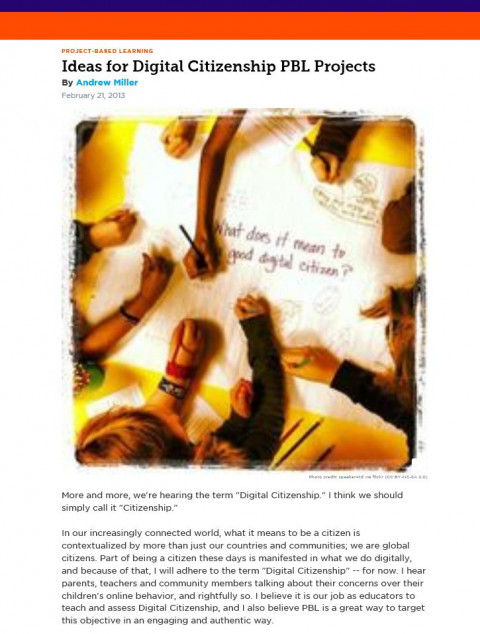 Ideas for Digital Citizenship PBL Projects Año de publicación: 2013 Autor: Andrew Miller In our increasingly connected world, what it means to be a citizen is contextualized by more than just our countries and communities; we are global citizens. Part of being a citizen these days is manifested in what we do digitally, and because of that, I will adhere to the term "Digital Citizenship" -- for now. I hear parents, teachers and community members talking about their concerns over their children's online behavior, and rightfully so. I believe it is our job as educators to teach and assess Digital Citizenship, and I also believe PBL is a great way to target this objective in an engaging and authentic way.
  INEE Thematic Paper: An Introduction to Education and Preventing Violent Extremism Año de publicación: 2017 Autor corporativo: Inter-agency Network for Education in Emergencies (INEE) This paper was conceptualized and developed by the INEE Education Policy Working Group subgroup on Youth, Violence and Peacebuilding. Though there remains limited consensus on how to define violent extremism, this paper highlights some of the more commonly used concepts and working definitions, presents current thinking and up-to-date research, and provides some examples of how education can contribute to preventing violent extremism. INEE does not take a particular stance.The paper is the most recent addition to the INEE’s work gathering resources on education and preventing violent extremism (PVE) from around the world, which may help policy-makers, teachers, principals, trainers, and researchers understand better the link between education and violent extremism and promote the positive ‘face’ of education. Documento temático de la INEE: una introducción a la educación y la prevención del extremismo violento Año de publicación: 2017 Autor corporativo: Inter-agency Network for Education in Emergencies (INEE) Sigue habiendo un consenso limitado sobre cómo definir el extremismo violento. Este documento destaca algunos de los conceptos y definiciones comúnmente utilizadas, aunque la INEE no adopta ninguna particular.El documento presenta el pensamiento actual y la investigación actualizada, y proporciona algunos ejemplos de cómo la educación puede contribuir a la prevención de la violencia. Document thématique de l'INEE: Introduction à l'éducation et prévention de l'extrémisme violent Año de publicación: 2017 Autor corporativo: Inter-agency Network for Education in Emergencies (INEE) Le sous-groupe de travail sur la jeunesse, la violence et la consolidation de la paix du Groupe de travail sur les politiques d'éducation de l'INEE a eu l'idée de cette thématique et a développé le document.Le consensus sur la définition de l'extrémisme violent reste limité. Cet article présente certains des concepts et des définitions pratiques les plus usuels, sachant toutefois que l'INEE ne prend pas de position sur la question. Le document présente les réflexions actuelles et la recherche à jour, et fournit quelques exemples de la façon dont l'éducation peut contribuer à la prévention de la violence.
  Address by Irina Bokova, Director-General of UNESCO, on the occasion of the reception hosted by Ambassador Ronald Lauder, President of the World Jewish Congress Año de publicación: 2017 Autor corporativo: UNESCO. Director-General, 2009-2017 (Bokova, I.G.) This address was delivered by Irina Bokova, Director-General of UNESCO, on the occasion of the reception hosted by Ambassador Ronald Lauder, President of the World Jewish Congress; New York, 17 September 2017.
  2018 High-level Political Forum: Contribution from the SDG-Education 2030 Steering Committee Año de publicación: 2018 Autor corporativo: SDG-Education 2030 Steering Committee ECOSOC invited intergovernmental bodies, including the SDG-Education 2030 Steering Committee, to contribute to the 2018 High-level Political Forum. This contribution is based on the HLPF mandated structure for all submissions, and suggested focus areas from the perspective of SDG4 based on discussions held during the last SDG-Education 2030 Steering Committee meeting (Paris, 28 February – 2 March 2018).