
Recursos
Exploren una amplia gama de recursos valiosos en GCED para profundizar su comprensión y promover su búsqueda, incidencia, enseñanza y aprendizaje.
2,193 resultados encontrados
 Adult education and development: global citizenship education (no 82, 2015) Año de publicación: 2015 Autor corporativo: DVV International Issue 82/2015 of the international journal Adult Education and Development (AED) explores the topic global citizenship education.In the international debates, we are witnessing a growing interest in the concept of global citizenship education. It is one of the three pillars of the Global Education First Initiative (GEFI) launched by the United Nations Secretary-General in 2012 and is being internationally promoted by the work of UNESCO. According to the GEFI, education that fosters global citizenship “must fully assume its central role in helping people to forge more just, peaceful, tolerant and inclusive societies”. The 2030 Agenda for Sustainable Development, adopted by the United Nations General Assembly in September 2015, refers to global citizenship as one tool to “ensure that all learners acquire the knowledge and skills needed to promote sustainable development”.The ambitions are high, but the concrete understanding of global citizenship education and its implications differ widely. Is it just another abstract concept? What meaning can the word citizenship have if it does not refer to a specific nation? What do people in different parts of the world understand by global citizenship? And how can global citizenship education be put into practice?Adult Education and Development decided to engage in the debate and invited authors from different regions, backgrounds and disciplines to share their thoughts and experiences on the topic and related questions such as identity, migration, peace, the meaning of citizenship, globalisation and sustainable development.Irina Bokova, Director-General of UNESCO, explains the organisation’s understanding of global citizenship education, and why adult education and “learning beyond the classrooms” are crucial when it comes to promoting global citizenship. Canadian author and journalist Doug Saunders (“Arrival City: How the Largest Migration in History Is Reshaping Our World”) talks about the challenges and opportunities of what he refers to as the last great human migration, that from the countryside to the cities, and about the positive role adult education can play during this transition.In the section “Citizens’ voices” people from all over the world talk about what global citizenship means to them and in what ways they see themselves as global citizens. And photographer Viktor Hilitksi travelled through Belarus and captured with his camera how villages rediscover their local traditions and cultures. L'éducation des adultes et le développement: l'éducation à la citoyenneté mondiale (82, 2015) Año de publicación: 2015 Autor corporativo: DVV International Problème 82/2015 de la revue internationale d'Éducation des Adultes et le Développement (EAD) explore l'éducation à la citoyenneté mondiale sujet.Dans les débats internationaux, nous assistons à un intérêt croissant pour le concept d'éducation à la citoyenneté mondiale. Il est l'un des trois piliers de la Première Initiative Mondiale pour l'éducation globale avant tout(GEFI) lancé par le Secrétaire général des Nations Unies en 2012 et est internationalement promu par le travail de l'UNESCO. Selon le GEFI, l'éducation qui favorise la citoyenneté mondiale "doit assumer pleinement son rôle central en aidant les gens à forger plus justes, des sociétés pacifiques, tolérantes et inclusives". L'Agenda 2030 pour le développement durable, adoptée par l'Assemblée générale des Nations Unies en Septembre 2015, se réfère à la citoyenneté mondiale comme un outil pour «faire en sorte que tous les apprenants à acquérir les connaissances et les compétences nécessaires pour promouvoir le développement durable». Les ambitions sont élevées, mais la compréhension concrète de L'éducation à la citoyenneté Mondiale (ECM) et ses implications diffèrent largement. Est-il juste un autre concept abstrait? Quel sens le mot citoyenneté peut avoir si elle ne se réfère pas à une nation spécifique? Que font les gens dans différentes parties du monde à comprendre par la citoyenneté mondiale? Et comment L'éducation à la citoyenneté Mondiale (ECM) être mis en pratique? Education des adultes et développement ont décidé de participer au débat et a invité les auteurs de différentes régions, milieux et disciplines à partager leurs réflexions et expériences sur le sujet et les questions connexes telles que l'identité, la migration, la paix, le sens de la citoyenneté, la mondialisation et le développement durable. Irina Bokova, Directrice générale de l'UNESCO, explique la compréhension de l'organisation de l'éducation à la citoyenneté mondiale, et pourquoi l'éducation des adultes et de «l'apprentissage au-delà des salles de classe" sont cruciales en matière de promotion de la citoyenneté mondiale. auteur canadien et journaliste Doug Saunders ( «Ville d'arrivée: Comment la plus grande migration dans l'histoire remodèle notre monde») parle des défis et des possibilités de ce qu'il désigne comme la dernière grande migration humaine, que de la campagne vers les villes, et sur le rôle positif l'éducation des adultes peut jouer au cours de cette transition. Dans la section «voix des citoyens" les gens de partout dans le monde parlent de ce que signifie la citoyenneté mondiale pour eux et de quelle manière ils se considèrent comme des citoyens du monde. Et le photographe Viktor Hilitksi a voyagé à travers le Bélarus et capturé avec sa caméra comment les villages redécouvrent leurs traditions et cultures locales. Educación de adultos y desarrollo: La educación para la ciudadanía mundial (no 82, 2015) Año de publicación: 2015 Autor corporativo: DVV International Issue 82/2015 of the international journal Adult Education and Development (AED) explores the topic global citizenship education.In the international debates, we are witnessing a growing interest in the concept of global citizenship education. It is one of the three pillars of the Global Education First Initiative (GEFI) launched by the United Nations Secretary-General in 2012 and is being internationally promoted by the work of UNESCO. According to the GEFI, education that fosters global citizenship “must fully assume its central role in helping people to forge more just, peaceful, tolerant and inclusive societies”. The 2030 Agenda for Sustainable Development, adopted by the United Nations General Assembly in September 2015, refers to global citizenship as one tool to “ensure that all learners acquire the knowledge and skills needed to promote sustainable development”.The ambitions are high, but the concrete understanding of global citizenship education and its implications differ widely. Is it just another abstract concept? What meaning can the word citizenship have if it does not refer to a specific nation? What do people in different parts of the world understand by global citizenship? And how can global citizenship education be put into practice?Adult Education and Development decided to engage in the debate and invited authors from different regions, backgrounds and disciplines to share their thoughts and experiences on the topic and related questions such as identity, migration, peace, the meaning of citizenship, globalisation and sustainable development.Irina Bokova, Director-General of UNESCO, explains the organisation’s understanding of global citizenship education, and why adult education and “learning beyond the classrooms” are crucial when it comes to promoting global citizenship. Canadian author and journalist Doug Saunders (“Arrival City: How the Largest Migration in History Is Reshaping Our World”) talks about the challenges and opportunities of what he refers to as the last great human migration, that from the countryside to the cities, and about the positive role adult education can play during this transition.In the section “Citizens’ voices” people from all over the world talk about what global citizenship means to them and in what ways they see themselves as global citizens. And photographer Viktor Hilitksi travelled through Belarus and captured with his camera how villages rediscover their local traditions and cultures. Quality Adult Education Benchmarks for Indigeneous Education Año de publicación: 2011 Autor: Sandra L. Morrison | Timote Vaioleti Autor corporativo: Asia South Pacific Association for Basic and Adult Education (ASPBAE) In November 2010, in Indonesia, Asia South Pacific Association for Basic and Adult Education(ASPBAE) brought together a number of educators from across its region to discuss benchmarking quality adult education for indigenous peoples. Educators came from across the ASPBAE region including the Philippines, India, Nepal, New Zealand, Australia, Thailand, Indonesia and Uzbekistan to share experiences and to build a collective understanding of what constitutes a good quality adult education program for indigenous peoples. Discussions were informed by a broader ASPBAE Quality Adult Education Framework, which had its origins in discussions held in 2009. The Core of the Framework is grounded on ASPBAE’s commitment to education as a right, adult education for transformation, and adult and basic education as integral and inter‐connected components of the vision of lifelong learning (Guevara, 2010). Other frameworks promoted by ASPBAE for education to be empowering, pro‐poor, gender just and sustainable were also important considerations. The 2010 gathering served as a nodal point to discuss the ASPBAE framework more deeply and to reaffirm or create a set of benchmarks for indigenous education which can be validated through a subsequent national and regional consultation process.
 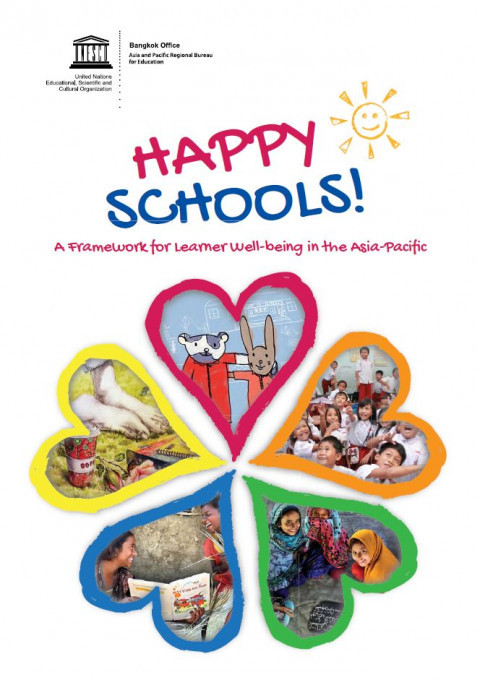 Happy Schools!: A Framework for Learner Well-being in the Asia-Pacific Año de publicación: 2016 Autor corporativo: UNESCO Bangkok The Happy Schools Project was launched in June 2014 in the aim of promoting learner well-being and holistic development. It follows on the findings of UNESCO Bangkok’s research on ‘Learning to Live Together’, which examined the ways in which education systems can promote peace through education in the Asia-Pacific region. While the concept of ‘Learning to Live Together’ is often reflected at policy level, there is little evidence as to how it is implemented in practice. Therefore, the Happy Schools Project aims to identify and recognize proven practices at school level that integrate this concept. Écoles Heureux: Un cadre pour l'apprenant Bien-être dans la région Asie-Pacifique Año de publicación: 2016 Autor corporativo: UNESCO Bangkok Le projet Bonne écoles a été lancé en Juin 2014, le but de promouvoir l'apprenant le bien-être et le développement holistique. Il en résulte sur les résultats de la recherche de l'UNESCO à Bangkok sur «Apprendre à vivre ensemble», qui a examiné la manière dont les systèmes éducatifs peuvent promouvoir la paix par l'éducation dans la région Asie-Pacifique. Bien que le concept de «Apprendre à vivre ensemble» se traduit souvent au niveau politique, il y a peu de preuves quant à la façon dont il est mis en œuvre dans la pratique. Par conséquent, des écoles Heureux vise à identifier et reconnaître les pratiques éprouvées au niveau des écoles qui intègrent ce concept. Счастливые школы: Основа благополучия учащихся в Азиатско-Тихоокеанском регионе Año de publicación: 2016 Autor corporativo: UNESCO Bangkok Этот региональный доклад был подготовлен Региональным бюро ЮНЕСКО по образованию в Азиатско-Тихоокеанском регионе (ЮНЕСКО, Бангкок). В нем представлены результаты исследования проведенного в рамках проекта «Счастливые школы». Этот отчет, основанный на результатах серии мероприятий, проводимых в рамках проекта «Счастливые школы», признает важную взаимосвязь между счастьем и качеством образования. Он объединяет эти два элемента и призывает системы образования выходить за рамки традиционных областей обучения, чтобы охватить разнообразие талантов и умений, признавая ценности, сильные стороны и компетенции, которые способствуют как повышению счастья, так и благополучию учащихся, но также и их процветать и праздновать свои достижения.
 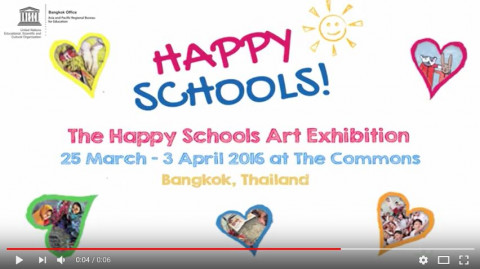 Happy Schools Art E-Exhibition Año de publicación: 2016 Autor corporativo: UNESCO Bangkok Happy Schools Art E-Exhibition What does a Happy School look like to you? A happy learner is more likely to be a thriving one – better able to solve problems and apply critical thinking skills, more self-confident and likelier to form and foster positive relationships with others. Happy learners require Happy Schools, those that ensure the holistic development and well-being of students and the wider school community. In today’s rapidly changing world, we are faced with increasing mobility, life stress, competition, information overload, inequalities and environmental concerns. As these symptoms of ‘unhappiness’ begin to emerge, the Happy Schools Project calls for the need for education systems to reposition the school as more than a service for educational instruction, but rather, an environment which allows for social and emotional growth and development for learners to contribute to a more peaceful, just and equitable world. As part of UNESCO Bangkok’s Happy Schools Project, the Happy Schools team hosted an art contest in early 2016 in an effort to capture actions, moments and ideas that are promoting happiness in schools. All residents of the Asia-Pacific region were invited to submit images of any kind (photos, drawings, cartoons, paintings, graphics, and posters) along with a caption/description that captures the concept of Happy Schools. Thirty winners were selected from the pool of entries for the Happy Schools Art Exhibition and Report Launch (of the Happy Schools: A Framework for Learner Well-being in the Asia-Pacific report. The artwork will be on display for the Happy Schools Art Exhibition from 25 March to 3 April, 2016 at The Commons in Bangkok, Thailand, and available to view here as an e-exhibition. Écoles Heureux Art E-Exhibition Año de publicación: 2016 Autor corporativo: UNESCO Bangkok Heureux Écoles d'art E-Exposition, qu'est-ce qu'une école heureux ressemble pour vous? Un apprenant heureux est plus susceptible d'être une entreprise florissante un - mieux à même de résoudre les problèmes et appliquer la pensée critique, plus confiant et plus susceptibles de former et de favoriser des relations positives avec les autres. Apprenants Heureux exigent l’écoles Heureux, ceux qui assurent le développement holistique et le bien-être des élèves et la communauté scolaire. Dans le monde en évolution rapide d'aujourd'hui, nous sommes confrontés à la mobilité croissante, le stress de la vie, la concurrence, la surcharge d'information, les inégalités et les préoccupations environnementales. Comme ces symptômes de «malheur» commencent à émerger, le projet Bonne écoles appelle à la nécessité pour les systèmes éducatifs pour repositionner l'école comme plus qu'un service pour l'enseignement de l'éducation, mais plutôt, un environnement qui favorise la croissance et le développement social et affectif pour apprenants de contribuer à un monde plus pacifique, juste et équitable. Dans le cadre du projet Écoles heureux de l'UNESCO à Bangkok, l'équipe Ecoles Heureux a organisé un concours d'art au début de 2016 dans le but de capturer des actions, des moments et des idées qui font la promotion du bonheur dans les écoles. Tous les résidents de la région Asie-Pacifique ont été invités à soumettre des images de toute nature (photos, dessins, bandes dessinées, peintures, graphiques et affiches) avec une légende / description qui capture le concept des écoles Heureux. Trente gagnants ont été sélectionnés à partir du pool d'entrées pour les écoles Bonne Exposition Art et Rapport de lancement (des écoles Heureux:. Un cadre pour l'apprenant le bien-être dans le rapport Asie-Pacifique, l'œuvre sera exposée pour l'Exposition Heureux Ecoles d'Art du 25 Mars au 3 Avril, 2016 au The Commons à Bangkok, en Thaïlande et à la disposition de la considérer comme un e-exposition) Russian regions for sustainable development: education and culture of peoples in Russian Federation; proceedings of the international conference Año de publicación: 2010 Autor: Ilona Graf | Natalia Dulepova | Nikolai Lyakhov | Vera Markova | Vladimir Sobyanin | Victoria Shatrova Autor corporativo: Novosibirsk State University The publication gives careful consideration to RF regional efforts to contribute undertaking a survey of educational contents and methods promoting cultural diversity, including traditional modes of transmission, in Siberia as a vast territory involving three greatest regions of Russian Federation. The mainstream of this recognition and accommodation of Siberian cultural diversity – efforts to create opportunities and facilities for culture-specific learning in each region, adapting teaching methods to the requirements of the everyday life of learners with the support of educational policymakers, educational professionals at all levels and local communities. The goal of publication is contributing to raising the awareness of Siberian population in recognizing the cultural dimension as a central pillar of the UNESCO decade «Education for Sustainable Development» (2005-2014). The publication is aimed at teachers, ethnologists, sociologists, linguists, philosophers, those researching the education and culture of peoples in Russia, government specialists, representatives of national-cultural communities of indigenous peoples and ethnic minorities.