
Recursos
Exploren una amplia gama de recursos valiosos en GCED para profundizar su comprensión y promover su búsqueda, incidencia, enseñanza y aprendizaje.
1,451 resultados encontrados
 苏格兰特殊教育法案的评述及思考(创新教育研究; vol. 7, no. 1) Año de publicación: 2019 Autor: Qiuhan Feng 苏格兰以高水平的教育质量和融合教育发展程度闻名于世,其以教育公平促进社会公平的理念是当地教 育的特色之一。迄今为止,苏格兰已经颁布多种教育法案来扩大额外支持需要的服务范围,并保障家长 的参与权,建立完善的教师教育体系来提升各种弱势儿童群体的教育质量。然而额外支持需要带来的分 类与标签问题、污名化问题、教育资源传递有效性问题依然存在,引发学者对教育公平的思考。
 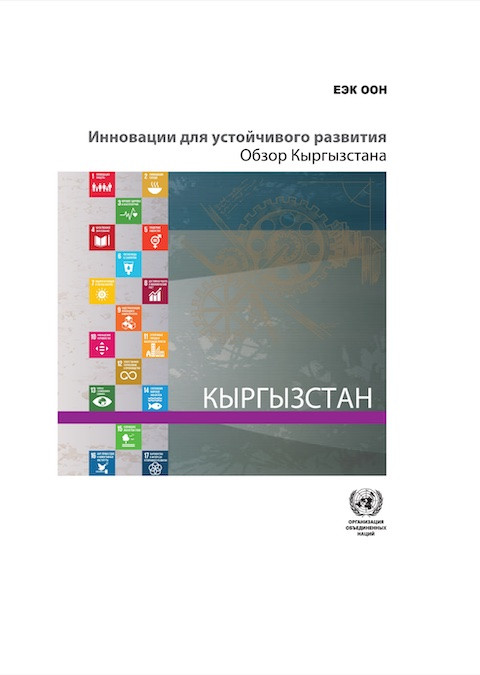 Innovation for Sustainable Development: Review of Kyrgyzstan Año de publicación: 2019 Autor: Anders Jönsson | Christopher Athey | Slavo Radosevic Autor corporativo: United Nations Economic Commission for Europe (UNECE) The practical work on the Innovation for Sustainable Development Review of Kyrgyzstan began in December 2016 with a preparatory mission to Bishkek by representatives of the UNECE secretariat to establish contact and discuss the structure and content of the Review with the national Government institutions and other stakeholders. The main project mission took place from 30 March to 7 April 2017 with the participation of a team that included representatives of the UNECE secretariat as well as international and national experts. This Review reflects the outcome of a series of consultations and discussions between the Review team and policymakers, Government officials, representatives of academic institutions and the business community, and other innovation stakeholders of Kyrgyzstan.This report presents a thematic regional analysis of unpaid work in Eastern Europe and Central Asia (EECA) and the resulting empowerment women gain when their responsibility for such work is reduced. The report focuses on Albania, Azerbaijan, Bosnia & Herzegovina, Georgia, Kazakhstan, Kyrgyzstan, Kosovo, Montenegro, North Macedonia, Republic of Moldova, Serbia, Turkey, Ukraine and Uzbekistan.Apart from three country case studies (on Kyrgyzstan, Republic of Moldova and Serbia) the other reports in the series cover the 56 UNECE member States, including the countries of Europe and countries in North America (Canada and United States), Central Asia (Kazakhstan, Kyrgyzstan, Tajikistan, Turkmenistan and Uzbekistan) and Western Asia (Israel). Инновации для устойчивого развития: Обзор Кыргызстана Año de publicación: 2019 Autor: Anders Jönsson | Christopher Athey | Slavo Radosevic Autor corporativo: United Nations Economic Commission for Europe (UNECE) Практическая работа над документом «Инновации для устойчивого развития: Обзор по Кыргызской Республике» началась в декабре 2016 года с подготовительного визита в г. Бишкек группы представителей секретариата ЕЭК ООН для установления контактов и обсуждения структуры и содержания Обзора с национальными органами госуправления и другими заинтересованными сторонами. Основной визит в рамках проекта состоялся с 30 марта по 7 апреля 2017 года при участии авторской группы, в состав которой вошли представители секретариата ЕЭК ООН, а также международные и национальные эксперты. Данный Обзор отражает итоги серии консультаций и дискуссий авторской группы с представителями правительственных структур, государственными должностными лицами, представителями научных учреждений и бизнес-сообщества и другими участниками инновационного процесса Кыргызской Республики.
 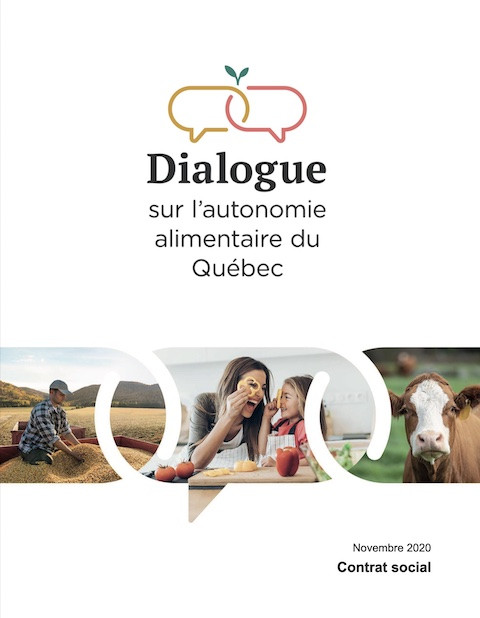 Dialogue on Quebec Food Autonomy Año de publicación: 2020 Autor corporativo: Institut du Nouveau Monde (INM) Food autonomy is more than ever a crucial subject for Quebec society. The COVID-19 pandemic has revealed the fragility of our food system and has created a new opportunity to talk about this strategic issue. Several players are saying it: it It is time to bring agricultural producers closer to citizens, and to create new forms of solidarity between them.To do this, the Union des producteurs agricoles (UPA) wishes to set up a real opportunity for dialogue between the two ends of the production chain food, that is to say producers and citizens.The Dialogue on food autonomy is an opportunity for citizens to participate in the development of a social contract on issues related to food autonomy and to facilitate a dialogue between them and producers, who are an essential link. of this strategic issue. It provides opportunities for open and constructive exchanges between agricultural producers and citizens, first separately and then in a common group. It will then be offered to all of Quebec. Dialogue sur l’autonomie alimentaire du Québec Año de publicación: 2020 Autor corporativo: Institut du Nouveau Monde (INM) L’autonomie alimentaire est plus que jamais un sujet crucial pour la société québécoise. La pandémie de COVID-19 a révélé la fragilité de notre système alimentaire et a créé une nouvelle occasion de parler de cet enjeu stratégique. Plusieurs acteurs le disent : il est temps de rapprocher les producteurs agricoles des citoyens, et de créer de nouvelles solidarités entre eux. Pour ce faire, l’Union des producteurs agricoles (UPA) souhaite mettre en place une occasion réelle de dialogue entre les deux extrémités de la chaîne de production alimentaire, soit les producteurs et les citoyens.Le Dialogue sur l’autonomie alimentaire est l’occasion pour les citoyens de participer à l’élaboration d’un contrat social sur les enjeux liés à l’autonomie alimentaire et de faciliter un dialogue entre eux et les producteurs, qui sont un maillon essentiel de cet enjeu stratégique. Il prévoit des occasions d’échanges ouverts et constructifs entre les producteurs agricoles et les citoyens, d’abord séparément puis dans un groupe commun. Il sera par la suite proposé à l’ensemble du Québec.
  Encyclopedia on Democracy and Citizen Participation Autor: Malorie Flon | Émilie Béorofei Autor corporativo: Institut du Nouveau Monde (INM) As part of its Strategic Meeting on Democracy and Citizen Participation, the INM has set up an online information pack, the first contents of which you will find on this site.A vast deliberative process, the Strategic Rendezvous aims to enlighten the people of Quebec on the current transformations of our democracy: a representative system that no longer responds, on its own, to the democratic requirement; a growing demand from certain citizens to participate in decisions that affect them; increasingly complex social issues and collective challenges, which public and private authorities must tackle; institutions forced to adapt quickly and continuously to a constantly changing world.The Briefing Kit tackles these questions by providing basic notions of the concepts involved: democracy, participation, citizenship, etc. To questions frequently asked during public debates, the dossier offers some possible answers. It outlines, for the reader who wants to dive into it, definitions of the different types of citizen participation: public, electoral, social. In order to better understand what is practiced in Quebec in each of these categories, the reader will turn to The authorities of public participation in Quebec.Are you a practitioner or would you like to deepen your knowledge of the practice of citizen participation? The Toolbox is here for you! It contains references, guides, methods and examples of experiences that will equip you to implement, in turn, participatory practices. Encyclopédie sur la démocratie et la participation citoyenne Autor: Malorie Flon | Émilie Béorofei Autor corporativo: Institut du Nouveau Monde (INM) Dans le cadre de son Rendez-vous stratégique Démocratie et participation citoyenne, l’INM a mis sur pied un dossier d’information en ligne, dont vous trouverez les premiers contenus dans ce site.Vaste démarche délibérative, le Rendez-vous stratégique vise à éclairer la population québécoise sur les transformations actuelles de notre démocratie: un système représentatif qui ne répond plus, seul, à l’exigence démocratique; une demande croissante de certains citoyens à participer aux décisions qui les touchent; des enjeux sociaux et des défis collectifs de plus en plus complexes, auxquels les pouvoirs publics et privés doivent s’attaquer; des institutions obligées de s’adapter rapidement et continuellement à un monde en constante transformation. Le dossier d’information s’attaque à ces questions en fournissant des notions de base sur les concepts en jeu: démocratie, participation, citoyenneté, etc. Aux questions fréquemment posées lors des débats publics, le dossier offre des pistes de réponses. Il esquisse, pour le lecteur qui voudra s’y plonger, des définitions des différents types de participation citoyenne: publique, électorale, sociale. Afin de mieux comprendre ce qui se pratique au Québec dans chacune de ces catégories, le lecteur se tournera vers Les instances de participation publique au Québec. Vous êtes praticien ou souhaitez approfondir votre connaissance de la pratique de la participation citoyenne? La Boîte à outils est là pour vous! Elle contient des références, guides, méthodes et exemples d’expériences qui vous outilleront pour mettre en œuvre, à votre tour, des pratiques participatives.
 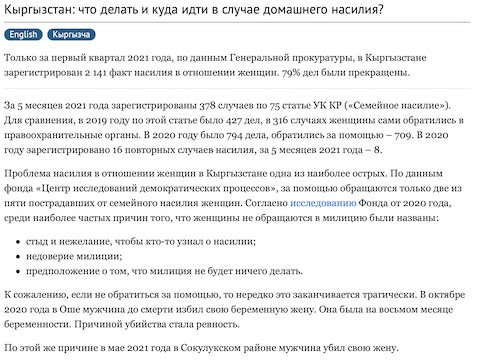 Kyrgyzstan: What to Do and Where to Go in Case of Domestic Violence? Año de publicación: 2021 Autor: Mehrinisa Sulaimanovna Autor corporativo: Central Asian Bureau for Analytical Reporting (CABAR) The problem of violence against women in Kyrgyzstan is one of the most relevant. According to the Centre for Democratic Processes Studies Fund, only two of five female victims of domestic violence call for help. Кыргызстан: Что делать и куда идти в случае домашнего насилия?? Año de publicación: 2021 Autor: Mehrinisa Sulaimanovna Autor corporativo: Central Asian Bureau for Analytical Reporting (CABAR) Проблема насилия в отношении женщин в Кыргызстане одна из наиболее острых. По данным фонда «Центр исследований демократических процессов», за помощью обращаются только две из пяти пострадавших от семейного насилия женщин.
 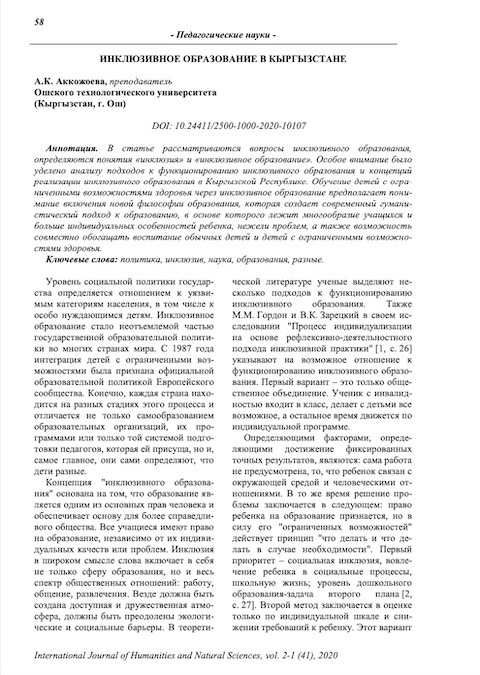 Inclusive Education in Kyrgyzstan (International Journal of Humanities and Natural Sciences; vol. 2-1, no. 41) Año de publicación: 2020 Autor: A.K. Akkojoeva The article deals with issues of inclusive education, defines the concepts of "inclusion" and "inclusive education". Special attention was paid to the analysis of approaches to the functioning of inclusive education and concepts for the implementation of inclusive education in the Kyrgyz Republic. teaching children with disabilities through inclusive education involves understanding the inclusion of a new philosophy of education that creates a modern humanistic approach to education based on the diversity of students and more individual characteristics of the child than problems, as well as the ability to jointly enrich the education of ordinary children and children with disabilities.