
Recursos
Exploren una amplia gama de recursos valiosos en GCED para profundizar su comprensión y promover su búsqueda, incidencia, enseñanza y aprendizaje.
3,446 resultados encontrados
 Situation Analysis: Children and Adolescents with Disabilities in Kyrgyzstan Año de publicación: 2021 Autor corporativo: UNICEF Kyrgyzstan The study identified barriers and obstacles to the provision of quality and inclusive services to children and adolescents with disabilities, as well as problems at the level of policy-making and evidence base. The rationale for this Situation Analysis is to inform stakeholders, both governmental, civil society and development partners, as to the current situation with regards to the fulfilment of children and adolescents with disabilities’ rights. Ситуационный анализ: дети и подростки с инвалидностью в Кыргызстане Año de publicación: 2021 Autor corporativo: UNICEF Kyrgyzstan В ходе исследования были выявлены барьеры и препятствия в предоставлении качественных и инклюзивных услуг детям и подросткам с инвалидностью, а также проблемы на уровне принятия политических решений и наличия доказательной базы. Обоснованием для проведения данного анализа является информирование заинтересованных сторон, таких как государственные органы, гражданское общество, а также партнёров по развитию, о текущей ситуации по реализации прав детей и подростков с инвалидностью.
  Женщины Таджикистана в науке: социально-статистический анализ (Вестник МГЛУ. Общественные науки. Вып. 3(852) Año de publicación: 2023 Autor: Хушкадамова Халимахон Отамбековна Исследование репрезентирует пример Таджикистана по проблематике участия женщин в науке. Автором применяются разные эмпирические методы – непосредственное наблюдение, контент-анализ публикаций СМИ, биографический метод и статистический анализ официальных данных. Выявляются основные ступени подготовки ученых из числа женщин и девушек. Даются портреты известных женщин-ученых таджикского социума. Рассматриваются факторы, способствующие гендерному разрыву в науке.
  Éducation aux Droits de l'Homme en Russie: rapport analytique Año de publicación: 2008 Autor: Anatoly Azarov Autor corporativo: Moscow School of Human Rights Le livre examine l'état, les tendances et les questions de l'éducation des droits de l'homme, y compris le VIH / SIDA éducation à la prévention dans la Fédération de Russie. Il couvre la période allant du début des années 1990 à Décembre 2008, l'analyse des deux conditions préalables positives pour la diffusion des droits de l'homme et des libertés connaissances en Russie et les obstacles rencontrés dans le processus. Une attention particulière est sur les lois, les règlements et les normes applicables à l'enseignement supérieur. Le livre décrit les activités des institutions primaires sociaux engagés dans EDH: écoles polyvalentes et les universités, les commissaires des droits de l'homme, des ONG. Il montre des exemples de l'enseignement du droit international humanitaire; offre une évaluation de la littérature EDH pour les universités russes; offre un concept de la science et de la discipline des droits de l'homme. Le livre examine aussi l'état de l'éducation de la prévention du VIH / SIDA dans le cadre du respect des droits de l'homme. Les conclusions et les jugements des auteurs sont soutenus par un sondage spécial. Global citizenship in primary and secondary education in the Netherlands Año de publicación: 2012 Autor: Lette Hogeling Autor corporativo: National Committee for International Cooperation and Sustainable Development (NCDO) NCDO has examined the opinions and methods of teachers and directors with regard to global citizenship, as well as the obstacles and opportunities they experience around global citizenship in education. More than 1,500 teachers and almost 300 directors have participated in the research. A large majority of the teachers in primary and secondary education think that global citizenship is an important subject for Dutch education. Also, the majority of the teachers are of the opinion that it is important that the lessons link up with current events. Nevertheless, only a minority of the teachers in primary and secondary education believe that global citizenship should be a compulsory part of the curriculum. It is mainly teachers of geography, economics, cultural and social subjects who are of the opinion that global citizenship is an important theme. La citoyenneté mondiale dans l'enseignement primaire et secondaire aux Pays-Bas Año de publicación: 2012 Autor: Lette Hogeling Autor corporativo: National Committee for International Cooperation and Sustainable Development (NCDO) NCDO a examiné les opinions et les méthodes des enseignants et des administrateurs à l'égard de la citoyenneté mondiale, ainsi que les obstacles et les opportunités qu'ils rencontrent autour de la citoyenneté mondiale dans l'éducation. Plus de 1.500 enseignants et près de 300 directeurs ont participé à la recherche. Une grande majorité des enseignants dans l'enseignement primaire et secondaire pensent que la citoyenneté mondiale est un sujet important pour l'éducation néerlandaise. En outre, la majorité des enseignants sont d'avis qu'il est important que les leçons de lien avec l'actualité. Néanmoins, seule une minorité des enseignants dans l'enseignement primaire et secondaire croient que la citoyenneté mondiale devrait être une partie obligatoire du programme. Il est principalement les professeurs de géographie, l'économie, la culture et les sujets sociaux qui sont d'avis que la citoyenneté mondiale est un thème important. Global citizenship: from public support to active participation Año de publicación: 2012 Autor: Christine Carabain | Shelena Keulemans | Marije van Gent | Gabi Spitz Autor corporativo: National Committee for International Cooperation and Sustainable Development (NCDO) This publication explores the concept of global citizenship by drawing on the most relevant, mainly scientific, literature. This exploration will in the coming years be the basis for NCDO’s programmes in the area of research, staff training, and knowledge sharing. NCDO has the important task of engaging people in these two major changes in perspective: what does it mean, how important is it to us, how can we contribute to it? NCDO considers it its responsibility to raise awareness amongst Dutch citizens of the growing connection and mutual dependency between people across the globe, as well as to make them aware of the opportunities they have to help tackle global issues. In other words: NCDO aims to advance the global dimension of citizenship in the Netherlands. But what exactly is that global dimension of citizenship? Despite growing awareness of the importance of global citizenship, a clear and broadly accepted definition of the concept is still lacking (Hart, 2011). To date the concept is often explained by using examples and focus areas. This publication will present the definition of global citizenship that NCDO will employ in the coming period. Global citizenship: from public support to active participation Año de publicación: 2012 Autor: Christine Carabain | Shelena Keulemans | Marije van Gent | Gabi Spitz Autor corporativo: National Committee for International Cooperation and Sustainable Development (NCDO) Cette publication explore le concept de citoyenneté mondiale en abordant essentiellement le côté scientifique, la littérature la plus pertinente,. Cette exploration dans les années à venir sera la base pour les programmes de NCDO dans le domaine de la recherche, la formation du personnel, et le partage des connaissances. NCDO a la tâche importante d'engager les gens dans ces deux grands changements en perspective: qu'est-ce que cela veut dire, combien il est important pour nous, comment pouvons-nous y contribuer? NCDO estime qu'il lui incombe de sensibiliser les citoyens néerlandais de la connexion croissante et la dépendance mutuelle entre les peuples à travers le monde, ainsi que pour leur faire connaître les possibilités qu'ils ont pour aider à résoudre les problèmes mondiaux. En d'autres termes: NCDO vise à faire progresser la dimension globale de la citoyenneté aux Pays-Bas. Mais qu'est-ce que la dimension mondiale de la citoyenneté? Malgré la prise de conscience de l'importance de la citoyenneté mondiale, une définition claire et largement acceptée du concept fait toujours défaut (Hart, 2011). À ce jour, le concept est souvent expliqué à l'aide des exemples et des domaines d'intervention. Cette publication présentera la définition de la citoyenneté mondiale qui NCDO emploiera dans la période à venir.
 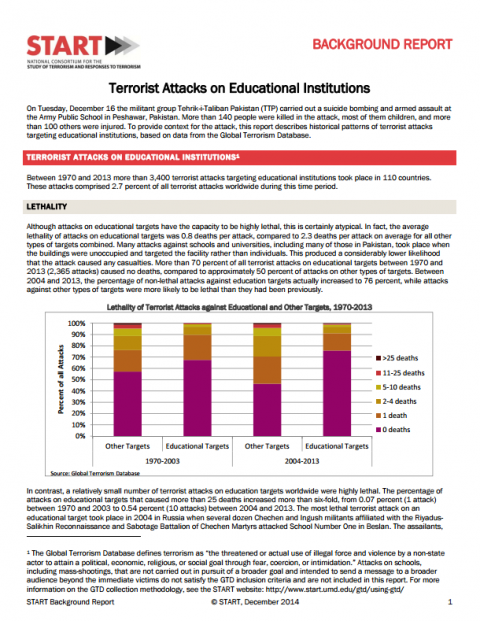 Terrorist Attacks on Educational Institutions Año de publicación: 2014 Autor: Erin Miller Autor corporativo: National Consortium for the Study of Terrorism and Responses to Terrorism (START) | Department of Homeland Security Science and Technology The report describes historical patterns of terrorist attacks targeting educations institutions dating back to 1970. Since that year, more than 3,400 terrorist attacks targeting educations institutions took place in 110 countries. These attacks comprised 2.7 percent of all terrorist attacks worldwide during this time period. Terrorist Attacks on Educational Institutions Año de publicación: 2014 Autor: Erin Miller Autor corporativo: National Consortium for the Study of Terrorism and Responses to Terrorism (START) | Department of Homeland Security Science and Technology Le rapport revient sur les attaques terroristes qui ont ciblé les institutions éducatives depuis 1970. A partir de cette année, on dénombre plus de 3.400 attaques terroristes qui avaient pour cible les institutions éducatives, dans 110 pays. Ces attaques représentent 2,7 % de l’ensemble des attaques terroristes perpétrées à travers le monde au cours de cette période.