
Recursos
Exploren una amplia gama de recursos valiosos en GCED para profundizar su comprensión y promover su búsqueda, incidencia, enseñanza y aprendizaje.
661 resultados encontrados
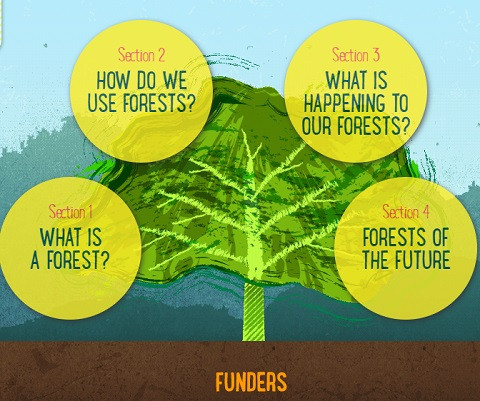 Our Forest, Our Future Autor corporativo: Scotdec This material helps teachers and pupils to explore the interdependence of people and forests and the vital role forests play in sustaining our environment – in the past, the present and hopefully the future. The Scots Pine forests in Scotland and the Congo Basin rainforest in Africa provide case studies through which pupils will begin to understand why our forests are under threat and the implications for our planet.In making connections between consumerism, people and the environment, pupils will be encouraged to see how they and their actions have an impact on the lives of others globally. It encourages reflection on the possible futures of the world's forests and ways of taking positive actions for a future where people and forests co-exist in a sustainable way. The resource is structured around a global citizenship framework devised by Oxfam.
  Отчет об общественном мониторинге законодательства и правоприменительной практики местной полицейской службы в сфере предупреждения и профилактики бытового насилия в РК Año de publicación: 2017 Autor: S.V. Korneytchuk | N.S. Gladyr Autor corporativo: OSCE. Programme Office in Astana Основной целью настоящего мониторинга является деятельность по оценке и прогнозированию законодательства путем выявления противоречий в законодательстве, устаревших, коррупциогенных и неэффективно реализуемых норм права, а также выработка предложений по совершенствованию законодательства и механизмов его реализации подразделениями местной полицейской службы. Это издание опубликовано при финансовой поддержке Офиса программ ОБСЕ в Астане в рамках проекта «Общественный мониторинг законодательства и правоприменительной практики местной полицейской службы в сфере предупреждения и профилактики бытового насилия в РК».
  Comment être citoyen du monde? Año de publicación: 2015 Autor: Radhi Meddeb Autor corporativo: TEDxCarthage | TEDx Talks Le monde a salué la Révolution tunisienne comme étant celle des technologies de l'information et des communications. Cela est vrai en partie, car les jeunes tunisiens ont déjoué la censure, ont relayé les images de la révolte et des protestations. Mais en même temps, l'usage de l'ordinateur et d'Internet reste aujourd'hui très en deçà des normes internationales. Plus encore, il présente des disparités régionales majeures. Des cyberbases dans l'ensemble des régions tunisiennes peuvent donner à chaque tunisien un passeport vers la modernité et la citoyenneté.
  Qu'est ce qu'être citoyen du monde aujourd'hui? Año de publicación: 2017 Autor: Louis Lourme Autor corporativo: Rendez-vous Philosophiques Orléans-Tours Il y a des questions fondamentales à partir desquelles il devient possible de définir notre époque comme un nouvel âge de la citoyenneté mondiale. Quels sont les changements de l’époque contemporaine? Comment se manifeste cette citoyenneté mondiale? Et que reste-t-il de l’ancien idéal du cosmopolitisme lorsqu’il gagne ce nouveau sens politique?
  2019 Arab Region SDG Index and Dashboards Report Año de publicación: 2019 Autor: Lara Dahan Autor corporativo: Emirates Diplomatic Academy (EDA) | Sustainable Development Solutions Network (SDSN) The Arab Region SDG Index and Dashboards are intended as a tool for governments and other stakeholders to measure progress on the Sustainable Development Goals (SDGs), and to highlight gaps in both implementation and data. The 2019 Arab Region SDG Index is the first in its kind and is therefore also intended as a conversation-opener about priority areas, policies and actions.The 2019 Arab Region SDG Index comprises 105 indicators, each of which have an assigned score (0–100) and a traffic light colour (green, yellow, orange, or red) to indicate performance. In addition, arrows indicate trends in progress towards achieving the goals for those indicators where data for multiple years are available.Compared to the Sustainable Development Report 2019, which contains the SDG Index and Dashboards for all UN Member States, the Arab Region Index introduces 30 new indicators that reflect regional priorities and challenges. The selection of these indicators, along with related thresholds, was greatly informed by two rounds of regional expert consultations, which were conducted in May and August 2019 and collected more than 200 comments from more than 40 individuals. The regional Index also removes indicators that are not useful or relevant for the region or where data coverage is currently insufficient.In addition, the 2019 Arab Region Index includes Palestine, which has so far not been included in the global SDG Index reports. It also provides a total SDG achievement score for two countries – Libya and Somalia – that did not receive one in the global Index due to low data availability.
  Education at a Glance 2019: OECD Indicators Año de publicación: 2019 Autor corporativo: Organisation for Economic Co-operation and Development (OECD) Education at a Glance is the authoritative source for information on the state of education around the world. It provides data on the structure, finances and performance of education systems across OECD countries and a number of partner economies.The 2019 edition includes a focus on tertiary education with new indicators on tertiary completion rates, doctoral graduates and their labour market outcomes, and on tertiary admission systems, as well as a dedicated chapter on the Sustainable Development Goal 4. Regards sur l'éducation 2019: Les indicateurs de l'OCDE Año de publicación: 2019 Autor corporativo: Organisation for Economic Co-operation and Development (OECD) Regards sur l’éducation est la publication de référence sur l’état de l’éducation dans le monde. Elle fournit des données clés sur la structure, le financement et la performance des systèmes d’éducation des pays de l’OCDE, ainsi que d’un certain nombre de pays partenaires. Avec plus de 100 tableaux et graphiques – et des liens vers de nombreuses données supplémentaires sur notre base de données consacrée à l’éducation – cette publication présente des données clés sur les résultats des établissements d’enseignement ; l’impact de l’apprentissage dans les différents pays ; l’accès, la participation et la progression au sein des systèmes d’éducation ; les ressources financières investies dans l’éducation ; et les enseignants, l’environnement d’apprentissage et l’organisation scolaire.L'édition 2019 inclut un éclairage spécifique sur l'enseignement tertiaire, avec de nouveaux indicateurs sur le taux de réussite à ce niveau, sur les doctorants et leurs perspectives sur le marché du travail, sur les systèmes d'admission dans l'enseignement tertiaire, ainsi qu'un chapitre dédié au quatrième Objectif de développement durable.
  Regional Capacity Development Resource Book on Monitoring SDG4-Education 2030 in Asia-Pacific Año de publicación: 2019 Autor corporativo: UNESCO Bangkok | UNICEF East Asia and the Pacific The Education 2030 Agenda calls for robust monitoring, reporting, and evaluating indicators from Early Childhood Education (ECE) to adult education. The new agenda demands clear indicators and measurement to generate evidence-based international discourses and advocacy. Ensuring availability of education data and statistics for evidence based policy making and planning is also crucial. Countries’ capacity to respond to these demands will depend on quality mechanism for monitoring in place and technical capacity of data providers and users. The modules included in the this Regional Capacity Development Resource Book on Monitoring SDG 4-Education 2030 in Asia Pacific covers various topics that are relevant to building an effective national monitoring system, such as the creation of a national indicator framework and the development of national strategies for education statistics; strengthening the administrative data production system; and increasing the household survey application in monitoring education at the national level, as well as reporting at the global level.
 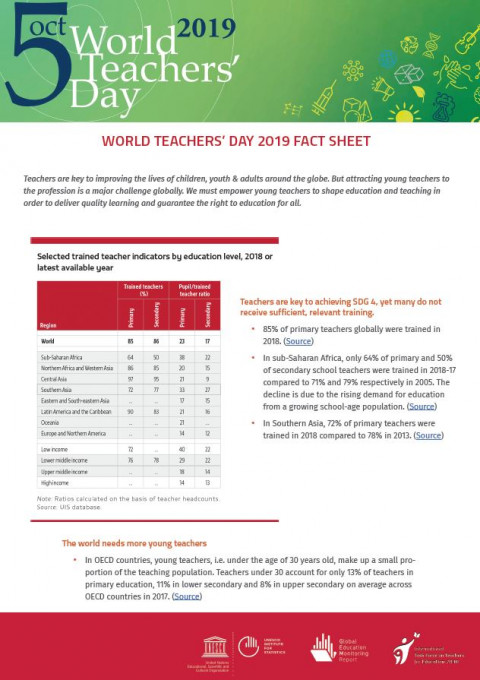 World Teachers' Day 2019: Fact sheet Año de publicación: 2019 Autor corporativo: UNESCO Institute for Statistics (UIS) | International Task Force on Teachers for Education 2030 To mark World Teachers’ Day, GEM(Global education monitoring) report partnered with the UNESCO Institute for Statistics (UIS) and the International Task Force on Teachers for Education 2030 to pull together key facts and statistics on challenges for teachers around the world.The new factsheet provides the latest UIS data on trained teachers, the global indicator for SDG target 4.c. Globally, 85% of primary teachers were trained in 2018 but only 64% in sub-Saharan Africa. The proportion of teachers that are trained in sub-Saharan Africa is falling, mostly due to the rising demand for education from a growing school-age population.
  Do All Students Have Equal Opportunities to Learn Global and Intercultural Skills at School? (PISA in Focus; No.109) Año de publicación: 2020 Autor: Tarek Mostafa Autor corporativo: Organisation for Economic Co-operation and Development (OECD) Many education systems seek to create an open, diverse and tolerant society, as education can play a significant role in countering racial, ethnic and national prejudice among children and adolescents. Education for living in an interconnected and diverse world could also contribute to forming generations of citizens who care about global and intercultural issues and who are able and willing to take action for sustainable development and collective well-being.In its 2018 assessment, PISA assessed the competences needed to live in an interconnected and diverse world. Global competence is defined in PISA 2018 as a multi-dimensional capacity that encompasses the ability to: 1) examine issues of local, global and cultural significance; 2) understand and appreciate the perspectives and worldviews of others; 3) engage in open, appropriate and effective interactions across cultures; and 4) take action for collective well-being and sustainable development. This PISA in Focus examines the equity of the learning opportunities for global and intercultural skills.