
Recursos
Exploren una amplia gama de recursos valiosos en GCED para profundizar su comprensión y promover su búsqueda, incidencia, enseñanza y aprendizaje.
1,405 resultados encontrados
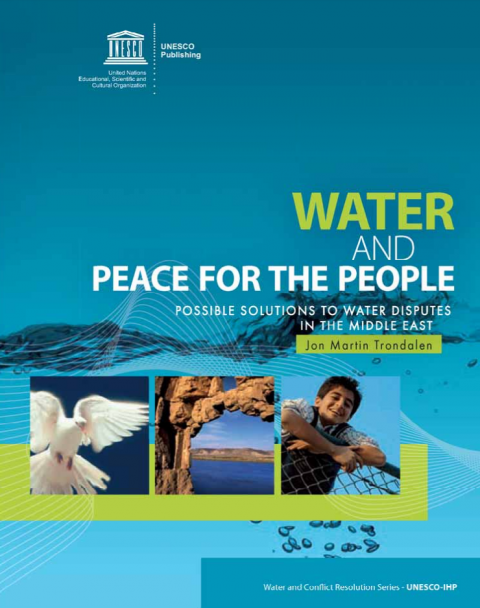 المياه والسلام من أجل الناس: حلول ممكنة للنزاعات المائية في الشرق الأوسط Año de publicación: 2008 Autor corporativo: UNESCO This book proposes practical and objective solutions to the entrenched water conflicts in the Middle East. The author reveals and clarifies the complexity of the water conflicts, drawing on years of experience facilitating and chairing water negotiations in the region. The bottom line is: Unless the countries involved co-operate, the consequences will be devastating. The lack of plentiful and clean water for the people will not only result in severe human suffering, but could also have grave geopolitical consequences. Water and peace for the people: possible solutions to water disputes in the Middle East Año de publicación: 2008 Autor corporativo: UNESCO This book proposes practical and objective solutions to the entrenched water conflicts in the Middle East. The author reveals and clarifies the complexity of the water conflicts, drawing on years of experience facilitating and chairing water negotiations in the region. The bottom line is: Unless the countries involved co-operate, the consequences will be devastating. The lack of plentiful and clean water for the people will not only result in severe human suffering, but could also have grave geopolitical consequences.
  Study on challenges in the development of local equality indicators: a human-rights-centred model; Commitment 2 of the Ten-Point Plan of Action Año de publicación: 2010 Autor: Klaus Starl | Jennifer Pinno Autor corporativo: UNESCO | European Training and Research Centre for Human Rights and Democracy (Austria) The study aims at: Providing a theoretical fundament of ECCAR Indicators to measure racism or (in)equality1 and to evaluate municipal anti-discrimination policies (framework concept), and Discussing related legal and practical issues such as legality and reliability of available ‘ethnic’ data (legal and practical preconditions) in the context of ECCAR’s endeavours to set up an ECCAR-wide applicable system of monitoring racism, discrimination, equality and respective municipal policies. The study is structured in three parts. In the first part, preliminary questions concerning legality and practical feasibility of ‘ethnic’ data collection as a prerequisite for the development of and work with adequate indicators will be discussed. The second part deals with the conceptualization of human rights law as the constructing principle of ECCAR Indicators. It includes the discussion of the proposed model of the ECCAR-ADIX. The third part of the study describes practical examples of indicator use in selected ECCAR member cities. The section shows various approaches and gives evidence on different attempts by municipalities to set up fact-based anti-racism policies but also highlights the variety of methods, data, measurement topics, goals, etc.
  Shaping the future we want: UN decade of education for sustainable development; final report Año de publicación: 2014 Autor: Carolee Buckler | Heather Creech Autor corporativo: UNESCO The United Nations Decade of Education for Sustainable Development (2005 –2014) (DESD) aimed at integrating the principles and practices of sustainable development into all aspects of education and learning, to encourage changes in knowledge, values and attitudes with the vision of enabling a more sustainable and just society for all. The mandate of the DESD has energized a vast number of stakeholders – across Member States, UN agencies, the education sector, the private sector and civil society – to work in partnership to reorient education systems towards sustainable development. This final DESD Global Monitoring and Evaluation Report (GME) provides an assessment of progress towards embedding Education for Sustainable Development (ESD) into education systems and into sustainable development efforts. Building on the findings of the past two DESD GME reports, and based upon Member States’ and other stakeholders’ assessments of the current state of ESD, this report maps the achievements and challenges of a decade of progress and action on ESD at the global, regional, national and local levels – and within all areas and levels of education. Shaping the future we want: UN decade of education for sustainable development; final report Año de publicación: 2014 Autor: Carolee Buckler | Heather Creech Autor corporativo: Organisation des Nations Unies pour l'éducation, la science et la culture (UNESCO) La Décennie de l’ONU pour l'Éducation pour le Développement Durable (2005 -2014) (DEDD) visant à intégrer les principes et pratiques du développement durable dans tous les aspects de l'éducation et de l'apprentissage, afin d'encourager les changements dans les connaissances, les valeurs et les attitudes avec la vision de permettre à un plus durable et plus juste pour tous. Le mandat de la DEDD a stimulé un grand nombre de parties prenantes - dans tous les États Membres, les organismes de l’ONU, le secteur de l'éducation, le secteur privé et la société civile – pour travailler en partenariat afin de réorienter les systèmes d'éducation vers un développement durable. Cette dernière DEDD Suivi Mondiale et le Rapport d'Évaluation (SME) fournit une évaluation des progrès accomplis vers l'intégration Éducation pour le Développement Durable (EDD) dans les systèmes d'éducation et dans les efforts de développement durable. Se fondant sur les conclusions des deux dernières DEDD SME rapports, et basées sur des États membres et d'autres parties prenantes et les évaluations de l'état actuel de l'EDD, ce rapport maps les réalisations et les défis d'une décennie de progrès et d'action sur l'EDD à l'échelle mondiale, niveaux régional, national et local - et dans tous les domaines et niveaux d'éducation. Façonner l'avenir que nous voulons: décennie des Nations Unies pour l'éducation au service du développement durable (2005-2014), rapport final, résumé Año de publicación: 2014 Autor: Carolee Buckler | Heather Creech Autor corporativo: Organisation des Nations Unies pour l'éducation, la science et la culture (UNESCO) This summary for policy- and decision-makers provides a brief overview of the key findings and trends, a synopsis of highlights, challenges and actions across all levels and areas of education, and steps for scaling up actions presented in the UNESCO 2014 Global Monitoring and Evaluation Final Report, Shaping the Future We Want – UN Decade of Education for Sustainable Development (2005-2014). The Final Report provides an assessment of progress towards embedding education for sustainable development (ESD) into education systems and into sustainable development efforts. Building on the findings of the past two DESD Global Monitoring and Evaluation reports, and based upon Member States’ and other stakeholders’ assessments of the current state of ESD, the Final Report maps the achievements and challenges of a decade of progress and action on ESD at the global, national, regional and local levels, and within all areas and levels of education. The Final Report concludes that a solid foundation has been laid for ESD at the end of the DESD, achieved by raising awareness, influencing policies and generating significant numbers of good practice projects in all areas of education and learning. At the end of 10 years of work, 10 key findings and trends have emerged that will guide ESD into the future. The report also shows that despite the successes, a full integration of ESD into education systems has yet to take place in most countries.
 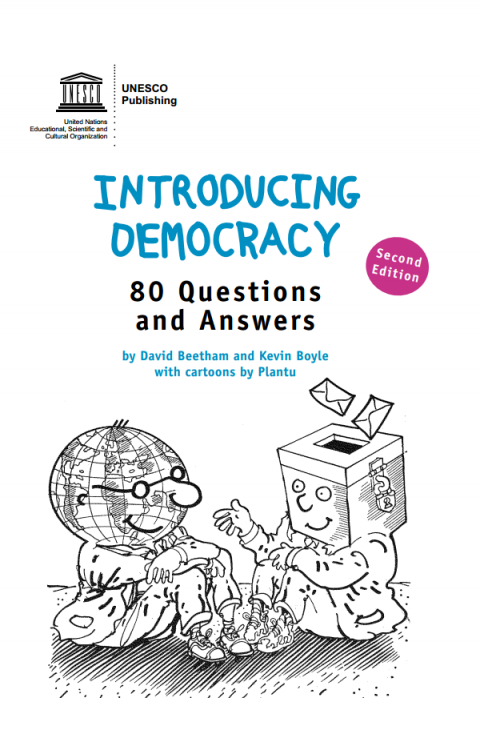 Introducing democracy: 80 questions and answers Año de publicación: 2009 Autor: David Beetham | Kevin Boyle Autor corporativo: UNESCO Humorously illustrated by Plantu, the famous cartoonist of the French newspaper Le Monde, this book is a valuable tool for all those who want to know more about democracy and human rights, whether it be students, activists, civil servants, or simply as interested citizens. What is democracy? What is the relation between democracy and individual rights? Is majority rule always democratic? How can democracy be maintained and improved? This book tackles these and other questions about democracy, covering six broad areas: basic concepts and principles; free and fair elections; open and accountable government; individual rights and their defence; democratic or civil society; the future of democracy. Démocratie: questions et réponses Año de publicación: 2009 Autor: David Beetham | Kevin Boyle Autor corporativo: UNESCO Humorously illustrated by Plantu, the famous cartoonist of the French newspaper Le Monde, this book is a valuable tool for all those who want to know more about democracy and human rights, whether it be students, activists, civil servants, or simply as interested citizens. What is democracy? What is the relation between democracy and individual rights? Is majority rule always democratic? How can democracy be maintained and improved? This book tackles these and other questions about democracy, covering six broad areas: basic concepts and principles; free and fair elections; open and accountable government; individual rights and their defence; democratic or civil society; the future of democracy. الديمقراطية: أسئلة وأجوبة Año de publicación: 2009 Autor: David Beetham | Kevin Boyle Autor corporativo: UNESCO Humorously illustrated by Plantu, the famous cartoonist of the French newspaper Le Monde, this book is a valuable tool for all those who want to know more about democracy and human rights, whether it be students, activists, civil servants, or simply as interested citizens. What is democracy? What is the relation between democracy and individual rights? Is majority rule always democratic? How can democracy be maintained and improved? This book tackles these and other questions about democracy, covering six broad areas: basic concepts and principles; free and fair elections; open and accountable government; individual rights and their defence; democratic or civil society; the future of democracy.
 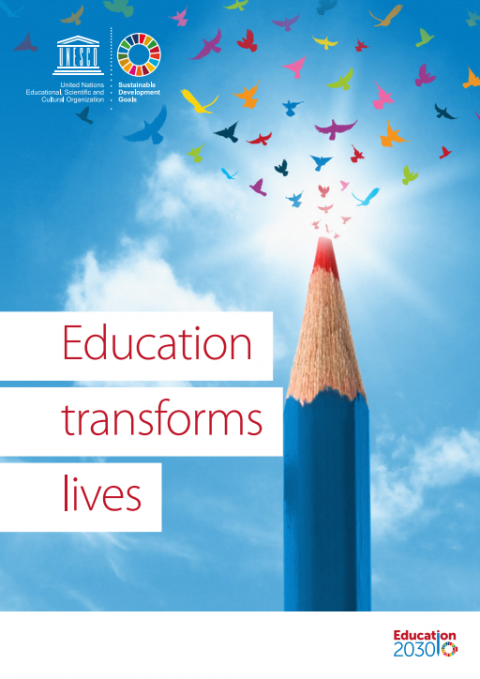 Education Transforms Lives Año de publicación: 2017 Autor corporativo: UNESCO This brochure explores UNESCO’s role in leading and coordinating the Education 2030 Agenda, which is part of a global movement to eradicate poverty through 17 Sustainable Development Goals by 2030. Education, essential to achieve all of these goals, has its own dedicated Goal 4, which aims to “ensure inclusive and equitable quality education and promote lifelong learning opportunities for all”. UNESCO is the United Nations’ specialized agency for education and the Education Sector provides global and regional leadership in education and responds to contemporary global challenges through education with a special focus on gender equality and Africa.