
Recursos
Exploren una amplia gama de recursos valiosos en GCED para profundizar su comprensión y promover su búsqueda, incidencia, enseñanza y aprendizaje.
883 resultados encontrados
 Evaluation Study: Lessons learned from Danish and other international efforts on Countering Violent Extremism (CVE) in development contexts Año de publicación: 2015 Autor corporativo: Danish International Development Assistance (DANIDA) This evaluation study collates lessons being learned from Danish efforts and those of other development actors on Countering Violent Extremism (CVE) that can inform evidence based policy making and increase shared understanding on CVErelated programming in development contexts.
  Global Education Magazine No. 13: International #Volunteer Day Año de publicación: 2015 Autor: Global Education Magazine This year’s International Volunteer Day (IVD) theme, "The world is changing. Are you? Volunteer!" is challenging each and every one of us to be part of implementing the newly launched Global Goals. The 2030 Agenda for Sustainable Development is a plan of action for ending poverty in all its dimensions, irreversibly, everywhere. Volunteerism, and each one of your volunteer actions, are critical to ensure we “leave no one behind” in this effort.The contribution of volunteers in the new development agenda is two-fold. Volunteerism is a way for us all to be directly involved in achieving sustainable development and peace. At the same time, this essential way of fostering people’s participation makes it a key element for success when striving for sustainability of development. Volunteer organizations can be brokers of civic engagement, connecting institutional initiatives with volunteer action at local, national and global levels.
  Dakar Office: Annual Report 2017 Año de publicación: 2018 Autor corporativo: UNESCO Dakar Across the globe, the 2030 Agenda remains the unifying tool of the international community in the construction of a prosperous, peaceful, and sustainable world for all. The 17 Sustainable Development Goals are the expression of a shared global and transformative vision to change the world and improve the well-being of all peoples. UNESCO plays a transformative role in the implementation of this agenda, thanks to its education, culture, sciences and communication and information programmes.This annual report underlines the drive and spirit of our team in promoting innovation to uphold the 2030 and 2063 Agendas. It is a resounding testament to the unwavering forts of our team in 2017, and the depth of their commitment to advance the ideals and objectives of UNESCO.The 2017 Annual Report of the UNESCO Regional Office covers seven countries in the region: Burkina Faso, Cabo Verde, Guinea-Bissau, Niger, Senegal, The Gambia as well as Mali, supported by the national office in Bamako.
  The Education We Want: An Advocacy Toolkit Año de publicación: 2014 Autor: James Edleston | Dan Smith | Sumaya Saluja | David Crone | Chernor Bah | Emily Laurie Autor corporativo: A World at School | UN Global Education First Initiative - Youth Advocacy Group (YAG) | Plan International Developed by Plan International, A World at School and the Youth Advocacy Group of the Global Education First Initiative, this toolkit was made for and by young people to advocate for quality education.Packed full of ideas, tools and inspiring stories, it helps children and youth to effectively carry out their own advocacy campaign.Although this advocacy toolkit focuses on education, its tips and ideas are applicable to young people advocating for a variety of development and rights issues.
 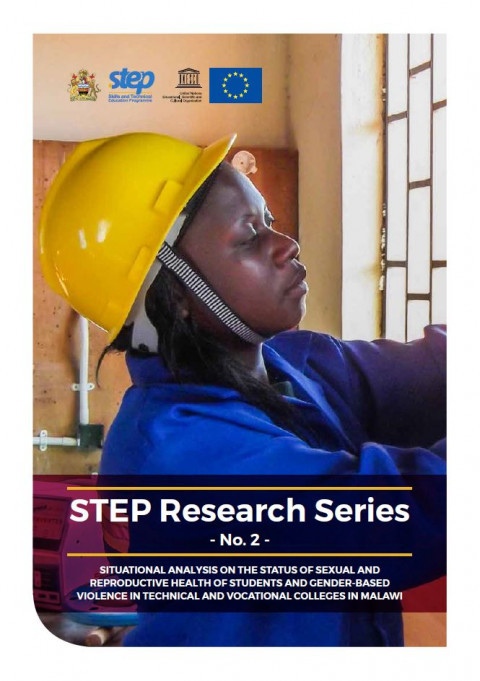 Situational Analysis on the Status of Sexual and Reproductive Health of Students and Gender-based Violence in Technical and Vocational Colleges in Malawi (STEP Research Series No. 2) Año de publicación: 2017 Autor corporativo: Skills and Technical Education Programme (STEP) Funded by the EU and implemented by UNESCO in collaboration with the Government of Malawi, the Skills and Technical Education Programme (STEP) is dedicated to reinforcing Technical, Entrepreneurial and Vocational Education and Training (TEVET) in Malawi.The programme will run from 2016-2020 and aims to improve TEVET at post-secondary level with a focus on equal access to enrolment, with particular emphasis on female learners; improving quality in the sector; and the establishment of clear governance structures. The STEP Research Series presents the highlights of the research undertaken by the programme.The situational analysis on the status of sexual and reproductive health of students and gender-based violence in technical and vocational colleges in Malawi is the second report in the STEP Research Series.
  The Critical Thinking Workbook: Games and Activities for Developing Critical Thinking Skills Autor corporativo: Global Digital Citizen Foundation Critical thinking is clear, rational, logical, and independent thinking. It’s about improving thinking by analyzing, assessing, and reconstructing how we think. It also means thinking in a self-regulated and self-corrective manner. It’s thinking on purpose!The Critical Thinking Workbook helps you and your students develop mindful communication and problem-solving skills with exciting games and activities. It has activities that are adaptable to any grade level you want.The activity pages in the Critical Thinking Workbook are meant to be shared and explored. Use it as an electronic document or as worksheets.You can either print off the pages and use them as activity sheets, or you can edit them directly right in the document on your computer.There are also Answer Keys for the activities that need them provided at the back of the book.
  Beyond Access: Toolkit for Integrating Gender-based Violent Prevention and Response into Education Projects Año de publicación: 2015 Autor corporativo: United States Agency for International Development (USAID) This toolkit was developed to support implementation of the U.S. Strategy to Prevent and Respond to Gender-based Violence Globally. It provides guidance and resources for USAID technical and program officers working on education to increase understanding of GBV in the education context and strengthen integration of a gender-based violence (GBV) response into projects and activities. Because reducing school-related GBV is a high priority for USAID in all school systems globally, this toolkit includes school-related GBV, but the overall focus is GBV in the education context broadly.The Toolkit provides:The United States government definition of GBV and USAID’s definition of school-related GBVExplanation for why integrating GBV prevention and response improves education outcomes, and the evidence on the prevalence of GBV in the education sectorGuiding principles to ensure the well-being of those at risk for, and survivors of, GBVIllustrative GBV prevention and response activities by the USAID Education Strategy GoalsGuidance on how to integrate GBV prevention and response throughout theUSAID Program Cycle to be able to monitor, evaluate, learn, and adapt education projects and activities accordingly, and it includes illustrative indicators for measuringGBV prevention and response for each of the USAID Education Strategy goals.
  Journée de la mémoire des génocides et de la prévention des crimes contre l'humanité Año de publicación: 2017 Autor corporativo: éduscol Le travail de mémoire passe prioritairement par l'éducation des enfants et des adolescents. Depuis 2003, la journée du 27 janvier est l'occasion pour la communauté éducative d'engager une réflexion sur les génocides et de rappeler les valeurs humanistes qui fondent notre démocratie. Une démarche à destination des jeunes générations qui, près de soixante-dix ans après la découverte des crimes commis par les nazis reste toujours aussi importante en termes d'éducation à la citoyenneté.
 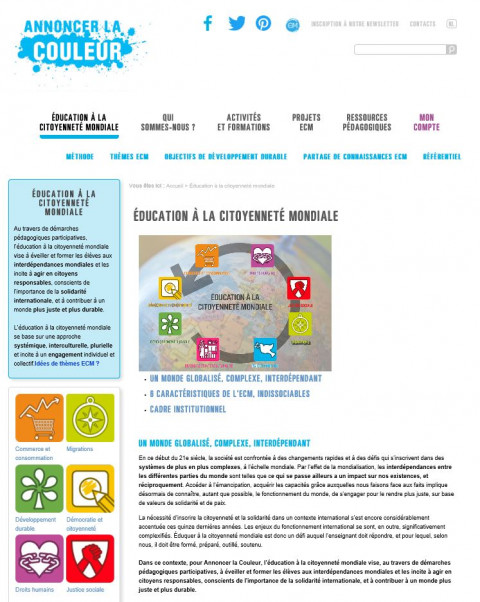 Éducation à la citoyenneté mondiale Autor corporativo: Annoncer la Couleur (ALC) En ce début du 21e siècle, la société est confrontée à des changements rapides et à des défis qui s'inscrivent dans des systèmes de plus en plus complexes, à l'échelle mondiale. Par l’effet de la mondialisation, les interdépendances entre les différentes parties du monde sont telles que ce qui se passe ailleurs a un impact sur nos existences, et réciproquement. Accéder à l’émancipation, acquérir les capacités grâce auxquelles nous faisons face aux faits implique désormais de connaître, autant que possible, le fonctionnement du monde, de s'engager pour le rendre plus juste, sur base de valeurs de solidarité et de paix.La nécessité d’inscrire la citoyenneté et la solidarité dans un contexte international s’est encore considérablement accentuée ces quinze dernières années. Les enjeux du fonctionnement international se sont, en outre, significativement complexifiés. Éduquer à la citoyenneté mondiale est donc un défi auquel l’enseignant doit répondre, et pour lequel, selon nous, il doit être formé, préparé, outillé, soutenu.Dans ce contexte, pour Annoncer la Couleur, l’éducation à la citoyenneté mondiale vise, au travers de démarches pédagogiques participatives, à éveiller et former les élèves aux interdépendances mondiales et les incite à agir en citoyens responsables, conscients de l'importance de la solidarité internationale, et à contribuer à un monde plus juste et plus durable.
  ABC de l’éducation à la citoyenneté et à la participation politique Año de publicación: 2018 Autor corporativo: Campus pour la démocratie Les thèmes éducation à la citoyenneté et participation politique sont discutés de manière controversée. Pour des raisons de lisibilité, nous ne présentons ici que quelques définitions et modèles abrégés et renonçons à la prétention d’exhaustivité.