
Recursos
Exploren una amplia gama de recursos valiosos en GCED para profundizar su comprensión y promover su búsqueda, incidencia, enseñanza y aprendizaje.
518 resultados encontrados
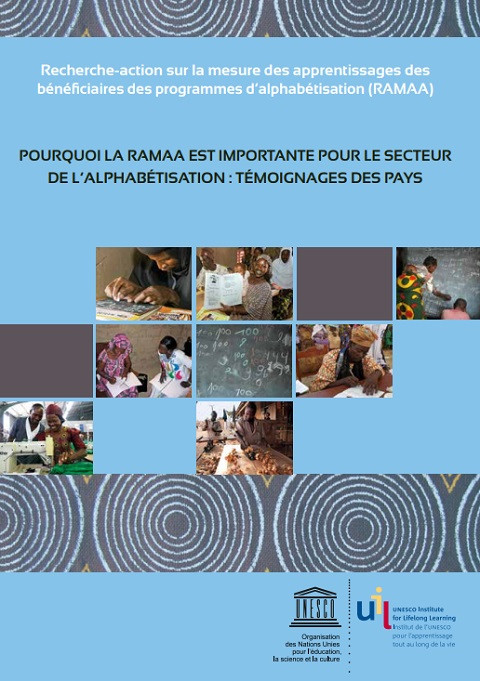 Pourquoi la RAMAA est importante pour le secteur de l'alphabétisation: Témoignages des pays; Recherche-action sur la mesure des apprentissages des bénéficiaires des programmes d'alphabétisation (RAMAA) Año de publicación: 2016 Autor corporativo: UNESCO Institute for Lifelong Learning (UIL) La Recherche-action RAMAA, lancée à l’initiative de l’Institut de l’UNESCO pour l’apprentissage tout au long de la vie (UIL), et pilotée en partenariat avec les bureaux UNESCO répond à ce besoin vital d’évaluer la qualité des programmes d’alphabétisation en prenant comme variable objective les apprentissages réellement acquis par les bénéficiaires à la sortie de leur formation.La première phase de la RAMAA comptait cinq pays, douze pays sont désormais engagés dans la deuxième phase de la RAMAA - Bénin, Burkina Faso, Cameroun, Côte d’Ivoire, République centrafricaine, République démocratique du Congo, Maroc, Mali, Niger, Sénégal, Tchad et Togo. L’engagement des pays tout au long de la mise en œuvre de la deuxième phase de la RAMAA et l’intégration des résultats dans les dispositifs nationaux deviennent impératifs.
  CONFINTEA VI Mid-Term Review 2017: The Status of Adult Learning and Education in Sub-Saharan Africa; Regional Report Año de publicación: 2017 Autor: John Aitchison Autor corporativo: UNESCO Institute for Lifelong Learning (UIL) The Sustainable Development Goals include educational targets which are entirely congruent with the existing focuses of ALE in African countries – to ‘ensure that all youth and a substantial proportion of adults, both men and women, achieve literacy and numeracy’ (4.6), to ‘substantially increase the number of youth and adults who have relevant skills, including technical and vocational skills, for employment, decent jobs and entrepreneurship’ (4.4) and to ‘ensure that all learners acquire the knowledge and skills needed to promote sustainable development, including, among others, through education for sustainable development and sustainable lifestyles, human rights, gender equality, promotion of a culture of peace and non-violence, global citizenship and appreciation of cultural diversity and of culture’s contribution to sustainable development’ (4.7). National targets and the criteria for success in reaching those targets will need to be developed. Undoubtedly, international cooperation and international support can help this gearing-up process.
  Optimising learning, education and publishing in Africa: the language factor; a review and analysis of theory and practice in mother-tongue and bilingual education in sub-Saharan Africa Año de publicación: 2011 Autor: Adama Ouane | Christine Glanz Autor corporativo: UNESCO Institute for Lifelong Learning (UIL) | Association for the Development of Education in Africa (ADEA) This analytical review consists of three sections. The first section lays the theoretical foundations and is covered by Ekkehard Wolff and Kathleen Heugh: 1) language politics and planning in the light of development and 2) theories of bi- and multilingual education models and their implementation in the African context. A second section analyses teaching practices and classroom interaction in schools in two chapters by Birgit Brock-Utne and Hassana Alidou. This is followed by a review of the use of African languages in literacy and non-formal education by Hassana Alidou1 . Next, a review study by Kathleen Heugh addresses the critical issue of costs by assessing the costs related to implementing mother tongue and strong bilingual education programmes. Finally, the third section explores the role of locally-based multilingual publishing in supporting and promoting African languages and developing the language industries and the creative sector. Here, Yaya Satina Diallo from Guinea and Peter Reiner2 from Namibia shed light on the promise and pitfalls of publishing in African languages.Each of these sections focuses on theoretical frameworks and specific strategies designed to optimise learning and education in multilingual Africa. The language issue is dealt with at the levels of: policy and development; costing and financing; educational reform and governance; education models; classroom interaction; formal and non-formal education settings; literacy and publishing. Optimiser l'apprentissage, l'éducation et l'édition en Afrique: le facteur langue; étude bilan sur la théorie et la pratique de l'enseignement en langue maternelle et l'éducation bilingue en Afrique subsaharienne Año de publicación: 2011 Autor: Adama Ouane | Christine Glanz Autor corporativo: UNESCO Institute for Lifelong Learning (UIL) | Association for the Development of Education in Africa (ADEA) This analytical review consists of three sections. The first section lays the theoretical foundations and is covered by Ekkehard Wolff and Kathleen Heugh: 1) language politics and planning in the light of development and 2) theories of bi- and multilingual education models and their implementation in the African context. A second section analyses teaching practices and classroom interaction in schools in two chapters by Birgit Brock-Utne and Hassana Alidou. This is followed by a review of the use of African languages in literacy and non-formal education by Hassana Alidou1 . Next, a review study by Kathleen Heugh addresses the critical issue of costs by assessing the costs related to implementing mother tongue and strong bilingual education programmes. Finally, the third section explores the role of locally-based multilingual publishing in supporting and promoting African languages and developing the language industries and the creative sector. Here, Yaya Satina Diallo from Guinea and Peter Reiner2 from Namibia shed light on the promise and pitfalls of publishing in African languages.Each of these sections focuses on theoretical frameworks and specific strategies designed to optimise learning and education in multilingual Africa. The language issue is dealt with at the levels of: policy and development; costing and financing; educational reform and governance; education models; classroom interaction; formal and non-formal education settings; literacy and publishing.
  Discourses on Global Citizenship Education in Africa: Questioning and Answering from a Post-Colonial Perspective (Journal of Education for International Understanding; vol.16, no.3) Año de publicación: 2021 Autor: Yoonjung Choi | Yeji Kim Autor corporativo: Korean Society of Education for International Understanding (KOSEIU) Theoretically framed by post-colonialism and critical global citizenship education(GCED), this study explored major discourses on and practices of GCED in African countries through the use of a systematic review method. The findings demonstrated that studies related to GCED in African countries pointed out the limitations of state-centered civic education based on uncritical patriotism and passive citizenship, and further emphasize the importance of promoting more critical and reflective GCED. In addition, research emphasized the implementation of alternative and unique GCED education unique built on indigenous African knowledge and philosophy. This study provides significant insights into GCED in the context of South Korea and discusses the pursuit of globally oriented, sustainable GCED aiming for peace and solidarity around the world. 아프리카 세계시민교육의 동향과 비전: 탈식민주의 시각에서 묻고 답하다 (국제이해교육연구; vol.16, no.3) Año de publicación: 2021 Autor: 최윤정 | 김예지 Autor corporativo: 한국국제이해교육학회 본 연구는 탈식민주의 인식론과 비판적 세계시민교육 이론을 기반으로 아프리카 세계시민교육에 대한 연구 동향과 사례, 주요 담론을 체계적 문헌고찰 방법을 통해 탐색하였다. 연구 결과, 아프리카 지역의 세계시민교육 연구들은 무비판적 애국심과 수동적 시민성을 강조하는 국가중심 시민교육의 한계를 지적하고, 탈식민주의적 세계시민교육의 필요성을 강조하는 것으로 나타났다. 또한 아프리카에서의 세계시민교육 실천에 대해 서구의 이론과 방법을 답습하는 것이 아니라 탈식민주의와 토착 지식에 기반을 둔, 지역적으로 맥락화된 세계시민교육을 구축해야 한다는 점을 역설하였다. 이러한 연구 결과를 바탕으로 본 연구는 아프리카 지역의 세계시민교육 담론과 실천이 한국의 맥락에 주는 시사점과 의의를 찾고 나아가 평화와 공존, 연대, 지속가능성을 위한 보다 ‘세계’적인 세계시민교육의 의미를 논의한다.
 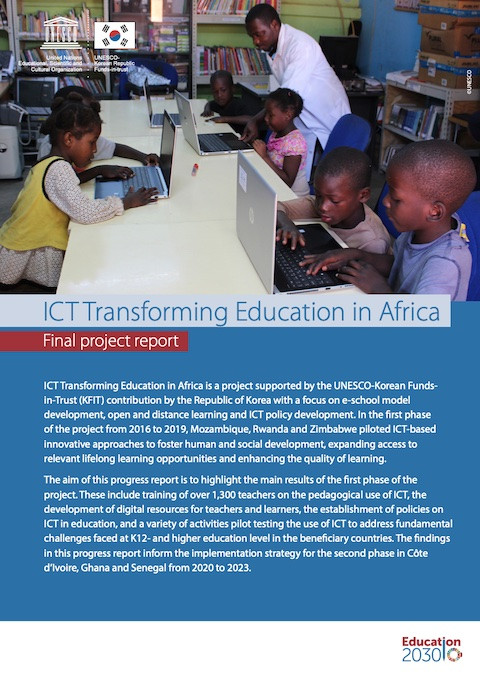 ICT Transforming Education in Africa: Final Project Report Año de publicación: 2020 Autor corporativo: UNESCO ICT Transforming Education in Africa is a project supported by the UNESCO-Korean Funds- in-Trust (KFIT) contribution by the Republic of Korea with a focus on e-school model development, open and distance learning and ICT policy development. In the first phase of the project from 2016 to 2019, Mozambique, Rwanda and Zimbabwe piloted ICT-based innovative approaches to foster human and social development, expanding access to relevant lifelong learning opportunities and enhancing the quality of learning.The aim of this progress report is to highlight the main results of the first phase of the project. These include training of over 1,300 teachers on the pedagogical use of ICT, the development of digital resources for teachers and learners, the establishment of policies on ICT in education, and a variety of activities pilot testing the use of ICT to address fundamental challenges faced at K12- and higher education level in the beneficiary countries. The findings in this progress report inform the implementation strategy for the second phase in Côte d’Ivoire, Ghana and Senegal from 2020 to 2023.
  Roadmap for Integrating Global Citizenship and Liberation History in Teaching and Learning in SADC Member States Año de publicación: 2021 Autor corporativo: UNESCO The Roadmap for integrating GCED and SALH in teaching and learning in SADC member states is grounded in two visions: Identify common values and learning outcomes that can be advanced by GCED and SALH, with a view of promoting the sense of belonging, solidarity, and regional identity and integration. Guide education planners and practitioners to mobilize the GCED and SALH contents to contribute to the SADC vision of reconciliation, social cohesion, resilience, peace, solidarity, development, and freedom for future generations through promoting an education that equips young people with skills, values, knowledge, behaviours, and attitudes that critically and creatively address today’s local, national, regional, and global challenges through an inclusive lens. The objectives of this Roadmap are to: Provide general guidance and steps for the integration of SALH and GCED in curricula and teaching and learning practices in SADC member states; Provide articulations between the regional and local philosophical concepts and the GCED core values, such as ubuntu, to support a contextualized teaching of GCED values; Support countries to identify priority topics and steps towards integrating GCED and SALH in education policies in a manner that highlights the regional dimensions of liberation history, as well as universal values; Propose learning outcomes and competencies as well as teaching and learning approaches for GCED and SALH; Provide guidance on integration of GCED and SALH in teacher education programmes, as well as possible assessment methods.
  Climate Change Mitigation and Adaptation: Simple Guide to Schools in Africa Año de publicación: 2019 Autor corporativo: UNESCO This booklet aims to support educators in Africa to impart knowledge on climate change to students in secondary level education.
  Artificial Intelligence Needs Assessment Survey in Africa Año de publicación: 2021 Autor: Prateek Sibal | Bhanu Neupane Autor corporativo: UNESCO There are encouraging signs of AI innovation and development across Africa, from community run AI classes over weekends, AI training bootcamps for students and young researchers to the establishment of private sector and government driven innovation hubs across the continent. Even as there is an enormous potential for AI development, there are also legacy challenges in terms of infrastructure availability as well as human and institutional capacity gaps to develop and govern AI to optimise benefits and minimise harms. Building upon the recommendations of UNESCO report Steering AI and Advanced ICTs for Knowledge Societies, the findings of this survey aim to bridge the information gap concerning the strategic priorities, policy measures, developmental challenges, human and institutional capacity needs, and legal frameworks concerning AI in African countries.