
Recursos
Exploren una amplia gama de recursos valiosos en GCED para profundizar su comprensión y promover su búsqueda, incidencia, enseñanza y aprendizaje.
2,781 resultados encontrados
 种族·文化·制度: 新加坡双语政策中的国家认同构建 (社会科学前沿; vol. 10, no. 4) Año de publicación: 2021 Autor: Zhang Lifang 本文介绍了新加坡的双语教育政策,并探讨了相关政策与国家认同建构的关系。
  معايير جودة الدمج التعليمي Año de publicación: 2020 Autor: Abdalbasit Huaidi | Eman Durki Autor corporativo: Child Evaluation and Education Center الفيديو عبارة عن شرح لمعايير الدمج التعليمي في مركز تعليم وتقويم الطفل. ويشرح المحاضر وثيقة جودة معايير الدمج بجميع مجالاتها وأهدافها. الفيديو مناسب للمؤسسات التربوية المهتمة بالدمج التعليمي. Quality Standards for Educational Inclusion Año de publicación: 2020 Autor: Abdalbasit Huaidi | Eman Durki Autor corporativo: Child Evaluation and Education Center The video is an explanation of the educational inclusion standards in the Child Education and Assessment Center. The lecturer explains the quality document of the integration standards in all its fields and objectives. The video is suitable for educational institutions interested in educational integration.
  Mutation du cosmopolitisme à l’époque contemporaine : d’une définition de soi à la désignation d’un état du monde (Klesis Revue Philosophique; no. 38) Año de publicación: 2017 Autor: Louis Lourme Autor corporativo: Université Paul-Valéry Dans le langage ordinaire, on peut dire d’une rame de tramway ou d’une ville qu’elle est cosmopolite, cela ne fait évidemment pas référence à la même acception du terme « cosmopolitisme » que dans le fait de parler, par exemple, d’un projet d’institution cosmopolitique à l’échelle internationale. En effet, les usages du terme « cosmopolitisme » sont tellement variés, ils recouvrent tellement de sens différents, qu’on ne sait plus si des auteurs différents ont encore quelque chose en commun, à tel point qu’il faut peut-être même abandonner tout simplement l’idée que l’on puisse définir le cosmopolitisme de façon précise et univoque sous peine de réduire certaines philosophies ou certains usages à des caricatures pour les faire entrer dans des cadres définitionnels qui seraient de toute façon trop larges pour être pertinents – par exemple en se contentant de la tautologie « le cosmopolitisme désigne le fait de se sentir citoyen du monde » sans chercher à l’analyser. De fait, le concept de cosmopolitisme peut désigner plusieurs choses selon les auteurs et selon les contextes (une manière d’être, une réalité sociologique, un projet politique, une conception du monde, etc.), et cette multiplicité de significations doit être clarifiée. C’est l’un des objets de cet article. À partir de ce travail de clarification des différents types de cosmopolitismes, il doit être possible de réfléchir d’une part au besoin (et à la forme possible) d’une éducation au cosmopolitisme, et d’autre part à ses limites face à la réalité du monde contemporain qui a entrainé une mutation profonde du concept : la citoyenneté mondiale n’est plus essentiellement un objet éthique mais est devenue un objet politique.
  Transforming Our World: The 2030 Agenda for Sustainable Development Año de publicación: 2015 Autor corporativo: United Nations (UN) This Agenda is a plan of action for people, planet and prosperity. It also seeks to strengthen universal peace in larger freedom. We recognize that eradicating poverty in all its forms and dimensions, including extreme poverty, is the greatest global challenge and an indispensable requirement for sustainable development. All countries and all stakeholders, acting in collaborative partnership, will implement this plan. We are resolved to free the human race from the tyranny of poverty and want and to heal and secure our planet. We are determined to take the bold and transformative steps which are urgently needed to shift the world on to a sustainable and resilient path. As we embark on this collective journey, we pledge that no one will be left behind. The 17 Sustainable Development Goals and 169 targets which we are announcing today demonstrate the scale and ambition of this new universal Agenda. They seek to build on the Millennium Development Goals and complete what they did not achieve. They seek to realize the human rights of all and to achieve gender equality and the empowerment of all women and girls. They are integrated and indivisible and balance the three dimensions of sustainable development: the economic, social and environmental. The Goals and targets will stimulate action over the next 15 years in areas of critical importance for humanity and the planet. 变革我们的世界:2030年可持续发展议程 Año de publicación: 2015 Autor corporativo: United Nations (UN) 该文件是联合国为了实现人类的可持续发展所制定的行动议程,包含17个可持续发展目标及169个具体目标。
 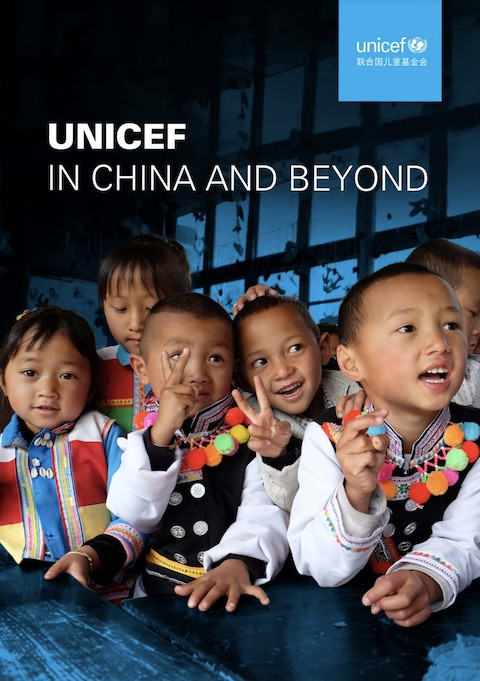 UNICEF in China and Beyond Año de publicación: 2019 Autor corporativo: United Nations Children's Fund (UNICEF) This report seeks to give an overview of UNICEF’s work in China and, through these experiences, provide a global perspective on the major development areas relevant to children today. This includes child-friendly spaces, poverty reduction and early childhood education. The publication presents a snapshot of the issues, challenges and accomplishments in health, education, child protection, and social policy and reform sectors in China. 中国经验 全球视角:联合国儿童基金会在华合作项目概览 Año de publicación: 2019 Autor corporativo: United Nations Children's Fund (UNICEF) 该报告概述了联合国儿童基金会在中国所开展的项目,并通过这些项目的经验,为关乎儿童利益的主要发展领域提供全球视角,包括儿童友好家园、减贫与儿童早期教育等。这份报告还简要介绍了合作项目在卫 生保健、教育、儿童保护、社会政策与改革等领域所关注的重点、取得的成果与面临的挑战。
 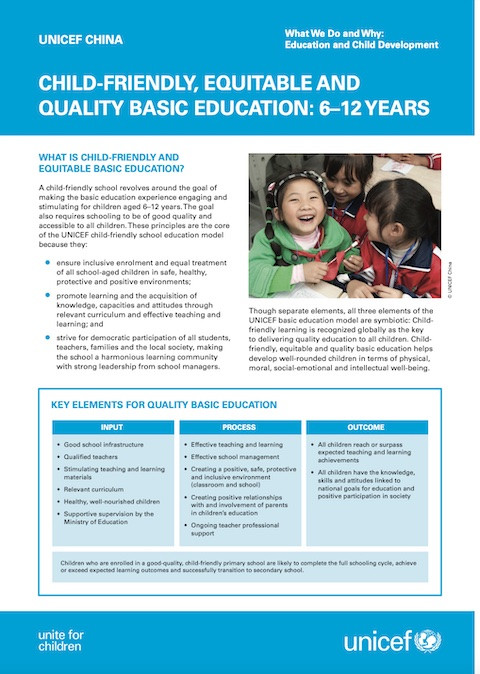 Child-Friendly, Equitable and Quality Basic Education: 6-12 Years Año de publicación: 2017 Autor corporativo: United Nations Children's Fund (UNICEF) This report introduces the ideas and specific practices of UNICEF-operated child-friendly and equitable education in China, including its inputs, processes, and results. It also describes the progress of related projects and specific programmes, such as school management standards. The report also includes future plans for related projects, particularly in the areas of global development and South-South cooperation. 爱生、公平和优质的基础教育:6 - 12岁 Año de publicación: 2017 Autor corporativo: United Nations Children's Fund (UNICEF) 该报告介绍了联合国儿童基金会在中国运营的爱生和公平教育的理念与具体做法,包括其投入、过程、成果等。也介绍了相关项目的进展与具体方案,如学校管理标准等。报告也包括了相关项目的未来计划,尤其是在全球发展和南南合作领域。