
Recursos
Exploren una amplia gama de recursos valiosos en GCED para profundizar su comprensión y promover su búsqueda, incidencia, enseñanza y aprendizaje.
1,447 resultados encontrados
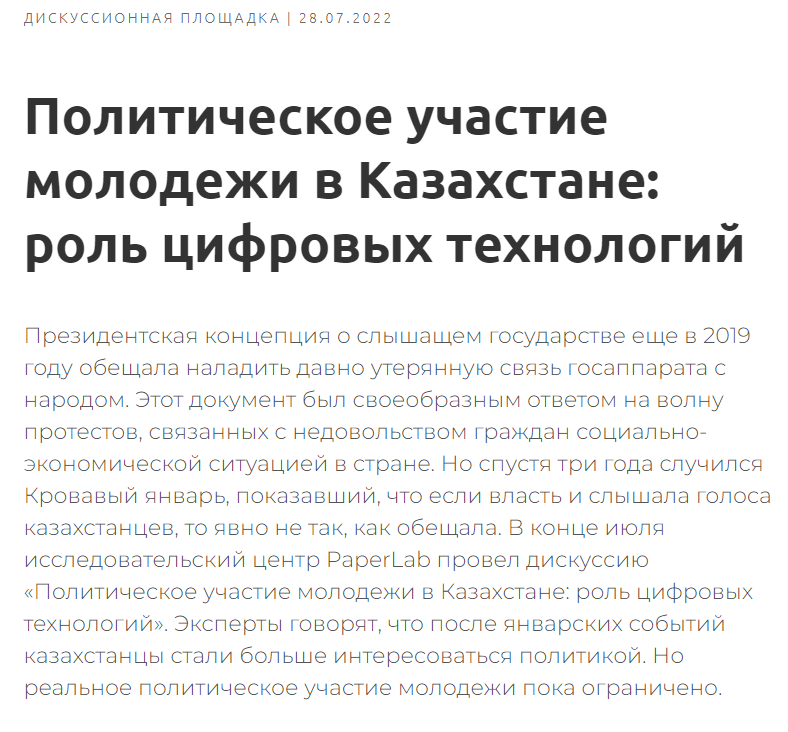 Political Participation of Young People in Kazakhstan: The Role of Digital Technologies Año de publicación: 2022 Autor corporativo: Paperlab Research Center (Kazakhstan) At the end of July, the PaperLab Research Center held a discussion on "Political participation of youth in Kazakhstan: the role of digital technologies". Experts say that after the January events, Kazakhstanis became more interested in politics. But the real political participation of young people is still limited. Политическое участие молодежи в Казахстане: Роль цифровых технологий Año de publicación: 2022 Autor corporativo: Исследовательский центр Paperlab (Казахстан) В конце июля исследовательский центр PaperLab провел дискуссию «Политическое участие молодежи в Казахстане: роль цифровых технологий». Эксперты говорят, что после январских событий казахстанцы стали больше интересоваться политикой. Но реальное политическое участие молодежи пока ограничено.
  Sustainable Development in the State of Qatar: Achievements and Challenges Año de publicación: 2008 Autor: Nuzad Alhiti | Mohammed Almahindi Autor corporativo: Standing Committee for Housing This book deals with the theoretical frameworks of sustainable development and its applications in the State of Qatar. It has been divided into four chapters. The first chapter deals with a statement of the concept of sustainable development, its dimensions and the development it has witnessed, as well as clarification of the indicators of sustainable social, economic, environmental and institutional development. The second chapter reviews the institutional and legislative developments for sustainable development in the State of Qatar, and the most important initiatives undertaken by the state to achieve sustainable development, in addition to a statement of the most important strategies and policies developed by the state in the social, economic, environmental and institutional fields of sustainable development. As for the third chapter, it deals with the analysis of the most important indicators of sustainable social, economic, environmental and institutional development, and its strengths and weaknesses, while the fourth and final chapter reviews the most important challenges facing sustainable development in the State of Qatar.
  Inclusive Education Año de publicación: 2008 Autor corporativo: UNESCO International Bureau of Education (IBE) Inclusive education: the road to the future is the subject of the forty-eighth meeting of the International Conference on Education (CIE) to be held in Geneva from November 25 to 28, 2008. I believe that a genuine dialogue and a frank debate between Ministers and other education actors on this central theme and on the four related sub-themes: approaches, scope and content; public politics; systems, interfaces and transitions, and students and teachers, will be both timely and appropriate.
  VII Days of Educational Corperation with Iberian America on Special Education and Educational Inclusion: Secondary Education Año de publicación: 2011 Autor: Daniela Eroles Autor corporativo: UNESCO Santiago | Spain. Ministry of Education The publication that we deliver contains some of the main papers and reflections emanating from the VII Conference on Educational Cooperation with Ibero-America on Special Education and Educational Inclusion, organized by the Ministry of Education of Spain and the Regional Office of Education for Latin America and the Caribbean ( OREALC / UNESCO Santiago). This publication has the inclusion in secondary education as a central theme, since it was the axis of the VII Conference. It is a particularly critical issue in our region since it establishes the minimum level necessary to escape poverty, to access decent employment and to exercise citizenship. However, access to secondary education is still very low in some countries and is especially low in the case of the most vulnerable populations, being those who most require access to this level of studies to overcome their situation of inequality. VII Jornadas de Cooperación Educativa con Iberoamérica sobre Educación Especial e Inclusión Educativa: Educación Secundaria Año de publicación: 2011 Autor: Daniela Eroles Autor corporativo: UNESCO Santiago | Spain. Ministry of Education La publicación que entregamos contiene algunas de las principales ponencias y reflexiones emanadas de las VII Jornadas de Cooperación Educativa con Iberoamérica sobre Educación Especial e Inclusión Educativa, organizadas por el Ministerio de Educación de España y la Oficina Regional de Educación para América Latina y el Caribe (OREAL C/UNESCO Santiago). Esta publicación tiene a la inclusión en la educación secundaria como tema central, pues constituyó el eje de las VII Jornadas. Es un tema especialmente crítico en nuestra región ya que establece el nivel mínimo necesario para salir de la pobreza, para acceder a un empleo digno y para ejercer la ciudadanía. Sin embargo, el acceso a la educación secundaria todavía es muy bajo en algunos países y es especialmente bajo en el caso de las poblaciones en situación de mayor vulnerabilidad, siendo quienes más requieren acceder a este nivel de estudios para superar su situación de desigualdad.
  Education for Democratic Citizenship in Secondary Schools in Latin America Año de publicación: 2005 Autor: Fernando Reimers, Eleonora Villegas Reimers Autor corporativo: Banco InterAmericano de Desarrollo (BID) This document was commissioned by the Educational Network of the Regional Policy Dialogue for the VII Hemispheric Meeting held on February 17 and 18, 2005. This report is a contribution to the discussion of the Dialogue on Formation for Democracy and Secondary Education in Latin America. In this text, we present an analysis of the results of a survey on education for democracy carried out as part of the activities of the Education Network, which was sent by the Bank to the member countries of the Dialogue2. We frame these results in a conceptualization of what it means to educate for democracy. We complement the discussion with information from additional sources that illuminate different aspects of the conceptual framework proposed here. Educación para la Ciudadanía Democrática en Escuelas Secundarias en América Latina Año de publicación: 2005 Autor: Fernando Reimers, Eleonora Villegas Reimers Autor corporativo: Banco InterAmericano de Desarrollo (BID) Este documento fue comisionado por la Red de Educación del Diálogo Regional de Política para la VII Reunión Hemisférica celebrada los días 17 y 18 de febrero de 2005. Este informe es un aporte a la discusión del Diálogo sobre la formación para la democracia y la educación secundaria en América Latina. En este texto presentamos un análisis de los resultados de una encuesta sobre la educación para la democracia realizada como parte de las actividades de la Red de Educación, que fue enviada por el Banco a los países miembros del Diálogo2. Enmarcamos estos resultados en una conceptualización sobre qué significa educar para la democracia. Complementamos la discusión con información de fuentes adicionales que iluminan distintos aspectos del marco conceptual que aquí proponemos. Educación Inclusiva Año de publicación: 2008 Autor corporativo: UNESCO International Bureau of Education (IBE) La educación inclusiva: el camino hacia el futuro es el tema de la cuadragésimo octava reunión de la Conferencia Internacional de Educación (CIE) que tendrá lugar en Ginebra del 25 al 28 de noviembre de 2008. Creo que un genuino diálogo y un franco debate entre los ministros y otros actores de la educación sobre este tema central y sobre los cuatro subtemas relacionados: enfoques, alcance y contenido; políticas públicas; sistemas, interfaces y transiciones, y alumnos y docentes, resultarán a la vez oportunos y apropiados. Education pour l'inclusion Año de publicación: 2008 Autor corporativo: UNESCO International Bureau of Education (IBE) L’auteur présente ce numéro spécial qui offre une sélection d’articles alliant recherche théorique et pratique sur la notion de l’éducation pour l’inclusion et sur les problèmes rencontrés dans l’élaboration de politiques et leur application pratique. Ces articles reflètent les approches diversifiées et à volets multiples de l’inclusion, eu égard aux aspects théoriques, disciplinaires et méthodologiques. Tout au long de ce numéro, l’inclusion est le principe de base qui oriente l’Éducation pour tous (EPT) de qualité —- c’est-à-dire, l’établissement de systèmes éducatifs tirant profit de la diversité et visant à édifier une société plus juste et plus démocratique.Ce numéro spécial est consacré au thème de la quarante-huitième session de la Conférence internationale de l’éducation (CIE) « L’éducation pour l’inclusion : la voie de l’avenir » (Genève, 25-28 novembre 2008).