
Recursos
Exploren una amplia gama de recursos valiosos en GCED para profundizar su comprensión y promover su búsqueda, incidencia, enseñanza y aprendizaje.
1,448 resultados encontrados
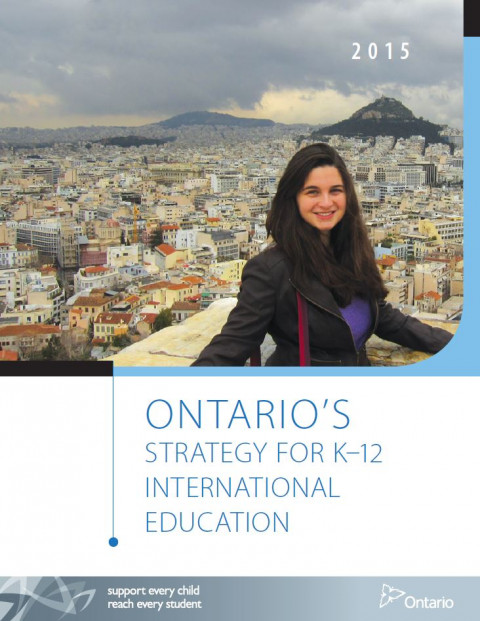 Ontario’s Strategy for K–12 International Education Año de publicación: 2015 Autor corporativo: Ontario (Canada). Ministry of Education Ontario’s strategy for international education will provide an integrated, coordinated approach that will link the continuum of learning from K–12 schooling to postsecondary education and training, to living and working in Ontario.The Ministry of Education will lead with phase one of the provincial strategy, focusing on K–12 learning opportunities. Ontario’s international education strategy will provide: enhanced course offerings and opportunities with an international context, to help Ontario K–12 students and educators build the global competencies, knowledge, and experiences needed to succeed in the worldwide economy;high-quality programs and services and a safe, welcoming environment for international students, to promote achievement and well-being and stimulate intercultural learning;opportunities to develop and share expertise among Ontario and international educators; andpathways for international students studying in Ontario, from elementary/secondary school to postsecondary education and beyond. Stratégie ontarienne en matière d’éducation internationale de la maternelle à la 12e année Año de publicación: 2015 Autor corporativo: Ontario (Canada). Ministry of Education Une stratégie ontarienne en matière d’éducation internationale procurera une approche intégrée et coordonnée qui s’appliquera à l’ensemble du continuum d’apprentissage, allant de la maternelle à la 12e année en passant par les études postsecondaires et la formation, et jusqu’à travailler et résider en Ontario.Le ministère de l’Éducation mènera la première phase de la stratégie provinciale, mettant l’accent sur les possibilités d’apprentissage. La Stratégie ontarienne en matière d’éducation internationale de la maternelle à la 12e année (la « Stratégie ») offrira : un éventail enrichi de cours et d’autres activités d’apprentissage à contexte international en vue d’aider les élèves et le personnel enseignant de la maternelle à la 12e année à développer les connaissances, les compétences et les expériences globales indispensables à la réussite dans le cadre d’une économie mondialisée;des programmes et services de qualité supérieure, et un environnement accueillant et sécuritaire pour les élèves étrangers, destinés à promouvoir le rendement scolaire et le bien-être, de même qu’à stimuler l’apprentissage interculturel;des possibilités accrues d’enrichissement et de partage des connaissances pour les membres du personnel enseignant de l’Ontario et d’ailleurs;un choix de parcours continus pour les élèves étrangers séjournant en Ontario, depuis l’école élémentaire ou secondaire aux études postsecondaires, et jusqu’aux possibilités de vivre et de travailler en Ontario.
  Global Education for Ontario Learners: Practical Strategies - A Summary of Research Año de publicación: 2018 Autor: Caroline Manion | Nadya Weber Autor corporativo: Ontario (Canada). Ministry of Education This summary report flows from the policy outlined in Ontario’s Strategy for K–12 International Education (OME, 2015). The report highlights current knowledge about good and/or promising practices in global education1 in order to suggest practical strategies for improved teaching, learning, and achievement. The intended audience for this piece includes all education stakeholders – community members, parents, learners, system leaders, school leaders, and educators – as active agents of change in support of an education strategy designed to integrate global perspectives, cultures, and experiences in the curriculum and learning environment. The purpose is to enable students to develop the competencies they will need to thrive as citizens in an increasingly globalized world.The discussion is organized by theme. To underline why global education is critically important for Ontario learners, we begin by outlining the significant contributions global education can make to the well-being of individuals and society as a whole. We then provide an overview synthesizing different conceptualizations of “global education” and “global citizenship education”, as well as a broad range of their overlapping sub-concepts. Next, through a review of the international literature on the subject, we present a series of challenges and opportunities for implementing global education, and list pertinent examples of good practices associated with delivering global education. A further section focuses on good practice in building system capacity and leadership for effective global education. We conclude by identifying key messages and lessons learned.
  Snapshot Report: SDGs in the UNECE Region Año de publicación: 2019 Autor corporativo: United Nations Economic Commission for Europe (UNECE) This document provides a brief snapshot of some aspects of SDG performance in the UNECE region. It covers the SDGs that will be discussed at the 2019 Regional Forum on Sustainable Development for the UNECE region but it does not attempt to provide an exhaustive assessment. It only uses the available information in the UN SDG Global Database and the sources referenced there to illustrate a selected number of SDG issues. In a very few cases, when no data is available from this database and associated sources, information from other international organizations is used to provide some context to the discussions.
  Global Education Digest 2015-2017: Compiled by the Development Education Research Centre Año de publicación: 2018 Autor corporativo: Development Education Research Centre (DERC) This is the first edition the Global Education Digest, a bibliography of recent published academic and research material relevant to the field of global education. This Digest has been compiled by Development Education Research Centre (DERC) on behalf of Global Education Network Europe (GENE) in the framework of ANGEL activities. ANGEL (Academic Network on Global Education & Learning) is the academic network of global education researchers and academics. The Digest is divided into eight themes/ areas of work, and within each we have identified policy reports, books, academic articles and doctoral research related to global education. Items for inclusion were found through keyword searches of Scopus, Web of Science, Google Scholar, and British Library (including ETHOS and Proquest) databases, as well as through informal discussions with colleagues in the field. The core focus of the Digest is on literature on global education. Selected literature with a focus on related concepts, such as global citizenship, environmental education, and education for sustainable development, has also been included where these have clear links to concerns in global education.
 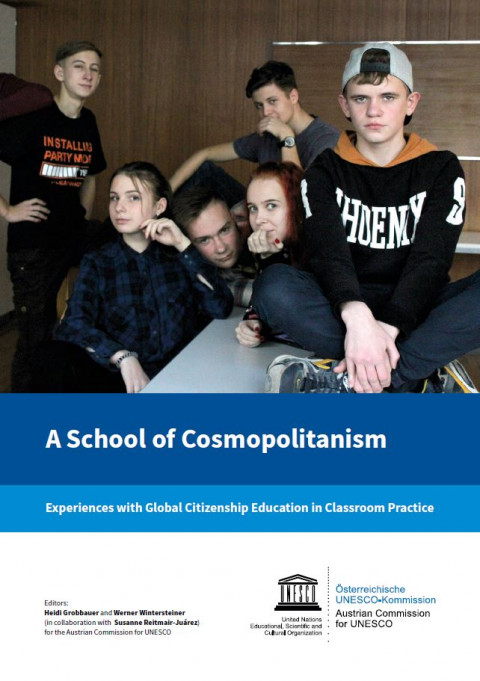 A School of Cosmopolitanism: Experiences with Global Citizenship Education in Classroom Practice Año de publicación: 2019 Autor: Heidi Grobbauer | Werner Wintersteiner Autor corporativo: Austrian Commission for UNESCO This publication focuses on examples from academic practice: this best practice collection demonstrates how young people can successfully be inspired to “think globally, act locally”. What is crucial is maintaining a view of the wider world; in particular, cooperation efforts with educational institutes outside of Europe (e.g. “élèves pour élèves” in Burkina Faso) provide a critical awareness of global connections. Learning to know/Learning to do/Learning to be/Learning to live together – these four pillars form the pedagogical foundation of the work carried out at more than 90 UNESCO schools throughout the whole of Austria. Since their founding in 1957, UNESCO schools have been considered model schools at which lessons are structured in a project-oriented, participative and even topic-specifc way. The unique ‘spirit’ of UNESCO schools often makes special projects possible. In the programme for the annual meetings of recent years, for example, Global Citizenship Education has been an ongoing topic of focus, accompanied by experts from various specialised institutions and NGOs. The pedagogical preparation of contents in a manner that ensures they are actually absorbed in the classroom presents a major challenge. Different types of schools have different educational goals, and the themes have to be made accessible for different age groups. The pedagogical finesse of each class team or individual teacher lies in finding the most motivating approaches.
 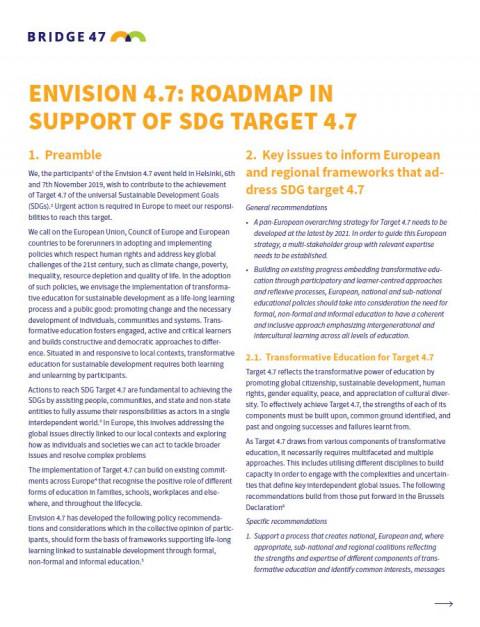 ENVISION 4.7: ROADMAP IN SUPPORT OF SDG TARGET 4.7 Año de publicación: 2019 Autor corporativo: Bridge 47 In November 2019, 200 policy makers, civil society members and researchers from all over the world got together in Helsinki to make a roadmap for the future implementation of SDG Target 4.7 in Europe. The participants of the Envision 4.7 event held in Helsinki, 6th and 7th November 2019, made this document to contribute to the achievement of Target 4.7 of the universal Sustainable Development Goals (SDGs). This document was shaped and influenced by the expertise and insight of everyone who came to the conference. Bridge 47 is calling on this collective knowledge and community of experts to continue moving these recommendations forward as we all aim to achieve SDG Target 4.7 and use transformative education as a mechanism for achieving all of the Sustainable Development Goals.
  The Ontario Curriculum, Grades 11 and 12 : Canadian and World Studies Año de publicación: 2015 Autor corporativo: Ontario (Canada). Ministry of Education In Canadian and world studies, students develop skills, knowledge and understanding, and attitudes that will serve them both inside and outside the classroom, including in the world of work and as responsible citizens in the various communities to which they belong.The focus of teaching and learning in the Canadian and world studies curriculum is the development of ways of thinking and of transferable skills that students need in order to acquire and apply knowledge and understanding. Students apply these ways of thinking and skills in a variety of contexts to examine information critically; to assess the significance of events, developments, and processes; to develop an understanding of and respect for different points of view; to reach supportable conclusions; and to propose solutions to, and courses of action to address, real problems.Citizenship education is an important facet of students’ overall education. In every grade and course in the Grade 11 and 12 Canadian and world studies curriculum, students are given opportunities to learn about what it means to be a responsible, active citizen in the community of the classroom and the diverse communities to which they belong within and outside the school. It is important for students to understand that they belong to many communities and that, ultimately, they are all citizens of the global community. Le curriculum de l'Ontario, 11e et 12e année : Études canadiennes et mondiales Año de publicación: 2015 Autor corporativo: Ontario (Canada). Ministry of Education Le présent document Le curriculum de l’Ontario, 11e et 12e année – Études canadiennes et mondiales, édition révisée, 2015 est destiné aux écoles de langue française; il remplace Le curriculum de l’Ontario, 11e et 12e année – Études canadiennes et mondiales, 2005 et Le supplément du curriculum de l’Ontario de la 9e à la 12e année – Études canadiennes et mondiales, 2008.À compter de septembre 2015, tous les cours d’études canadiennes et mondiales de 11e et 12e année seront fondés sur les attentes et les contenus d’apprentissage énoncés dans cette édition révisée du programme-cadre.LES ÉCOLES SECONDAIRES AU XXIe SIÈCLE Les écoles secondaires de l’Ontario offrent à chaque élève un programme d’études varié et planifié de grande qualité. Ce programme vise la réussite de tous les élèves dans la destination de leur choix. La mise à jour du curriculum de l’Ontario, de pair avec un élargissement des options d’apprentissage offertes à l’extérieur de la salle de classe traditionnelle, intègre l’apprentissage des compétences essentielles pour réussir au XXIe siècle et respecte les champs d’intérêt, les points forts ainsi que les besoins de chaque élève.Le programme-cadre révisé prend en compte le fait qu’aujourd’hui comme demain, la littératie critique sera fondamentale afin de synthétiser l’information, de prendre des décisions réfléchies, de communiquer de manière efficace et d’évoluer dans une communauté mondiale en continuel mouvement. Il est important que les élèves se sentent concernés par le curriculum établi, qu’ils se reconnaissent dans ce qui est enseigné et dans la méthode d’enseignement, et qu’ils réalisent comment leur apprentissage s’applique au monde qui les entoure. Le programme tient compte des besoins variés des élèves; il les aide à enrichir leurs connaissances et à développer leurs habiletés, et leur offre les perspectives dont elles ou ils ont besoin pour devenir des citoyennes et citoyens informés, productifs, bienveillants, responsables, en bonne santé et actifs au sein de leurs communautés et dans le monde.
  Grève scolaire pour le climat: L’engagement des jeunes à l’épreuve de la démocratie Año de publicación: 2019 Autor: Axel Winkel Qui a dit que les jeunes ne s’engageaient plus ? Que la politique ne les intéressait plus ? Les manifestations pour le climat organisées par les jeunes du secondaire depuis le début de l’année 2019 semblent nous indiquer le contraire. Elles chamboulent nos perceptions habituelles du jeune apathique et désintéressé par la vie de la cité. Elles posent aussi de nombreuses questions. Comment comprendre cet élan soudain de milliers d’étudiants à travers la Belgique ? Quelle forme particulière l’engagement de la nouvelle génération prend-il ?