
Recursos
Exploren una amplia gama de recursos valiosos en GCED para profundizar su comprensión y promover su búsqueda, incidencia, enseñanza y aprendizaje.
3,446 resultados encontrados
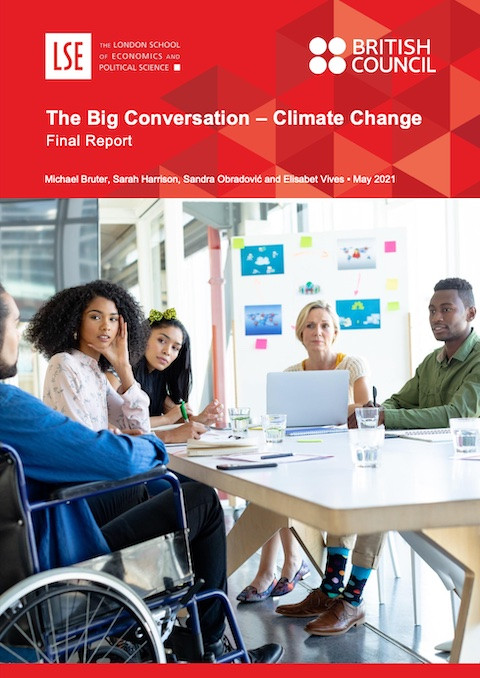 The Big Conversation: Climate Change; Final Report Año de publicación: 2021 Autor: Michael Bruter | Sarah Harrison | Sandra Obradović | Elisabet Vives Autor corporativo: British Council | London School of Economics and Political Science This research draws on experience from the field of international cultural relations as well as the latest academic research on values, behaviours and norms to understand more about how we can create the conditions for co-operation on shared global challenges.It delivers new insight on values and attitudes towards climate change among the populations of China, India, Japan and Mexico – selected to represent a diverse range of major world economies who are also important players in the global climate change debate.The research also draws on the experience of international cultural relations experts to provide new insight on how to strengthen international cooperation on climate change and the important role that cultural relations can play in supporting that.
  Media and Information Literacy in the Digital Age: How to Teach the Teachers Año de publicación: 2021 Autor corporativo: UNESCO Institute for Information Technologies in Education (IITE) This publication includes articles reflecting some trends in the development of the digital media environment, approaches to the formation of media and information literacy (MIL), practices describing the experience of implementing MIL training for teachers and students of various levels and forms of education. The publication also contains recommendations aimed to integrate MIL into teacher education and professional development.
 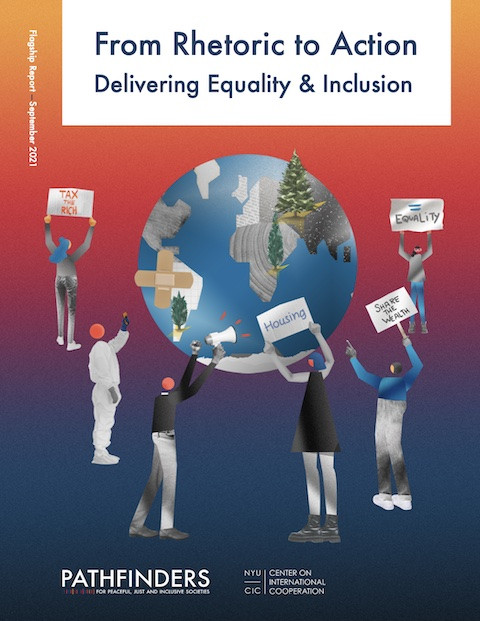 From Rhetoric to Action: Delivering Equality & Inclusion Año de publicación: 2021 Autor: Faiza Shaheen | Alexander Bossakov | Avner Cohen | Amanda Lenhardt | Nendirmwa Noel | Paula Sevilla Núñez | Paul von Chamier Autor corporativo: Pathfinders for Peaceful, Just and Inclusive Societies, NYU. Center on International Cooperation This flagship report of the Pathfinders Grand Challenge on Inequality and Exclusion is about the solutions that will deliver equality and inclusion.The report constructs a bridge between the rhetoric of “build back better” and action: a bridge between promise and progress. It underlines the need for renewed social contracts between citizens, civil society, the private sector, and governments, as well as between high and low- and middle-income countries. These social contracts must be built to serve future generations, to guard against climate breakdown and pandemics while delivering respect, opportunity, and justice for all.This report should serve as a practical handbook for policymakers and influencers; as a source of possibility for the public; and, as a call to all political leaders to act.
  Case Studies From Schools Involved in Inclusive Education in Macedonia Training-of-Trainers Programme (2012–2014) Año de publicación: 2014 Autor corporativo: United Nations Children's Fund (UNICEF) This short booklet offers some of the case studies that the teachers/ trainers developed in their schools, following the training-of-trainers. Some of the examples focus on telling a whole-school story, while others focus on individual children who have been supported to attend and participate in learning. All of the case studies offer ideas and inspiration to other practitioners – within and beyond the former Yugoslav Republic of Macedonia – who are working hard to make education more inclusive for all children.
 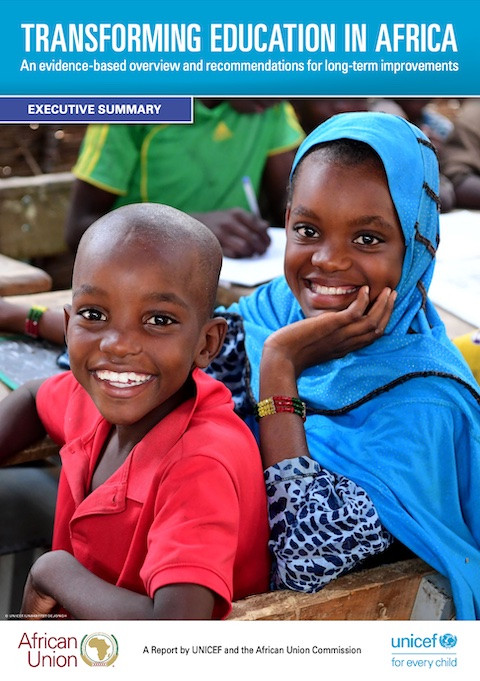 [Summary] Transforming Education in Africa: An Evidence-Based Overview and Recommendations for Long-Term Improvements Año de publicación: 2021 Autor: Nicolas Reuge | Lukman Olawale Jaji | Nicholas Ouma | Adoumtar Noubatour | Hambani Masheleni | Noguebzanga Jean Luc Yameogo | Achila Imchen | Alassane Ouedraogo | Beifith Kouak Tiyab | Yacouba Djibo Abdou | Erin Euiryeong Jeong Autor corporativo: United Nations Children's Fund (UNICEF) | African Union Commission This report is the result of a successful collaboration between UNICEF and the African Union Commission. The report intends to contribute to the facilitation of high-level policy discussions between national education authorities, regional and continental bodies on possible strategic shifts and interventions to boost access to education and improve the quality of teaching and learning in Africa. The report provides evidence-based analysis of the situation of education in Africa while putting into perspective the Sustainable Development Goals and the objectives of the Continental Education Strategy for Africa (CESA 16–25) in line with the African Union Agenda 2063. It highlights the progress made in the continent’s education sector over the past decade (2010–2020) while pointing out the challenges that remain, particularly in the area of equity. [Résumé] Transformer l’éducation en afrique: Un aperçu base sur des données probantes et des recommandations pour des améliorations à long terme Año de publicación: 2021 Autor: Nicolas Reuge | Lukman Olawale Jaji | Nicholas Ouma | Adoumtar Noubatour | Hambani Masheleni | Noguebzanga Jean Luc Yameogo | Achila Imchen | Alassane Ouedraogo | Beifith Kouak Tiyab | Yacouba Djibo Abdou | Erin Euiryeong Jeong Autor corporativo: United Nations Children's Fund (UNICEF) | African Union Commission Le présent rapport est le fruit d’une collaboration entre l’UNICEF et la Commission de l’Union africaine. Il entend contribuer à faciliter la tenue de débats politiques de haut niveau entre les autorités nationales chargées de l’éducation et les organismes régionaux et continentaux dans l’optique de déterminer les interventions et les changements stratégiques envisageables pour améliorer l’accès à l’éducation et la qualité de l’enseignement et de l’apprentissage en Afrique. Le rapport présente une analyse fondée sur des données probantes de la situation de l’éducation en Afrique, en mettant en perspective les objectifs de développement durable ainsi que les objectifs de la Stratégie continentale de l’éducation pour l’Afrique (CESA 2016-2025) conformes à l’Agenda 2063 de l’Union africaine. Il souligne les progrès accomplis sur le continent dans le secteur de l’éducation au cours de la dernière décennie (2010-2020) et met en évidence les défis qui restent à relever, notamment en matière d’équité.
  Education at a Glance 2021: OECD Indicator Año de publicación: 2021 Autor corporativo: Organisation for Economic Co-operation and Development (OECD) Education at a Glance is the authoritative source for information on the state of education around the world. It provides data on the structure, finances and performance of education systems across OECD countries and a number of partner economies. More than 100 charts and tables in this publication – as well as links to much more available on the educational database – provide key information on the output of educational institutions; the impact of learning across countries; access, participation and progression in education; the financial resources invested in education; and teachers, the learning environment and the organisation of schools.The 2021 edition includes a focus on equity, investigating how progress through education and the associated learning and labour market outcomes are impacted by dimensions such as gender, socio‐economic status, country of birth and regional location. A specific chapter is dedicated to Target 4.5 of the Sustainable Development Goal 4 on equity in education, providing an assessment of where OECD and partner countries stand in providing equal access to quality education at all levels. Two new indicators on the mechanisms and formulas used to allocate public funding to schools and on teacher attrition rate complement this year’s edition. Regards sur l’éducation 2021: Les indicateurs de l’OCDE Año de publicación: 2021 Autor corporativo: Organisation for Economic Co-operation and Development (OECD) Regards sur l’éducation est le rapport de référence sur l’état de l’éducation dans le monde. Ce rapport étudie la structure, le financement et la performance des systèmes d’éducation des pays de l’OCDE et d’un certain nombre de pays partenaires. Avec plus d’une centaine de tableaux et graphiques – et de nombreux liens vers la base de données de l’OCDE sur l’éducation – Regards sur l’éducation foisonne d’informations sur les résultats des établissements d’enseignement ; l’impact de l’apprentissage ; l’accès à l’éducation, les taux de scolarisation et les parcours scolaires ; les investissements dans l’éducation ; et les enseignants, l’environnement d’apprentissage et l’organisation de l’enseignement.L’édition 2021 s’intéresse à la question de l’équité : elle étudie dans quelle mesure le sexe, le milieu socio-économique, le pays d’origine ou encore la situation géographique influencent le parcours éducatif des élèves et étudiants, et ont un impact sur les résultats en termes d’apprentissage et d’emploi. Un chapitre spécifique est consacré à la cible 4.5 de l’objectif de développement durable 4 sur l’équité dans l’éducation. Il situe les pays membres et partenaires de l’OCDE par rapport aux objectifs en matière d’égalité d’accès à une éducation de qualité à tous les niveaux d’enseignement. Deux nouveaux indicateurs sur les mécanismes et les formules utilisés pour allouer les fonds publics aux établissements et sur le taux d’attrition des enseignants complètent l’édition 2021.
  Fifteen Analytical Keys to Strengthen the Education 2030 Agenda Año de publicación: 2017 Autor: Renato Opertti Autor corporativo: UNESCO International Bureau of Education (IBE) The joint review of the goals of the Education 2030 agenda and global change accentuated by the emergence of a fourth industrial revolution highlights the need to rethink the concepts that have influenced education over the past forty years. This necessity is accompanied by a major challenge: that of giving a new meaning to these concepts, in the same way education systems, in a transformational and united perspective. The present document proposes a global reflection based on fifteen keys of analysis, in order to help define a vision of education and learning that is in line with the Education 2030 agenda examines the following aspects: 1) education as a reflection of the type of society targeted; 2) the state as guarantor of the right to education; 3) education as a cultural, social and economic ; 4) the characteristics and roles of education systems; 5) learning throughout life long; 6) education according to age groups; 7) inclusion as a basis for education systems; 8) education for global and local citizenship; 9) education for sustainable development ; 10) STEM training to build sustainable societies; 11) the relevance of the gender issue at a time of the democratization of society and education; 12) computer programming as a new challenge in the teaching of ICT; 13) the evolution of the relationship between training and work; 14) the trio formed by curricula, educational establishments and pedagogy; and 15) teachers as decision-makers. Quinze clés d’analyse pour renforcer l’agenda Éducation 2030 Año de publicación: 2017 Autor: Renato Opertti Autor corporativo: UNESCO International Bureau of Education (IBE) L’examen conjoint des objectifs de l’agenda Éducation 2030 et des changements planétaires accentués par l’émergence d’une quatrième révolution industrielle met en évidence la nécessité de repenser les concepts qui ont influencé l’éducation au cours des quarante dernières années. Cette nécessité s’accompagne d’un défi de taille : celui de donner un sens nouveau à ces concepts, de même qu’aux systèmes éducatifs, dans une perspective transformationnelle et unie. Le présent document propose une réflexion globale reposant sur quinze clés d’analyse, en vue de contribuer à définir une vision de l’éducation et de l’apprentissage qui soit en adéquation avec l’agenda Éducation 2030. Il se penche ainsi sur les aspects suivants : 1) l’éducation en tant que reflet du type de société visé ; 2) l’État en tant que garant du droit à l’éducation ; 3) l’éducation en tant que politique culturelle, sociale et économique ; 4) les caractéristiques et les rôles des systèmes éducatifs ; 5) l’apprentissage tout au long de la vie ; 6) l’éducation en fonction de groupes d’âge ; 7) l’inclusion en tant que fondement des systèmes éducatifs ; 8) l’éducation à la citoyenneté mondiale et locale ; 9) l’éducation pour le développement durable ; 10) la formation aux STEM en vue de bâtir des sociétés durables ; 11) la pertinence de la problématique hommes-femmes à l’heure de la démocratisation de la société et de l’éducation ; 12) la programmation informatique en tant que nouveau défi dans l’enseignement des TIC ; 13) l’évolution de la relation entre la formation et le travail ; 14) le trio formé par les curricula, les établissements éducatifs et la pédagogie ; et 15) les enseignants en tant que décideurs.