
Recursos
Exploren una amplia gama de recursos valiosos en GCED para profundizar su comprensión y promover su búsqueda, incidencia, enseñanza y aprendizaje.
662 resultados encontrados
 Prix UNESCO de l'éducation pour la paix, 2008 Año de publicación: 2009 Autor corporativo: UNESCO The UNESCO Prize for Peace Education 2008 was awarded to the Institute for Justice and Reconciliation (South Africa) by Mr Koïchiro Matsuura, Director-General of UNESCO, on the recommendation of the International Jury of the Prize. The prize-giving ceremony, organized as part of the celebrations of the International Day of Peace (21 September), the International Decade for a Culture of Peace and Non-Violence for the Children of the World (2001- 2010) and the 60th anniversary of the Universal Declaration of Human Rights, was held at UNESCO Headquarters on 18 September 2008 in the presence of Mr Mohammed Arkoun, President of the International Jury, and H.E. Mr Javier Pérez de Cuéllar, member of the International Jury, former Prize laureates, Permanent Delegates of Member States and representatives of governmental and non-governmental organizations. The award ceremony was preceded by the screening of an excerpt from the documentary Truth, Justice, Memory: South Africa’s Truth and Reconciliation Process and by a video message from Archbishop Emeritus Desmond Tutu, winner of the 1984 Nobel Peace Prize for his role as a unifying leader in the campaign to resolve the problem of apartheid in South Africa, and former Chairperson of South Africa’s Truth and Reconciliation Commission
  UNESCO prize for peace education, 2008 Año de publicación: 2009 Autor corporativo: UNESCO The UNESCO Prize for Peace Education 2008 was awarded to the Institute for Justice and Reconciliation (South Africa) by Mr Koïchiro Matsuura, Director-General of UNESCO, on the recommendation of the International Jury of the Prize. The prize-giving ceremony, organized as part of the celebrations of the International Day of Peace (21 September), the International Decade for a Culture of Peace and Non-Violence for the Children of the World (2001- 2010) and the 60th anniversary of the Universal Declaration of Human Rights, was held at UNESCO Headquarters on 18 September 2008 in the presence of Mr Mohammed Arkoun, President of the International Jury, and H.E. Mr Javier Pérez de Cuéllar, member of the International Jury, former Prize laureates, Permanent Delegates of Member States and representatives of governmental and non-governmental organizations. The award ceremony was preceded by the screening of an excerpt from the documentary Truth, Justice, Memory: South Africa’s Truth and Reconciliation Process and by a video message from Archbishop Emeritus Desmond Tutu, winner of the 1984 Nobel Peace Prize for his role as a unifying leader in the campaign to resolve the problem of apartheid in South Africa, and former Chairperson of South Africa’s Truth and Reconciliation Commission Allocution de M. Koïchiro Matsuura, Directeur Général de l'UNESCO, à l'Occasion du Séminaire International sur l'Education au Changement Climatique, UNESCO, 27 Juillet 2009 Año de publicación: 2009 Autor corporativo: UNESCO This document is the address of Mr Mr Koïchiro Matsuura, Director-General of UNESCO, on the occasion of the International Seminar on Climate Change Education; UNESCO, 27 July 2009. He presented the climate change issues and highlighted the importance of education for sustainable future. Address by Mr Koïchiro Matsuura, Director-General of UNESCO, on the occasion of the International Seminar on Climate Change Education; UNESCO, 27 July 2009 Año de publicación: 2009 Autor corporativo: UNESCO This document is the address of Mr Mr Koïchiro Matsuura, Director-General of UNESCO, on the occasion of the International Seminar on Climate Change Education; UNESCO, 27 July 2009. He presented the climate change issues and highlighted the importance of education for sustainable future. Address by Mr Koïchiro Matsuura, Director-General of UNESCO, on the occasion of the International Seminar on Climate Change Education; UNESCO, 27 July 2009 Año de publicación: 2009 Autor corporativo: UNESCO Ce document est l'adresse de M. Koïchiro Matsuura, Directeur général de l'UNESCO, à l'occasion du Séminaire international sur les changements climatiques de l'éducation; UNESCO, le 27 Juillet 2009. Il a présenté les questions liées au changement climatique et a souligné l'importance de l'éducation pour un avenir durable. Escuelas asociadas de la UNESCO news infos: educación sobre el cambio climático Año de publicación: 2009 Autor corporativo: UNESCO As the United Nations Climate Change Conference takes place on December 7 to 18 2009 in Copenhagen, Denmark, this special issue will focus on selected climate change education activities carried out by the ASP network around the globe. Climate change is one of the most urgent challenges of sustainable development and a key action theme in the UN Decade of Education for Sustainable Development (DESD). ASPnet schools around the world work on Climate Change Education in order to enable students to make informed and responsible decisions, turn passive awareness into behaviour change and make sustainable behaviours a daily habit. The development of good practices and innovative educational materials in climate change education is a key element in ASPnet’s strategy to meet the pressing educational needs of the future generation. This newsletter highlights only a few of the large number of activities of ASPnet worldwide. Ecoles associées de l'UNESCO news infos: l'éducation au changement climatique Año de publicación: 2009 Autor corporativo: UNESCO As the United Nations Climate Change Conference takes place on December 7 to 18 2009 in Copenhagen, Denmark, this special issue will focus on selected climate change education activities carried out by the ASP network around the globe. Climate change is one of the most urgent challenges of sustainable development and a key action theme in the UN Decade of Education for Sustainable Development (DESD). ASPnet schools around the world work on Climate Change Education in order to enable students to make informed and responsible decisions, turn passive awareness into behaviour change and make sustainable behaviours a daily habit. The development of good practices and innovative educational materials in climate change education is a key element in ASPnet’s strategy to meet the pressing educational needs of the future generation. This newsletter highlights only a few of the large number of activities of ASPnet worldwide. UNESCO associated schools news infos: climate change education Año de publicación: 2009 Autor corporativo: UNESCO As the United Nations Climate Change Conference takes place on December 7 to 18 2009 in Copenhagen, Denmark, this special issue will focus on selected climate change education activities carried out by the ASP network around the globe. Climate change is one of the most urgent challenges of sustainable development and a key action theme in the UN Decade of Education for Sustainable Development (DESD). ASPnet schools around the world work on Climate Change Education in order to enable students to make informed and responsible decisions, turn passive awareness into behaviour change and make sustainable behaviours a daily habit. The development of good practices and innovative educational materials in climate change education is a key element in ASPnet’s strategy to meet the pressing educational needs of the future generation. This newsletter highlights only a few of the large number of activities of ASPnet worldwide.
 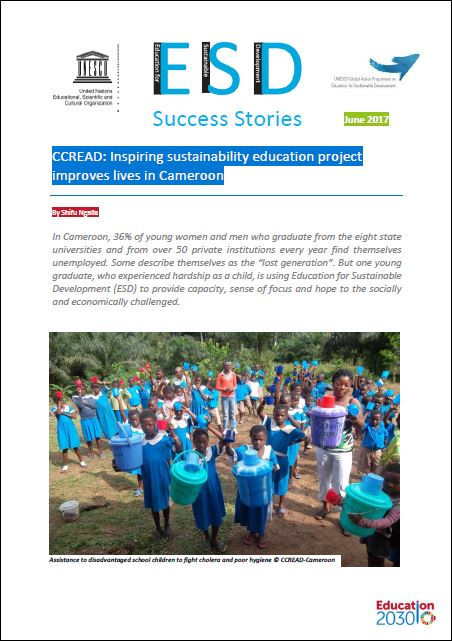 CCREAD: Inspiring Sustainability Education Project Improves Lives in Cameroon Año de publicación: 2017 Autor: Shifu Ngalla Autor corporativo: UNESCO This article is about sustainability education project in Cameroon. In Cameroon, 36% of young women and men who graduate from the eight state universities and from over 50 private institutions every year find themselves unemployed. Some describe themselves as the “lost generation”. But one young graduate, who experienced hardship as a child, is using Education for Sustainable Development (ESD) to provide capacity, sense of focus and hope to the socially and economically challenged. CCREAD: Un Projet d’éducation au Développement Durable Améliore des Vies au Cameroun Año de publicación: 2017 Autor: Shifu Ngalla Autor corporativo: UNESCO Ceci est un article sur le projet d'éducation à la durabilité au Cameroun.Chaque année au Cameroun, 36% des jeunes femmes et hommes qui obtiennent leur diplôme dans l’une des huit universités d’État et dans plus de 50 institutions privées se retrouvent sans-emploi. Certains d'entre eux se décrivent comme une « génération perdue ». Cependant, un jeune diplômé qui a vécu une expérience douloureuse pendant son enfance utilise l’Éducation au Développement Durable (EDD) afin de former et redonner de l’espoir aux jeunes défavorisés au niveau social et économique.