
Recursos
Exploren una amplia gama de recursos valiosos en GCED para profundizar su comprensión y promover su búsqueda, incidencia, enseñanza y aprendizaje.
1,405 resultados encontrados
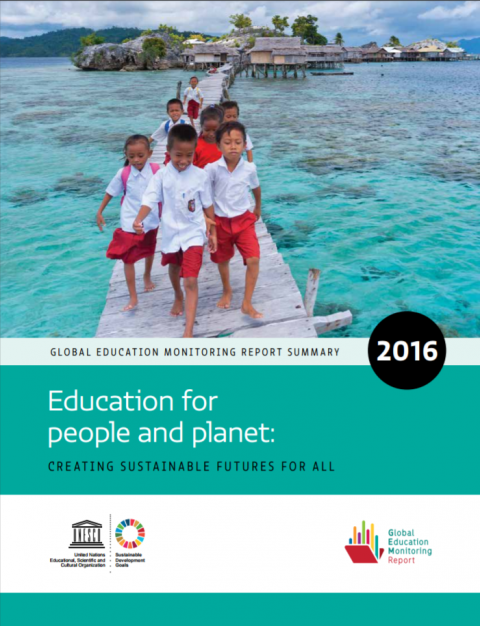 L'Education pour les peuples et la planète: créer des avenirs durables pour tous, résumé du rapport mondial de suivi sur l'éducation, 2016 Año de publicación: 2016 Autor corporativo: UNESCO The GEM Report provides an authoritative account of how education is the most vital input for every dimension of sustainable development. Better education leads to greater prosperity, improved agriculture, better health outcomes, less violence, more gender equality, higher social capital and an improved natural environment. Education is key to helping people around the world understand why sustainable development is such a vital concept for our common future. Education gives us the key tools – economic, social, technological, even ethical – to take on the SDGs and to achieve them. These facts are spelled out in exquisite and unusual detail throughout the report. Yet the report also emphasizes the remarkable gaps between where the world stands today on education and where it has promised to arrive as of 2030. La Educación al servicio de los pueblos y el planeta: creación de futuros sostenibles para todos, resumen del informe de seguimiento de la educación en el mundo 2016; Año de publicación: 2016 Autor corporativo: UNESCO The GEM Report provides an authoritative account of how education is the most vital input for every dimension of sustainable development. Better education leads to greater prosperity, improved agriculture, better health outcomes, less violence, more gender equality, higher social capital and an improved natural environment. Education is key to helping people around the world understand why sustainable development is such a vital concept for our common future. Education gives us the key tools – economic, social, technological, even ethical – to take on the SDGs and to achieve them. These facts are spelled out in exquisite and unusual detail throughout the report. Yet the report also emphasizes the remarkable gaps between where the world stands today on education and where it has promised to arrive as of 2030. Образование в интересах людей и планеты: ПОСТОЕНИЕ УСТОЙЧИВОГО БУДУЩЕГО ДЛЯВСЕХ, РЕЗЮМЕ ВСЕМИРНОГО ДОКЛАДА ПО МОНИТОРИНГУ ОБРАЗОВАНИЯ, 2016 Año de publicación: 2016 Autor corporativo: UNESCO The GEM Report provides an authoritative account of how education is the most vital input for every dimension of sustainable development. Better education leads to greater prosperity, improved agriculture, better health outcomes, less violence, more gender equality, higher social capital and an improved natural environment. Education is key to helping people around the world understand why sustainable development is such a vital concept for our common future. Education gives us the key tools – economic, social, technological, even ethical – to take on the SDGs and to achieve them. These facts are spelled out in exquisite and unusual detail throughout the report. Yet the report also emphasizes the remarkable gaps between where the world stands today on education and where it has promised to arrive as of 2030.
  Preventing Violent Extremism through Education: A guide for policy-makers Año de publicación: 2017 Autor corporativo: UNESCO This publication offers technical guidance for education professionals (policy-makers, teachers and various education stakeholders) on how to address the concrete challenges posed by violent extremism. The Guide particularly aims to help policy-makers within ministries of education to prioritize, plan and implement effective preventive educationrelated actions, contributing to national prevention efforts. La Prévention de l'extrémisme violent par l'éducation Año de publicación: 2017 Autor corporativo: Organisation des Nations Unies pour l'éducation, la science et la culture (UNESCO) Cette publication propose un guide technique pour les professionnels de l’éducation (décideurs, enseignants et autres acteurs du domaine) sur les façons d’adresser les défis posés par l’extrémisme violent. Le Guide vise particulièrement à assister les décideurs au sein des ministères de l’Éducation pour prioriser, planifier et instaurer des actions préventives en milieu scolaire complémentaires aux mesures préventives nationales.
  UNESCO's Role and Responsibilities in Implementing Global Citizenship Education and Promoting Peace and Human Rights Eudcation and Education for Sustainable Development Año de publicación: 2015 Autor corporativo: UNESCO This document is an addendum to document 196 EX/32. This item was included in the provisional agenda of the 196th session of the Executive Board at the request of Austria and Italy Rôle et responsabilités de l'UNESCO dans la mise en oeuvre de l'éducation à la citoyenneté mondiale et la promotion de l'éducation relative à la paix et aux droits de l'homme et de l'éducation en vue du développement durable Año de publicación: 2015 Autor corporativo: UNESCO This document is an addendum to document 196 EX/32. This item was included in the provisional agenda of the 196th session of the Executive Board at the request of Austria and Italy Función y responsabilidades de la UNESCO en la realización de la educación para la ciudadanía mundial y la promoción de la educación para la paz y los derechos humanos y la educación para el desarrollo sostenible Año de publicación: 2015 Autor corporativo: UNESCO This document is an addendum to document 196 EX/32. This item was included in the provisional agenda of the 196th session of the Executive Board at the request of Austria and Italy Роль и ответственность ЮНЕСКО в реализации программ обучения основам глобальной гражданственности, в поощрении воспитания в духе мира и прав человека и в образовании в интересах устойчивого развития Año de publicación: 2015 Autor corporativo: UNESCO This document is an addendum to document 196 EX/32. This item was included in the provisional agenda of the 196th session of the Executive Board at the request of Austria and Italy دور اليونسكو ومسؤولياتها في وضع تعليم المواطَنة العالمية موضع التطبيق وتعزيز التعليم من أجل السلام وحقوق الإنسان والتعليم من أجل التنمية المستدامة Año de publicación: 2015 Autor corporativo: UNESCO This document is an addendum to document 196 EX/32. This item was included in the provisional agenda of the 196th session of the Executive Board at the request of Austria and Italy