
Recursos
Exploren una amplia gama de recursos valiosos en GCED para profundizar su comprensión y promover su búsqueda, incidencia, enseñanza y aprendizaje.
684 resultados encontrados
 Kit pratique sur les compétences numériques Año de publicación: 2018 Autor: Chris Coward Autor corporativo: International Telecommunication Union (ITU) Ce kit pratique donne des indications aux parties prenantes sur l’élaboration d'une stratégie dans le domaine des compétences numériques. Il est destiné aux décideurs de même qu’aux partenaires du secteur privé, des organismes non-gouvernementaux et des milieux universitaires. Son objectif prio- ritaire consiste à promouvoir le développement d’une stratégie globale en matière de compétences numériques au niveau des pays. Il est également possible d’utiliser ce kit pratique pour se concentrer sur certaines priorités qui nécessitent une nouvelle approche. Portada de Conjunto de herramientas para las habilidades digitales Año de publicación: 2018 Autor: Chris Coward Autor corporativo: International Telecommunication Union (ITU) Este conjunto de herramientas proporciona a las partes interesadas directrices para el desarrollo de una estrategia de habilidades digitales. Se dirige a las instancias decisorias, a los asociados del sector privado, las organizaciones no gubernamentales y los sectores académicos. Su propósito general es facilitar el desarrollo de una estrategia de habilidades digitales de amplio alcance a nivel de país. También puede utilizarse esta guía para centrarse en determinadas prioridades que exigen un reno- vado planteamiento. Комплект материалов по цифровым навыкам Año de publicación: 2018 Autor: Chris Coward Autor corporativo: International Telecommunication Union (ITU) Настоящий комплект материалов предоставляет заинтересованным сторонам руководящие указания по разработке стратегии в области цифровых навыков Он предназначен для директивных органов наряду с партнерами в частном секторе, неправительственными и академическими организациями. Его всеобъемлющая цель заключается в содействии разработке всесторонней стратегии в области цифровых навыков на уровне страны. Кроме того, данное руководство можно использовать для ориентации на избранные приоритеты, требующие свежего взгляда на вещи. 数字技能工具包 Año de publicación: 2018 Autor: Chris Coward Autor corporativo: International Telecommunication Union (ITU) 本工具包为利益相关方的数字技能战略制定提供指导,适用于政策制定者及私营部 门、非政府组织和学术界合作伙伴,其总目标是从国家层面上促进数字技能战略的全面 发展。该指南亦可用于关注选定的需要新方法的优先事项。
  Gender Bias, Citizen Participation, and AI (Policy Research Working Papers; Planet; RRR; 11046) Año de publicación: 2025 Autor: Jose Antonio Cuesta Leiva | Natalia Gisel Pecorari Autor corporativo: World Bank This paper investigates the role of gender bias in artificial intelligence–driven analyses of citizen participation, using data from the 2023 Latinobarómetro Survey. The paper proposes that gender bias—whether societal, data driven, or algorithmic—significantly affects civic engagement. Using machine learning, particularly decision trees, the analysis explores how self-reported societal bias (machismo norms) interacts with personal characteristics and circumstances to shape civic participation. The findings show that individuals with reportedly low levels of gender bias, who express political interest, have high levels of education, and align with left-wing views, are more likely to participate. The paper also explores different strategies to mitigate gender bias in both the data and the algorithms, demonstrating that gender bias remains a persistent factor even after applying corrective measures. Notably, lower machismo thresholds are required for participation in more egalitarian societies, with men needing to exhibit especially low machismo levels. Ultimately, the findings emphasize the importance of integrated strategies to tackle gender bias and increase participation, offering a framework for future studies to expand on nonlinear and complex social dynamics.
 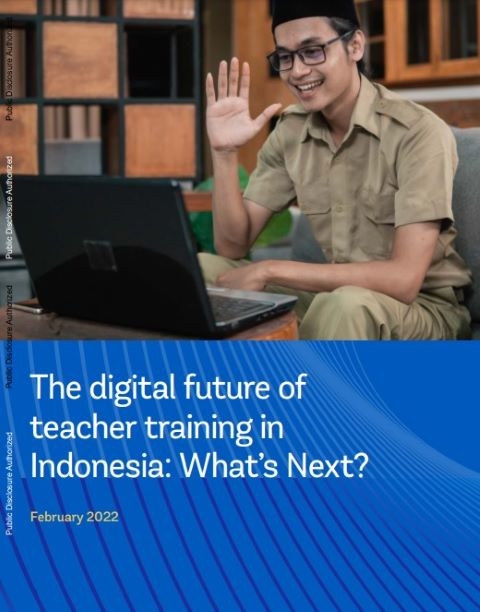 The Digital Future of Teacher Training in Indonesia: What’s Next? Año de publicación: 2022 Autor: Noah Yarrow | Noviandri Khairina | Jacobus Cilliers | Indah Dini Autor corporativo: World Bank | Government of Australia This report reflects on the Indonesia’s online teacher training ecosystem based on unique data collected from both teachers and providers during the COVID-19 period. A detailed mapping of the eight largest providers of online teacher training in Indonesia was conducted, covering 25 programs. We find that the majority of programs are short in duration and focus on digital literacy skills and remote learning. Training programs were mostly provided using online lectures, few provided individual coaching, while none provided opportunities for personalized learning. Second, we conducted a nationally representative phone survey of 435 primary and junior secondary teachers spanning 30 provinces across Indonesia (66 percent of whom are female teachers). The teacher survey was conducted between February and March 2021 and covered teachers under both the Ministry of Education, Research, and Technology (MoECRT) and the Ministry of Religious Affairs (MoRA). We find that 44 percent of teachers participated in online learning during the pandemic, and that three quarters of these teachers had never participated in online training prior to the pandemic. Many training participants reported challenges in implementing what they learned from online training. Most of the teachers who participated (88 percent) would like to continue receiving training online even after the pandemic ends. These results suggest that demand for online training is expected to persist, but more can be done to improve their quality.
  Artificial Intelligence and Gender Equality: Key Findings of UNESCO’s Global Dialogue Año de publicación: 2020 Autor corporativo: UNESCO The purpose of the UNESCO’s Dialogue on Gender Equality and AI was to identify issues, challenges, and good practices to help: Overcome the built-in gender biases found in AI devices, data sets and algorithms; Improve the global representation of women in technical roles and in boardrooms in the technology sector; and Create robust and gender-inclusive AI principles, guidelines and codes of ethics within the industry. This Summary Report sets forth proposed elements of a Framework on Gender Equality and AI for further consideration, discussion and elaboration amongst various stakeholders. It reflects experts’ inputs to the UNESCO Dialogue on Gender Equality and AI, as well as additional research and analysis. This is not a comprehensive exploration of the complexities of the AI ecosystem in all its manifestations and all its intersections with gender equality. Rather, this is a starting point for conversation and action and has a particular focus on the private sector. It argues for the need to 1. Establish a whole society view and mapping of the broader goals we seek to achieve in terms of gender equality;2. Generate an understanding of AI Ethics Principles and how to position gender equality within them; 3. Reflect on possible approaches for operationalizing AI and Gender Equality Principles; and4. Identify and develop a funded multi-stakeholder action plan and coalition as a critical next step.
  UNESCO Women for Ethical AI: Outlook Study on Artificial Intelligence and Gender Año de publicación: 2024 Autor corporativo: UNESCO The gender chapter of the UNESCO Recommendation on the Ethics of AI is a concrete commitment by 194 Member States to advance gender equality in the AI ecosystem. To track progress in the implementation of the gender provisions of UNESCO’s Recommendation, and to assess the impacts of AI on gender equality, the UNESCO Women for Ethical AI (W4EAI) Platform has been established. This report advances the workstream through evidence-based insights in three critical areas: women’s participation in AI development and deployment, the inclusion of gender equality concerns in AI governance and the impact of AI on gender equality. It highlights the significant underrepresentation of women in AI, the lack of gender-disaggregated data, and the compounded challenges women face in the field. The report also addresses the neglect of gender dimensions in AI policy, the risks posed by AI systems to women, and the need for responsible and ethical AI governance to promote gender equality. Finally, it outlines actionable recommendations to enhance gender equality through and in AI, emphasizing the importance of comprehensive data collection, targeted interventions, and inclusive policy-making.
  Media Literacy at Your Library: Learning and Prototyping Report Año de publicación: 2018 Autor corporativo: American Library Association (ALA) Media Literacy at Your Library was a project of the American Library Association (ALA) in collaboration with the Center for News Literacy at Stony Brook University (CNL), supported by the John S. and James L. Knight Foundation, the Democracy Fund, and the Rita Allen Foundation as part of the Knight Prototype Fund.Through this project, ALA sought to address a critical need in the field for adult media literacy education, with a focus on news literacy. The goal of the prototype project was to develop media literacy training and complementary resources designed to prepare public library professionals to educate their adult patrons to be informed media consumers.Following a one-day training led by CNL, teams from five public libraries took on the challenges of creating innovative media literacy programs serving their distinct communities. With the goal of making the CNL news literacy curriculum more broadly accessible to the library field, the teams also offered feedback on a series of online trainings based on the in-person training they attended. These five library teams guided and informed ALA and CNL’s understanding and development of prototype resources over the course of the project.
  장애 청소년(농아인) 미디어교육 프로그램 개발: 연구결과 보고서 Año de publicación: 2022 Autor: 최상배 | 김병련 | 오인혜 | 고은지 Autor corporativo: 시청자미디어재단 최근 들어 모든 사람을 위한 미디어리터러시가 강조되면서 청각장애인을 대상으로 한 미디어교육의 필요성이 대두되고 있다. 이 연구에서는 청각장애 청소년의 미디어교육 현황을 분석하여 청각장애인의 특성을 반영한 미디어교육 프로그램을 개발하고자 하였다.