
Recursos
Exploren una amplia gama de recursos valiosos en GCED para profundizar su comprensión y promover su búsqueda, incidencia, enseñanza y aprendizaje.
3,446 resultados encontrados
 L'éducation au service du développement: La vision de la Banque mondiale, de l'OCDE et de l'UNESCO (L’Education en débats: analyse comparée; no. 8) Año de publicación: 2016 Autor: Thibaut Lauwerier Autor corporativo: Université de Genève Dans ce présent article, nous nous intéressons aux liens entre éducation et développement du point de vue de la Banque mondiale, l’OCDE et l’UNESCO, organisations internationales majeures dans le secteur éducatif au niveau mondial. Après avoir présenté le contexte de la recherche, à savoir les caractéristiques majeures des trois organisations étudiées et la méthodologie utilisée, nous montrons comment le concept du développement est perçu par ces institutions. Ensuite, nous traitons des implications de ces visions du développement pour l’éducation. En conclusion, tout en analysant les récentes évolutions des discours des organisations internationales, nous discutons de la nécessité d’aller au-delà d’une vision étriquée du développement et donc de l’éducation.
  Human Dignity: Contemporary Pattern and Traditional Patterns (Revista Brasileira de Direito; vol. 11, no. 2) Año de publicación: 2015 Autor: Antonio Pelé Autor corporativo: Faculdade Meridional-IMED The concept of human dignity refers to the intrinsic and absolute value of human beings and repre- sents the grounding human rights. Those features are usually studied as if they were the results, in the history of Western thought, of the progressive recognition of the human moral value. Our work aims to show precisely the contrary, showing some clear differencies between the current paradigm of human dignity and the previous and traditional patterns of dignity. Thus, the basic features of each (current and previous) pattern are analyzed in order to show that the contemporary paradigm of human dignity as little in common with the previous paradigms of dignity. A dignidade humana: Modelo contemporaneo e modelos tradicionais (Revista Brasileira de Direito; vol. 11, no. 2) Año de publicación: 2015 Autor: Antonio Pelé Autor corporativo: Faculdade Meridional-IMED El concepto de dignidad humana se refiere al valor intrínseco y absoluto del ser humano y sería el fundamento de los derechos humanos. Estas características suelen ser estudiadas como si fuesen las consequencias de un lento desarrollo del reconocimiento progressivo del valor moral del ser humano en la historia del pensamiento occidental. Nuestro estudio pretende, al contrario, establecer unas claras diferencias entre el modelo contemporáneo de dignidad humana y los modelos anteriores (tradicionales) de dignidad. Para llegar a este fin, realizamos y destacamos las características principales de estos modelos, mostrando que el modelo contemporáneo de dignidad humana tiene poco en común con sus aproximaciones anteriores. Palabras-clave: dignidad humana, derechos humanos, filosofía clásica, humanismo, Pufendorf, Kant.
  La dignidad humana, parte esencial de los derechos sociales (Derechos Fundamentales a Debate/Comisión Estatal de Derechos Humanos Jalisco; no. 2) Año de publicación: 2016 Autor: Jorge Tapia Torres Autor corporativo: Instituto de Investigación y Capacitación de Derechos Humanos Los derechos humanos han cobrado mayor importancia en las últimas décadas del siglo XX y en los primeros años del presente siglo, derechos tales como la alimentación, la vivienda y una vida digna son incluidos en la mayoría de las constituciones nacionales. Ante este nuevo paradigma se encuentran grandes retos como buscar la manera de hacerlos exigibles, ya sea en forma ordinaria o judicial. En este contexto es necesario que algunos de estos derechos estén previstos en nuestra Carta Magna, como el derecho a una pensión o jubilación suficiente que le permita a una persona tener una vida digna después de haber concluido su vida laboral; y es que no hay que olvidar que el derecho a la vida es, por ende, el más importante de los derechos humanos y en consecuencia a que esta sea digna.
  On the Origins of the Globalization Process (Methaodos.revista de ciencias sociales; vol. 1, no. 1) Año de publicación: 2013 Autor: Antonio Martín-Cabello Autor corporativo: Rey Juan Carlos University This paper tries to define the origins of the globalization process. In order to do this, it has proceeded to review the abundant and scattered scientific literature. The analysis concludes that there are four usual answers about the origins of globalization. Firstly, place it alongside the emergence of the earliest human civilizations. Secondly, link the globalization process with the emergence of the European modernity during the fifteenth century. Thirdly, connect it to the consolidation of the industrial revolution in the nineteenth century. And finally, consider it the last stage of the expansion of global capitalism in the late twentieth century. Afterwards, the paper will attempt to make a critical assessment of these approaches. The article concludes that the latter is the more plausible answer, because it is closer to the available empirical facts and it avoids the pitfalls of teleology. Sobre los orígenes del proceso de globalización (Methaodos.revista de ciencias sociales; vol. 1, no. 1) Año de publicación: 2013 Autor: Antonio Martín-Cabello Autor corporativo: Rey Juan Carlos University Este artículo intenta delimitar los orígenes del proceso de globalización. Para ello, se ha procedido a revisar la abundante y dispersa literatura científica disponible. Del análisis realizado se concluye que existen cuatro respuestas habituales sobre los orígenes de la globalización. En primer lugar, situarla junto la aparición de las primeras civilizaciones humanas. En segundo, ligar el proceso de globalización con la aparición de la modernidad europea durante el siglo XV. En tercer lugar, unirla a la consolidación de la revolución industrial en el siglo XIX. Y, por último, considerarla la última etapa de la expansión del capitalismo a escala mundial a finales del siglo XX. Después, se intentará realizar una valoración crítica de estas aproximaciones. El artículo concluye afirmando que la última respuesta es la más plausible, pues se encuentra más cerca de los datos empíricos disponibles y evita las trampas de la teleología.
  Sustainability: A Strong Concept for Humanity (Tabula Rasa; no. 28) Año de publicación: 2018 Autor: Plinio Zarta Ávila Autor corporativo: University College of Cundinamarca The concept of sustainable development is still under construction, having transcended and being enriched, but also fragmenting, moving away from its origin. The indiscriminate use of the term "sustainable" has generated an exhaustion of its initial meaning, losing its meaning and hindering its rigorous analysis. This article promotes a critical discussion of the role of sustainability in the development of society, considering that this concept contemplates important changes in contemporaneity with respect to the values of society. La sustentabilidad o sostenibilidad: Un concepto poderoso para la humanidad (Tabula Rasa; no. 28) Año de publicación: 2018 Autor: Plinio Zarta Ávila Autor corporativo: University College of Cundinamarca El concepto de desarrollo sustentable o sostenible está aún en construcción, habiendo trascendido y siendo enriquecido, pero también fragmentándose, alejándose de su origen. El uso indiscriminado del término «sostenible» ha generado un agotamiento de su acepción inicial, perdiendo su significado y dificultando su riguroso análisis. Este artículo promueve la discusión crítica del papel de lo sustentable en el acontecer del desarrollo de la sociedad, considerando que éste concepto contempla cambios importantes en la contemporaneidad respecto a los valores de la sociedad.
 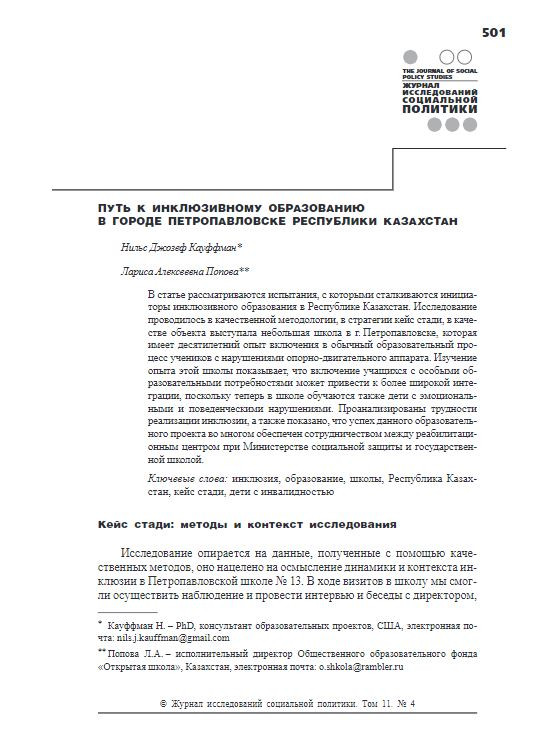 A Path to Inclusive Education in Petropavlovsk, Kazakhstan Año de publicación: 2013 Autor: Nils Joseph Kauffman | Larisa A. Popova The article examines the challenges faced by initiators of inclusive education in the Republic of Kazakhstan. The research was conducted in qualitative methodology, in a case study strategy, and the object was a small school in Petropavlovsk, which has ten years of experience in including students with motor disabilities in the regular educational process. The study of this school's experience shows that the inclusion of students with special educational needs can lead to broader integration, since children with emotional and behavioral disorders now also study at the school. The difficulties of implementing inclusion are analyzed, and it is shown that the success of this educational project is largely due to the cooperation between the rehabilitation center under the Ministry of Social Protection and the public school. Путь к инклюзивному образованию в городе Петропавловске Республики Казахстан Año de publicación: 2013 Autor: Nils Joseph Kauffman | Larisa A. Popova В статье рассматриваются испытания, с которыми сталкиваются инициаторы инклюзивного образования в Республике Казахстан. Исследование проводилось в качественной методологии, в стратегии кейс стади, в качестве объекта выступала небольшая школа в г. Петропавловске, которая имеет десятилетний опыт включения в обычный образовательный процесс учеников с нарушениями опорно-двигательного аппарата. Изучение опыта этой школы показывает, что включение учащихся с особыми образовательными потребностями может привести к более широкой интеграции, поскольку теперь в школе обучаются также дети с эмоциональными и поведенческими нарушениями. Проанализированы трудности реализации инклюзии, а также показано, что успех данного образовательного проекта во многом обеспечен сотрудничеством между реабилитационным центром при Министерстве социальной защиты и государственной школой.