
Recursos
Exploren una amplia gama de recursos valiosos en GCED para profundizar su comprensión y promover su búsqueda, incidencia, enseñanza y aprendizaje.
3,782 resultados encontrados
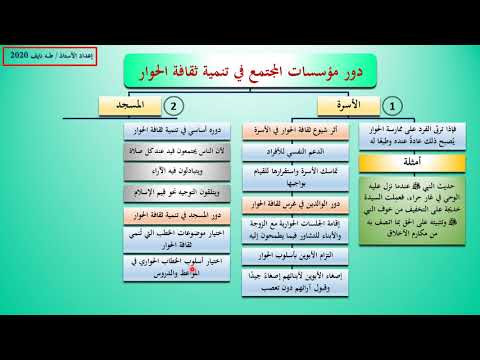 شرح الدرس الخامس: ثقافة الحوار Año de publicación: 2020 Autor: Taha Nayef يحاول المعلم في هذا الفيديو أن يشرح للطلاب مفهوم الحوار وآدابه. يقوم المعلم باستعراض أدوار الأسرة والمؤسسات التربوية وغيرها من مؤسسات المجتمع في تكوين الشخص المحاور. الدرس ملئ بالأمثلة الحية لآداب الحوار من خلال الحياة اليومية.
  Course: Dialogue and Dialogue Etiquette Año de publicación: 2017 Autor: Fath Omar Autor corporativo: Majmaah University The course includes two topics of dialogue and disagreement. It seeks to form the Muslim to be a tactful interlocutor and able to manage the conflict between him and his society and his counterparts. The course deals with one of the important pillars of global citizenship issues, which is dialogue. مقرر دراسي: الحوار وآداب الحوار Año de publicación: 2017 Autor: Fath Omar Autor corporativo: Majmaah University يتضمن المقرر موضوعي الحوار والخلاف. ويسعى لتشكيل المسلم ليكون محاوراً لبقاً، وقادراً على إدارة الخالف بينه ، وبين مجتمعه ومناظريه. المقرر يتعرض لأحد الركائز المهمة من مواضيع المواطنة العالمية وهو الحوار.
  [Video] Whole School Approach to Global Citizenship Año de publicación: 2011 Autor corporativo: Education Scotland Global citizenship brings together education for citizenship, international education and sustainable development education and recognises the common outcomes and principles of these three areas. All curriculum areas can contribute to developing the skills, attributes and knowledge that will create active global citizens.
 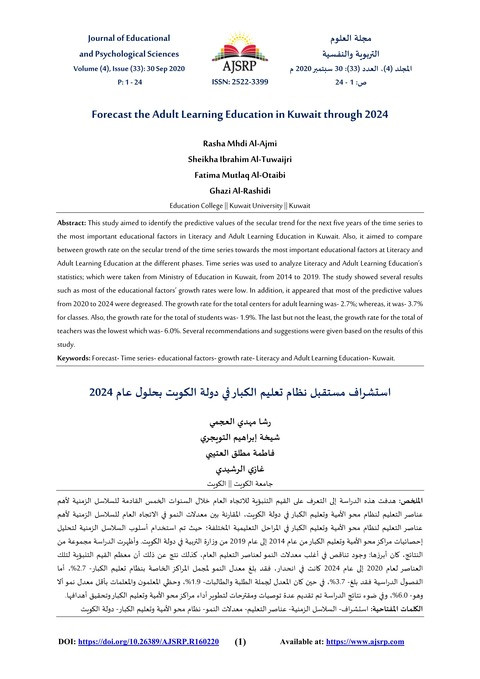 Forecast the Adult Learning Education in Kuwait Through 2024 (Journal of Educational and Psychological Sciences; vol.4, no.33) Año de publicación: 2020 Autor: Rasha Mhdi Al-Ajmi | Sheikha Ibrahim Al-Tuwaijri | Fatima Mutlaq Al-Otaibi | Ghazi Al-Rashidi Autor corporativo: Arab Institute of Science and Research Publishing (AISRP) This study aimed to identify the predictive values of the secular trend for the next five years of the time series to the most important educational factors in Literacy and Adult Learning Education in Kuwait. Also, it aimed to compare between growth rate on the secular trend of the time series towards the most important educational factors at Literacy and Adult Learning Education at the different phases. Time series was used to analyze Literacy and Adult Learning Education’s statistics; which were taken from Ministry of Education in Kuwait, from 2014 to 2019. The study showed several results such as most of the educational factors’ growth rates were low. In addition, it appeared that most of the predictive values from 2020 to 2024 were degreased. The growth rate for the total centers for adult learning was- 2.7%; whereas, it was- 3.7% for classes. Also, the growth rate for the total of students was- 1.9%. The last but not the least, the growth rate for the total of teachers was the lowest which was- 6.0%. Several recommendations and suggestions were given based on the results of this study. استشراف مستقبل نظام تعليم الكبار في دولة الكويت بحلول عام 2024 (مجلة العلوم التربوية و النفسية ;no.33, vol.4) Año de publicación: 2020 Autor: Rasha Mhdi Al-Ajmi | Sheikha Ibrahim Al-Tuwaijri | Fatima Mutlaq Al-Otaibi | Ghazi Al-Rashidi Autor corporativo: Arab Institute of Science and Research Publishing (AISRP) هدفت هذه الدراسة إلى التعرف على القيم التنبؤية للاتجاه العام خلال السنوات الخمس القادمة للسلاسل الزمنية لأهم عناصر التعليم لنظام محو الأمية وتعليم الكبار في دولة الكويت، المقارنة بين معدلات النمو في الاتجاه العام للسلاسل الزمنية لأهم عناصر التعليم لنظام محو الأمية وتعليم الكبار في المراحل التعليمية المختلفة؛ حيث تم استخدام أسلوب السلاسل الزمنية لتحليل إحصائيات مراكز محو الأمية وتعليم الكبار من عام 2014 إلى عام 2019 من وزارة التربية في دولة الكويت. وأظهرت الدراسة مجموعة من النتائج، كان أبرزها: وجود تناقص في أغلب معدلات النمو لعناصر التعليم العام، كذلك نتج عن ذلك أن معظم القيم التنبؤية لتلك العناصر لعام 2020 إلى عام 2024 كانت في انحدار، فقد بلغ معدل النمو لمجمل المراكز الخاصة بنظام تعليم الكبار- 2.7%، أما الفصول الدراسية فقد بلغ- 3.7%، في حين كان المعدل لجملة الطلبة والطالبات- 1.9%، وحظي المعلمون والمعلمات بأقل معدل نمو ألا وهو- 6.0%، وفي ضوء نتائج الدراسة تم تقديم عدة توصيات ومقترحات لتطوير أداء مراكز محو الأمية وتعليم الكبار وتحقيق أهدافها.
  Teaching approaches that help to build resilience to extremism among young people Año de publicación: 2011 Autor corporativo: United Kingdom. Department of Education This is a summary for decision-makers – policy- makers, school leaders, teachers and other practitioners, such as youth and community workers – of the key ingredients of evidence-based teaching approaches and interventions that are effective in building resilience to extremism among young people. It also details support factors in schools and other education settings that maximize the benefits and impact of such interventions. Teaching approaches that help to build resilience to extremism among young people Año de publicación: 2011 Autor corporativo: United Kingdom. Department of Education Il s’agit d’un résumé des éléments clés des approches et interventions éducatives qui se sont avérées efficaces pour développer et renforcer la résilience des jeunes à l’extrémisme, destiné aux décideurs politiques ou non, chefs d’établissement scolaire, enseignants et autres acteurs du domaine éducatif, comme les jeunes et les animateurs socio-culturels. Le livre détaille également le soutien à apporter aux écoles et autres environnements éducatifs pour maximiser les bénéfices et l’impact de ces interventions. Developing Positive Values: A case study of Holocaust Memorial Day in the primary schools of one local authority in Scotland Many schools and local authorities saw the initial Holocaust Memorial Day as an important stimulus to develop lessons and events in Holocaust history amongst young people of vital importance for today. The focus of this paper is to examine the potential for Holocaust education in the primary curriculum in Scotland and whether the instance of Holocaust Memorial Day and the undertaking of a serious commitment to it by a local authority had an impact on the teaching and raising of Holocaust issues in the primary schools in that area. The authors previously argued (Maitles & Cowan, 1999) that there needed to be a major commitment from the Scottish Executive and/or local councils to encourage teachers and schools to coordinate or introduce Holocaust education in the schools. To test this, the field research for this survey was conducted by means of a questionnaire to every primary school in the local authority and achieved a 91% response rate. Strong national commitment to Holocaust educational activities, backed up by commitment from the local authority, in terms of staff development and teaching materials, ensured a quality of experience as well as the quantity. Linked to this was an effective structure in the schools, with a designated Holocaust education coordinator and the involvement of the wider community. This led teachers in schools to imaginatively develop pupil skills, knowledge and understanding and informed attitudes in Holocaust history which potentially has a resonance in the wider citizenship area. (By the publisher) Values and Attitudes - Positive and Negative: A study of the impact of teaching the Holocaust on citizenship among Scottish 11-12 year olds Previous research on teaching the Holocaust, notably case studies in the primary or the secondary sectors, suggests that Holocaust education can make a significant contribution to citizenship by developing pupils’ understandings of justice, tolerance, human rights issues, and the many forms of racism and discrimination. Yet, there have been no longitudinal studies into its impact on primary pupils. This paper reports on the first stages of ongoing longitudinal research (sponsored by the Scottish Executive Education Department) and concentrates on the relevance of Holocaust education to citizenship, by comparing the attitudes of primary 7 pupils before and after Holocaust teaching using data from questionnaires. Results show an improvement in pupils’ values and attitudes after learning about the Holocaust in almost every category related to minority groups, ethnic or otherwise. One significant finding was a deep anti-English feeling and this in itself indicates the need for further investigation. (By the author)