
Recursos
Exploren una amplia gama de recursos valiosos en GCED para profundizar su comprensión y promover su búsqueda, incidencia, enseñanza y aprendizaje.
1,447 resultados encontrados
 Realization of the Sustainable Development Goals by, for and with Persons with Disabilities (UN Flagship Report on Disability and Development 2018) Año de publicación: 2018 Autor corporativo: United Nations (UN) Realization of the Sustainable Development Goals by, for and with persons with disabilities 'Disability and the 2030 Agenda for Sustainable Development' this report represents the first UN systemwide effort to examine disability and the Sustainable Development Goals (SDGs) of the 2030 Agenda for Sustainable Development at the global level. The report reviews data, policies and programmes and identifies good practices; and uses the evidence it reviewed to outline recommended actions to promote the realization of the SDGs for persons with disabilities. The report shows that despite the progress made in recent years, persons with disabilities continue to face numerous barriers to their full inclusion and participation in the life of their communities. It sheds light on their disproportionate levels of poverty, their lack of access to education, health services, employment, their under-representation in decision-making and political participation. This is particularly the case for women and girls with disabilities. Main barriers to inclusion entail discrimination and stigma on the ground of disability, lack of accessibility to physical and virtual environments, lack of access to assistive technology, essential services, rehabilitation and support for independent living that are critical for the full and equal participation of persons with disabilities as agents of change and beneficiaries of development. Data and statistics compiled and analysed in the present report indicate that persons with disabilities are not yet sufficiently included in the implementation, monitoring and evaluation of the SDGs.
 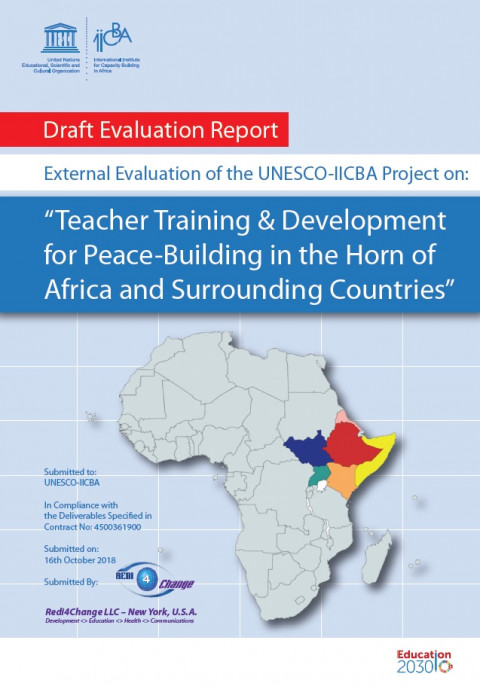 [Draft Evaluation Report] External Evaluation of the UNESCO-IICBA Project on: “Teacher Training & Development for Peace-Building in the Horn of Africa and Surrounding Countries” Año de publicación: 2018 Autor corporativo: UNESCO International Institute for Capacity-Building in Africa (IICBA) The project on “Teacher Training and Development for Peace-Building in the Horn of Africa and Surrounding Countries” was designed by UNESCO-IICBA and financed by the Government of Japan. The project benefitted six conflict-affected countries; Ethiopia, Eritrea, Somalia, Kenya, Uganda, and South Sudan by building on the mandate and niche expertise of UNESCO-IICBA in teacher education, as well as benefiting from the empathetic insights and financing of the Government of Japan.This evaluation report analyses the design, implementation, and consolidation of the project to assess the likelihood that it can facilitate peace education as an effective and integral part of the national education systems. The project’s short timeframe and modest financing mean that the evaluation could not credibly deal with its outcomes and impact; but efforts are made to gauge the uptake and sustainability of this project as a vehicle for promoting peace education and so help to prevent violent conflict and cultivate a culture of peace in the countries concerned.
  The United Nations World Water Development Report 2019: Leaving No One Behind Año de publicación: 2019 Autor corporativo: UNESCO World Water Assessment Programme (WWAP) The UNESCO World Water Assessment Programme brings together the work of numerous UN-Water Members and Partners to produce the United Nations World Water Development Report series.The annual editions focus on strategic water issues. UN-Water Members and Partners as well as other experts contribute the latest knowledge on a specific theme.The 2019 Report seeks to inform policy and decision-makers, inside and outside the water community, how improvements in water resources management and access to water supply and sanitation services are essential to overcoming poverty and addressing various other social and economic inequities.In an increasingly globalized world, the impacts of water-related decisions cross borders and affect everyone. Extreme events, environmental degradation, population growth, rapid urbanization, unsustainable and inequitable consumption patterns, conflicts and social unrest, and unprecedented migratory flows are among the interconnected pressures faced by humanity, often hitting those in vulnerable situations the hardest through their impacts on water.Addressing the inequalities faced by disadvantaged groups requires tailored solutions that take account of the day-to-day realities of people and communities in vulnerable situations. Properly designed and adequately implemented policies, efficient and appropriate use of financial resources, as well as evidence-based knowledge on water resources and water-related issues are also vital to eliminating inequalities in access to safe drinking water and sanitation.Titled ‘Leaving No One Behind ’, the report reinforces the commitments made by the UN member states in adopting the 2030 Agenda for Sustainable Development and in recognizing the human rights to safe drinking water and sanitation, both of which are essential for eradicating poverty and for building prosperous, peaceful societies. Informe mundial de las Naciones Unidas sobre el desarrollo de los recursos hídricos 2019: no dejar a nadie atrás Año de publicación: 2019 Autor corporativo: UNESCO World Water Assessment Programme (WWAP) El Programa Mundial de la UNESCO de Evaluación de los Recursos Hídricos reúne el trabajo de numerosos miembros y socios de ONU-Agua para producir la serie de informes de las Naciones Unidas sobre el desarrollo de los recursos hídricos en el mundo.Los informes anuales sobre el desarrollo de los recursos hídricos en el mundo se centran en cuestiones estratégicas relacionadas con el agua.Los miembros y socios de ONU-Agua, así como otros expertos, aportan los últimos conocimientos sobre un tema específico.La edición de 2019 del Informe Mundial de las Naciones Unidas sobre el Desarrollo de los Recursos Hídricos pretende informar a los responsables de las políticas y de la toma de decisiones, tanto dentro como fuera de la comunidad del agua, de hasta qué punto las mejoras en la gestión de los recursos hídricos y el acceso al suministro de agua y a los servicios de saneamiento son esenciales para superar la pobreza y afrontar varias otras desigualdades sociales y económicas.En un mundo cada vez más globalizado, los impactos de las decisiones relacionadas con el agua cruzan las fronteras y afectan a todas las personas. Los eventos extremos, la degradación del medio ambiente, el crecimiento demográfico, la rápida urbanización, unos patrones de consumo insostenibles e injustos y unos flujos migratorios sin precedentes son algunas de las presiones interrelacionadas a que se enfrenta la humanidad, y que a menudo golpean con mayor dureza a quienes se hallan en situaciones vulnerables a través de sus impactos en el agua.Abordar las desigualdades a que se enfrentan los grupos desfavorecidos requiere soluciones a medida, que tengan en cuenta las realidades del día a día de la gente y las comunidades en situaciones vulnerables. Políticas bien diseñadas y adecuadamente aplicadas, un uso eficiente y apropiado de los recursos financieros, así como un conocimiento de los recursos hídricos y las cuestiones relacionadas con el agua basado en la evidencia también son vitales para acabar con las desigualdades en el acceso al agua potable y al saneamiento seguros.El informe, titulado “No dejar a nadie atrás”, refuerza los compromisos asumidos por los Estados miembros de la ONU al adoptar la Agenda 2030 para el Desarrollo Sostenible y al reconocer los derechos humanos al agua potable y el saneamiento seguros, ambos esenciales para erradicar la pobreza y construir unas sociedades prósperas y pacíficas. Rapport mondial des Nations Unies sur la mise en valeur des ressources en eau 2019: ne laisser personne pour compte Año de publicación: 2019 Autor corporativo: UNESCO World Water Assessment Programme (WWAP) Le Programme mondial de l’UNESCO pour l’évaluation des ressources en eau (WWAP) réunit les travaux de nombreux membres et partenaires d’ONU-Eau afin de donner naissance à la série des Rapports mondiaux des Nations Unies sur la mise en valeur des ressources en eau (WWDR).Chaque année, ces Rapports mettent en lumière les enjeux stratégiques actuels liés à l’eau et les membres et partenaires d’ONU-Eau ainsi que d’autres experts ont recours aux connaissances les plus récentes sur un thème spécifique.L’édition 2019 du Rapport sur la mise en valeur des ressources en eau a pour objectif d’informer les décideurs et les responsables politiques, qu’ils fassent ou non partie de la communauté de l’eau, au sujet de la nécessité d’améliorer la gestion des ressources en eau et l’accès aux services d’approvisionnement en eau et d’assainissement en vue de venir à bout de la pauvreté et des diverses autres formes d’inégalités sociales et économiques.À l’heure de la mondialisation, les répercussions des décisions portant sur l’eau traversent les frontières et concernent tout un chacun. Les phénomènes extrêmes, la dégradation de l’environnement, la croissance démographique, l’urbanisation rapide, les modes de consommation non durables et non équitables, les conflits et les mécontentements sociaux, ainsi que les flux migratoires sans précédent, constituent les défis interdépendants auxquels est confrontée l’humanité et qui touchent souvent le plus durement ceux en situation de vulnérabilité de par leurs impacts sur les ressources en eau.La lutte contre les inégalités auxquelles font face les groupes défavorisés requiert également des solutions adaptées qui tiennent compte des réalités quotidiennes des personnes et des communautés en situation de vulnérabilité. Des politiques correctement conçues et mises en oeuvre, une utilisation efficace et appropriée des ressources financières, ainsi que des connaissances factuelles relatives aux ressources et aux questions liées à l’eau, sont également indispensables de manière à mettre fin aux inégalités d’accès à l’eau potable et à l’assainissement.Ce rapport, intitulé « Ne laisser personne pour compte », renforce les engagements pris par les États membres de l’ONU lors de l’adoption du Programme de développement durable à l’horizon 2030 et de la reconnaissance des droits de l’homme à l’eau potable et à l’assainissement, qui sont tous deux indispensables à l’éradication de la pauvreté et à la mise en place de sociétés prospères et pacifiques.
  [Summary] SDG 4 Data Digest 2018: Data to Nurture Learning; Executive Summary Año de publicación: 2018 Autor corporativo: UNESCO Institute for Statistics (UIS) The 2018 edition of the SDG 4 Data Digest: Data to Nurture Learning builds on last year’s report, which proposed a conceptual framework and tools to help countries improve the quality of their data and fulfil their reporting requirements. In this report, we present the wide range of national and cross-national learning assessments currently underway and the assessment experiences of practitioners in the field. The report draws on these experiences to present pragmatic approaches that can help countries monitor progress and make the best possible use of data for policymaking purposes. [Resumen] Compendio 2018 de Datos sobre el ODS 4: Estadísticas para Fomentar el Aprendizaje; resumen Año de publicación: 2018 Autor corporativo: UNESCO Institute for Statistics (UIS) La edición del Compendio 2018 de Datos sobre el ODS 4: Estadísticas para Fomentar el Aprendizaje apoya y expande el contenido del informe del año precedente, que proponía a los países un marco conceptual y un conjunto de herramientas para mejorar la calidad de sus estadísticas y cumplir con las obligaciones en materia de informes. En este documento, presentamos una amplia gama de evaluaciones de aprendizaje nacionales e internacionales que se realizan actualmente, así como las experiencias en evaluaciones de expertos en la materia. En el informe se elabora sobre esas experiencias para ofrecer soluciones pragmáticas que ayuden a monitorear el progreso y a lograr el mejor uso posible de los datos con miras a la formulación de políticas.
  National Consultation on the Situation of Prisons in Senegal: Improvement of the Condition of Detention, Social Integration and Prevention of Violent Extremism through Education, 23-24 May 2017, Dakar, Senegal: Report Año de publicación: 2017 Autor corporativo: UNESCO Dakar Sustainable Development Goal (SDG) 4 on education highlights the need to include our society’s most vulnerable and most margined members, such as prisoners, in order to ensure that all learners acquire the knowledge, skills, values and attitudes that are needed to build just, peaceful, and sustainable societies.The situation in Senegalese prisons is of a major concern given the overall condition of detention as well as the context of insecurity that characterizes the sector. In 2016, the country had 37 penal institutions for a total prison population of 9,422 prisoners (including pre-trial detainees and remand prisoners), of which approximately 200 were minors.1 Despite the efforts to humanize the prisons by adopting the name, “House of Arrest and Corrections” [Maison d'arrêt et de correction (MAC)] instead of the term "prison," and improving the living conditions in prisons, the fate of prisoners is not satisfactory. The reintegration promoted by Senegal's correctional facilities has largely consisted of a series of education programs, such as literacy and painting, developed by a number of organizations, but the space provided by prison administration, line Ministries, and NGOs are limited and the impact so far has been insufficient. A prison is not just a building, but it is also an instrument of rehabilitation to regain a place in society. This obviously requires the development of training, education and vocational guidance to support smooth reintegration into society.In this context, UNESCO's Dakar Regional Multi-Sectoral Office organized, in partnership with the Senegal National Commission for UNESCO and experts, a “National Consultation on the Situation of Prisons in Senegal: Improvement of the Condition of Detention, Social Integration, and Prevention of Violent Extremism through Education” in Dakar, Senegal, from 23 to 24 May 2017.
  Capacity Building Workshop on the Prevention of Violent Extremism through Education in West Africa and the Sahel: Final Report Año de publicación: 2017 Autor corporativo: UNESCO Dakar | Institut de la Francophonie pour l'éducation et la formation (IFEF) The capacity building workshop for the countries of West Africa and the Sahel, was organized in close collaboration with IICBA and APCEIU from 9 to 11 May 2017 in Dakar. The following countries participated in the meeting: Côte d’Ivoire, Cameroon, Guinea‐Bissau, Liberia, Mali, Mauritania, Niger, Senegal, Sierra Leone and The Gambia.This workshop was organized on the basis of a long‐standing partnership between UNESCO and the International Organization of La Francophonie (OIF), which strengthens its action on PVE. The regional workshop on capacity building for the prevention of violent extremism through education mainly used UNESCO materials and those for youth promoted by OIF. This workshop is a follow‐up to a similar initiative for education stakeholders of East and Southern Africa, organized in Addis Ababa in February 2017 by UNESCO through its International Institute for Capacity Building in Africa (IICBA).The overall objective of the workshop was to guide the countries of West Africa and the Sahel towards the Prevention of Violent Extremism (PVE). This includes familiarization with key issues, challenges, and opportunities identified to implement and further stimulate the implementation of the PVE strategy at the country level.
  2018 High-level Political Forum: Contribution from the SDG-Education 2030 Steering Committee Año de publicación: 2018 Autor corporativo: SDG-Education 2030 Steering Committee ECOSOC invited intergovernmental bodies, including the SDG-Education 2030 Steering Committee, to contribute to the 2018 High-level Political Forum. This contribution is based on the HLPF mandated structure for all submissions, and suggested focus areas from the perspective of SDG4 based on discussions held during the last SDG-Education 2030 Steering Committee meeting (Paris, 28 February – 2 March 2018).