
Recursos
Exploren una amplia gama de recursos valiosos en GCED para profundizar su comprensión y promover su búsqueda, incidencia, enseñanza y aprendizaje.
684 resultados encontrados
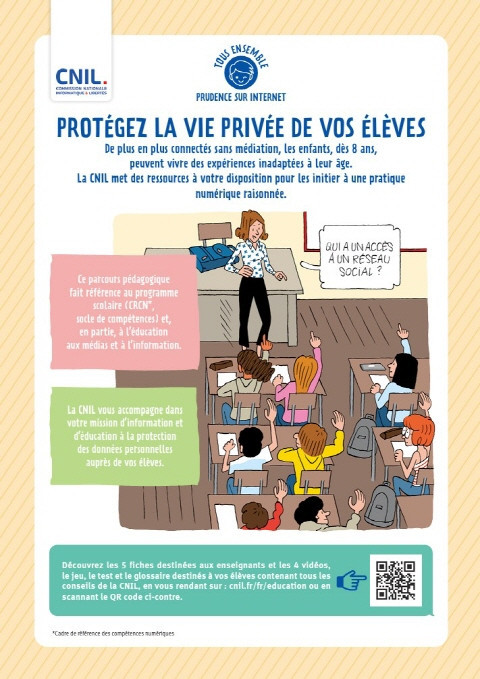 Protégez la vie privée de vos élèves Año de publicación: 2022 Autor corporativo: Commission nationale de l'informatique et des libertés (CNIL) La CNIL propose ce dossier pédagogique pour accompagner les enseignants dans leur mission d’information et d’éducation à la protection des données personnelles auprès de leurs élèves. Sous la forme d’un livret, découvrez cinq fiches adaptées au programme scolaire des cycles 2 et 3 (6 à 10 ans). Chacune présente le déroulé d’une séance de travail en classe en plusieurs temps dont un consacré au jeu. The CNIL offers this educational pack to support teachers in their mission to inform and educate their students about personal data protection. In the form of a booklet, discover five fact sheets adapted to the school curriculum for cycles 2 and 3 (ages 6 to 10). Each one outlines a class work session in several stages, one of which is devoted to games.
  Report on Digital Transformation in Higher Education in South Asia Año de publicación: 2025 Autor: Anil Mammen | Vinay Lautre Autor corporativo: UNESCO Bangkok | International Centre for Higher Education Innovation This report explores how higher education institutions (HEIs) in South Asia are advancing digital transformation to accelerate progress toward Sustainable Development Goal 4 (SDG 4) on quality education. Focusing on Bhutan, India, Maldives, Nepal, Pakistan, and Sri Lanka, it provides one of the first comprehensive regional analyses of how digitalization is reshaping teaching, learning, research, and community engagement.
  Global Media and Information Literacy Assessment Framework: Country Readiness and Competencies Año de publicación: 2013 Autor corporativo: UNESCO The MIL Assessment Framework can foster lifelong learning initiatives by building on the relationship between information, media, digital, and ICT literacies, along with societal transformations, education, workforce, policy and decision making processes, economic growth and democracy. The overall goal of the publication is to guide UNESCO’s Member States throughout the assessment of country readiness and competencies regarding the media and information literacy of citizens, in particular teachers in service and in training. The document is particularly aimed at the following stakeholders: policy makers and decision makers; national officers responsible for statistical data collection and analysis; educational policy makers and planners working in formal and informal education settings; teacher training institutions and teachers. It is also of relevance to the professional information and communication community, and has wide applicability for civil society at large.
  UNESCO MIL CLICKS Social Media Innovation Año de publicación: 2016 Autor corporativo: UNESCO MIL CLICKS is a way for people to acquire media and information literacy (MIL) competencies in their normal day-to-day use of the Internet and social media and to engage peer education in an atmosphere of browsing, playing, connecting, sharing, and socializing.The acronym MIL CLICKS stands for Media and Information Literacy: Critical-thinking, Creativity, Literacy, Intercultural, Citizenship, Knowledge & Sustainability.The objectives of this social media strategy are to use social media to:1) Expose people to become more media and information literate and to2) Raise awareness about the importance of media and information literacy.
  UNESCO MIL CLICKS: Innover avec les médias sociaux Año de publicación: 2016 Autor corporativo: Organisation des Nations Unies pour l'éducation, la science et la culture (UNESCO) MIL CLICKS permet non seulement aux gens d'acquérir des compétences en matière d'éducation aux médias et à l'information (MIL en anglais) dans leur utilisation quotidienne d'Internet et des médias sociaux mais également d'engager l'éducation par les pairs dans une atmosphère de navigation, de jeu, de connexion, de partage et de socialisation.
 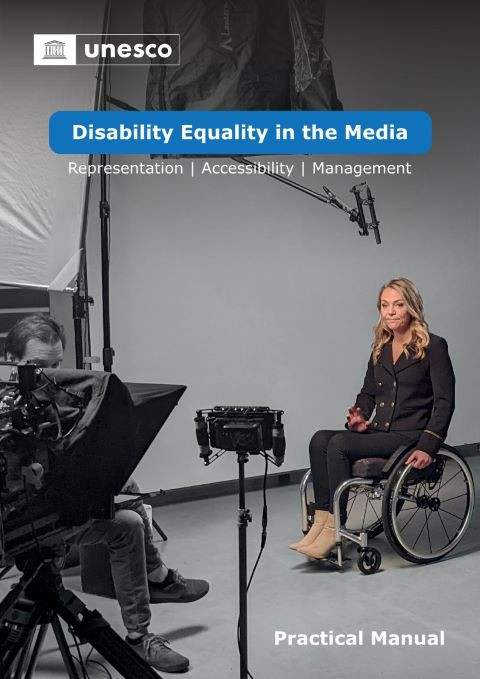 L’égalité des personnes handicapées dans les médias : représentation, accessibilité, gestion; manuel pratique Año de publicación: 2025 Autor corporativo: Organisation des Nations Unies pour l'éducation, la science et la culture (UNESCO) Promouvoir l’égalité des personnes handicapées dans les médias Malgré tous les changements positifs qui se produisent dans les salles de rédaction et les postes de direction, la diversité dans les médias reste un défi. Lorsque certains groupes sont laissés de côté, les médias ne présentent pas tous les aspects d'une histoire, manquent de perspectives diverses et d'idées novatrices. Par conséquent, le public ne reçoit pas une image complète, et les promesses de représentation juste et précise ne sont souvent pas tenues, ce qui affecte la perception que nous avons les uns des autres dans la société. C'est le cas des personnes handicapées, qui représentent 16 % de la population mondiale mais demeurent l'un des groupes les plus marginalisés. La couverture médiatique les néglige souvent, et lorsque leurs histoires sont racontées, elles sont souvent encadrées par des stéréotypes. Cela crée non seulement des obstacles, mais les prive également de leurs droits. Pour remédier à cette situation, les organisations médiatiques devraient renforcer les politiques éditoriales et la représentation, améliorer les conditions d'emploi et favoriser un environnement plus inclusif pour les professionnels handicapés.Le manuel pratique et la master classe fournissent des conseils concrets aux équipes éditoriales sur la manière d’assurer un traitement équitable et impartial du handicap. Pour les producteurs de contenus, ils décrivent comment rendre les contenus et les services médiatiques accessibles. Pour les responsables et les décideurs, ils incitent au changement, en démontrant comment l’égalité des personnes handicapées peut contribuer à la croissance du secteur des médias et créer de nouvelles sources de revenus.Le présent travail contribue à la mise en œuvre de la Convention des Nations Unies relative aux droits des personnes handicapées (2006) et promeut la liberté d’expression, le développement des médias et l’accès à l’information pour une participation véritable des personnes handicapées au débat public. Igualdad para las personas con discapacidad en los medios: representación, accesibilidad, gestión : manual práctico Año de publicación: 2025 Autor corporativo: Organización de las Naciones Unidas para la Educación, la Ciencia y la Cultura (UNESCO) Promover la igualdad para las personas con discapacidad en los mediosA pesar de todos los cambios positivos que suceden en las salas de prensa y con los roles de liderazgo, la diversidad en los medios continúa presentando un desafío. Cuando se excluyen ciertos grupos, los medios omiten mostrar todos los ángulos de una historia, las distintas perspectivas y las ideas innovadoras. Por lo tanto, la audiencia no recibe la información completa y las promesas de una representación certera, generalmente, no son suficientes, lo que afecta nuestra percepción del otro en la sociedad. Es el caso de las personas con discapacidad, que constituyen un dieciséis por ciento de la población global, pero aún es uno de los grupos más marginados. La cobertura de los medios con frecuencia los ignora y cuando se cuentan sus historias, por lo general, se enmarcan en un estereotipo. Esto no solo crea obstáculos, sino que además les niega el ejercicio de sus derechos. A fin de abordar esta situación, los medios deben ampliar las políticas editoriales y aumentar la representación, mejorar las condiciones de empleo y promover un entorno más inclusivo para profesionales con discapacidad.El Manual Práctico y la Master Class brindan consejos útiles para los equipos editoriales sobre el modo de asegurar que la cobertura de las personas con discapacidad sea justa y no esté sesgada. Para los generadores de contenido, se detalla de qué manera hacer que el contenido y los servicios mediáticos sean accesibles. Para gerentes y quienes estén a cargo de tomar decisiones, este material alienta a realizar cambios, demostrando cómo la igualdad de las personas con discapacidad puede contribuir al crecimiento de la industriaz mediática y generar nuevas fuentes de ingreso.Este trabajo contribuye a implementar la Convención Internacional de las Naciones Unidas sobre los Derechos de las Personas con Discapacidad de 2006 y promueve la libertad de expresión, el desarrollo de los medios y el acceso a la información, a fin de que las personas con discapacidad participen significativamente en el debate público.
  Opportunities for Media and Information Literacy in the Middle East and North Africa: Yearbook 2016 Año de publicación: 2016 Autor: Magda Abu-Fadil | Jordi Torrent | Alton Grizzle Autor corporativo: International Clearinghouse on Children, Youth and Media (Sweden) Opportunities for Media and Information Literacy in the Middle East and North Africa is the seventeenth Yearbook published by the Clearinghouse and fills a gap in the existing body of literature about the progress of media and information literacy work in different parts of the world. This book also helps educators in the Middle East and North Africa region looking for opportunities to bring to their classrooms elements of MIL education. Disability Equality in the Media: Representation, Accessibility, Management; Practical Manual Año de publicación: 2025 Autor corporativo: UNESCO Promoting Disability Equality in the Media Despite all the positive changes happening in newsrooms and leadership roles, diversity in the media remains a challenge.When certain groups are left out, the media fails to present all angles of a story, missing diverse perspectives and innovative ideas. Consequently, audiences do not receive the full picture, and promises of fair and accurate representation often fall short, affecting our perceptions of each other in society. It is the case of persons with disabilities, who make up 16 percent of the global population but remain one of the most marginalized groups. Media coverage frequently overlooks them, and when their stories are told, they are often framed through stereotypes. This not only creates barriers but also denies them their rights. To address this, media organizations should enhance editorial policies and representation, improve employment conditions, and foster a more inclusive environment for professionals with disabilities.The Practical Manual and Master Class provide hands-on advice to editorial teams on how to ensure fair and unbiased coverage of disability. For content producers, it details how to make media content and services accessible. To managers and decision makers, the material inspires change, demonstrating how disability equality can contribute to media industry growth and create new revenue streams.This work contributes to the implementation of the United Nations Convention on the Rights of Persons with Disabilities (2006) and promotes freedom of expression, media development, and access to information for the meaningful participation of persons with disabilities in public debate.
  Seoul Declaration on Media and Information Literacy for Everyone and by Everyone: A Defence Against Disinfodemics Año de publicación: 2020 Autor corporativo: UNESCO On the 10th anniversary of Global Media and Information Literacy Week, stakeholders from all over the world gave a resounding affirmation as to the urgency to strengthen people’s media and information literacy competencies. The number of celebratory events increased from one hundred events in 2019 to over three hundred events in 2020.The outcomes of the deliberations in the Feature Conference and Youth Agenda Forum have been immortalized in the Seoul Declaration on Media and Information Literacy for Everyone and by Everyone: A Defence against Disinfodemics. This Seoul Declaration benefited from a consultation with close to one thousand registered participants.Through the Seoul Declaration, partners and participants called for media and information literacy for all. They:Emphasized that “media and information literacy (MIL) is a core competency for addressing the disinfodemic, and that MIL also contributes to access to information, freedom of expression, protection of privacy, prevention of violent extremism, promotion of digital security and combating hate speech and inequality”.Recognized “UNESCO’s effort to promote a Global MIL Cities Framework to stimulate creative learning about MIL in city spaces and the involvement of non-traditional actors in promoting MIL”.Called on duty bearers at the national to city levels to “commit to advancing ‘Media and Information Literacy for Everyone and by Everyone’ through policy and resource allocation across all relevant areas, including education, health, elections, child protection, climate, gender equality, governance and regulation, to mention some examples”.Urged technological intermediaries to “play an accountable role, through institutionalized multi-stakeholder systems, as part of the social endeavor to tackle disinformation and to build communities that are media and information literate”.Requested UNESCO, in cooperation with other UN Agencies, to “maintain a focus on inclusion of disadvantaged groups in MIL engagements, and to continue to foster gender equality in relation to MIL.”