
Recursos
Exploren una amplia gama de recursos valiosos en GCED para profundizar su comprensión y promover su búsqueda, incidencia, enseñanza y aprendizaje.
883 resultados encontrados
 Teaching Controversial Issues Año de publicación: 2006 Autor corporativo: Oxfam GB Young people frequently face making decisions about a wide range of issues on which there are many different views. Issues like sexuality, religion, bullying, and war can evoke complicated emotions, both in and out of the classroom.Young people need to develop skills that allow them to discuss and come to their own views about these types of issues. Having a chance to engage with controversial topics in a constructive environment will help young people to develop as global citizens, and teachers have a key role to play in enabling this.This guide explores what controversial issues are, why they should be taught, and includes classroom strategies, existing guidance and practical teaching activities. Teaching Controversial Issues Año de publicación: 2006 Autor corporativo: Oxfam GB Les jeunes sont souvent confrontés à des prises de décisions dans de nombreux domaines. Des sujets tels que la sexualité, la religion, le harcèlement scolaire et la guerre peuvent susciter des émotions compliquées, que ce soit au sein des salles de classe ou ailleurs.Il est nécessaire que les jeunes développent des compétences leur permettant d’échanger sur ces sujets et de se forger leur propre opinion. Avoir la possibilité d’échanger sur des sujets controversés dans un environnement constructif peut aider les jeunes à devenir des citoyens mondiaux ; les enseignants ont un rôle primordial à jouer dans ce processus.Ce guide s'interroge sur la nature des questions controversées et la nécessité d'en parler ; il comprend des conseils et des activités pratiques d'apprentissage.
 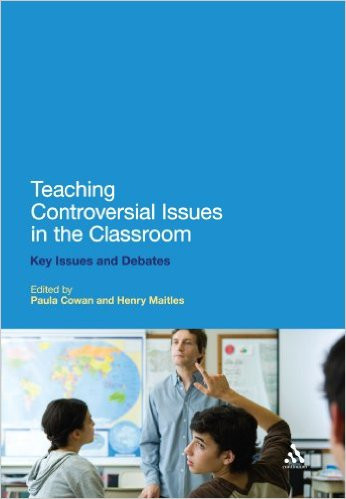 Teaching Controversial Issues in the Classroom: Key Issues and Debates Año de publicación: 2012 Autor: Paula Cowan, Henry Maitles Autor corporativo: Continuum The book provides an exploration of current debates and controversies relating to teaching controversial issues in primary and secondary schools. It investigates the changing nature of this type of learning experience and explore its contribution to the curriculum, particularly history and citizenship education. Topics covered include: - What is the 'right' age to discuss controversial issues? - The Citizenship Agenda - Discussing Iraq with school students - Teaching the Holocaust in the multicultural classroom – Islamophobia. International case studies provide fresh insights and valuable student and teacher feedback regarding the teaching of what many perceive as sensitive and difficult subjects. Teaching Controversial Issues in the Classroom: Key Issues and Debates Año de publicación: 2012 Autor: Paula Cowan, Henry Maitles Autor corporativo: Continuum Cet ouvrage propose un tour d'horizon des débats actuels que soulève la question de savoir s'il faut enseigner des sujets controversés à l’école primaire et au collège. L’auteur analyse également les changements engendrés par ce type d’expérience d’apprentissage et leur contribution aux programmes scolaires, particulièrement d’histoire et d’éducation civique.Les principaux thèmes abordés sont les suivants : A quel âge peut-on commencer à discuter de sujets controversés ? - L’agenda citoyen - Parler de l'Iraq avec les collégiens et lycéens - Enseigner l'Holocauste à une classe marquée par la diversité culturelle – L'islamophobie.
  Educating Against Extremism: Towards a Critical Politicisation of Young People Año de publicación: 2009 Autor: Lynn Davis The paper examines the nature of extremism; identity formation and radicalization; religious belief, faith schools and the myth of equal value; justice, revenge and honour; and free speech, humour and satire. It argues that religious fundamentalism, as well as state terrorism, needs to be addressed in schools. Specific forms of citizenship education are needed, which provide skills to analyse the media and political or religious messages, but also enable critical idealism to be fostered. ÉDUQUER CONTRE L’EXTRÉMISME : VERS UNE POLITISATION CRITIQUE DES JEUNES Año de publicación: 2009 Autor: Lynn Davis ÉDUQUER CONTRE L’EXTRÉMISME : VERS UNE POLITISATION CRITIQUE DES JEUNES—Cette Étude est basÉe sur un livre rÉcemment publiÉ, Educating against Extremism (Davies,Educating Against Extremism, 2008), qui explore le rôle potentiel des Écoles pour empêcher les formes plus nÉgatives et plus violentes d’extrÉmisme dans un pays. Elle examine la nature de l’extrÉmisme; la formation et la␣radicalisation de l’identitÉ; la croyance religieuse, les Écoles religieuses et le mythe de la valeur Égale; la justice, la vengeance et l’honneur; ainsi que la libre parole, l’humour et la satire. Cette Étude soutient que le fondamentalisme religieux doit être abordÉ dans les Écoles, aussi bien que le terrorisme d’État. L’argumentation de ce livre plaide pour une plus grande politisation des jeunes par le forgeage d’un (ir)respect critique et l’utilisation d’un fondement sÉculaire des droits de l’homme. On a besoin de formes spÉcifiques d’Éducation à la citoyennetÉ, qui fournissent des compÉtences pour analyser les mÉdias et les messages politiques ou religieux, mais qui permettent Également la stimulation d’un idÉalisme critique.
  Radicalisations Awareness Network (RAN) Edu's Guide on training programmes 'Effective and confident teachers and other school staff' Año de publicación: 2016 Autor corporativo: Radicalisations Awareness Network (RAN) This document will help teachers, principals, schools and (local and national) authorities discuss and design training programmes. Different training modules are identified, like (de)polarisation training, critical thinking, and how to turn a school into a safe and democratic mini society. Radicalisations Awareness Network (RAN) Edu's Guide on training programmes 'Effective and confident teachers and other school staff' Año de publicación: 2016 Autor corporativo: Radicalisations Awareness Network (RAN) Ce document aidera les enseignants, les directeurs d'école, les écoles et les autorités (locales et nationales) à discuter et à concevoir des programmes de formations. Différents modules de formation sont identifiés, comme la formation de dépolarisation, la pensée critique, et comment transformer une école en une mini société sûre et démocratique.
  Manifesto for Education - Empowering Educators and Schools Año de publicación: 2015 Autor corporativo: Radicalisations Awareness Network (RAN) The manifesto is a call to action to help empower the very group of people who have the potential to be some of the most influential in the lives of our young people and to help them truly prevent violent extremism. As it is impossible for schools to solve the problem alone and immediately, on different levels (the educator, the school, the partners and the government) suggestions are made to inspire interventions that could start tomorrow (short term) and help establish a sustainable approach for the future (long term). These insights are mostly based on experiences in secondary education but can easily be translated to primary, vocational and higher education. Manifesto for Education - Empowering Educators and Schools Año de publicación: 2015 Autor corporativo: Radicalisations Awareness Network (RAN) Le manifeste est un appel à l'action pour aider à renforcer ceux qui ont le potentiel d'être parmi les plus influents dans la vie de nos jeunes et pour les aider à prévenir véritablement l'extrémisme violent. Comme il est impossible pour les écoles de résoudre le problème seul et immédiatement, des suggestions sont faites à différents niveaux (au niveau de l'éducateur, de l'école, des partenaires, du gouvernement) pour inspirer des interventions qui pourraient commencer demain (à court terme) et aider à établir une approche durable pour l'avenir (à long terme). Ces idées sont principalement basées sur des expériences dans l'enseignement secondaire, mais peuvent facilement s'appliquer à l'enseignement primaire, professionnel et supérieur.