
Recursos
Exploren una amplia gama de recursos valiosos en GCED para profundizar su comprensión y promover su búsqueda, incidencia, enseñanza y aprendizaje.
1,727 resultados encontrados
 Éducation à la Citoyenneté Mondiale en Europe: Combien compte-t-elle pour nous? Año de publicación: 2018 Autor corporativo: European confederation of Relief and Development NGOs (CONCORD) Cette étude analyse le niveau des financements de l’éducation à la citoyenneté mondiale par les gouvernements nationaux à travers les États membres de l’UE, ainsi que la Norvège, entre 2011 et 2015. Le postulat de l’idée transparaît dans son intitulé « combien compte-telle pour nous ». En effet, un des indicateurs déterminants de l’engagement d’un pays en faveur d’une solidarité mondiale et d’une sensibilisation de ses propres citoyens aux interdépendances mondiales est le montant de financements publics dédiés à l’Education à la Citoyenneté Mondiale (mentionnée ci-après ECM). Le montant des fonds nationaux dédiés à l’ECM est directement lié à d’autres facteurs aux niveaux national et international, qui conditionnent l’ampleur du soutien et des engagements des gouvernements en faveur de l’ECM. Ainsi, au-delà de l’analyse des données liées aux financements, cette étude vise à explorer les contextes dans lesquels opèrent les gouvernements et les ONG, afin de brosser un tableau complet de l’état de l’ECM en Europe.
  Informative Kit on Global Citizenship Education (GCE) for Policy Makers: Boosting Global Citizenship Education Using Digital Storytelling Año de publicación: 2017 Autor corporativo: European Union (EU) | European Commission This informative kit aims to equip policy makers with all the necessary knowledge about the role that Global Citizenship Education (GCE) can play in contemporary society. This document will summarize GCE, its principles, capabilities and advantages and will provide best cases regarding its application. The goal is to convince policy makers into adopting GCE in the training and education curricula. Furthermore, it presents the Digital Storytelling (DS) method and its benefits as a tool to teach GCE more effectively.
  Manifeste pour une éducation à la citoyenneté planétaire: Pour vivre ensemble à 10 milliards, changeons l'éducation Año de publicación: 2015 Autor corporativo: Collectif Paris-Education 2015 Face à l’ampleur, l’urgence, la diversité et la complexité des problématiques engendrées par le modèle de développement de nos sociétés contemporaines, nous sommes donc obligés, dans l’urgence, de nous pencher sur les questions d’éducation et de formation des générations futures qui devront affronter des réalités biophysiques, économiques et politiques inédites, dont nous commençons à peine à entrevoir l’ampleur. Ce qui est dès lors en jeu, avec l’avenir de l’homme et de la Terre, c’est l’humain, ce qu’il deviendra, ce qu’il sera capable de porter comme projet pour l’humanité.Quelles qualités d’humains devons-nous faire advenir pour que ces réalités inédites puissent être rencontrées demain, sans que l’humanité bascule dans la violence et le dépeçage égoïste de la planète? Quels enfants voulons-nous laisser à notre Terre?Cette urgence impose un changement d’échelle dans la transformation des systèmes éducatifs, des contenus et des méthodes d’enseignement. Malgré la volonté et la compétence de nombreux acteurs de l’école, force est de constater que les actions menées pour une éducation plus en cohérence avec les enjeux climatiques et, plus largement, sociétaux restent à la marge. Elles sont réalisées par des individus clairvoyants. Il est temps d’enclencher la vitesse supérieure.
  L’école apprend la citoyenneté (Congrès des personnels d’encadrement MLF/OSUI 2016) Año de publicación: 2017 Autor corporativo: Mission laïque française Le groupe scolaire Louis-Massignon à Bouskoura (Casablanca, Maroc) a accueilli du 9 au 11 mai 2016 près de 300 acteurs de l’enseignement français, représentants des établissements du réseau mlfmonde, du réseau de l’AFLEC, des académiespartenaires (Dijon, Paris, Poitiers et Reims), des représentants du MAEDI, du MENESR, de la DNE, de la DGESCO et de l’AEFE, des grands établissements de l’Éducation nationale (CNED, Canopé, ESENESR, CIEP), des représentants de l’organisation du baccalauréat international, de l’Unesco et de la société civile.Les mesures qui entrent en vigueur sur l’éducation à la citoyenneté concernent les «valeurs de la République».Parce que l’enseignement moral et civique est conçu et établi pour et dans un contexte strictement national, se pose dès lors la question d’une adaptation à l’usage de l’enseignement français à l’étranger qui ne soit pas en contradiction avec l’intention et l’esprit de cette partie du programme.
 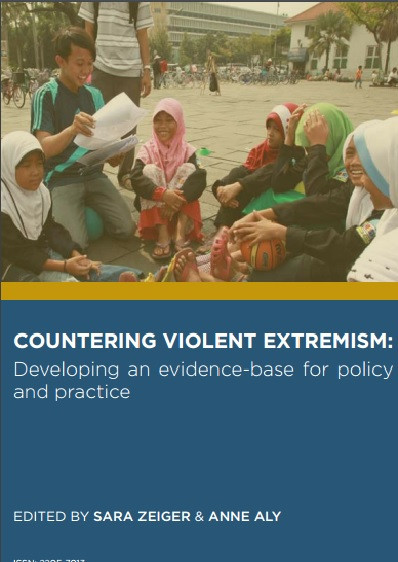 COUNTERING VIOLENT EXTREMISM: Developing an evidence-base for policy and practice Año de publicación: 2015 Autor: Sara Zeiger | Anne Aly Autor corporativo: Hedayah and Curtin University This volume reports on the range of papers presented at the Annual Countering Violent Extremism (CVE) Research Conference 2014 from 7-8 December 2014 in Abu Dhabi, United Arab Emirates. It presents two case studies on engaging with non-state actors within the community, namely families, community leaders and youth. COUNTERING VIOLENT EXTREMISM: Developing an evidence-base for policy and practice Año de publicación: 2015 Autor: Sara Zeiger | Anne Aly Autor corporativo: Hedayah | Curtin University Ce rapport présente une gamme des documents présentés à la Conférence annuelle de recherche sur la lutte contre l’extrémisme violent (CVE), qui a eu lieu du 7 au 8 décembre 2014 à Abou Dhabi, aux Emirats Arabes Unis. Il présente deux études de cas sur l’implication des acteurs non étatiques au sein de la communauté, à savoir les familles, les dirigeants communautaires et les jeunes.
  L'Éducation au Développement la citoyenneté mondiale au coeur de l’école Año de publicación: 2013 Autor: Sarah Goffin Autor corporativo: Fédération des Associations de Parents de l'enseignement Officiel Éducation au Développement » (ED), « Éducation à la Citoyenneté Mondiale » (ECM) ou encore « sensibilisation à la solidarité Nord-Sud »… autant d’expressions obscures auxquelles sont confrontés les élèves de primaire et de secondaire, souvent sollicités par des ONG ou par leurs professeurs. Mais que se cache-t-il réellement derrière ces concepts ?C’est ce que nous allons chercher à identifier au cours de cette analyse : définir les concepts, décortiquer ce qui se passe en classe, comment, par qui et pourquoi.La question sera abordée sous divers angles et points de vue : celui des enseignants, des élèves et des intervenants extérieurs.
  Développement d’une perspective mondiale pour enseignants et enseignantes (Revue d'éducation Volume 3, No 2, Automne 2013) Año de publicación: 2013 Autor: Lorna R. McLean | Nicholas Ng-A-Fook Autor corporativo: Université d’Ottawa. Faculté d’éducation Les corédacteurs tiennent à remercier Marc-Alexandre Prud’homme, Jennifer Cogswell, Joanne Lalonde et Taiva Tegler pour leur aide dans la préparation des dossiers et la communication avec les auteurs, leurs collègues pour la relecture des articles ainsi que le vice-doyen Raymond Leblanc et Anne-Sophie Ducellier pour leur soutien constant à la publication de cette revue.
 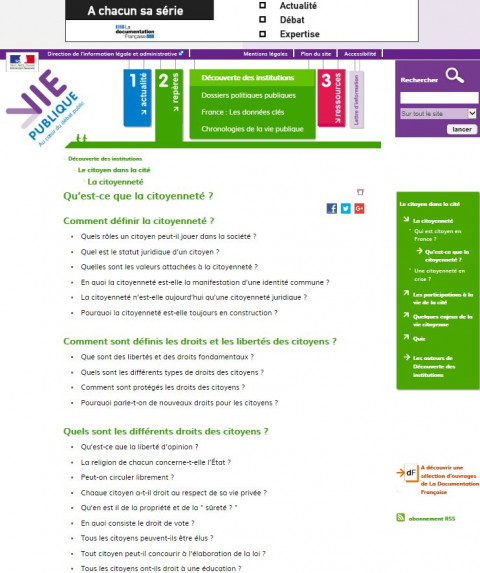 Qu’est-ce que la citoyenneté ? Año de publicación: 2018 Autor corporativo: Direction de l'information légale et administrative Qu’est-ce que la citoyenneté ? Comment définir la citoyenneté ? Comment sont définis les droits et les libertés des citoyens ? Quels sont les différents droits des citoyens ? Les citoyens ont-ils des devoirs ? Quels sont les devoirs des citoyens ?
  Periodismo e inteligencia artificial en América Latina Año de publicación: 2023 Autor: Natalia Zuazo Autor corporativo: UNESCO Montevideo En un contexto de crecimiento exponencial de la inteligencia artificial (IA) y predominancia tecnológica en todas las esferas de la vida –económica, social, cultural, ambiental y política-, este Cuaderno explora el impacto de la IA en el periodismo desde una perspectiva crítica y ética, con especial atención a América Latina. Se abordan desigualdades y desafíos inherentes a la implementación de la IA en la región. Con ello, se busca ofrecer una herramienta útil en la formación continua de estudiantes y profesionales de medios de comunicación.