
Recursos
Exploren una amplia gama de recursos valiosos en GCED para profundizar su comprensión y promover su búsqueda, incidencia, enseñanza y aprendizaje.
1,447 resultados encontrados
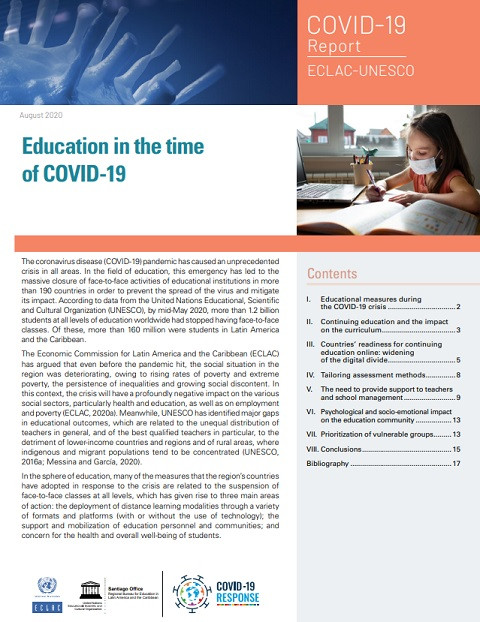 Education in the Time of COVID-19 (COVID-19 Report; ECLAC-UNESCO) Año de publicación: 2020 Autor corporativo: Economic Commission for Latin America and the Caribbean (ECLAC) | UNESCO Santiago The coronavirus disease (COVID-19) pandemic has caused an unprecedented crisis in all areas. In the field of education, this emergency has led to the massive closure of face-to-face activities of educational institutions in more than 190 countries in order to prevent the spread of the virus and mitigate its impact. The Economic Commission for Latin America and the Caribbean (ECLAC) has argued that even before the pandemic hit, the social situation in the region was deteriorating, owing to rising rates of poverty and extreme poverty, the persistence of inequalities and growing social discontent. In this context, the crisis will have a profoundly negative impact on the various social sectors, particularly health and education, as well as on employment and poverty. Meanwhile, UNESCO has identified major gaps in educational outcomes, which are related to the unequal distribution of teachers in general, and of the best qualified teachers in particular, to the detriment of lower-income countries and regions and of rural areas, where indigenous and migrant populations tend to be concentrated.In the sphere of education, many of the measures that the region’s countries have adopted in response to the crisis are related to the suspension of face-to-face classes at all levels, which has given rise to three main areas of action: the deployment of distance learning modalities through a variety of formats and platforms (with or without the use of technology); the support and mobilization of education personnel and communities; and concern for the health and overall well-being of students.The aim of this document is to shed light on various consequences that these measures will have on educational communities in the short and medium term, and to offer key recommendations on how to manage those consequences in the best possible manner, drawing attention to opportunities for learning and innovation in the post-pandemic education system. La educación en tiempos de la pandemia de COVID-19 (Inform COVID-19; CEPAL-UNESCO) Año de publicación: 2020 Autor corporativo: Economic Commission for Latin America and the Caribbean (ECLAC) | UNESCO Santiago La pandemia de enfermedad por coronavirus (COVID-19) ha provocado una crisis sin precedentes en todos los ámbitos. En la esfera de la educación, esta emergencia ha dado lugar al cierre masivo de las actividades presenciales de instituciones educativas en más de 190 países con el fin de evitar la propagación del virus y mitigar su impacto.La Comisión Económica para América Latina y el Caribe (CEPAL) ha planteado que, incluso antes de enfrentar la pandemia, la situación social en la región se estaba deteriorando, debido al aumento de los índices de pobreza y de pobreza extrema, la persistencia de las desigualdades y un creciente descontento social. En este contexto, la crisis tendrá importantes efectos negativos en los distintos sectores sociales, incluidos particularmente la salud y la educación, así como en el empleo y la evolución de la pobreza. Por su parte, la UNESCO ha identificado grandes brechas en los resultados educativos, que se relacionan con una desigual distribución de los docentes, en general, y de los docentes mejor calificados, en particular, en desmedro de países y regiones con menores ingresos y de zonas rurales, las que suelen concentrar además a población indígena y migrante.En el ámbito educativo, gran parte de las medidas que los países de la región han adoptado ante la crisis se relacionan con la suspensión de las clases presenciales en todos los niveles, lo que ha dado origen a tres campos de acción principales: el despliegue de modalidades de aprendizaje a distancia, mediante la utilización de una diversidad de formatos y plataformas (con o sin uso de tecnología); el apoyo y la movilización del personal y las comunidades educativas, y la atención a la salud y el bienestar integral de las y los estudiantes.El objetivo de este documento es visibilizar la diversidad de consecuencias que estas medidas tendrán sobre las comunidades educativas a corto y mediano plazo, así como plantear las principales recomendaciones para sobrellevar el impacto de la mejor manera posible, proyectando oportunidades para el aprendizaje y la innovación en la educación posterior a la pandemia.
 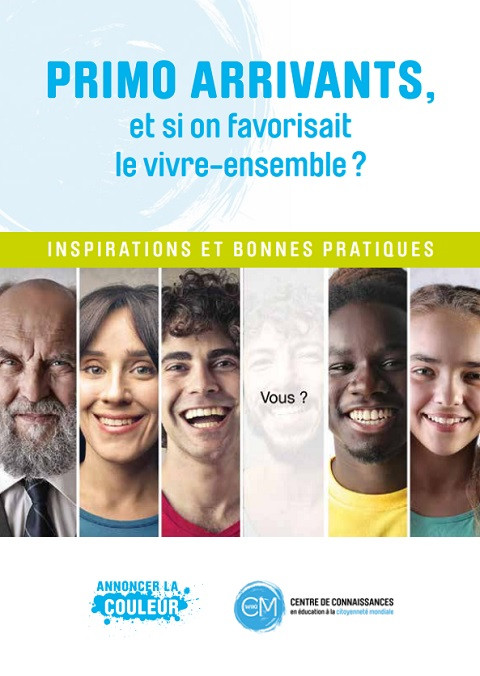 Primo arrivants, et si on favorisait le vivre-ensemble: Inspirations et bonnes pratiques Año de publicación: 2018 Autor corporativo: Annoncer la Couleur (ALC) | Centre de Connaissances en Éducation à la Citoyenneté Mondiale (WikiCM) Depuis plusieurs années, Annoncer la Couleur soutient des projets qui ont pour objectif de favoriser le vivre-ensemble dans les écoles avec des primo-arrivants. Ces projets, créés dans des contextes multiples et variés, nous ont questionné sur le rôle que joue l’éducation à la citoyenneté mondiale dans l’intégration des élèves. À travers cette publication, nous souhaitons vous présenter le fruit de la réflexion menée lors de la journée d’échanges et d’inspiration qui s’est déroulée le vendredi 12 octobre 2018 à Namur autour de la thématique « Primo-arrivants à l’école : et si on favorisait le vivreensemble ? » Lors de celle-ci, nous avons rassemblé des spécialistes et des enseignant∙e∙s porteur∙euse∙s de projets pour réfléchir et questionner la place des projets d’éducation à la citoyenneté mondiale face à ce défi toujours plus grand d’ouverture et d’acceptation des différences. L’ensemble des interventions, témoignages et échanges sont venus éclairer et enrichir nos pratiques de projets dans ce contexte d’intégration des primo-arrivants. Cette journée nous a confirmé que l’éducation à la citoyenneté mondiale peut être un levier pour favoriser le vivre-ensemble dans les écoles avec des élèves primo-arrivants (en DASPA ou non). Au sein de cet ouvrage, vous trouverez les articles tirés des interventions de Martine AbdellahPretceille « Éducation interculturelle et éducation la citoyenneté » et de Danièle Crutzen et Ahmed Talbi « Discours directs et indirects ». Ensuite, vous découvrirez huit projets d’éducation à la citoyenneté mondiale qui visent à favoriser l’intégration des primo-arrivants à l’école. Pour conclure, nous vous proposons un article synthétisant les « bonnes pratiques » que nous avons relevées pour la mise en projet.
  한국사회와 지속가능발전목표 16: 우리의 지속가능한 평화 Año de publicación: 2019 Autor: 김성경 | 이성훈 | 이재영 | 이향규 | 정성헌 | 김명신 Autor corporativo: 유네스코한국위원회 유네스코한국위원회는 좀더 많은 사람들이 SDGs를 쉽게 이해하도록 돕기 위해 ‘한국사회와 지속기능발전목표’ 라는 이름 아래 SDGs 해설서를 발간하고 있습니다.16번 해설서인 『한국사회와 지속가능발전목표 16: 우리의 지속가능한 평화』 는 남북 분단 상황 속에서 점차 다문화사회로 변화해가는 오늘날 우리의 일상이 어떻게 하면 더욱 포용적으로 발전할 수 있을지에 대한 이야기로 독자 여러분의 이해를 돕기 위해 각 분야의 전문가들을 인터뷰한 내용으로 구성돼 있습니다.
 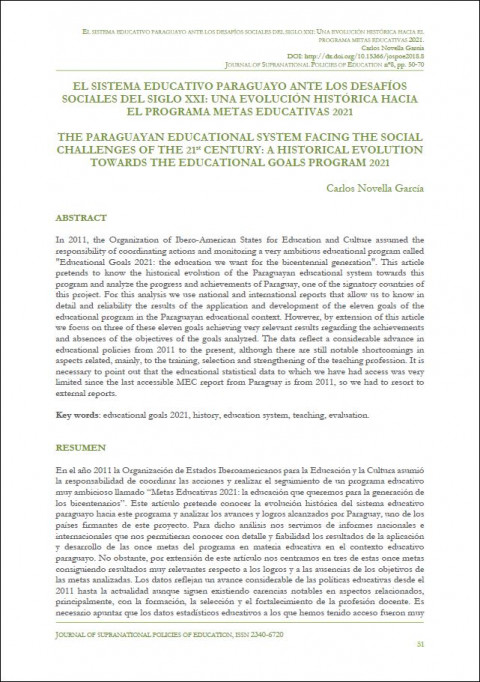 The Paraguayan Educational System Facing the Social Challenges of the 21st Century: A Historical Evolution Towards the Educational Goals Program 2021 Año de publicación: 2018 Autor: Carlos Novella García Autor corporativo: Autonomous University of Madrid In the summary the author sustains: "In 2011 the Iberoamerican States Organization for Education and Culture assumed the responsibility of coordinatin the actions and follow a challenging educative programa called "Educative Goals 2021: the education that we want for the generations of the bicentenary". This article pretends to learn the full details of this program and analyze the progresses and achievements made by Paraguay, one of the countries that signed this project. Different national and international reports were analysed in order to know, in detail and in a reliable way, the results of the application and development of the eleven goals of the program regarding education in the Paraguayan context. Nevertheless, due to the extension of this article, the authors focused on three of the eleven goals and obtained very relevant results concerning the absences and achievements of the objectives of these goals. The data evidences considerable progress in the education policies since 2011 although education, selection and professional development of teachers is still lacking development." I would add that the author highlights the importance of an international and Iberoamerican citizenship. El sistema educativo paraguayo ante los desafíos sociales del siglo XXI: una evolución histórica hacia el programa metas educativas 2021 Año de publicación: 2018 Autor: Carlos Novella García Autor corporativo: Autonomous University of Madrid En el resumen el autor sostiene: "En el año 2011 la Organización de Estados Iberoamericanos para la Educación y la Cultura asumió la responsabilidad de coordinar las acciones y realizar el seguimiento de un programa educativo muy ambicioso llamado “Metas Educativas 2021: la educación que queremos para la generación de los bicentenarios”. Este artículo pretende conocer con más detalle los fines de este programa y analizar los avances y logros alcanzados por Paraguay uno de los países firmantes de este proyecto. Para dicho análisis nos servimos de informes nacionales e internacionales que nos permitieran conocer con detalle y fiabilidad los resultados de la aplicación y desarrollo de las once metas del programa en materia educativa en el contexto educativo paraguayo. No obstante, por extensión de este artículo nos centramos en tres de estas once metas consiguiendo resultados muy relevantes respecto a los logros y a las ausencias de los objetivos de las metas analizadas. Los datos reflejan un avance considerable de las políticas educativas desde el 2011 hasta la actualidad aunque siguen existiendo carencias notables en aspectos relacionados, principalmente, con la formación, la selección y el fortalecimiento de la profesión docente." Agregaría que el autor subraya la importancia de una ciudadanía internacional e Iberoamericana.
  The Future of Education and Skills: Education 2030 Año de publicación: 2018 Autor corporativo: Organisation for Economic Co-operation and Development (OECD) The aim of OECD’s Education 2030: The Future of Education and Skills project is to support countries to find answers to two far-reaching questions: “What knowledge, skills, attitudes and values will today’s students need to shape and thrive their world in 2030?” and “How can instructional systems develop these knowledge, skills, attitudes and values effectively?” This OECD Education 2030 position paper considers the challenges that young people will face; suggests the importance of the concept of learner agency; proposes an overarching learning framework with transformative competencies; reviews the nature of the knowledge, skills, attitudes and values that young people will need; and ends with possible curriculum design principles. It encapsulates the key messages of the project so far. Le Futur de l’éducation et des compétences: Projet Éducation 2030 Año de publicación: 2018 Autor corporativo: Organisation for Economic Co-operation and Development (OECD) Le projet Le Futur de l’éducation et des compétences : Éducation 2030 a pour objectif d’aider les pays à trouver des réponses à deux questions d’une portée considérable : « De quelles connaissances, compétences, attitudes et valeurs les élèves d’aujourd’hui auront-ils besoin pour réussir leur vie et bâtir le monde de demain ? » et « Comment les systèmes éducatifs peuvent-ils transmettre ces connaissances, compétences, attitudes et valeurs de manière efficace ? » Cette note d’information sur le projet Éducation 2030 de l’OCDE étudie les défis auxquels les jeunes générations vont être confrontées, met en lumière l’idée de capacité d’agir des apprenants, propose un cadre d’apprentissage global reposant sur des compétences transformatives, revient sur la nature des connaissances, des compétences, des attitudes et des valeurs dont les jeunes auront besoin à l’avenir et se conclut par de possibles principes de conception des programmes scolaires. Les principaux messages tirés du projet jusqu’à présent sont également présentés. OECD学习框架 2030: 经济合作与发展组织 (OECD) Año de publicación: 2018 Autor corporativo: Organisation for Economic Co-operation and Development (OECD) "教育公平" "高质量的教育" "核心素养" "减负'等已成为流行热词,在新时代背景下实践者对 究竟要"教什么"需要再思考。经济合作与发展组织(简称经合组织 OECD) 2015 年启动了"教育2030: 未来 的教育与技能"项目,项目中启动了"面向 2030 的学习指南"讨论,旨在开发一种新的学习框架,描述需要用什 么样的能力来塑造未来的一代。学习框架包括知识、技能、态度和价值观,个人和社会的福祉 变革性能力,通 过反思、预期和行动的过程,调动知识 技能、态度和价值观,以便发展与世界接触所需的相互关联的能力.此 外, "教育与技能2030项目"专家组也提出了设计教育体系与课程改革的指导原则,包括概念、内容和主题设计 以及流程设计.
  Programa de formación continua en educación para la sustentabilidad; Informe Edición 2018 Año de publicación: 2018 Autor corporativo: Universidad de San Andrés El programa(Programa de Educación para la Sustentabilidad) se propuso trabajar en la promoción de la Educación para la Susten-tabilidad en las escuelas, a fin de generar en toda la comunidad educativa una cultu-ra sustentable. Este trabajo se basó en un enfoque holístico orientado al desarrollo de una mirada crítica y transformadora, y en la promoción de la participación ciuda-dana.Nuestro planteo fue que cada participante diseñe una propuesta pedagógica innova-dora en Educación para la Sustentabilidad, que responda a las particularidades de su institución de pertenencia, pero que a la vez pueda ser replicada por otras institu-ciones y actores. De esta forma, se deja capacidad instalada para la planificación e implementación de proyectos educativos orientados a la promoción de la Educación para la Sustentabilidad. Mediante las suce-sivas ediciones del programa, buscamos fortalecer una masa crítica de especialistas en Educación para la Sustentabilidad como apoyo a la calidad del sistema educativo en Argentina, conformando una Comunidad Profesional de Aprendizaje que reconozca a nuestro programa como un espacio de encuentro y referencia.