
Recursos
Exploren una amplia gama de recursos valiosos en GCED para profundizar su comprensión y promover su búsqueda, incidencia, enseñanza y aprendizaje.
1,448 resultados encontrados
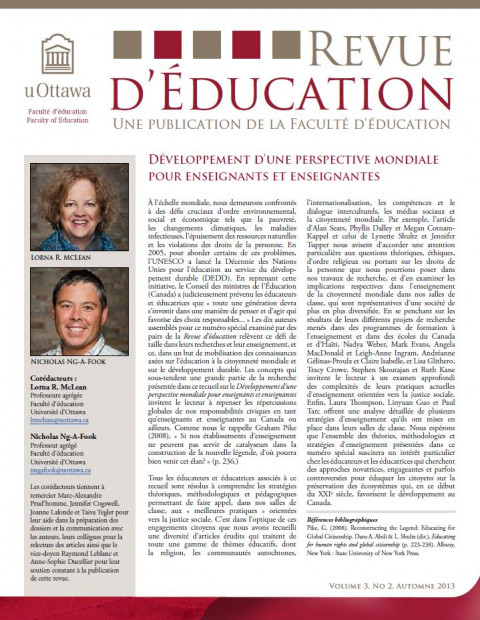 Développement d’une perspective mondiale pour enseignants et enseignantes (Revue d'éducation Volume 3, No 2, Automne 2013) Año de publicación: 2013 Autor: Lorna R. McLean | Nicholas Ng-A-Fook Autor corporativo: Université d’Ottawa. Faculté d’éducation Les corédacteurs tiennent à remercier Marc-Alexandre Prud’homme, Jennifer Cogswell, Joanne Lalonde et Taiva Tegler pour leur aide dans la préparation des dossiers et la communication avec les auteurs, leurs collègues pour la relecture des articles ainsi que le vice-doyen Raymond Leblanc et Anne-Sophie Ducellier pour leur soutien constant à la publication de cette revue.
 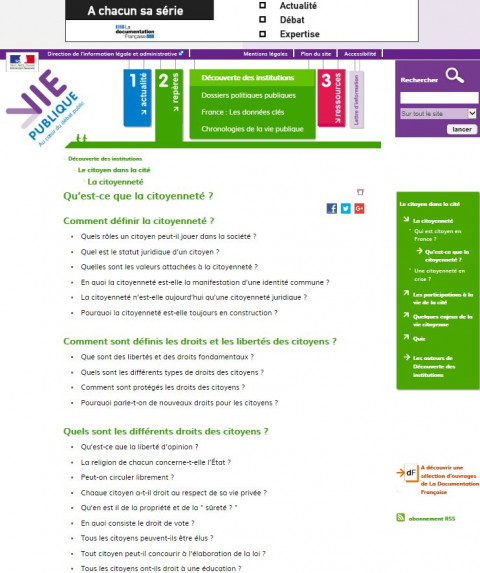 Qu’est-ce que la citoyenneté ? Año de publicación: 2018 Autor corporativo: Direction de l'information légale et administrative Qu’est-ce que la citoyenneté ? Comment définir la citoyenneté ? Comment sont définis les droits et les libertés des citoyens ? Quels sont les différents droits des citoyens ? Les citoyens ont-ils des devoirs ? Quels sont les devoirs des citoyens ?
 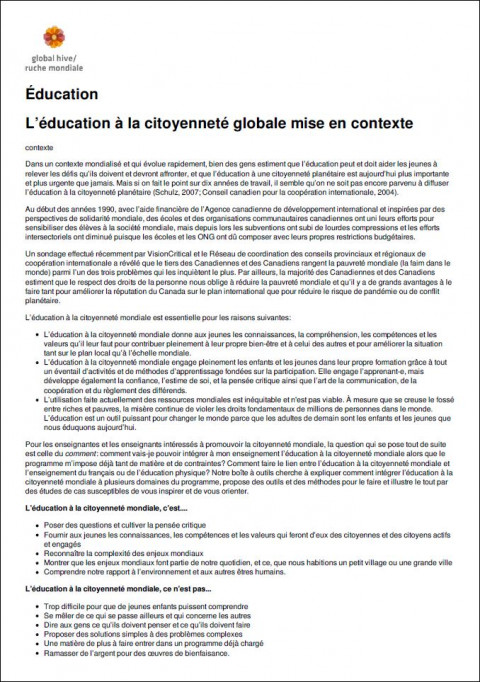 L'éducation à la citoyenneté globale mise en contexte Autor corporativo: Global Hive L’éducation à la citoyenneté mondiale est essentielle pour les raisons suivantes:L’éducation à la citoyenneté mondiale donne aux jeunes les connaissances, la compréhension, les compétences et les valeurs qu’il leur faut pour contribuer pleinement à leur propre bien-être et à celui des autres et pour améliorer la situation tant sur le plan local qu’à l’échelle mondiale.L’éducation à la citoyenneté mondiale engage pleinement les enfants et les jeunes dans leur propre formation grâce à tout un éventail d’activités et de méthodes d’apprentissage fondées sur la participation. Elle engage l’apprenant-e, mais développe également la confiance, l’estime de soi, et la pensée critique ainsi que l’art de la communication, de la coopération et du règlement des différends.L’utilisation faite actuellement des ressources mondiales est inéquitable et n'est pas viable. À mesure que se creuse le fossé entre riches et pauvres, la misère continue de violer les droits fondamentaux de millions de personnes dans le monde.L’éducation est un outil puissant pour changer le monde parce que les adultes de demain sont les enfants et les jeunes que nous éduquons aujourd’hui.Pour les enseignantes et les enseignants intéressés à promouvoir la citoyenneté mondiale, la question qui se pose tout de suite est celle du comment: comment vais-je pouvoir intégrer à mon enseignement l’éducation à la citoyenneté mondiale alors que le programme m’impose déjà tant de matière et de contraintes? Comment faire le lien entre l’éducation à la citoyenneté mondiale et l’enseignement du français ou de l’éducation physique? Notre boîte à outils cherche à expliquer comment intégrer l’éducation à la citoyenneté mondiale à plusieurs domaines du programme, propose des outils et des méthodes pour le faire et illustre le tout par des études de cas susceptibles de vous inspirer et de vous orienter.
 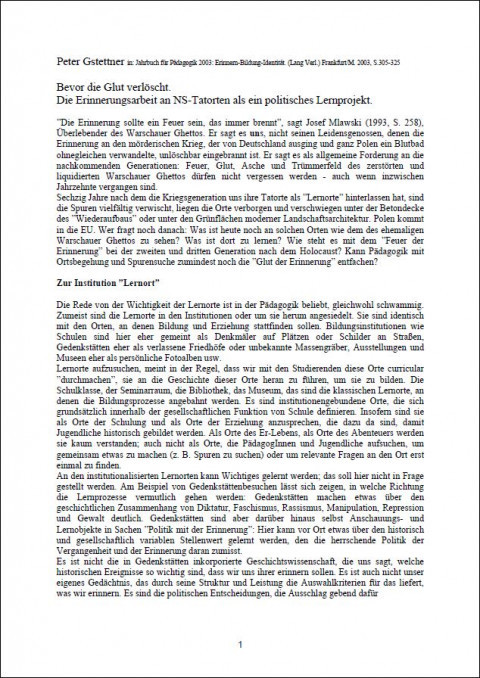 Before the Fire is Extinguished: The Commemoration Work at Nazi Memorial Sites as a Project of Political Learning Año de publicación: 2003 Autor: Peter Gstettner The original title: Bevor die Glut verlöscht: Die Erinnerungsarbeit an NS-Tatorten als ein Politisches Lernprojekt(In Jahrbuch für Pädagogik 2003)The author reflects upon his experience of reconstructing Nazi history in Germany. All efforts to spread light upon the dark sides of this history end up in the attempt to break the collective silence and to retune the song from “the good old times.” Memorial sites pedagogy and educational policies must decide the relevance of the past for the present, expose local Nazi history, and set the gaze, across the wall of silence, on the future. Tangible memory work and personal experiences of pain are steps towards makingxsubmerged memories, obliterated traces and forgotten places useful again for an education for democracy and tolerance. (Written by publisher) The above abstract is taken from the International Holocaust Remembrance Alliance Education Research Project. Please also consult the full list of abstracts in 15 languages and the accompanying publication Research in Teaching and Learning about the Holocaust: A Dialogue Beyond Borders. Ed: IHRA, Monique Eckmann, Doyle Stevick, Jolanta Ambrosewicz-Jacobs, 2017, Metropol Verlag at www.holocaustremembrance.com/resources/publications.
  Between Distanced Textual Analysis and Moral Judgment – an Excerpt from Mein Kampf in History Class Año de publicación: 2002 Autor: Oliver Hollstein The original title: Zwischen Distanzierter Textanalyse und Moralischer Verurteilung – ein Auszug aus Mein Kampf im Geschichtsunterricht(Pädagogische Korrespondenz, 29, pp. 70–87)This case study analyses how students in a German Upper Secondary class works with an excerpt from Mein Kampf in a thematic block about the Nazi state’s racist ideology and propaganda.The above abstract is taken from the International Holocaust Remembrance Alliance Education Research Project. Please also consult the full list of abstracts in 15 languages and the accompanying publication Research in Teaching and Learning about the Holocaust: A Dialogue Beyond Borders. Ed: IHRA, Monique Eckmann, Doyle Stevick, Jolanta Ambrosewicz-Jacobs, 2017, Metropol Verlag at www.holocaustremembrance.com/resources/publications.
 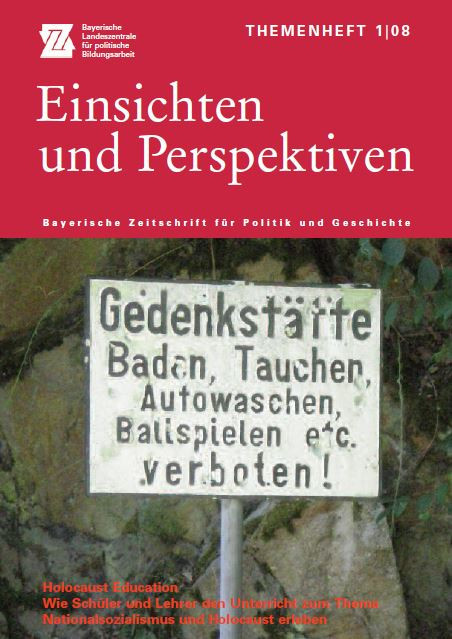 Holocaust Education: How Students and Teachers Experience Teaching and Learning about National Socialism and the Holocaust Año de publicación: 2008 Autor corporativo: Bayerische Landeszentrale fürpolitische Bildungsarbeit The original title: Holocaust Education: Wie Schüler und Lehrer den Unterricht zum Thema Nationalsozialismus und Holocaust Erleben(Bayerische Zeitschrift für Politik und Geschichte, 1(8) [Themenheft Einsichten und Perspektiven]) Special issue of a Journal presenting several articles of a pilot study carried out in Bayern, focusing on the subjective experiences and representations of teachers and students when dealing with the Holocaust and with National Socialism. The above abstract is taken from the International Holocaust Remembrance Alliance Education Research Project. Please also consult the full list of abstracts in 15 languages and the accompanying publication Research in Teaching and Learning about the Holocaust: A Dialogue Beyond Borders. Ed: IHRA, Monique Eckmann, Doyle Stevick, Jolanta Ambrosewicz-Jacobs, 2017, Metropol Verlag at www.holocaustremembrance.com/resources/publications.
  Early Historical Learning about National Socialism and the Persecution of Jews: Family Conditions, Interests and Acquisition of Knowledge among Fourth Graders Año de publicación: 2012 Autor: Christina Klätte The original title: Frühes Historisches Lernen über Nationalsozialismus und Judenverfolgung: Familiäre Bedingungen, Interessen und Wissenserwerb bei Viertklässlern(Kinder und Zeitgeschichte: Jüdische Geschichte und Gegenwart, Nationalsozialismus und Antisemitismus Supplement 8, pp. 85–99) This is a quantitative study of German primary school children’s knowledge about the Holocaust. It demonstrates the importance of family background, family discussion and a general interest in history. It also displays how teachers’ willingness to bring up the Nazi period at a comparatively early age, among other things, depends upon the socio-economic status of the school children’s parents. The above abstract is taken from the International Holocaust Remembrance Alliance Education Research Project. Please also consult the full list of abstracts in 15 languages and the accompanying publication Research in Teaching and Learning about the Holocaust: A Dialogue Beyond Borders. Ed: IHRA, Monique Eckmann, Doyle Stevick, Jolanta Ambrosewicz-Jacobs, 2017, Metropol Verlag at www.holocaustremembrance.com/resources/publications.
  The Memory of Nazism and the Migration Society: Fears, Experiences and Attributions. Intergenerational Historical Consciousness Año de publicación: 2008 Autor: Angela Kühner The original title: NS-Erinnerung und Migrationsgesellschaft: Befüchtungen, Erfahrungen und Zuschreibungen(Einsichten und Perspektiven, Bayerische Zeitschrift für Politik und Geschichte, 1(8), pp. 52-65) The articles deals with a specific part of the pilot-study (see Kühner et al. 2008) on teachers’ and students’ experiences and representations, i.e. with the dimension of a migration-society. The author suggests to use the idea of “a society of migration as a context,” instead of the “migrants as target group.” This approach allows the author to work out several ways in which the students and teachers position themselves towards the national-socialist past of German society, and how the attribution of guilt, shame or esponsibility to several groups of “Others” serves as an interactive pattern in a migration society. Migration can therefore offer on one hand a tool to project their own fears or feelings, but on the other hand, it can also offer an opportunity for dialog and a higher degree of reflexivity on the past and the present. The above abstract is taken from the International Holocaust Remembrance Alliance Education Research Project. Please also consult the full list of abstracts in 15 languages and the accompanying publication Research in Teaching and Learning about the Holocaust: A Dialogue Beyond Borders. Ed: IHRA, Monique Eckmann, Doyle Stevick, Jolanta Ambrosewicz-Jacobs, 2017, Metropol Verlag at www.holocaustremembrance.com/resources/publications.
 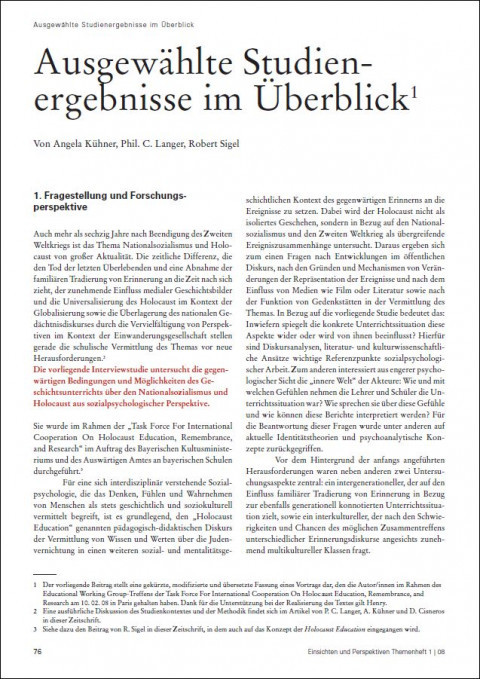 Overview of Selected Research Results Año de publicación: 2008 Autor: Angela Kühner | Phil. C. Langer | Robert Sigel The original title: Ausgewählte Studienergebnisse im Überblick(Einsichten und Perspektiven, Bayerische Zeitschrift für Politik und Geschichte, 1(8), pp. 76-82)The article deals with the results of a pilot study carried out in Bayern, which focuses on the subjective experiences and representations of teachers and students from a social-psychology perspective. The research questions: How does the educational situation reflect remembrance today? How do teachers and students interpret situations of “Holocaust Education,” and what feelings do they report? The study carried out qualitative interviews with students and their teachers, and analyzes the pedagogical setting of history classes in secondary schools. Intercultural and intergenerational dimensions are also analyzed. The authors conclude that both sides, students and teachers, show a high degree of interest to the topic, but also a tendency to Selbst-Überforderung ; thus, concrete possibilities and spaces for self-reflection about their own feelings and conflicting pedagogical aims must be recognized and supported. The above abstract is taken from the International Holocaust Remembrance Alliance Education Research Project. Please also consult the full list of abstracts in 15 languages and the accompanying publication Research in Teaching and Learning about the Holocaust: A Dialogue Beyond Borders. Ed: IHRA, Monique Eckmann, Doyle Stevick, Jolanta Ambrosewicz-Jacobs, 2017, Metropol Verlag at www.holocaustremembrance.com/resources/publications.
 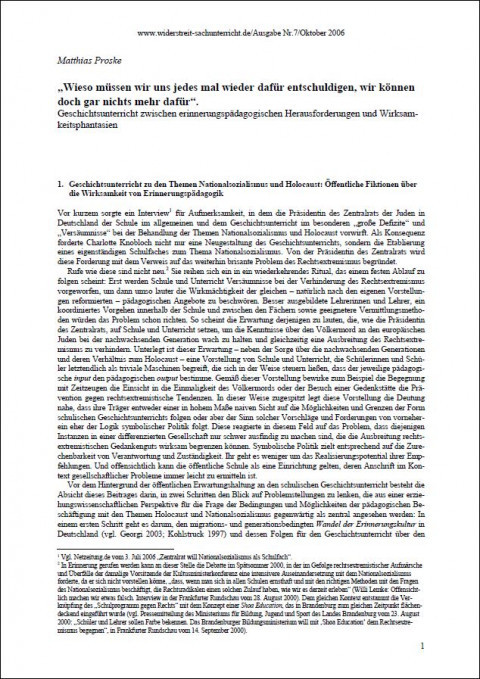 “Why Do We Have to We Apologize for It All the Time, We Can’t Help it”: History Education between Memory-Pedagogy Challenges and Fantasies about Effectiveness Año de publicación: 2006 Autor: Matthias Proske The original title: “Wieso Müssen Wir Uns Jedes Mal Wieder dafür Entschuldigen, Wir Können Doch Gar Nichts Mehr Dafür”: Geschichtsunterricht zwischen Erinnerungspädagogischen Herausforderungen und Wirksamkeitsphantasien(Widerstand sachunterricht, 7, pp. 1–10)Against the background of public expectations on the schools’ history education, the article connects a theoretical analysis of the changes in the German historical culture and their consequences for history education about the Holocaust and Nazism with a discussion about how students and teachers take on these themes in educational practice. This is exemplified with a case study from a 9th grade history class. The above abstract is taken from the International Holocaust Remembrance Alliance Education Research Project. Please also consult the full list of abstracts in 15 languages and the accompanying publication Research in Teaching and Learning about the Holocaust: A Dialogue Beyond Borders. Ed: IHRA, Monique Eckmann, Doyle Stevick, Jolanta Ambrosewicz-Jacobs, 2017, Metropol Verlag at www.holocaustremembrance.com/resources/publications.