
Recursos
Exploren una amplia gama de recursos valiosos en GCED para profundizar su comprensión y promover su búsqueda, incidencia, enseñanza y aprendizaje.
1,727 resultados encontrados
 Disinformation and Peacebuilding in Sub-Saharan Africa : Security Implications of AI-Altered Information Environments : Research Report Año de publicación: 2024 Autor: Eduardo Albrecht | Eleonore Fournier-Tombs | Rebecca Brubake Autor corporativo: United Nations University This report aims to further explore the way in which AI technologies as they currently stand impact peace and conflict, and what methods might be used to mitigate their adverse effects - through the development of better tools and the inclusion of peace and conflict considerations in AI governance frameworks. The report proposes the following recommendations: 1. More funding and support should be provided to civil society organization efforts to expand media literacy and fact-checking initiatives using AI tools to enhance capabilities. 2. Governments need to work with civil society to develop and implement comprehensive, transparent legal frameworks combating disinformation. These legislative measures need to support digital and media literacy campaigns and fact-checking organizations. 3. Social media companies need to expand investment and research into understanding local information environments, so they can better identify and respond to instances of disinformation in all contexts in which they operate and enhance transparency. 4. Peacebuilding organizations need to carefully consider local media ecosystems and information environments when conducting conflict analyses, and factor these dynamics into their projects' frameworks.
  Journalism and Artificial Intelligence in Latin America Año de publicación: 2023 Autor: Natalia Zuazo Autor corporativo: UNESCO Montevideo In a context of exponential growth of artificial intelligence (AI) and technological dominance in all spheres of life — economic, social, cultural, environmental, and political —, this Paper explores the impact of AI on journalism from a critical and ethical perspective, with special attention to Latin America. It addresses inequalities and challenges inherent in the implementation of AI in the region. The aim is to offer an useful tool in the continuous training of students and media professionals.
  Les politiques des grandes plateformes sur le discours de haine pendant la COVID-19 Año de publicación: 2021 Autor corporativo: UNESCO Montevideo Ce document fait état d’une augmentation des messages considérés comme des discours de haine sur Facebook, Twitter et YouTube, depuis l’avènement de la pandémie de COVID-19. Bien qu’inégale, cette augmentation peut être établie à partir des rapports de transparence des différentes plateformes et de la croissance enregistrée dans la modération de ces contenus à partir de mars 2020. Étant donné qu’au cours de la même période, et en conséquence des mesures d’isolement prises dans la plupart des pays du monde, les plateformes ont décidé d’accroître l’utilisation d’outils d’intelligence artificielle dans leurs processus de modération, il n’est pas possible d’être certain que cette croissance est due à une augmentation de la création et de la publication de messages ou à un changement dans les systèmes de détection qui a affecté les résultats d’une année à l’autre.
  Educación y diversidad cultural: lecciones desde la práctica innovadora en América Latina Año de publicación: 2008 Autor: Carolina Hirmas R. Autor corporativo: UNESCO Santiago Esta publicación, que constituye el segundo volumen de la colección, es el resultado del análisis y la reflexión acerca de un conjunto experiencias educativas innovadoras de varios países de Latinoamérica, que responden con pertinencia pedagógica al contexto cultural de los estudiantes y ofrecen una educación orientada al conocimiento, comprensión y diálogo entre personas de diferentes culturas. El aporte significativo de las experiencias referidas, reside en el reconocimiento y valoración de la diversidad étnica y cultural de sus estudiantes y comunidades, como punto de partida para el desarrollo de nuevos aprendizajes y afirmación de su identidad. A su vez, la vida en los centros educativos promueve relaciones interculturales de respeto y fraternidad en un contexto sociogeográfico local y subregional, caracterizado por la multiculturalidad.
  التصدي لمعدات السامية عن طريق التعليم مبادئ تةجيهية لواضعي السياسات Año de publicación: 2018 Autor corporativo: OSCE. Office for Democratic Institutions and Human Rights (ODIHR) A new UNESCO and OSCE co-publication takes up the challenge of educating learners to resist contemporary anti-Semitism at a time when the issue is becoming ever more crucial around the world. It suggests concrete ways to address anti-Semitism, counter prejudice and promote tolerance through education, by designing programmes based on a human rights framework, global citizenship education, inclusiveness and gender equality.It also provides policymakers with tools and guidance to ensure that education systems build the resilience of young people to anti-Semitic ideas and ideologies, violent extremism and all forms of intolerance and discrimination, through critical thinking and respect for others.
  The Education We Want: An Advocacy Toolkit Año de publicación: 2014 Autor: James Edleston | Dan Smith | Sumaya Saluja | David Crone | Chernor Bah | Emily Laurie Autor corporativo: A World at School | UN Global Education First Initiative - Youth Advocacy Group (YAG) | Plan International Developed by Plan International, A World at School and the Youth Advocacy Group of the Global Education First Initiative, this toolkit was made for and by young people to advocate for quality education.Packed full of ideas, tools and inspiring stories, it helps children and youth to effectively carry out their own advocacy campaign.Although this advocacy toolkit focuses on education, its tips and ideas are applicable to young people advocating for a variety of development and rights issues.
  Beyond Access: Toolkit for Integrating Gender-based Violent Prevention and Response into Education Projects Año de publicación: 2015 Autor corporativo: United States Agency for International Development (USAID) This toolkit was developed to support implementation of the U.S. Strategy to Prevent and Respond to Gender-based Violence Globally. It provides guidance and resources for USAID technical and program officers working on education to increase understanding of GBV in the education context and strengthen integration of a gender-based violence (GBV) response into projects and activities. Because reducing school-related GBV is a high priority for USAID in all school systems globally, this toolkit includes school-related GBV, but the overall focus is GBV in the education context broadly.The Toolkit provides:The United States government definition of GBV and USAID’s definition of school-related GBVExplanation for why integrating GBV prevention and response improves education outcomes, and the evidence on the prevalence of GBV in the education sectorGuiding principles to ensure the well-being of those at risk for, and survivors of, GBVIllustrative GBV prevention and response activities by the USAID Education Strategy GoalsGuidance on how to integrate GBV prevention and response throughout theUSAID Program Cycle to be able to monitor, evaluate, learn, and adapt education projects and activities accordingly, and it includes illustrative indicators for measuringGBV prevention and response for each of the USAID Education Strategy goals.
  [Vidéo] L'école apprend la citoyenneté Año de publicación: 2016 Autor corporativo: Mission laïque française Organisé au Maroc en mai 2016, le congrès du réseau d'enseignement français à l'étranger mlfmonde a réuni 300 personnes autour du thème "l'école apprend la citoyenneté", élément central du projet éducatif de la Mission laïque française.
 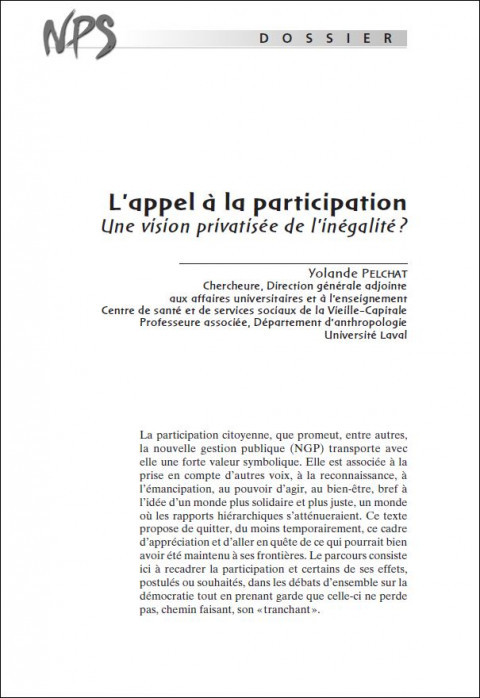 The Call for Participation: A Vision Exempt from Inequality? Año de publicación: 2010 Autor: Yolande Pelchat Autor corporativo: Nouvelles pratiques sociales Citizen participation, which is promoted by the New Public Management, conveys a high symbolic value. Citizen participation is generally associated with the consideration of others’ voices, recognition, emancipation, empowerment and well-being. In short, it carries the promise of a more just world with greater social solidarity and less hierarchic social relations. This paper proposes to leave aside this fashionable rhetoric, at least temporarily, and to search for what might have been left at its borders. This exploratory journey aims to reframe, within larger debates about democracy, the call for participation and its assumed or desired effects. The invitation to beware of losing, on the way, the radical nature of democracy, is issued. L’appel à la participation: Une vision privatisée de l’inégalité ? Año de publicación: 2010 Autor: Yolande Pelchat Autor corporativo: Nouvelles pratiques sociales La participation citoyenne, que promeut, entre autres, la nouvelle gestion publique (NGP) transporte avec elle une forte valeur symbolique. Elle est associée à la prise en compte d’autres voix, à la reconnaissance, à l’émancipation, au pouvoir d’agir, au bien-être, bref à l’idée d’un monde plus solidaire et plus juste, un monde où les rapports hiérarchiques s’atténueraient. Ce texte propose de quitter, du moins temporairement, ce cadre d’appréciation et d’aller en quête de ce qui pourrait bien avoir été maintenu à ses frontières. Le parcours consiste ici à recadrer la participation et certains de ses effets, postulés ou souhaités, dans les débats d’ensemble sur la démocratie tout en prenant garde que celle-ci ne perde pas, chemin faisant, son « tranchant ».