
Recursos
Exploren una amplia gama de recursos valiosos en GCED para profundizar su comprensión y promover su búsqueda, incidencia, enseñanza y aprendizaje.
1,448 resultados encontrados
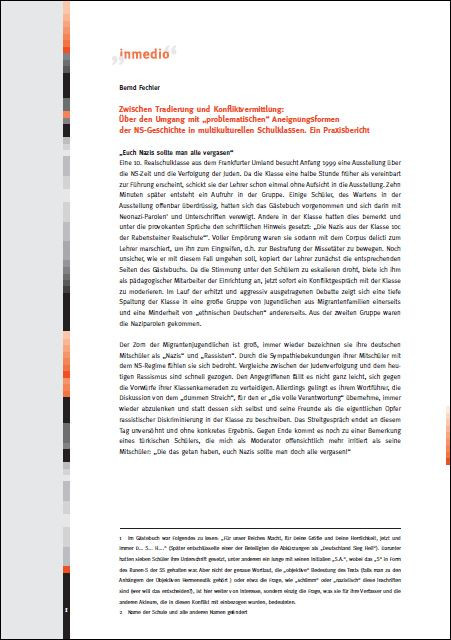 Between Transmission and Conflict Mediation: On the Handling of “Problematic” Forms of Appropriation of Nazi History in Multicultural School Classes Año de publicación: 2000 Autor: Bernd Fechler The original title: Zwischen Tradierung und Konfliktvermittlung: Über den Umgang mit “Problematischen” Aneignungsformen der NS-Geschichte in Multikulturellen Schulklassen(Erziehung nach Auschwitz” in der multikulturellen Gesellschaft: Pädagogische und soziologische Annäherungen, pp.1-18) Discussion of the challenges of Holocaust education a multicultural setting, based on a case when a German 10th grade class visited an exhibition about the Nazi period, something which led to an intense conflict between “German” and “immigrant” students.The above abstract is taken from the International Holocaust Remembrance Alliance Education Research Project. Please also consult the full list of abstracts in 15 languages and the accompanying publication Research in Teaching and Learning about the Holocaust: A Dialogue Beyond Borders. Ed: IHRA, Monique Eckmann, Doyle Stevick, Jolanta Ambrosewicz-Jacobs, 2017, Metropol Verlag at www.holocaustremembrance.com/resources/publications
 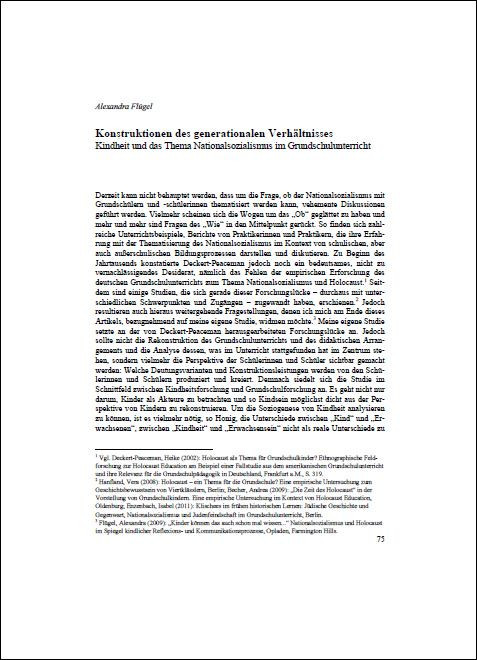 Constructions of Generational Relations: Childhood and the Theme of National Socialism in Primary-School Education Año de publicación: 2012 Autor: Alexandra Flügel The original title: Konstruktionen des Generationalen Verhältnisses: Kindheit und das Thema Nationalsozialismus im Grundschulunterricht(Kinder und Zeitgeschichte: Jüdische Geschichte und Gegenwart, Nationalsozialismus und Antisemitismus, Supplement 8, pp. 75–84) This is a qualitative study, based on the results in Fügel 2009, of German primary school children’s communication about Nazism and the Holocaust. It demonstrates how interwoven these exchanges are with general German memory discourses about these topics, but also how the children already at the age of 9–10 reflect upon their need to learn about this dark side of German history.The above abstract is taken from the International Holocaust Remembrance Alliance Education Research Project. Please also consult the full list of abstracts in 15 languages and the accompanying publication Research in Teaching and Learning about the Holocaust: A Dialogue Beyond Borders. Ed: IHRA, Monique Eckmann, Doyle Stevick, Jolanta Ambrosewicz-Jacobs, 2017, Metropol Verlag at www.holocaustremembrance.com/resources/publications.
  Addressing Anti-Semitism: why and how? a guide for educators Año de publicación: 2007 Autor corporativo: Organization for Security and Co-operation in Europe (OSCE) These guidelines provide suggestions for teachers and other educators who feel the need to address issues pertaining to contemporary anti-Semitism. Recognizing that the context may vary in every country, or even in individual classrooms, this document provides educators with a general overview of common manifestations of contemporary anti-Semitism, as well as with some key educational principles and strategies for addressing this complex and challenging subject. Aborder l'antisémitisme: pourquoi et comment? Un guide pour les éducateurs Año de publicación: 2007 Autor corporativo: Organization for Security and Co-operation in Europe (OSCE) Ces instructions générales apportent des conseils et indications aux enseignants et autres éducateurs qui doivent aborder des sujets liés à l'antisémitisme contemporain. Ce document, qui reconnaît que le contexte varie selon le pays et selon la composition de la salle de classe, donne aux éducateurs un aperçu général des manifestations courantes de l'antisémitisme contemporain, et formule des principes éducatifs clés et des stratégies pour traiter de ce sujet complexe et délicat.
 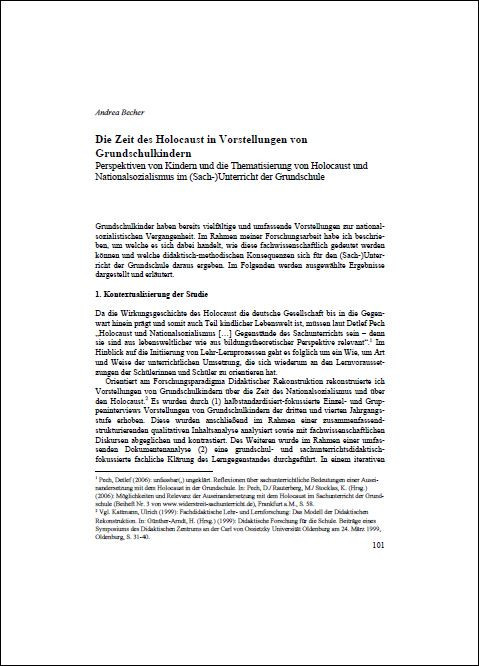 The Time Period of the Holocaust in the Beliefs of Primary School Children – Children’s Perspectives and the Thematization of the Holocaust and National Socialism in Primary-School Instruction (in General Subjects) Año de publicación: 2012 Autor: Andrea Becher The original title: Die Zeit des Holocaust in Vorstellungen von Grundschulkindern – Perspektiven von Kindern und die Thematisierung von Holocaust und Nationalsozialismus im (Sach-)Unterricht der Grundschule(In I. Enzenbach, C. Klätte, & D. Pech, (Eds.). Kinder und Zeitgeschichte: Jüdische Geschichte und Gegenwart, Nationalsozialismus und Antisemitismus, Supplement, 8, pp. 101–120) This is a summary of a study of German primary school children’s beliefs about the Holocaust, based on interviews conducted in two classes in 2005. The author finds that the children almost exclusively focus on Hitler; that one can find “latent anti-Semitic fragments” in their statements; that, even without formal education, the pupils still possess knowledge about the Holocaust; and their main source of information about Nazi Germany seems to be family members. However, the family narratives mainly touch upon everyday-life and avoid the topic of the Holocaust. From these findings, the author argues that one could and should teach the Holocaust already in the German primary school. The above abstract is taken from the International Holocaust Remembrance Alliance Education Research Project. Please also consult the full list of abstracts in 15 languages and the accompanying publication Research in Teaching and Learning about the Holocaust: A Dialogue Beyond Borders. Ed: IHRA, Monique Eckmann, Doyle Stevick, Jolanta Ambrosewicz-Jacobs, 2017, Metropol Verlag.
 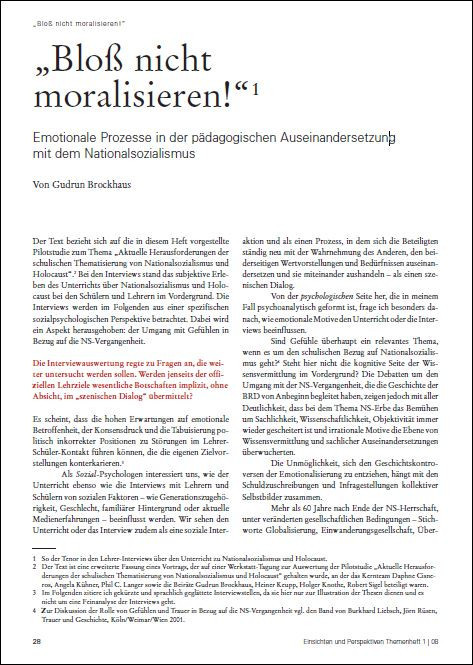 “Just Don’t Moralize!” Emotional Processes in the Pedagogical Engagement with National Socialism Año de publicación: 2008 Autor: Gudrun Brockhaus The original title: “Bloß nicht moralisieren!” Emotionale Prozesse in der pädagogischen Auseinandersetzung mit dem Nationalsozialismus(Einsichten und Perspektiven, Bayerische Zeitschrift für Politik und Geschichte, 1(8), pp. 28–33.) The article is a critical reflection on the outcomes of an empirical study (Kühner 2008; Kühner et al. 2008), based on a psychological/psychoanalytical perspective: how should we deal with emotions when dealing with the Holocaust? The author highlights the teachers’ very high expectations regarding the emotional Betroffenheit, the pressure on consensus, and the tabooisation of “political incorrectness” in the classroom, tendencies that can lead to a problematic teacher-student relationship. Thus, teachers encounter specific didactical difficulties and show a certain lack of self-assertion. Brockhaus assumes that this is based on how the teacher relates, as a person and as a pedagogue, to the heritage of National Socialism. Brockhaus concludes by insisting on the necessity to reflect openly, as students and as teachers, on the emotional processes and the reluctance caused by the topic of the Holocaust in this society. The above abstract is taken from the International Holocaust Remembrance Alliance Education Research Project. Please also consult the full list of abstracts in 15 languages and the accompanying publication Research in Teaching and Learning about the Holocaust: A Dialogue Beyond Borders. Ed: IHRA, Monique Eckmann, Doyle Stevick, Jolanta Ambrosewicz-Jacobs, 2017, Metropol Verlag at www.holocaustremembrance.com/resources/publications
 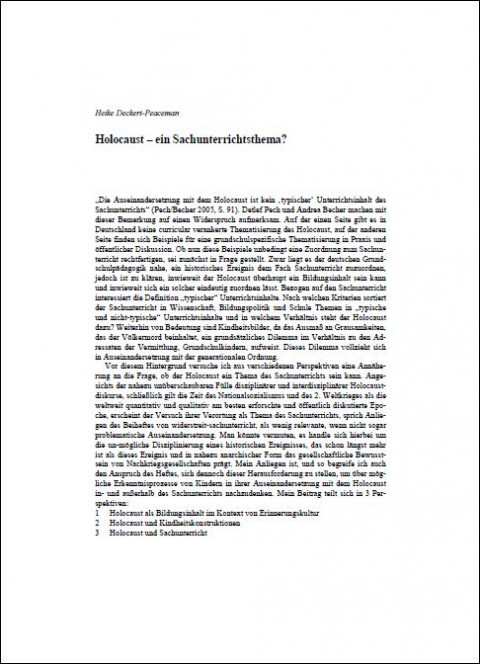 The Holocaust – A Theme for Instruction in General Subjects? Año de publicación: 2006 Autor: H. Deckert-Peaceman The original title: Holocaust – ein Sachunterrichtsthema?(Möglichkeiten und Relevanz der Auseinandersetzung mit dem Holocaust im Sachunterricht der Grundschule. Supplement, 3, pp. 35–50) An interesting discussion about the Holocaust as a topic for younger children, and especially about the use of youth literature in Holocaust education, but not an empirical analysis.The above abstract is taken from the International Holocaust Remembrance Alliance Education Research Project. Please also consult the full list of abstracts in 15 languages and the accompanying publication Research in Teaching and Learning about the Holocaust: A Dialogue Beyond Borders. Ed: IHRA, Monique Eckmann, Doyle Stevick, Jolanta Ambrosewicz-Jacobs, 2017, Metropol Verlag.
  Education and Disability: Analysis of Data from 49 Countries (UIS Information Paper No. 49) Año de publicación: 2018 Autor corporativo: UNESCO Institute for Statistics (UIS) Sustainable Development Goal (SDG) 4 calls for “inclusive and quality education for all”. Persons with a disability are among the population groups most likely to suffer from exclusion from education but data that permit an analysis of the links between disability and education remain scarce.This paper examines educational disparities linked to disability based on data from 49 countries and territories for five education indicators: Proportion of 15- to 29-year-olds who ever attended school Out-of-school rate (primary school age, lower secondary school age) Completion rate (primary education, lower secondary education) Mean years of schooling of the population 25 years and older Adult literacy rate (population 15 years and older)
  Mémorial de la Shoah - Musée, Centre de documentation juive contemporaine The Shoah Memorial provides access to various resources on the Holocaust, mostly in French.
  UNESCO Survey on Intercultural Dialogue, 2017: Analysis of Findings Año de publicación: 2018 Autor corporativo: UNESCO Institute for Statistics (UIS) The present report sets out the key findings of the first UNESCO survey on intercultural dialogue conducted among its Member States. The survey takes stock of the current understanding and operational mechanisms and strategies of intercultural dialogue at national level. It assesses the main issues and opportunities, current policies and legislation, available data and resources, and main stakeholders in this field. The resulting information permits an initial inventory of countryspecific intercultural dialogue policies that will function as a point of analysis for future monitoring and inform future policy-making.The questionnaire for the survey was distributed to 199 National Commissions for UNESCO in six official United Nations languages with a submission deadline of Spring 2017. There was a response rate of 21.622%. The respondents represent all geographic regions, including countries with large, middle and small populations, and over half are from developing economies.