
Recursos
Exploren una amplia gama de recursos valiosos en GCED para profundizar su comprensión y promover su búsqueda, incidencia, enseñanza y aprendizaje.
2,781 resultados encontrados
 The 2030 Agenda and the Regional Gender Agenda: Synergies for Equality in Latin America and the Caribbean (Asuntos de Género; no. 143) Año de publicación: 2017 Autor: Nicole Bidegain Ponte Autor corporativo: UN. Economic Commission for Latin America and the Caribbean (ECLAC) This document analyzes the 2030 Agenda for Sustainable Development and its Sustainable Development Goals (SDGs) in light of the challenges and priorities for gender equality and the rights and autonomy of women in Latin America and the Caribbean. Illustrative examples of the interrelationships between goals and targets of the 2030 Agenda are presented, and it warns about the importance of a comprehensive approach to ensure that progress in some of the SDGs is not made through means that may hinder the achievement of the goals and targets related to gender equality and women's rights. La Agenda 2030 y la Agenda Regional de Género: Sinergias para la igualdad en América Latina y el Caribe (Asuntos de Género; no. 143) Año de publicación: 2017 Autor: Nicole Bidegain Ponte Autor corporativo: UN. Economic Commission for Latin America and the Caribbean (ECLAC) En este documento se analiza la Agenda 2030 para el Desarrollo Sostenible y sus Objetivos de Desarrollo Sostenible (ODS) a la luz de los desafíos y prioridades para la igualdad de género y los derechos y la autonomía de las mujeres en América Latina y el Caribe. Se presentan ejemplos ilustrativos sobre las interrelaciones entre objetivos y metas de la Agenda 2030, y se advierte sobre la importancia de un abordaje integral para asegurar que el progreso en algunos de los ODS no se realice a través de medios que puedan obstaculizar el logro de los objetivos y metas vinculados a la igualdad de género y los derechos de las mujeres.
 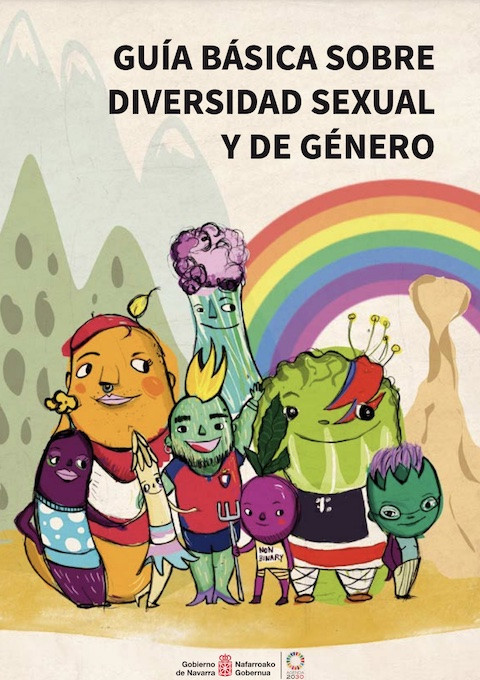 Basic Guide on Sexual and Gender Diversity Año de publicación: 2020 Autor: Miriam Solá García Autor corporativo: Navarra Institute for Equality This guide is a tool to learn about affective, sexual and gender diversity and reflect on why all of us have a key role in social change to achieve equality and recognition of LGTBI+ people. Respect for affective, sexual and gender diversity is an element of value and social wealth in whose promotion and experience all citizens are involved. Guía básica sobre diversidad sexual y de género Año de publicación: 2020 Autor: Miriam Solá García Autor corporativo: Navarra Institute for Equality Esta guía es una herramienta para conocer la diversidad afectiva, sexual y de género y reflexionar sobre por qué todas las personas tenemos un papel clave en el cambio social para lograr la igualdad y reconocimiento de las personas LGTBI+. El respeto por la diversidad afectiva, sexual y de género es un elemento de valor y de riqueza social en cuya promoción y vivencia está implicada toda la ciudadanía
  Paulo Freire's Contributions to Intercultural Education: A Case Study in Compulsory Secondary Education (Ibero-American Journal of Education; vol.76) Año de publicación: 2018 Autor: Maria Verdeja Muniz | Xose Anton Gonzalez Riano The general purpose of this research is to synthesize the contributions of Paulo Freire's pedagogy to intercultural education and study the possibilities of application to the educational system. The research is raised from a qualitative perspective and completed with a case study. At first, an analysis of a selected part of Freire's written work was carried out and the basic lines of what his intercultural sensitivity would be established. In another level of analysis, a study of the subjects of the ESO curriculum in Asturias in its intercultural dimension is carried out. The case study in the educational center shows that, in order to carry out true intercultural education proposals, it would be necessary for there to be some previous conditions that are described in the article. Aportaciones de Paulo Freire a la educación intercultural: Un estudio de caso en la Educación Secundaria Obligatoria (Revista Iberoamericana De Educación; vol.76) Año de publicación: 2018 Autor: Maria Verdeja Muniz | Xose Anton Gonzalez Riano La finalidad general de esta investigación es sintetizar las aportaciones de la pedagogía de Paulo Freire a la educación intercultural y estudiar las posibilidades de aplicación al sistema educativo. La investigación está planteada desde una perspectiva cualitativa y completada con un estudio de caso. En un primer momento se realizó un análisis de una parte seleccionada de la obra escrita de Freire y se establecen las líneas básicas de lo que sería su sensibilidad intercultural. En otro plano de análisis se realiza un estudio de las materias del currículo de la ESO en Asturias en su dimensión intercultural. El estudio de caso en el centro educativo pone de manifiesto que, para llevar a cabo verdaderas propuestas de educación intercultural, sería necesario que existieran unas condiciones previas que se describen en el artículo.
  Anti-racist, Inclusive and Rights Education in the Development of Professional Competencies for School Staff and Student Abilities (Éthique en éducation et en formation; no. 3) Año de publicación: 2017 Autor: Maryse Potvin Autor corporativo: Université du Québec à Montréal (UQAM) This article examines the differences and convergences that emerge from the major theoretical trends in the area of education for ethnocultural (inter/multicultural, anti-racist/critical, civic, inclusive) diversity regarding the professional skills school personnel must acquire to achieve the major objectives of equity, effectiveness of rights, harmonious living and the development of students’ capabilities. The article is based on a review of the national and international literature, which aimed to identify the skills (knowledge, expertise, soft skills) that are essential for knowing how to act in the context of diversity and that, according to theoreticians, should be developed in all teacher training programs. These issues are discussed from a crosscutting perspective rather than from a disciplinary angle related to the Quebec curriculum (ethics and religious culture, history and education for citizenship). The article begins by providing some background on these trends in order to identify their common objectives and convergence toward an integrated and inclusive global approach. It then examines two objectives supported by all theoreticians in terms of the core professional skills needed by school personnel for developing students’ capabilities: 1) taking into account the realities, needs and rights of students, particularly those in minority or vulnerable groups, and 2) preparing students to live together in a pluralistic and democratic society. As well, it identifies the key challenges involved in the consideration and implementation of these two goals. L’éducation antiraciste, inclusive et aux droits dans le développement des compétences professionnelles du personnel scolaire et des capabilités des élèves (Éthique en éducation et en formation; no. 3) Año de publicación: 2017 Autor: Maryse Potvin Autor corporativo: Université du Québec à Montréal (UQAM) Cet article porte un regard sur les différences et convergences qui se dégagent des grands courants théoriques dans le champ de l’éducation à la diversité ethnoculturelle (inter/multiculturel, antiraciste /critique, civique, inclusif) quant aux compétences professionnelles à développer par le personnel scolaire pour atteindre les grandes finalités de l’équité, de l’effectivité des droits, du vivre-ensemble et du développement des capabilités des élèves. L’article s’appuie sur une revue de la littérature nationale et internationale, qui visait à dégager les éléments de compétences (savoirs, savoir-faire, savoir-être essentiels) pour savoir-agir en contexte de diversité, et qui, selon les théoriciens, devraient être développés dans tous les programmes de formation à l’enseignement. Il n’aborde pas ces enjeux sous un angle disciplinaire, lié au curriculum québécois (éthique et culture religieuse, histoire et éducation à la citoyenneté), mais dans une perspective transversale. L’article présente d’abord quelques fondements de ces courants afin de dégager leurs objectifs communs et leur convergence vers une approche globale et inclusive intégrée. Il porte ensuite une attention particulière aux deux finalités centrales qui font consensus parmi les théoriciens et qui sont au coeur des compétences professionnelles du personnel scolaire pour développer les capabilités des élèves : 1) prendre en compte les réalités, besoins et droits des élèves, particulièrement ceux des groupes minoritaires ou vulnérables, pour développer leurs capabilités, et 2) les préparer à vivre ensemble dans une société pluraliste et démocratique. Il dégage aussi les principaux défis liés à la prise en compte et à la mise en oeuvre de ces deux finalités.
  Reaching Out to All Learners: A Resource Pack for Supporting Inclusion and Equity in Education Año de publicación: 2021 Autor corporativo: UNESCO International Bureau of Education (IBE) The Reaching Out to All Learners resource materials tackle the practicalities of addressing these challenges in schools and other education centres, including early years and further education provision. More specifically, the materials focus on three strategic questions:How can schools be developed in order to respond positively to student diversity?How can classroom practices be developed that will ensure that lessons are inclusive?How can practitioners engage families, partner schools and the wider community in their efforts to become inclusive and equitable? Llegando a todos los estudiantes: Una caja de recursos de la UNESCO-OIE para apoyar la inclusión y la equidad en la educación Año de publicación: 2021 Autor corporativo: UNESCO International Bureau of Education (IBE) El material de recursos LLEGANDO A TODOS LOS ESTUDIANTES aborda los aspectos prácticos de la solución a estos problemas. En concreto, estos recursos se centran en tres cuestiones estratégicas:¿Cómo pueden crecer las escuelas para responder positivamente a la diversidad de los estudiantes?¿Cómo pueden desarrollarse prácticas docentes en el aula que garanticen que las lecciones sean inclusivas?¿Cómo pueden las escuelas involucrar a las familias, a las escuelas asociadas y a la comunidad en general en sus esfuerzos por ser inclusivas y equitativas?