
Recursos
Exploren una amplia gama de recursos valiosos en GCED para profundizar su comprensión y promover su búsqueda, incidencia, enseñanza y aprendizaje.
730 resultados encontrados
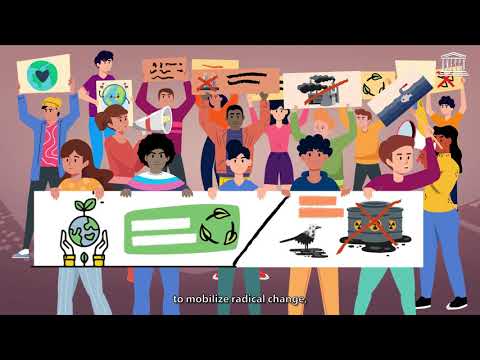 How Can Education Really Contribute to Solving the Climate Crisis? Año de publicación: 2020 Autor corporativo: UNESCO “Debating the Futures of Education” is a video series produced by UNESCO, within the framework of an initiative that seeks to reimagine the futures of education. The purpose of this video is to think about how education can really contribute to solving the climate crisis. Comment l'éducation peut-elle réellement contribuer à résoudre la crise climatique? Año de publicación: 2020 Autor corporativo: Organisation des Nations Unies pour l'éducation, la science et la culture (UNESCO) « Débattre sur les futurs de l'éducation» est une série de vidéos produites par l'UNESCO, dans le cadre d'une initiative visant à réinventer les futurs de l'éducation. Cette vidéo a pour but de réfléchir à la manière dont l'éducation peut réellement contribuer à résoudre la crise climatique.
  UNESCO Green Citizens: A Global Voice for Local Actors of Change Año de publicación: 2020 Autor corporativo: UNESCO UNESCO launches the UNESCO Green Citizens Initiative, a flagship project to support citizen engagement for the planet. The UNESCO Green Citizens campaign echos the global voice of local actors of change, highlighting innovative citizen projects from around the world. UNESCO Green Citizens: Une voix globale pour des acteurs locaux du changement Año de publicación: 2020 Autor corporativo: Organisation des Nations Unies pour l'éducation, la science et la culture (UNESCO) L’UNESCO lance l’initiative UNESCO Green Citizens, un projet phare visant à soutenir l’engagement des citoyens pour la planète. La campagne offre une voix globale aux acteurs locaux du changement, en mettant en lumière des projets citoyens innovants du monde entier.
  UNESCO MIL CLICKS Social Media Innovation Año de publicación: 2016 Autor corporativo: UNESCO MIL CLICKS is a way for people to acquire media and information literacy (MIL) competencies in their normal day-to-day use of the Internet and social media and to engage peer education in an atmosphere of browsing, playing, connecting, sharing, and socializing.The acronym MIL CLICKS stands for Media and Information Literacy: Critical-thinking, Creativity, Literacy, Intercultural, Citizenship, Knowledge & Sustainability.The objectives of this social media strategy are to use social media to:1) Expose people to become more media and information literate and to2) Raise awareness about the importance of media and information literacy.
  UNESCO MIL CLICKS: Innover avec les médias sociaux Año de publicación: 2016 Autor corporativo: UNESCO MIL CLICKS permet non seulement aux gens d'acquérir des compétences en matière d'éducation aux médias et à l'information (MIL en anglais) dans leur utilisation quotidienne d'Internet et des médias sociaux mais également d'engager l'éducation par les pairs dans une atmosphère de navigation, de jeu, de connexion, de partage et de socialisation.
 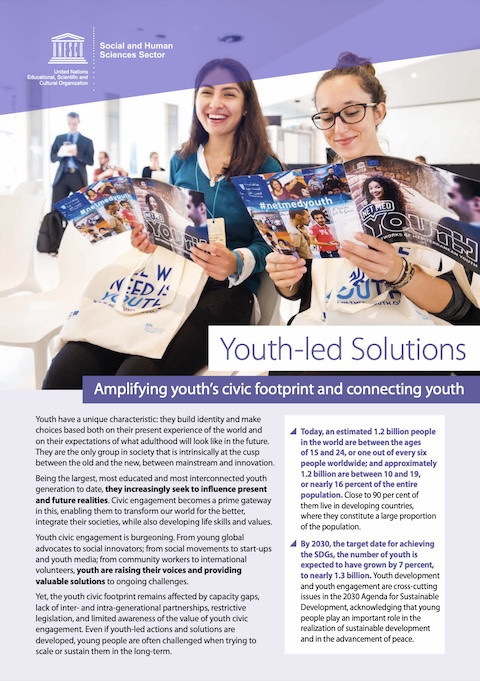 Soluciones impulsadas por las juventudes: Ampliar la huella cívica de las personas jóvenes y ponerles en contacto Año de publicación: 2019 Autor corporativo: Organización de las Naciones Unidas para la Educación, la Ciencia y la Cultura (UNESCO) La Organización de las Naciones Unidas para la Educación, la Ciencia y la Cultura (UNESCO) cree en el valor de la participación cívica de las personas jóvenes y en las soluciones que generan . Con el fin de colaborar de forma productiva con las juventudes, trabajamos con ellas considerándolas generadoras del cambio y socias, no meras beneficiarias, en consonancia con nuestra Estrategia Operacional sobre la Juventud (2014-2021). Aplicamos estrategias y programas de punta que contribuyen a conformar un ecosistema propicio para una participación cívica significativa, eficaz y sostenible de las personas jóvenes. Solutions pilotées par les jeunes: Renforcer la responsabilité civique des jeunes et les connecter entre eux Año de publicación: 2019 Autor corporativo: Organisation des Nations Unies pour l'éducation, la science et la culture (UNESCO) L’UNESCO reconnaît la valeur de l’engagement civique des jeunes et des solutions proposées par ces derniers. Dans la continuité de sa Stratégie opérationnelle sur la jeunesse (2014-2021), l’UNESCO est voué à associer les jeunes en tant que partenaires et porteurs de changements, et pas seulement en tant que bénéficiaires. Nous mettons en place des approches et des programmes de pointe qui contribuent à façonner un écosystème propice à un engagement civique significatif, efficace et durable des jeunes.
  Lumni Autor corporativo: Institut national de l'audiovisuel (INA) | France Télévisions Lumni est l’offre de tous les acteurs de l’audiovisuel public français au service de l’éducation pour les élèves et les enseignants. Cette offre donne accès à la culture, au savoir et à la connaissance pour tous les enfants de 3 à 20 ans et couvre l’ensemble des disciplines scolaires de la maternelle à la terminale. Tous les programmes sont indexés par niveau, matière et thématique.Avec plus de 12 000 vidéos, audios, jeux, dossiers, ce catalogue propose :• aux élèves, seuls ou accompagnés, de développer leur culture générale, de prolonger leurs cours, de comprendre le monde en apprenant autrement et de devenir des citoyens éclairés capables de décrypter l’actualité ;• aux enseignants, d’enrichir et de préparer leurs cours ;Avec une proposition éditoriale adaptée à chaque univers, Lumni enrichit régulièrement son offre avec des séries webnatives, des cours, des jeux, des quiz, ainsi que des programmes et des opérations à forte valeur éducative. Lumni is the educational offering for students and teachers from all French public broadcasters. This offer provides access to culture, knowledge and learning for all children aged 3 to 20, and covers all school subjects from kindergarten to the end of secondary school. All programs are indexed by level, subject and theme.With more than 12,000 videos, audios, games and dossiers, this catalog offers:• students, alone or accompanied, to develop their general knowledge, extend their lessons, understand the world by learning differently, and become enlightened citizens capable of deciphering current events;• teachers, to enrich and prepare their lessons;With an editorial proposal adapted to each universe, Lumni regularly enriches its offer with webnative series, courses, games, quizzes, as well as programs and operations with high educational value.
  Tutoriel enseignant: Aborder l’éducation au développement durable autrement Año de publicación: 2019 Autor: Tabasco Vidéo Autor corporativo: Agence Française de Développement (AFD) Comment aborder l’éducation au développement durable autrement ? Cette vidéo tutoriel réalisée par Tabasco Vidéo avec les élèves de la 4ème 6 Environnement du Collège Jacques Prévert à Marseille propose des idées d’animation clé en main à mettre en place en classe ou dans un contexte extrascolaire pour sensibiliser les élèves aux enjeux de développement durable et de solidarité internationale. Depuis 2016, l’Agence française de développement a été mandatée pour « promouvoir en France comme à l’étranger la connaissance par les citoyens des Objectifs de développement durable ainsi que l’éducation au développement et à la solidarité internationale ». Dans ce cadre, nous développons des outils, accessibles à tous, pour mieux expliquer et décrypter les enjeux de développement durable et transmettre tout ce qui fait le sens de notre action.