
Recursos
Exploren una amplia gama de recursos valiosos en GCED para profundizar su comprensión y promover su búsqueda, incidencia, enseñanza y aprendizaje.
883 resultados encontrados
 International Day against Homophobia & Transphobia: Lesson Plan Año de publicación: 2014 Autor corporativo: UNESCO Each year, the world celebrates the International Day Against Homophobia and Transphobia (IDAHO) on May 17th. During the days surrounding IDAHO, private and public actors, ranging from the United Nations agencies, to city councils, police stations, human rights organiza-tions, individual citizens, schools and others, implement activities to mark the day. The theme of this year’s IDAHO is “Fighting homophobia and transphobia IN and THROUGH education”. This theme was selected in response to a growing awareness that homophobic and transphobic bullying in schools which are manifestations of homophobia and transphobia, are serious issues that students and educational staff face every day across the world.Over the years, teachers around the world have been developing activities in their classrooms, with the help of various organizations working on efforts to address and homophobia and transphobia in educational institutions. Building on the success of these experiences, UNESCO and the IDAHO Committee propose teachers take advantage of the International Day Against Homophobia and Transphobia to conduct an ‘IDAHO Lesson’. The four activities proposed below are aimed at both primary and secondary level classes. A list of resources from other organizations for teachers, for all subjects and all grades is included below to enable greater choice of possible activities. By conducting an “IDAHO Lesson”, you can create safer learning environments, address discrimination and encourage respect and tolerance between and amongst learners.(Title: International Day against Homophobia and Transphobia: Lesson Plan) Combattre l’homophobie et la transphobie : Propositions pédagogiques Año de publicación: 2014 Autor corporativo: UNESCO Le présent programme pédagogique a été élaboré à l’occasion de l’IDAHO 2012, autour du thème « Combattre l’homophobie et la transphobie DANS et PAR l’éducation », en réponse à la prise de conscience que le harcèlement homophobe ou transphobe dans les écoles sont des manifestations de l’homophobie et de la transphobie auxquelles étudiants et membres du corps enseignant du monde entier doivent faire face au quotidien. Un problème sérieux qui ne peut être ignoré.Diverses études démontrent que le harcèlement homophobe ou transphobe peut avoir de graves répercussions sur la santé physique et mentale des jeunes gens et jeunes filles qui le subissent à un moment crucial de leur vie. Le harcèlement homophobe peut entraîner une baisse des performances d’apprentissage, voire, parfois, le décrochage scolaire. Les jeunes personnes lesbiennes, gays, bisexuelles, transgenres ou intersexes (LGBTI) victimes de harcèlement homophobe sont plus enclines à l’automutilation, et on dénombre parmi cette population beaucoup plus de cas de suicide que chez les autres jeunes. Les recherches révèlent aussi que les jeunes LGBTI ont tendance à adopter des comportements à haut risque tels que les rapports sexuels non protégés et la consommation de stupéfiants.
  Media and Information Literacy: Reinforcing Human Rights, Countering Radicalization and Extremism (The MILID Yearbook, 2016) Año de publicación: 2016 Autor: Jagtar Singh | Paulette Kerr | Esther Hamburger Autor corporativo: UNESCO | Alliance of Civilizations Media and Information Literacy (MIL) is a strong tool, cutting across educational, cultural and social contexts. It can help overcome disinformation, stereotypes and intolerance conveyed through some media and in online spaces. Here, stimulating critical empathy is one of the vital components and there are many stakeholders that have a role to play in this dimension of MIL.This year’s edition is focused on a highly relevant theme of “Media and Information Literacy: Reinforcing Human Rights, Countering Radicalization and Extremism”. It is a relevant reference point to initiate discussion and offer perspectives to stakeholders seeking to apply MIL as a tool to counter violent extremism. There is evident need for evidence-based research, assessment and evaluation that can provide insight into the impact of media and information literacy on societies. UNESCO trusts that this publication will contribute to ongoing scholarship and debate on these key topics.For media and other information providers to serve their purpose, we need critical minds in the public, which means to develop MIL programmes at the national, regional and international levels.
  Let's Decide How to Measure School Violence (Policy Paper 29) Año de publicación: 2017 Autor corporativo: UNESCO Violence in schools and other education settings causes serious harm to children and adolescents that can last into adulthood. As the UN World Report on Violence against Children observed, it is a global phenomenon (Pinheiro, 2006). Policies, laws and strategies to prevent school-related violence depend on accurate knowledge of its global prevalence, trends and effects, but such evidence is lacking.In schools, manifestations of violence include bullying, corporal punishment, verbal and emotional abuse, intimidation, sexual harassment and assault, gang activity and the presence of weapons. While attention usually focuses on extreme events, the more common and often unnoticed forms of violence cause the greatest harm to the education experience of children and adolescents. These tend to be under-reported, as they often involve taboos.To collect data on aspects of violence in schools, large-scale, multi-country school-based surveys are increasingly used; some countries also have well-established monitoring mechanisms. Overall, however, consistent evidence on the global prevalence and trends of school-related violence is lacking. To ensure reliable data is gathered, action is needed to bridge differences between the various monitoring methods. This paper, launched to coincide with the International Symposium on School Violence and Bullying: From Evidence to Action, in Seoul, Republic of Korea (January 17–19, 2017), aims to inform the current debate and propose options for the future.
  The King Abdullah bin Abdulaziz International Programme for a Culture of Peace and Dialogue: Key Achievements of Phase I Año de publicación: 2016 Autor corporativo: UNESCO The King Abdullah bin Abdulaziz International Programme for a Culture of Peace and Dialogue arose from the institutional framework of UNESCO’s Programme for a Culture of peace and non-violence. More than a concept, the Culture of Peace is a commitment to make peace a tangible reality for all. It denotes “a set of values, attitudes, traditions and modes of behaviour and ways of life based on respect for life, ending of violence and […] adherence to the principles of freedom, justice, democracy, tolerance, solidarity, cooperation, pluralism, cultural diversity, dialogue and understanding at all levels of society and among nations” (Article 1, Declaration and Programme of Action of a Culture of Peace, UNESCO, 1999). UNESCO continue its work to nurture a Culture of Peace, with development considerations, by joining forces with committed stakeholders in education, the sciences, culture, and communication and information.
 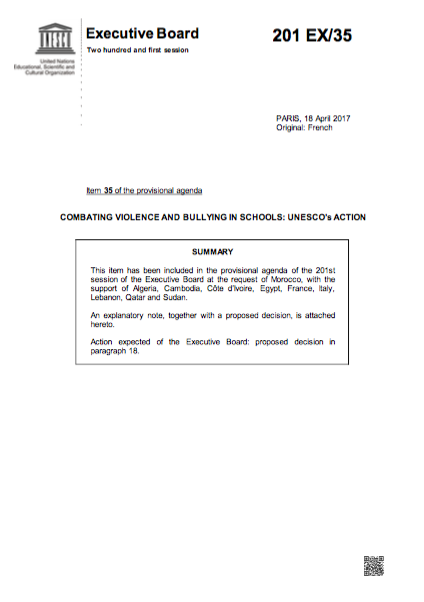 Борьба с насилием и притеснениями в школьной среде: деятельность ЮНЕСКО Año de publicación: 2017 Autor corporativo: UNESCO This item has been included in the provisional agenda of the 201st session of the Executive Board at the request of Morocco, with the support of Algeria, Cambodia, Côte d’Ivoire, Egypt, France, Italy, Lebanon, Qatar and Sudan. 打击校园暴力和欺凌行为:教科文组织的行动 Año de publicación: 2017 Autor corporativo: UNESCO This item has been included in the provisional agenda of the 201st session of the Executive Board at the request of Morocco, with the support of Algeria, Cambodia, Côte d’Ivoire, Egypt, France, Italy, Lebanon, Qatar and Sudan.
 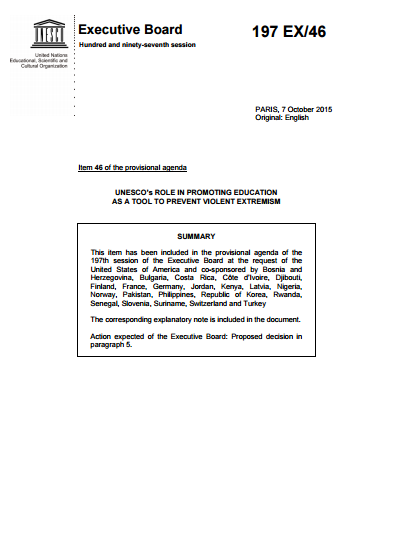 UNESCO's role in promoting education as a tool to prevent violent extremism Año de publicación: 2015 Autor corporativo: UNESCO This item has been included in the provisional agenda of the 197th session of the Executive Board at the request of the United States of America and co-sponsored by Bosnia and Herzegovina, Bulgaria, Costa Rica, Côte d’Ivoire, Djibouti, Finland, France, Germany, Jordan, Kenya, Latvia, Nigeria, Norway, Pakistan, Philippines, Republic of Korea, Rwanda, Senegal, Slovenia, Suriname, Switzerland and Turkey Combating Violence and Bullying in Schools: UNESCO's Action Año de publicación: 2017 Autor corporativo: UNESCO This item has been included in the provisional agenda of the 201st session of the Executive Board at the request of Morocco, with the support of Algeria, Cambodia, Côte d’Ivoire, Egypt, France, Italy, Lebanon, Qatar and Sudan. Combattre la violence et le harcèlement en milieu scolaire: action de l'UNESCO Año de publicación: 2017 Autor corporativo: UNESCO This item has been included in the provisional agenda of the 201st session of the Executive Board at the request of Morocco, with the support of Algeria, Cambodia, Côte d’Ivoire, Egypt, France, Italy, Lebanon, Qatar and Sudan.