
Recursos
Exploren una amplia gama de recursos valiosos en GCED para profundizar su comprensión y promover su búsqueda, incidencia, enseñanza y aprendizaje.
3,448 resultados encontrados
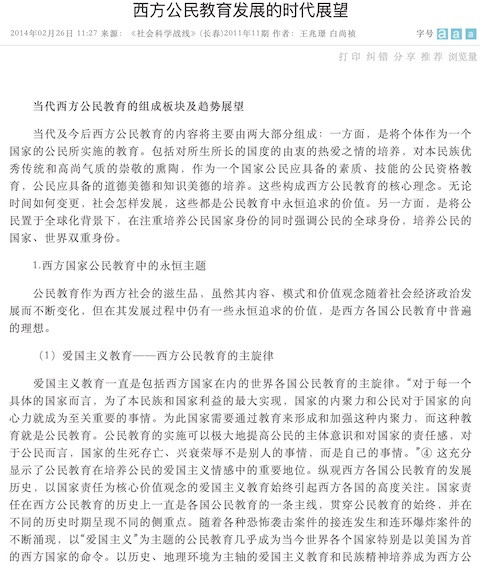 西方公民教育发展的展望 Año de publicación: 2011 Autor: Wang Zhaojing | Bai Shangzhen Autor corporativo: Social Science Front 文章讨论了全球化背景下西方公民教育的核心议题,即培养爱国主义精神与世界公民意识,并分别探讨了二者的核心要素。
 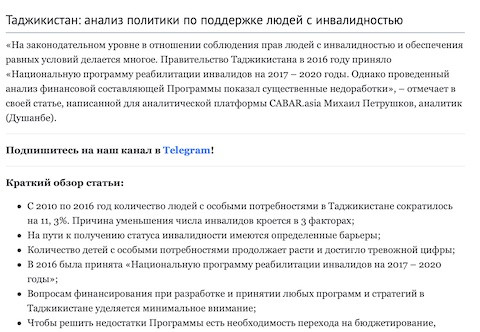 Таджикистан: Анализ политики по поддержке людей с инвалидностью Año de publicación: 2018 Autor: Mikhail Petrushkov Autor corporativo: Central Asian Bureau for Analytical Reporting (CABAR) | Institute for War and Peace Reporting (IWPR) «На законодательном уровне в отношении соблюдения прав людей с инвалидностью и обеспечения равных условий делается многое. Правительство Таджикистана в 2016 году приняло «Национальную программу реабилитации инвалидов на 2017 – 2020 годы. Однако проведенный анализ финансовой составляющей Программы показал существенные недоработки», – отмечает в своей статье, написанной для аналитической платформы CABAR.asia Михаил Петрушков, аналитик (Душанбе).
  Media Literacy Education to Counter Truth Decay: An Implementation and Evaluation Framework Año de publicación: 2021 Autor: Alice Huguet | John F. Pane | Garrett Baker | Laura S. Hamilton | Susannah Faxon-Mills Autor corporativo: RAND Corporation Media literacy (ML) education has emerged as a promising approach to slowing the spread of Truth Decay, described as the diminishing role that facts, data, and analysis play in political and civil discourse. Several factors contribute to Truth Decay, including a rapidly evolving information ecosystem and overburdened educational institutions. Many teachers believe their students lack the complex skills that are necessary to navigate today’s information- saturated world. This gap—between students’ existing competencies and those required to engage responsibly in a fast-paced media environment— could lead to negative consequences for individuals and society writ large.However, teachers report a lack of guidance around promoting ML education in their practice, and rigorous research about what kinds of ML educationwork best, and in what conditions, remains limited. This report presents a framework for implementing and evaluating ML educational efforts. Following an introduction to the framework, the authors discuss six steps of ML implementation and evaluation: setting ML learning expectations; identifying conditions that can influence ML instructional efforts; exploring instructional resources; identifying measures of ML competencies; monitoring progress; and finally, measuring the summative impacts of ML education on student learning. By bringing this information together for implementors—such as district decisionmakers and teachers—as well as evaluators, the authors emphasize the important connections between these too often separate groups.
  School Closures and Regional Policies to Mitigate Learning Loss due to COVID-19: A Focus on the Asia-Pacific Año de publicación: 2021 Autor corporativo: UNESCO Institute for Statistics (UIS) Global school closures as a result of COVID-19 have caused learning losses for millions of children despite efforts to deploy remote learning options. Greater economic insecurity among families may also affect school enrolment as many struggle to pay school fees, or require children to work to supplement family income. Ultimately, this will lead to rising dropout rates, estimated to be as much as 4% in a region where 128 million children and young people were already out of school before COVID-19. The largest number of learners at risk reside in South and West Asia.Together, the education and economic fallout from the pandemic threaten progress toward the Sustainable Development Goal for education (SDG 4). Even prior to the COVID-19 disruptions, progress towards SDG 4 was lagging in many countries in the Asia-Pacific and without significant contributions to education finance, the pandemic threatens to push the region even further behind.This report breaks down the effects of school closures. It considers, for example, how many schools were closed, and when, across the Asia-Pacific, and the effects on different levels of education from early childhood education, through to primary and secondary school. The report analyses country efforts to implement remote learning, and strategies to mitigate learning losses as the proportion of students expected to fall below minimum proficiency levels is expected to rise.To achieve SDG 4, all children and young people, and especially those in marginalized groups, need support to get the education they need and deserve.
  Как улучшить доступность дошкольного и начального образования в Казахстане? Año de publicación: 2019 Autor: Meruert Seidumanova Autor corporativo: Central Asian Bureau for Analytical Reporting (CABAR) | Institute for War and Peace Reporting (IWPR) «Равный доступ для всех социальных групп к качественному дошкольному и начальному образованию является ключом к устойчивому развитию, как и отдельного индивидуума, так и общество в целом», – отмечает Меруерт Сейдуманова, казахстанский независимый исследователь, в своей специальной статье для CABAR.asia.
  Cross-Sectoral Cooperation for Sustainable Futures Año de publicación: 2021 Autor: Jana Arbeiter | Maja Bučar Autor corporativo: Bridge 47 Cross-sectoral cooperation is important to strengthen the coherence and collaboration, as well as mobilization of resources needed for addressing systemic challenges, implementing the Sustainable Development Goals (SDGs), and enabling transformative change. Building or strengthening cross-sectoral multi-stakeholder groups or coalitions within SDG Target 4.7, can support equipping everyone with the knowledge, skills and competencies needed to contribute to a more sustainable and just future.Multi-stakeholder groups or coalitions in support of SDG Target 4.7 on a local, regional and global level are essential mechanisms for promoting and implementing sustainable development. They can enable coherence and collaboration, as well as pooling of expertise and resources needed for co-creation of the relevant policy proposals linked to the implementation of SDG Target 4.7. Building and strengthening multi-stakeholder groups or coalitions require a clear basis for establishing well-defined relationships within the multi-stakeholder groups or coalitions, well-designed structures and operating procedures and strong coordination. But most importantly, they have the potential to combine key stakeholders from relevant sectors of society, which can advocate for the implementation of SDG Target 4.7 and the (co)-creation of appropriate policies that address global justice, sustainability, and key global challenges. This publication identifies the following recommendations for establishing multi-stakeholder groups or coalitions in support of SDG Target 4.7: Multi-stakeholder groups or coalitions in support of SDG Target 4.7 on a local, regional and global level should be established, and resources should be made available for this. Stakeholders wishing to establish multi-stakeholder groups in the context of SDG Target 4.7 should clearly define their main goals and objectives. Stakeholders involved in multi-stakeholder groups in the context of SDG Target 4.7 need to be strategically identified and cover all major societal sectors, including different components of SDG Target 4.7. Coalitions in support of SDG Target 4.7 should place focus on facilitation, active listening, and peer learning opportunities. Inclusive and flexible coordination and leadership should be applied, stressing transparency, accountability and joint commitment to the cause.
  Transformative Education: Bridging Education for Change Año de publicación: 2021 Autor: Jana Arbeiter | Maja Bučar Autor corporativo: Bridge 47 This publication suggests that improvements in the areas of coordination, cooperation, awareness raising and capability development are needed, as outlined in the recommendations below. Policies and strategies at national, regional and global level should adopt overarching visions for transformative education in the form of overarching strategies for SDG Target 4.7. Mechanisms for coordination and collaboration between the different components of SDG Target 4.7 should be established at national, regional and global levels. Awareness of the role of transformative education and SDG Target 4.7 in contributing to more just and sustainable futures should be raised jointly between the different components of SDG Target 4.7. Opportunities for capacity building and upskilling of practitioners and learners linked to transformative education should be enabled and created at national, regional and global levels.
  Unlocking the Transformative Potential of Education: The Alliance Between Lifelong Learning and SDG Target 4.7 Año de publicación: 2021 Autor: Chris Millora Autor corporativo: Bridge 47 This paper has found that Lifelong learning as a spectrum of formal, informal and non-formal learning, offers a framework to embrace different forms of learning people gain in various spaces across their lifespan. While several lifelong learning policies emphasise economic benefits, evidence shows that lifelong learning also facilitates active citizenship, tolerance to diversity, empathy, learning to live together, leadership, intergenerational learning, and awareness of social injustices. This paper demonstrated the impact of ALE provisions that bring to centre stage the needs of adults – particularly women – in resource-poor contexts. These programmes recognise the ‘funds of knowledge’ and ‘banks of skills’ already existing in these communities – challenging the deficit discourse that is dominant particularly in development circles even today.Based on these findings, this paper puts forward seven interrelated policy recommendations: (1) acknowledgement, within SDG 4.7 policies, that learning occurs in all life stages, forms and spaces; (2) prioritisation of lifelong learning and transformative approaches to education into local, national, regional and global level policies, including provisions of funding; (3) a focus on the transformative competencies and outcomes of lifelong learning; (4) positioning lifelong learning as a cross- cutting (rather than separate) approach to achieving the SDGs; (5) increased attention to recognising, validating and accrediting (RVA) non-formal and informal learning; (6) involving marginalised groups as stakeholders that can shape policy and not only recipients; (7) increased government support and financing to adult educators and literacy facilitators.
  Indicators: The Need and Challenges of Tracking Implementation of Target 4.7 Año de publicación: 2021 Autor: Johanna Helin Autor corporativo: Bridge 47 This paper investigates the existing and proposed indicators and monitoring frame- works for 4.7. Examining efforts at national, regional, and global levels will identify the main challenges in measurement initiatives. The paper will start by looking at the context of SDGs and the special character of Target 4.7. Thereafter, it will discuss the process and limitations of defining the indicators at the global level. It will also review regional developments, tools, and ideas for national and local level assessment frameworks in Asia-Pacific and Europe. The paper ends with conclusions and policy recommendations.
  Resources: For SDG Target 4.7 Año de publicación: 2021 Autor: Sandra Oliveira Autor corporativo: Bridge 47 This paper is part of a series of publications commissioned to support advocacy for more space for SDG Target 4.7 of Agenda 2030 in European and global policies. In November 2019, Bridge 47 organised an event called Envision 4.7, which brought together civil society organisations, national governments, MEPs, European and global organisations, and together wrote a Roadmap for SDG Target 4.7 for Europe.Focusing on the key themes of this Envision 4.7 Roadmap and drawing on the Envision 4.7. policy papers as key references, this paper focuses on providing a global overview and identification of the types of resources re- quired to achieve this target.\