
Recursos
Exploren una amplia gama de recursos valiosos en GCED para profundizar su comprensión y promover su búsqueda, incidencia, enseñanza y aprendizaje.
1,447 resultados encontrados
 Programme mondial de partenariats scolaires et Rapport d'évaluation d'impact Año de publicación: 2011 Autor: Juliet Sizmur | Bernadetta Brzyska | Louise Cooper | Jo Morrison | Kathryn Wilkinson | David Kerr Autor corporativo: National Foundation for Educational Research L'objectif principal de cette évaluation est d'évaluer l'impact de partenariats scolaires internationaux(PSI) et le programme de DFID sur les niveaux de prise de conscience globale et attitudes aux enjeux mondiaux chez les élèves fréquentant les écoles PSI au Royaume-Uni. Cet objectif principal peut être décomposé en quatre objectifs subsidiaires, à savoir: 1. pour mesurer les niveaux de prise de conscience globale et attitudes à l'égard des enjeux mondiaux entre les élèves qui participent aux activités du programme PSI 2. pour comparer les niveaux de sensibilisation et les attitudes des élèves dans les écoles du PSI avec ceux des élèves des écoles non-PSI 3. afin d'évaluer si l'impact du PSI sur la sensibilisation et les attitudes envers les problèmes mondiaux global diffère selon les élèves «âges et niveaux d'enseignement (par exemple, au primaire ou au secondaire) 4. d'évaluer si les niveaux de sensibilisation et attitudes parmi les élèves participants changent à mesure que le programme PSI devient plus intégré dans les écoles (à savoir si, au fil du temps, le programme a un impact positif, neutre ou négatif sur le niveau des élèves de sensibilisation au développement).
 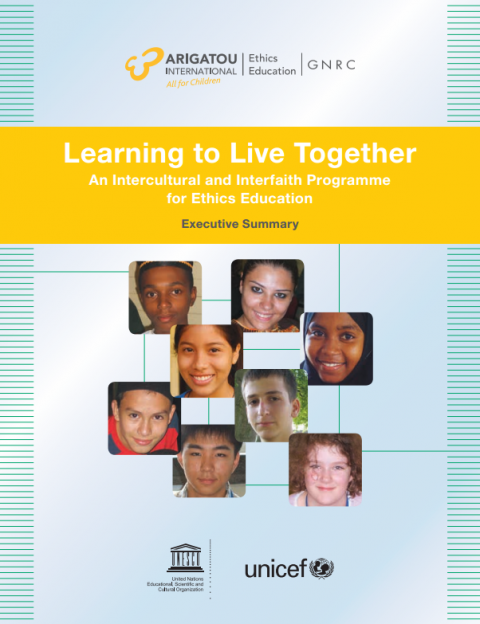 Learning to live together: an intercultural and interfaith programme for ethics education: Executive Summary Año de publicación: 2015 Autor corporativo: United Nations Children's Fund (UNICEF) | Interfaith Council on Ethics Education for Children | Arigatou Foundation What is the Learning to Live Together? How was it developed? Where and how can it be used? In the Executive Summary you can find answers to all these questions, as well as information about outstanding projects that show the potential of the programme. Apprendre à vivre ensemble: Un programme interculturel et interreligieux pour l’enseignement de l’éthique: Résumé Año de publicación: 2015 Autor corporativo: United Nations Children's Fund (UNICEF) | Interfaith Council on Ethics Education for Children | Arigatou Foundation What is the Learning to Live Together? How was it developed? Where and how can it be used? In the Executive Summary you can find answers to all these questions, as well as information about outstanding projects that show the potential of the programme. Aprender a vivir juntos: Un programa intercultural e interreligioso para la educación ética: Resumen Año de publicación: 2015 Autor corporativo: United Nations Children's Fund (UNICEF) | Interfaith Council on Ethics Education for Children | Arigatou Foundation What is the Learning to Live Together? How was it developed? Where and how can it be used? In the Executive Summary you can find answers to all these questions, as well as information about outstanding projects that show the potential of the programme. Learning to live together: an intercultural and interfaith programme for ethics education: Executive Summary Año de publicación: 2015 Autor corporativo: United Nations Children's Fund (UNICEF) | Interfaith Council on Ethics Education for Children | Arigatou Foundation What is the Learning to Live Together? How was it developed? Where and how can it be used? In the Executive Summary you can find answers to all these questions, as well as information about outstanding projects that show the potential of the programme. Conferencia mundial de la UNESCO sobre la educación para el desarrollo sostenible, 31 de Marzo-2 de Abril 2009, Bonn, Alemania: actas Año de publicación: 2009 Autor corporativo: German Federal Ministry of Education and Research (BMBF) | German Commission for UNESCO As the United Nations Decade of Education for Sustainable Development (DESD) approached its midpoint, the “UNESCO World Conference on Education for Sustainable Development – Moving into the Second Half of the UN Decade” was held from 31 March to 2 April 2009 in Bonn, Germany. It brought together 900 participants from 147 countries, among them 49 Ministers and Deputy-Ministers. Participants included representatives of UNESCO Member States, UN agencies, civil society organizations, education institutions, youth, and the private sector, as well as individual experts. The Conference was organized by UNESCO and the German Federal Ministry of Education and Research, in cooperation with the German Commission for UNESCO. The programme was developed in consultation with an international advisory group. Regional workshop on enhancing teachers' competencies in education for sustainable development, Alexandria, Egypt, 7-9 May 2007: final report Año de publicación: 2007 Autor corporativo: UNESCO Beirut | University of Alexandria In the framework of the UN decade of education for sustainable development, the UNESCO offices in the Arab region held their first workshop in September 2005 on the role of education and training for sustainable development. This second workshop was inaugurated in May 2007 on Enhancing Teachers’ Competencies in Education for sustainable Development. The choice of the teacher to be at the center of this workshop stresses the role teacher plays in development programs. Atelier régional sur le renforcement des compétences des enseignants en matière d'éducation pour le développement durable, Alexandrie, Égypte, 7-9 mai 2007: rapport final Año de publicación: 2007 Autor corporativo: UNESCO Beirut | University of Alexandria Dans le cadre de la Décennie des Nations Unies pour l'éducation au développement durable, les bureaux de l'UNESCO dans la région arabe ont tenu leur premier atelier en septembre 2005 sur le rôle de l'éducation et de la formation pour le développement durable. Ce deuxième atelier a été inauguré en mai 2007 sur le renforcement des compétences des enseignants en éducation pour le développement durable. Le choix de l'enseignant à être au centre de cet atelier met l'accent sur le rôle que l'enseignant joue dans les programmes de développement. مؤتمر اليونسكو العالمي للتعليم من أجل التنمية المستدامة: ٣١ آذار/مارس - ٢ نيسان/أبريل ٢٠٠٩ Año de publicación: 2009 Autor corporativo: German Federal Ministry of Education and Research (BMBF) | German Commission for UNESCO As the United Nations Decade of Education for Sustainable Development (DESD) approached its midpoint, the “UNESCO World Conference on Education for Sustainable Development – Moving into the Second Half of the UN Decade” was held from 31 March to 2 April 2009 in Bonn, Germany. It brought together 900 participants from 147 countries, among them 49 Ministers and Deputy-Ministers. Participants included representatives of UNESCO Member States, UN agencies, civil society organizations, education institutions, youth, and the private sector, as well as individual experts. The Conference was organized by UNESCO and the German Federal Ministry of Education and Research, in cooperation with the German Commission for UNESCO. The programme was developed in consultation with an international advisory group. Conférence mondiale de l'UNESCO sur l'éducation au développement durable: 31 mars-2 avril 2009, Bonn, Allemagne: procédure Año de publicación: 2009 Autor corporativo: German Federal Ministry of Education and Research (BMBF) | German Commission for UNESCO Alors que la Décennie des Nations Unies pour l'éducation en vue du développement durable (DEDD) approchait de son point médian, le «Worldconferenceon Education pour le développement durable de l'UNESCO - Passer à la deuxième moitié de la Décennie des Nations Unies» s'est tenu du 31 mars au 2 avril 2009 à Bonn. Elle a réuni 900 participants de 147 pays, dont 49 ministres et sous-ministres. Les participants comprenaient des représentants des États membres de l'UNESCO, des organismes des Nations Unies, des organisations de la société civile, des établissements d'enseignement, des jeunes et du secteur privé, ainsi que des experts individuels. La Conférence a été organisée par l'UNESCO et le Ministère fédéral allemand de l'éducation et de la recherche, en coopération avec la Commission allemande pour l'UNESCO. Le programme a été élaboré en consultation avec un groupe consultatif international.