
Recursos
Exploren una amplia gama de recursos valiosos en GCED para profundizar su comprensión y promover su búsqueda, incidencia, enseñanza y aprendizaje.
1,447 resultados encontrados
 문화다양성협약 국내 이행을 위한 논의: 유튜브에서 AI까지, 21세기 한국에서의 문화다양성 Año de publicación: 2020 Autor: 김재인 | 염신규 | 이광석 | 이동연 | 이상욱 | 홍성수 | 황승흠 Autor corporativo: 대한민국 문화체육관광부 | 한국문화예술위원회 | 유네스코한국위원회 「문화다양성협약 국내 이행을 위한 논의 - 유튜브에서 AI까지, 21세기 한국에서의 문화다양성」는 모두 세 차례에 걸쳐 진행된 전문가회의에서 각 분야 전문가들이 발표하고 토론한 내용을 담은 종합보고서입니다. 올해는 문화다양성협약의 이행과 관련된 이슈들 중 특히 디지털플랫폼의 급부상, 인공지능 기술의 급격한 발달에 초점을 두어 논의하는 한편, 우리들의 일상을 송두리째 바꿔놓은 코로나19가 낳은 불안과 공포, 이로 인한 적대감이 초래한 소외와 고립, 혐오와 갈등의 문제를 짚어보았습니다. 전문가회의에서 나온 전문가들의 진단과 논의가 앞으로 한국사회에서 문화다양성협약 이행 관련 의제를 주도하는 데 있어서 필요한 비전과 전략 수립에도 기여하기를 기대합니다.
  Towards More Gender Equality in Sport: Recommendations and Action Plan From the High Level Group on Gender Equality in Sport (2022) Año de publicación: 2022 Autor corporativo: European Commission | European Union (EU) Gender equality is a fundamental European Union (EU) principle. Enshrined in the Treaties, it is something the EU is actively trying to achieve – most recently through its Gender Equality Strategy 2021-2025. The Strategy aims to give women, men, girls and boys, in all their diversity, the freedom to pursue their chosen path in life and equal opportunities to thrive and to participate in and lead European society. Looking back at the steps already taken, the ‘Gender equality in sport – Proposal for strategic actions 2014-2020’ has certainly led to achievements, but the pace of reforms needs to be accelerated. Firstly, the principle of gender equality now underpins all actions funded under Erasmus+ Sport and projects supporting women’s sport are actively encouraged. Secondly, awareness raising is at the core of EU action in this field, notably through studies or discussions, such as within the Commission Expert Group on Good Governance. Finally, initiatives such as the annual #BeInclusive EU Sport Awards recognise those organisations using sport to increase social inclusion, including gender equality. In 2020, Commissioner Gabriel announced the setting up of an expert group with the aim of discussing the way forward and proposing future actions in the area of gender equality in sport to the European Commission, EU Member States and sports organisations. The work of the experts will lead to the implementation of concrete actions at local, national and European level. This report is the result of the work of the European Commission High-Level Group (HLG) on Gender Equality in Sport. The 15 members of the HLG were appointed in December 2020. Work began in February 2021 and was completed in December 2021. Meetings focused on six areas of engagement identified by the experts. Scientists and practitioners shared findings of their research and good practices. Each meeting was followed by working sessions to summarise the presentations and formulate recommendations. Vers une plus grande égalité des genres dans le sport: Recommandations et plan d'action du groupe de haut niveau sur l’égalité des genres dans le sport (2022) Año de publicación: 2022 Autor corporativo: European Commission | European Union (EU) L’égalité des genres est l’un des principes fondamentaux de l’Union européenne (UE). Inscrite dans les traités, elle constitue un objectif que l’UE s’efforce activement d’atteindre – notamment dans le cadre de sa stratégie en faveur de l’égalité entre les femmes et les hommes 2021-2025. Cette stratégie a pour objectif de donner aux femmes, aux hommes, aux jeunes filles et aux jeunes garçons, dans toute leur diversité, la liberté de suivre le chemin qu’ils ont choisi dans la vie et des chances égales de s’épanouir, de participer à la société européenne et de la diriger. Si l’on considère les mesures déjà prises, le rapport « Égalité des genres dans le sport – Proposition d’actions stratégiques 2014-2020 » a certes permis des avancées, mais le rythme des réformes doit être accéléré. Tout d’abord, le principe de l’égalité des genres sous-tend désormais toutes les actions financées dans le cadre du programme Erasmus+ Sport, et les projets soutenant le sport féminin sont activement encouragés. Ensuite, la sensibilisation est au coeur de l’action de l’UE dans ce domaine, notamment par le biais d’études ou de discussions, comme au sein du groupe d’experts de la Commission sur la bonne gouvernance. Enfin, des initiatives telles que les prix annuels #BeInclusive EU Sport Awards récompensent les organisations qui se servent du sport pour accroître l’inclusion sociale, notamment l’égalité des genres. En 2020, la commissaire Mariya Gabriel a annoncé la création d’un groupe d’experts chargé de déterminer la marche à suivre et de proposer des actions à implémenter dans le domaine de l’égalité des genres dans le sport à la Commission européenne, aux États membres de l’UE et aux organisations sportives. Le travail des experts permettra de mettre en oeuvre des actions concrètes aux niveaux locaux, nationaux et européen. Ce rapport est le résultat du travail du groupe de haut-niveau (GHN) de la Commission européenne sur l’égalité des genres dans le sport. Les 15 membres du groupe de haut-niveau ont été nommés en décembre 2020 Les travaux ont commencé en février 2021 et se sont terminés en décembre 2021. Les réunions ont porté sur six domaines d’engagement identifiés par les experts. Des scientifiques et des praticiens ont partagé le fruit de leurs recherches et leurs bonnes pratiques. Chaque réunion a été suivie par des sessions de travail destinées à résumer les présentations et à formuler des recommandations.
  How Can We Talk About Climate Without Turning It Into a Contentious Issue? Año de publicación: 2023 Autor: Laurent Cordonier Autor corporativo: Le Monde How can we tackle the climate issue without talking only to the convinced? Debates on the climate issue run the risk of becoming a highly divisive political issue, hampering much-needed action, warns sociologist Laurent Cordonier in a new episode of “Chaleur humaine”, a weekly podcast for reflection and debate on ways of tackling the climate challenge. Comment parler du climat sans en faire un sujet d'affrontement ? Año de publicación: 2023 Autor: Laurent Cordonier Autor corporativo: Le Monde Comment aborder le sujet du climat sans parler seulement aux convaincus ? Les débats sur la question climatique risquent de devenir un sujet de clivage politique très fort, ce qui entraverait l’indispensable action, prévient le sociologue Laurent Cordonier dans un nouvel épisode du podcast « Chaleur humaine », podcast hebdomadaire de réflexion et de débat sur les manières de faire face au défi climatique.
  女童和妇女教育 国际研讨会总结报告. 中华人民共和国,北京. 2016年6月4—7日 Año de publicación: 2016 Autor corporativo: National Commission of the People's Republic of China for UNESCO | UNESCO Beijing The International Seminar on Girls’ and Women’s Education, held 4-6 June 2016 in Beijing, explored benefits of education on girls and women along with barriers to the achievement of gender equality in education. It provided a platform for dialogue on the role of education for girls and women, particularly in the context of the 2030 Agenda for Sustainable Development, and specifically in reaching SDG 4 and supporting the achievement of other SDGs. The event also marked the first award ceremony of the UNESCO Prize for Girls’ and Women’s Education, which honoured two laureates for their outstanding innovation and contributions to advancing girls’ and women’s education. This publication presents a synthesis of information that was shared during the seminar’s sessions, and the findings and recommendations originating from the exchanges.
 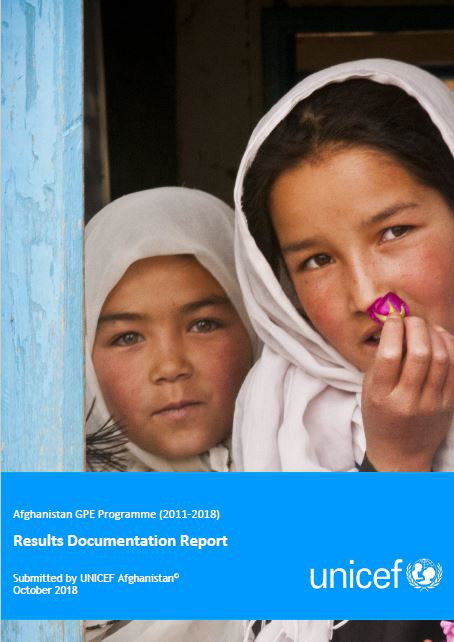 2018 grant completion report. Afghanistan Año de publicación: 2019 Autor corporativo: UNICEF Afghanistan This is the completion report of GPE’s program in Afghanistan, which ran from 2012 to 2018. Overall, it appears education access and equity has been improved in target districts, and some of these effects promise to persist beyond the program period.Community engagement in schooling has also improved, as well as school performance. Target schools have safer and more conducive learning environments for children, and monitoring of education pathways has also improved.Schools have been reopened, and numbers of female teachers in target areas have grown. Finally, the Ministry of Education and national education sectors have seen advances in institutional capacity, and national aid coordination mechanisms also seem to have improved.
  Pandemic-Related Disruptions to Schooling and Impacts on Learning Proficiency Indicators: A Focus on the Early Grades Año de publicación: 2021 Autor: Martin Gustafsson Autor corporativo: UNESCO Institute for Statistics (UIS) This report focusses on the impacts of the pandemic on learning proficiency, specifically as measured by Sustainable Development Goal (SDG) Indicator 4.1.1. Over the last couple of decades, there has been a growing awareness of how crucial learning proficiency, especially that of younger children, is for human development. The evidence is clear that improvements in proficiency underpin future economic development, and the building of more cohesive and equal societies. The indicators on learning proficiency are among the most discussed indicators within the SDG framework. This report explains the impact of COVID-19 on learning losses for primary-aged children and the need for an effective response.
 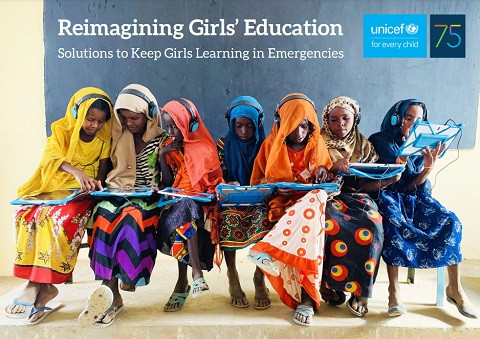 Reimagining Girls’ Education: Solutions to Keep Girls Learning in Emergencies Año de publicación: 2021 Autor corporativo: United Nations Children's Fund (UNICEF) Reimagining Girls’ Education: Solutions to Keep Girls Learning in Emergencies presents an empirical overview of what works to support learning outcomes for girls in emergencies. Research shows that girls in emergencies are disadvantaged at all stages of education and are more likely to be out-of-school than in non-emergency settings. Girls are also struggling to learn.This solutions book seeks to highlight promising evidence-based actions in education for decision makers who are designing and implementing interventions to support girls’ education in low and middle-income country humanitarian settings and settings where education has been interrupted by the COVID‑19 pandemic. It documents practical examples of approaches that have been or are being tested, and from which lessons can be drawn.The overarching aim is that this evidence be used to inform programming in crises and support diverse stakeholders in mitigating the impact of emergencies on girls’ education.
 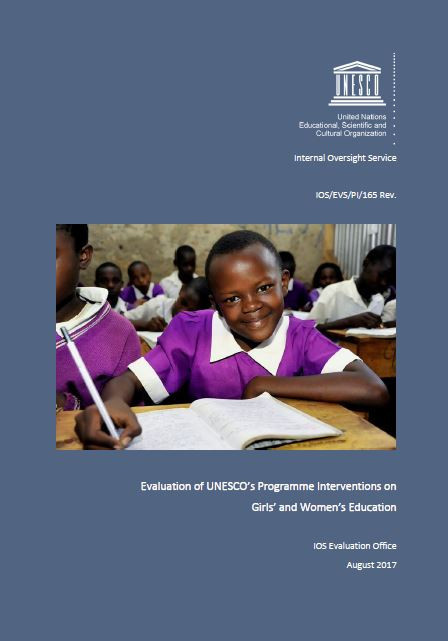 Evaluation of UNESCO's Programme Interventions on Girls' and Women's Education Año de publicación: 2017 Autor: Michael Reynolds, Martina Rathner, Estelle Loiseau Autor corporativo: UNESCO Internal Oversight Service (IOS) Since 2008, Gender Equality has been one of two global priorities for UNESCO. In May 2011, UNESCO launched the Global Partnership for Girls’ and Women’s Education, also known as “Better Life, Better Future”, which aims to increase learning opportunities for adolescent girls and women and to find solutions to some of the biggest obstacles to their education. To further advance the global priority of Gender Equality, since 2015 a dedicated Section of Education for Inclusion and Gender Equality specifically addresses the gender dimensions in education that contribute to differential access, participation, completion, and learning outcomes by boys and girls, and men and women. The evaluation examines UNESCO’s programme interventions in girls’ and women’s education during the period 2015 to 2017, in particular to ascertain the relevance, effectiveness, efficiency and sustainability of initiatives, and to clarify the strategic role and positioning of the Organization in supporting girls’ and women’s education at regional and country levels.The evaluation found that although UNESCO’s efforts for enhancing girls’ and women’s education are clearly aligned to SDG 4 and SDG 5 and also broadly in line with the overall principle of leaving no one behind, there is at times a trade-off between targeting the hardest to reach and other donor priorities, and UNESCO needs to more clearly position its efforts in support of girls’ and women’s education and its niche in the 2030 Agenda. Furthermore, continued efforts are required to scale up and/or replicate small-scale interventions, to better ensure sustainability and to consolidate mechanisms for coordination and information sharing among different interventions to seize synergies and enhance organizational learning.