
Recursos
Exploren una amplia gama de recursos valiosos en GCED para profundizar su comprensión y promover su búsqueda, incidencia, enseñanza y aprendizaje.
3,448 resultados encontrados
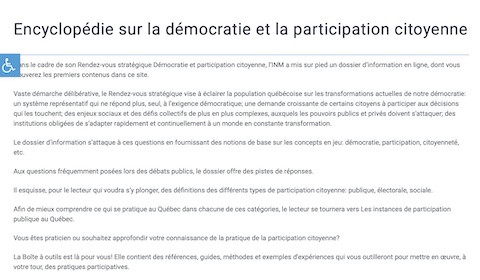 Encyclopedia on Democracy and Citizen Participation Autor: Malorie Flon | Émilie Béorofei Autor corporativo: Institut du Nouveau Monde (INM) As part of its Strategic Meeting on Democracy and Citizen Participation, the INM has set up an online information pack, the first contents of which you will find on this site.A vast deliberative process, the Strategic Rendezvous aims to enlighten the people of Quebec on the current transformations of our democracy: a representative system that no longer responds, on its own, to the democratic requirement; a growing demand from certain citizens to participate in decisions that affect them; increasingly complex social issues and collective challenges, which public and private authorities must tackle; institutions forced to adapt quickly and continuously to a constantly changing world.The Briefing Kit tackles these questions by providing basic notions of the concepts involved: democracy, participation, citizenship, etc. To questions frequently asked during public debates, the dossier offers some possible answers. It outlines, for the reader who wants to dive into it, definitions of the different types of citizen participation: public, electoral, social. In order to better understand what is practiced in Quebec in each of these categories, the reader will turn to The authorities of public participation in Quebec.Are you a practitioner or would you like to deepen your knowledge of the practice of citizen participation? The Toolbox is here for you! It contains references, guides, methods and examples of experiences that will equip you to implement, in turn, participatory practices. Encyclopédie sur la démocratie et la participation citoyenne Autor: Malorie Flon | Émilie Béorofei Autor corporativo: Institut du Nouveau Monde (INM) Dans le cadre de son Rendez-vous stratégique Démocratie et participation citoyenne, l’INM a mis sur pied un dossier d’information en ligne, dont vous trouverez les premiers contenus dans ce site.Vaste démarche délibérative, le Rendez-vous stratégique vise à éclairer la population québécoise sur les transformations actuelles de notre démocratie: un système représentatif qui ne répond plus, seul, à l’exigence démocratique; une demande croissante de certains citoyens à participer aux décisions qui les touchent; des enjeux sociaux et des défis collectifs de plus en plus complexes, auxquels les pouvoirs publics et privés doivent s’attaquer; des institutions obligées de s’adapter rapidement et continuellement à un monde en constante transformation. Le dossier d’information s’attaque à ces questions en fournissant des notions de base sur les concepts en jeu: démocratie, participation, citoyenneté, etc. Aux questions fréquemment posées lors des débats publics, le dossier offre des pistes de réponses. Il esquisse, pour le lecteur qui voudra s’y plonger, des définitions des différents types de participation citoyenne: publique, électorale, sociale. Afin de mieux comprendre ce qui se pratique au Québec dans chacune de ces catégories, le lecteur se tournera vers Les instances de participation publique au Québec. Vous êtes praticien ou souhaitez approfondir votre connaissance de la pratique de la participation citoyenne? La Boîte à outils est là pour vous! Elle contient des références, guides, méthodes et exemples d’expériences qui vous outilleront pour mettre en œuvre, à votre tour, des pratiques participatives.
 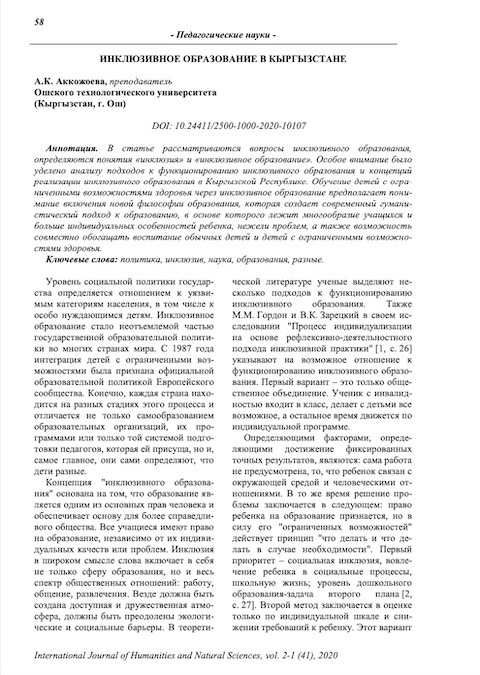 Inclusive Education in Kyrgyzstan (International Journal of Humanities and Natural Sciences; vol. 2-1, no. 41) Año de publicación: 2020 Autor: A.K. Akkojoeva The article deals with issues of inclusive education, defines the concepts of "inclusion" and "inclusive education". Special attention was paid to the analysis of approaches to the functioning of inclusive education and concepts for the implementation of inclusive education in the Kyrgyz Republic. teaching children with disabilities through inclusive education involves understanding the inclusion of a new philosophy of education that creates a modern humanistic approach to education based on the diversity of students and more individual characteristics of the child than problems, as well as the ability to jointly enrich the education of ordinary children and children with disabilities. Инклюзивное образование в Кыргызстане (Международный журнал гуманитарных и естественных наук; vol. 2-1, no. 41) Año de publicación: 2020 Autor: A.K. Akkojoeva В статье рассматриваются вопросы инклюзивного образования, определяются понятия «инклюзия» и «инклюзивное образование». Особое внимание было уделено анализу подходов к функционированию инклюзивного образования и концепций реализации инклюзивного образования в Кыргызской Республике. Обучение детей с ограниченными возможностями здоровья через инклюзивное образование предполагает понимание включения новой философии образования, которая создает современный гуманистический подход к образованию, в основе которого лежит многообразие учащихся и больше индивидуальных особенностей ребенка, нежели проблем, а также возможность совместно обогащать воспитание обычных детей и детей с ограниченными возможностями здоровья.
 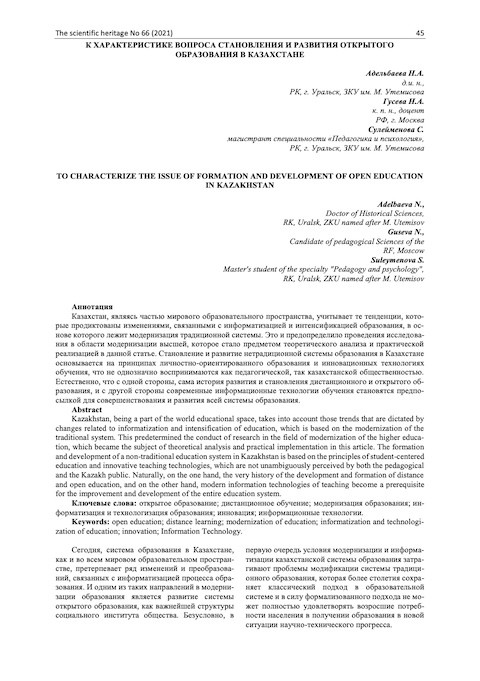 Сharacterizing the Formation and Development of Open Education in Kazakhstan (The Scientific Heritage; no. 66) Año de publicación: 2021 Autor: N. Adelbaeva | N. Guseva | S. Suleymenova Kazakhstan, being a part of the world educational space, takes into account those trends that are dictated by changes related to informatization and intensification of education, which is based on the modernization of the traditional system. This predetermined the conduct of research in the field of modernization of the higher education, which became the subject of theoretical analysis and practical implementation in this article. The formation and development of a non-traditional education system in Kazakhstan is based on the principles of student-centered education and innovative teaching technologies, which are not unambiguously perceived by both the pedagogical and the Kazakh public. Naturally, on the one hand, the very history of the development and formation of distance and open education, and on the other hand, modern information technologies of teaching become a prerequisite for the improvement and development of the entire education system. К характеристике вопроса становления и развития открытого образования в Казахстане (The Scientific Heritage; no. 66) Año de publicación: 2021 Autor: N. Adelbaeva | N. Guseva | S. Suleymenova Казахстан, являясь частью мирового образовательного пространства, учитывает те тенденции, которые продиктованы изменениями, связанными с информатизацией и интенсификацией образования, в основе которого лежит модернизация традиционной системы. Это и предопределило проведения исследования в области модернизации высшей, которое стало предметом теоретического анализа и практической реализацией в данной статье. Становление и развитие нетрадиционной системы образования в Казахстане основывается на принципах личностно-ориентированного образования и инновационных технологиях обучения, что не однозначно воспринимаются как педагогической, так казахстанской общественностью.Естественно, что с одной стороны, сама история развития и становления дистанционного и открытого образования, и с другой стороны современные информационные технологии обучения становятся предпосылкой для совершенствования и развития всей системы образования.
 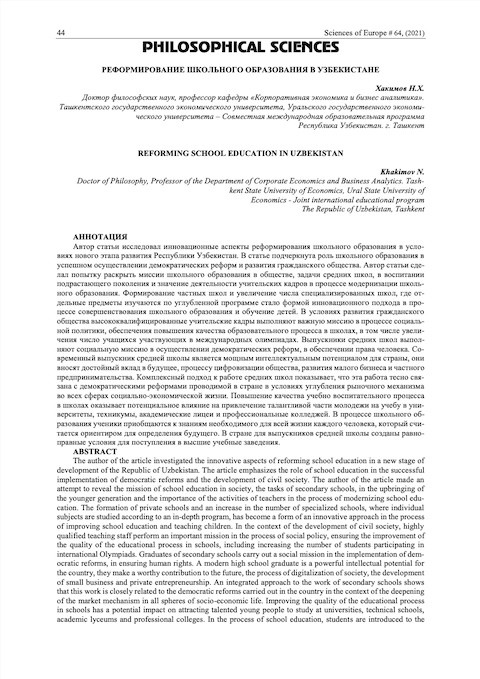 Reforming School Education in Uzbekistan (Sciences of Europe; no.64) Año de publicación: 2021 Autor: N. Khakimov The author of the article investigated the innovative aspects of reforming school education in a new stage of development of the Republic of Uzbekistan. The article emphasizes the role of school education in the successful implementation of democratic reforms and the development of civil society. The author of the article made an attempt to reveal the mission of school education in society, the tasks of secondary schools, in the upbringing of the younger generation and the importance of the activities of teachers in the process of modernizing school education.
 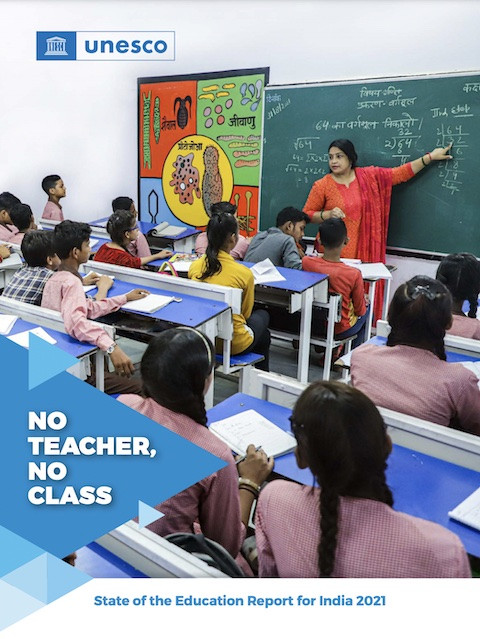 No Teacher, No Class: State of the Education Report for India, 2021 Año de publicación: 2021 Autor: Padma M. Sarangapani | Bindu Thirumalai | Anusha Ramanathan | Ruchi Kumar | Mythili Ramchand Autor corporativo: UNESCO New Delhi This report attempts to provide an understanding of key aspects of the teaching profession and workforce in India – nearly 9.7 million teachers in 2019/20 – the complex work that they do, and their professional development, through the filters of policy debates, choices, pushes and pulls. It looks at the questions that create core tensions in the sector and affect teacher quality and availability. It presents evidence wherever possible, and identifies gaps. The analytical framework of this report draws from important contextual and sectoral aspects including India’s social and political context — especially its federal structure – and social characteristics of gender, caste, rural-urban divide and the government-private divide. This report, prepared during the ongoing COVID-19 pandemic, and constrained by prevailing conditions, is primarily based on analysis of secondary data and review of policies, reports and research literature. Chapters explore specific themes and present key findings.
 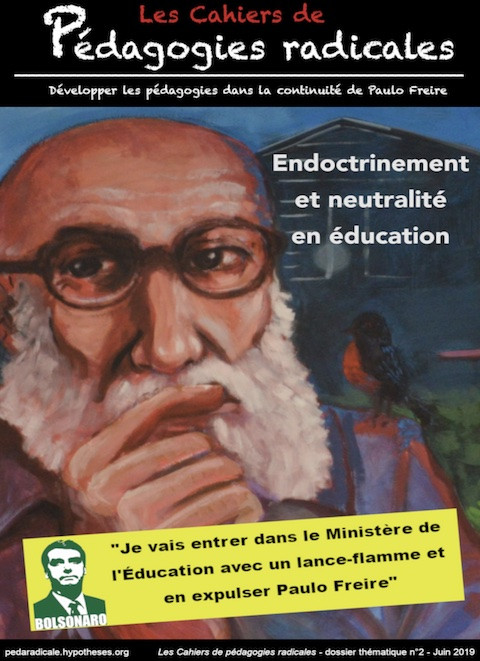 Les Cahiers de pédagogies radicales : Développer les pédagogies inspirées par l'œuvre de Paulo Freire; Endoctrinement et neutralité en éducation Año de publicación: 2019 Autor: Irène Pereira | Gauthier Tolini Autor corporativo: École supérieure du professorat et de l'éducation (ESPE) de Livry Garga Ce deuxième numéro des Cahiers de pédagogies radicales part dans unpremier temps de la volonté de faire connaître la situation au Brésil et lesdébats concernant le « Mouvement de l’école sans parti » qui s’attaque à laliberté pédagogique des enseignants en essayant de leur interdire d’aborderles questions de genre et et les questions économiques et sociales en classe.Pour cela, ce mouvement veut faire passer une loi sur la neutralité desenseignants qui n’existe pas au Brésil : ceux-ci étant tenu actuellementuniquement à une obligation de favoriser le pluralisme des idées. JairBolsonaro, qui est président du Brésil depuis janvier 2019, soutient cemouvement réactionnaire. Il accuse en particulier l’oeuvre de Paulo Freired’endoctrinement marxiste et veut éradiquer sa pensée de l’éducationbrésilienne.Cette situation au Brésil pose des problèmes qui sont centraux pour tous lespédagogues critiques. Quelle est la différence entre pédagogie critique etendoctrinement ? Pour Paulo Freire, c’est parce que la pédagogie critiquefavorise le pluralisme des idées et le dialogue critique qu’il n’y a pasendoctrinement. C’est d’ailleurs sans doute pourquoi l’approche de PauloFreire ne se trouve pas en contradiction avec le projet démocratique, mais aucontraire est insupportable aux régimes dictatoriaux. Mais ce qui est le plusinquiétant au Brésil, c’est qu’il semble tout simplement qu’un enseignant quidéfend dans sa classe les droits de l’homme et la lutte contre lesdiscriminations pourrait être considéré comme portant atteinte à la neutralité.
 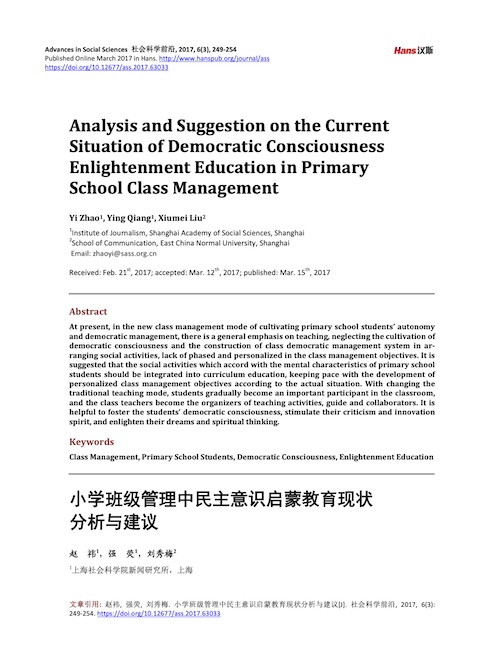 Analysis and Suggestion on the Current Situation of Democratic Consciousness Enlightenment Education in Primary School Class Management (Advances in Social Sciences; vol. 6, no. 3) Año de publicación: 2017 Autor: Zhao Wei | Qiang Ying | Liu Xiumei At present, in the new class management mode of cultivating primary school students’ autonomy and democratic management, there is a general emphasis on teaching, neglecting the cultivation of democratic consciousness and the construction of class democratic management system in ar- ranging social activities, lack of phased and personalized in the class management objectives. It is suggested that the social activities which accord with the mental characteristics of primary school students should be integrated into curriculum education, keeping pace with the development of personalized class management objectives according to the actual situation. With changing the traditional teaching mode, students gradually become an important participant in the classroom, and the class teachers become the organizers of teaching activities, guide and collaborators. It is helpful to foster the students’ democratic consciousness, stimulate their criticism and innovation spirit, and enlighten their dreams and spiritual thinking.