
Recursos
Exploren una amplia gama de recursos valiosos en GCED para profundizar su comprensión y promover su búsqueda, incidencia, enseñanza y aprendizaje.
3,385 resultados encontrados
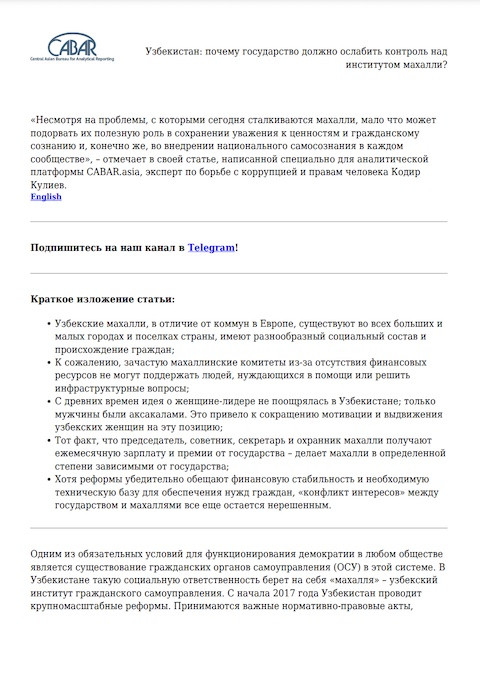 Узбекистан: Почему государство должно ослабить контроль над институтом махалли? Año de publicación: 2019 Autor: Kodir Kuliev Autor corporativo: Central Asian Bureau for Analytical Reporting (CABAR) | Institute for War and Peace Reporting (IWPR) Одним из обязательных условий для функционирования демократии в любом обществе является существование гражданских органов самоуправления (ОСУ) в этой системе. В Узбекистане такую социальную ответственность берет на себя «махалля» – узбекский институт гражданского самоуправления. С начала 2017 года Узбекистан проводит крупномасштабные реформы. Принимаются важные нормативно-правовые акты, которые должны создать благоприятные условия для качественной жизни и обеспечить свободу узбекскому народу. Однако с махаллей такое положительное изменение в долгосрочной перспективе кажется неоднозначным. Основные проблемы, с которыми сегодня сталкиваются махалли – это ограниченная свобода и контроль собственных дел и неспособноть эффективно решать проблемы граждан, что не оправдывает доверия людей.
 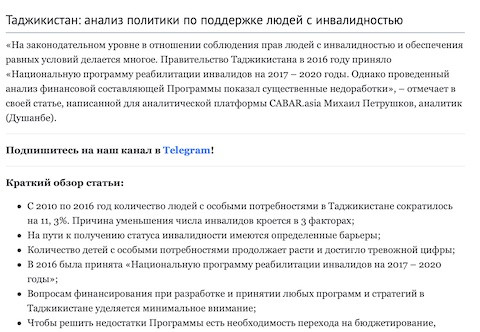 Tajikistan: Policy Analysis to Support Persons with Disabilities Año de publicación: 2018 Autor: Mikhail Petrushkov Autor corporativo: Central Asian Bureau for Analytical Reporting (CABAR) | Institute for War and Peace Reporting (IWPR) “Much is being done at the legislative level with regard to the observance of the rights of people with disabilities and ensuring equal conditions. In 2016, the Government of Tajikistan adopted the National Program for the Rehabilitation of Persons with Disabilities for 2017-2020. However, the analysis of the financial component of the Program showed significant shortcomings, ”says Mikhail Petrushkov, an analyst (Dushanbe), in his article written for the analytical platform CABAR.asia.
  School-Related Gender-Based Violence Measurement Toolkit Año de publicación: 2020 Autor: Dexis Consulting Group Autor corporativo: United States Agency for International Development (USAID) This toolkit delivers practical guidance and resources for measuring the prevalence and extent of students’ experiences of school-related gender-based violence (SRGBV), and provides methods for assessing key risk factors and drivers of SRGBV. This toolkit contains a conceptual framework for measuring SRGBV, a school- based survey for measuring experiences of SRGBV, risk factors, and drivers, as well as practical guidance for implementing the survey.
 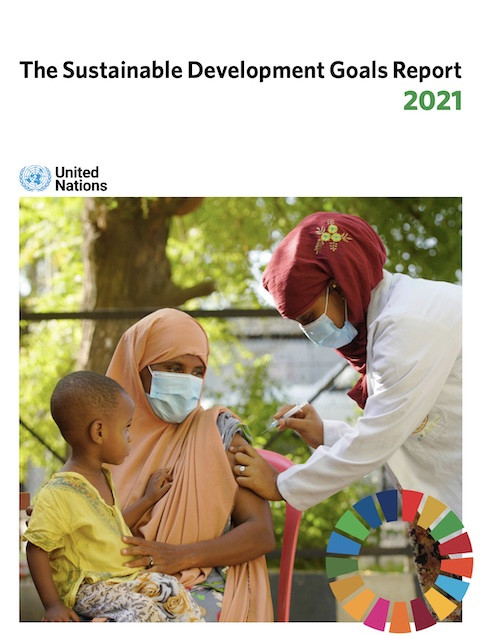 The Sustainable Development Goals Report 2021 Año de publicación: 2021 Autor corporativo: United Nations (UN) As the pandemic continues to unfold, The Sustainable Development Goals Report 2021 outlines some significant impacts in many areas that are already apparent. The global extreme poverty rate rose for the first time in over 20 years, and 119 to 124 million people were pushed back into extreme poverty in 2020. There is a risk of a generational catastrophe regarding schooling, where an additional 101 million children have fallen below the minimum reading proficiency level, potentially wiping out two decades of education gains. Women have faced increased domestic violence, child marriage is projected to rise after a decline in recent years, and unpaid and underpaid care work is increasingly and disproportionately falling on the shoulders of women and girls, impacting educational and income opportunities and health. Notwithstanding the global economic slowdown, concentrations of major greenhouse gases continue to increase. With the global average temperature reaching about 1.2°C above pre-industrial levels, the climate crisis has well and truly arrived, and its impacts are being felt across the world. The pandemic has also brought immense financial challenges, especially for developing countries – with a significant rise in debt distress and dramatic decreases in foreign direct investment and trade. Yet, with a surge in global solidarity and leadership from the highest political level, countries can still deliver on the 2030 Agenda and the 2015 Paris Agreement on Climate Change. A global vaccination plan, designed and implemented by the countries that can produce vaccines today or will be able to do so if properly supported, is an urgent first step in that direction. A recommitment by Governments, cities, businesses, and industries to ensure that the recovery reduces carbon emissions, conserves natural resources, creates better jobs, advances gender equality and tackles growing poverty and inequalities is a further imperative.
  Youth Activist Toolkit: A Digital Guide Año de publicación: 2021 Autor corporativo: Scotdec | European Union (EU) This toolkit is designed to empower young people to campaign for positive change around local and global issues and to use the learning to form social media actions for change. Rapport sur les objectifs de développement durable 2021 Año de publicación: 2021 Autor corporativo: United Nations (UN) Le Rapport sur les objectifs de développement durable pement durable 2021 décrit certains effets importants qui se manifestent déjà dans de nombreux domaines. Le taux mondial d’extrême pauvreté a augmenté pour la première fois en plus de 20 ans, et entre 119 et 124 millions de personnes ont basculé dans l’extrême pauvreté en 2020. Un risque de catastrophe générationnelle se dessine en matière de scolarisation, alors que 101 millions d’enfants de plus sont passés sous le seuil minimum de compétence en lecture, ce qui pourrait réduire à néant deux décennies de progrès scolaires. Les femmes ont été confrontées à une hausse de la violence conjugale, le mariage d’enfants devrait augmenter après des années de baisse, et le travail domestique non rémunéré et sous-payé repose de plus en plus et de façon disproportionnée sur les femmes et les filles, avec des répercussions sur leurs possibilités d’édu- cation et de revenu et leur santé. Malgré le ralentissement économique mondial, la concentration des principaux gaz à effet de serre continue d’augmenter. La température moyenne mondiale s’établissant à environ 1,2 °C au-dessus des niveaux préindustriels, la crise climatique est bel et bien là et ses effets se font sentir partout dans le monde. La pandémie a également engendré d’immenses défis financiers, en particulier pour les pays en développement, avec une augmentation significative du surendettement et une baisse spectaculaire de l’investissement étranger direct et du commerce.Pourtant, avec un élan de solidarité mondiale et un leadership au plus haut niveau politique, les pays peuvent encore réaliser le Programme 2030 et l’Accord de Paris sur les changements climatiques adopté en 2015. Un plan mondial de vaccination, conçu et mis en œuvre par les pays qui peuvent aujourd’hui produire des vaccins ou qui le pourront dans le futur avec le soutien adéquat, est une première étape urgente pour y parvenir.Il est également impératif que les gouvernements, les villes, les entreprises et les industries s’engagent de nouveau à assurer une reprise qui prises et les industries s’engagent de nouveau à assurer une reprise qui réduise les émissions de carbone, préserve les ressources naturelles, crée de meilleurs emplois, fasse progresser l’égalité entre les sexes et fasse reculer la pauvreté et les inégalités croissantes.
  Review and Reflection on Special Education Act in Scotland (Creative Education Studies; vol. 7, no. 1) Año de publicación: 2019 Autor: Qiuhan Feng Scotland is famous for its high quality education and the development of inclusive education around the world. Education equality is a core concept to improve social justice in Scotland. The government has published many educational acts to enlarge the additional support system, protect parents’ involvement and establish teacher education system to improve the education of children in disadvantaged situations. However, problems come along with the expansion of additional support needs, such as categories and labels, stigmatization, effectiveness of education resource delivery. Education equality still remains as a big problem. 苏格兰特殊教育法案的评述及思考(创新教育研究; vol. 7, no. 1) Año de publicación: 2019 Autor: Qiuhan Feng 苏格兰以高水平的教育质量和融合教育发展程度闻名于世,其以教育公平促进社会公平的理念是当地教 育的特色之一。迄今为止,苏格兰已经颁布多种教育法案来扩大额外支持需要的服务范围,并保障家长 的参与权,建立完善的教师教育体系来提升各种弱势儿童群体的教育质量。然而额外支持需要带来的分 类与标签问题、污名化问题、教育资源传递有效性问题依然存在,引发学者对教育公平的思考。
  SDG 4 Data Digest 2020: Using Household Survey Data to Monitor SDG 4 Año de publicación: 2020 Autor corporativo: UNESCO Institute for Statistics (UIS) The 2020 edition of the SDG 4 Data Digest by the UNESCO Institute for Statistics focuses on household surveys as an important and underutilized tool to collect the data needed to track progress towards Sustainable Development Goal 4 and to ensure that no one is left behind. The Digest describes existing survey programmes and offers advice on the design and implementation of new surveys. The Digest identifies a number of advantages to using household surveys and describes the categories of indicators best suited for monitoring with survey data. Data from household surveys complement administrative data collected in schools and can be disaggregated to a greater extent than administrative data to facilitate the monitoring of exclusion in education. The definitions and calculation methods of selected indicators are laid out and the combination of household survey data with data from other sources is explained. This issue of the Digest is aimed at government officials, national planners, donors and others who make decisions about the implementation of nationally representative household surveys. It describes the requirements for conducting a household survey and the steps that must be followed from questionnaire design to data collection and analysis, and it gives advice on presentation of the findings. A section on COVID-19 summarizes the impact of the current pandemic on data collection. Additional resources, with suggested survey questions for the collection of education data through household surveys, are also included. Compendio de Datos sobre el ODS 4: Cómo utilizar datos de encuestas de hogares para monitorear el ODS 4 Año de publicación: 2020 Autor corporativo: UNESCO Institute for Statistics (UIS) La edición 2020 del Compendio de Datos sobre el ODS 4 del Instituto de Estadística de la UNESCO se centra en las encuestas de hogares como una importante e infrautilizada herramienta para la recolección de los datos necesarios para rastrear el progreso hacia el Objetivo de Desarrollo Sustentable 4 y para garantizar que nadie quede en el camino. El Compendio describe los programas de encuestas existentes y brinda consejos para el diseño y la implementación de nuevas encuestas. El Compendio identi ca una serie de ventajas en el uso de las encuestas de hogares y describe las categorías de indicadores más adecuados para el monitoreo con datos de encuestas. Los datos de encuestas de hogares complementan los datos administrativos recolectados en las escuelas y pueden ser desglosados a un grado mayor que los datos administrativos, facilitando el monitoreo de la exclusión en la educación. Se han expuesto las de niciones y métodos de cálculo de los indicadores seleccionados y se ha explicado cómo se combinan los datos de encuestas de hogares con los datos de otras fuentes. Esta edición del Compendio está dirigida a los funcionarios de gobierno, plani cadores nacionales, contribuyentes y quienes tomen decisiones sobre la implementación de las encuestas de hogares nacionalmente representativas. Describe los requisitos para la ejecución de una encuesta de hogares y los pasos que deben seguirse desde el diseño del cuestionario hasta la recolección y análisis de datos, además de dar consejos sobre cómo presentar los hallazgos. Una sección sobre el COVID-19 resume el impacto que tiene la actual pandemia sobre la recolección de datos. También se han incluido recursos adicionales, con preguntas de encuestas sugeridas para la recolección de datos educativos mediante las encuestas de hogares.