
Recursos
Exploren una amplia gama de recursos valiosos en GCED para profundizar su comprensión y promover su búsqueda, incidencia, enseñanza y aprendizaje.
1,405 resultados encontrados
 The United Nations world water development report 2016: water and jobs Año de publicación: 2016 Autor corporativo: UNESCO Three out of four jobs worldwide rely on water. As such, water shortages and lack of access may limit economic growth in the years to come, according to the World Water Development Report 2016. From its collection, through various uses, to its ultimate return to the natural environment, water is a key factor in the development of job opportunities either directly related to its management (supply, infrastructure, wastewater treatment, etc.) or in economic sectors that are heavily water-dependent such as agriculture, fishing, power, industry and health. In its analysis of the economic impact of access to water, the report cites numerous studies that show a positive correlation between investments in the water sector and economic growth. It also highlights the key role of water in the transition to a green economy. Rapport mondial des Nations Unies sur la mise en valeur des ressources en eau 2016: l'eau et l'emploi Año de publicación: 2016 Autor corporativo: UNESCO Three out of four jobs worldwide rely on water. As such, water shortages and lack of access may limit economic growth in the years to come, according to the World Water Development Report 2016. From its collection, through various uses, to its ultimate return to the natural environment, water is a key factor in the development of job opportunities either directly related to its management (supply, infrastructure, wastewater treatment, etc.) or in economic sectors that are heavily water-dependent such as agriculture, fishing, power, industry and health. In its analysis of the economic impact of access to water, the report cites numerous studies that show a positive correlation between investments in the water sector and economic growth. It also highlights the key role of water in the transition to a green economy.
  Réponses du secteur de l'éducation au harcèlement homophobe Año de publicación: 2013 Autor corporativo: UNESCO This publication is part of a Good Policy and Practice series that addresses key themes of UNESCO’s work with the education sector including HIV and AIDS and safe, healthy educational environments for all learners. This volume, on the theme of homophobic bullying in educational institutions, builds on UNESCO’s work on gender, discrimination and violence in schools. 第十次全民教育(EFA)高级工作组会议: 宗滴恩宣言 Año de publicación: 2011 Autor corporativo: UNESCO This statement is the outcome of 10th meeting of the High-level Group on Education for All. The meeting was held from 22 to 24 March 2011 in Jomtien, Thailand to urge to progress towards the EFA goals.
 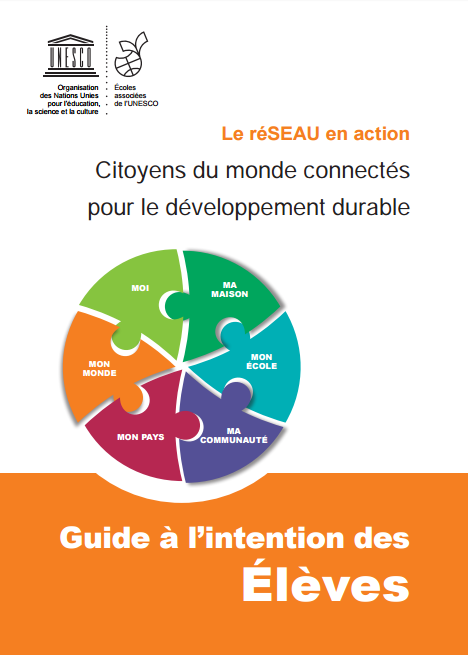 Le réSEAU en action: citoyens du monde connectés pour le développement durable: guide à l'intention des élèves Año de publicación: 2017 Autor corporativo: UNESCO Le guide « Le réSEAU en action : Citoyens du monde connectés pour le développement durable » à l’intention des élèves a pour but d’initier les élèves du secondaire à l’éducation à la citoyenneté mondiale (ECM) et à l’éducation en vue du développement durable (EDD), et de leur proposer des idées et des activités pour qu’ils contribuent activement à la construction d’un monde plus pacifique et durable. Le guide s’appuie sur les discussions et les activités de près de 1 100 participants originaires de 104 pays, notamment des coordinnateurs nationaux du réSEAU, des chefs d’établissement, des enseignants, des élèves et des experts qui ont contribué à la plateforme collaborative en ligne « Le réSEAU en action : Citoyens du monde connectés pour le développement durable » en 2014 et 2015 [http://fr.unesco.org/aspnet/globalcitizens/]. Le guide à l’intention des élèves : donne une idée de ce que signifie « être un citoyen du monde » ainsi que des suggestions pour contribuer au développement durable ; propose des idées pour agir vous-mêmes dans votre foyer, dans votre école, dans votre communauté, dans votre pays et dans le monde ; présente une sélection d’activités sur l’ECM et l’EDD mises en œuvre par des écoles du réSEAU du monde entier.
 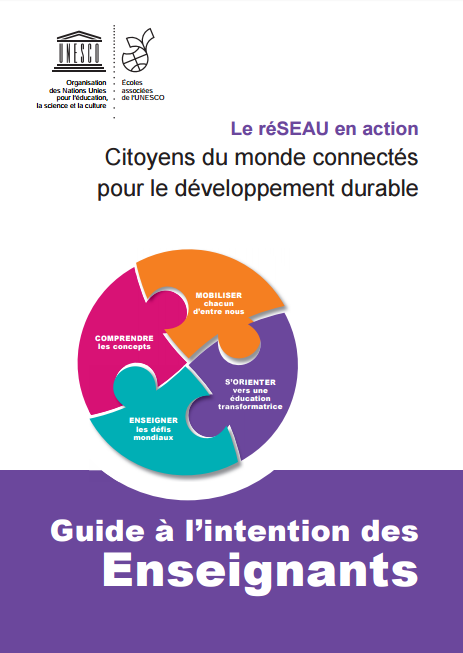 Le réSEAU en action: Citoyens du monde connectés pour le développement durable: guide à l'intention des enseignants Año de publicación: 2017 Autor corporativo: UNESCO Le guide à l’intention des enseignants : donne aux élèves une idée de ce que signifie pour eux « devenir des citoyens du monde » ainsi que des suggestions pour contribuer au développement durable ; propose des idées d’activités en classe pour aider les élèves du secondaire à développer des connaissances, des compétences, des valeurs, des attitudes et des comportements en faveur de l’ECM et de l’EDD ; présente une sélection d’activités sur l’ECM et l’EDD mises en œuvre par les écoles du réSEAU du monde entier. لاجتماع العاشر للفريق الرفيع المستوى المعني بالتعليم للجميع Año de publicación: 2011 Autor corporativo: UNESCO This statement is the outcome of 10th meeting of the High-level Group on Education for All. The meeting was held from 22 to 24 March 2011 in Jomtien, Thailand to urge to progress towards the EFA goals.
  UNESCO Strategy on Education for Health and Well-Being: Contributing to the Sustainable Development Goals Año de publicación: 2016 Autor corporativo: UNESCO This strategy builds on UNESCO’s longstanding commitment to strengthen the links between education and health, reflecting international recognition that a more comprehensive approach to school health and coordinated action across sectors is needed. As stated in the 2015 Incheon Declaration, education develops the skills, values and attitudes that enable citizens to lead healthy and fulfilled lives, make informed decisions, and respond to local and global challenges. It updates previous UNESCO strategies and expands on UNESCO’s work on HIV and on promoting comprehensive sexuality education and safe and inclusive learning environments, placing more emphasis on the role of schools in promoting health. More specifically, it reflects recent developments in the global education, HIV and health agendas, and is aligned with the new UNAIDS 2016-2021 Strategy and the Sustainable Development Goals, in particular SDG 3 Health, SDG 4 Education and SDG 5 Gender Equality. Stratégie de l'UNESCO sur l'éducation pour la santé et le bien-être: contribution aux Objectifs de développement durable Año de publicación: 2016 Autor corporativo: UNESCO This strategy builds on UNESCO’s longstanding commitment to strengthen the links between education and health, reflecting international recognition that a more comprehensive approach to school health and coordinated action across sectors is needed. As stated in the 2015 Incheon Declaration, education develops the skills, values and attitudes that enable citizens to lead healthy and fulfilled lives, make informed decisions, and respond to local and global challenges. It updates previous UNESCO strategies and expands on UNESCO’s work on HIV and on promoting comprehensive sexuality education and safe and inclusive learning environments, placing more emphasis on the role of schools in promoting health. More specifically, it reflects recent developments in the global education, HIV and health agendas, and is aligned with the new UNAIDS 2016-2021 Strategy and the Sustainable Development Goals, in particular SDG 3 Health, SDG 4 Education and SDG 5 Gender Equality. Proyecto de estrategia de la UNESCO sobre la educación para la salud y el bienestar: contribución a los Objetivos de Desarrollo Sostenible Año de publicación: 2016 Autor corporativo: UNESCO This strategy builds on UNESCO’s longstanding commitment to strengthen the links between education and health, reflecting international recognition that a more comprehensive approach to school health and coordinated action across sectors is needed. As stated in the 2015 Incheon Declaration, education develops the skills, values and attitudes that enable citizens to lead healthy and fulfilled lives, make informed decisions, and respond to local and global challenges. It updates previous UNESCO strategies and expands on UNESCO’s work on HIV and on promoting comprehensive sexuality education and safe and inclusive learning environments, placing more emphasis on the role of schools in promoting health. More specifically, it reflects recent developments in the global education, HIV and health agendas, and is aligned with the new UNAIDS 2016-2021 Strategy and the Sustainable Development Goals, in particular SDG 3 Health, SDG 4 Education and SDG 5 Gender Equality.