
Recursos
Exploren una amplia gama de recursos valiosos en GCED para profundizar su comprensión y promover su búsqueda, incidencia, enseñanza y aprendizaje.
875 resultados encontrados
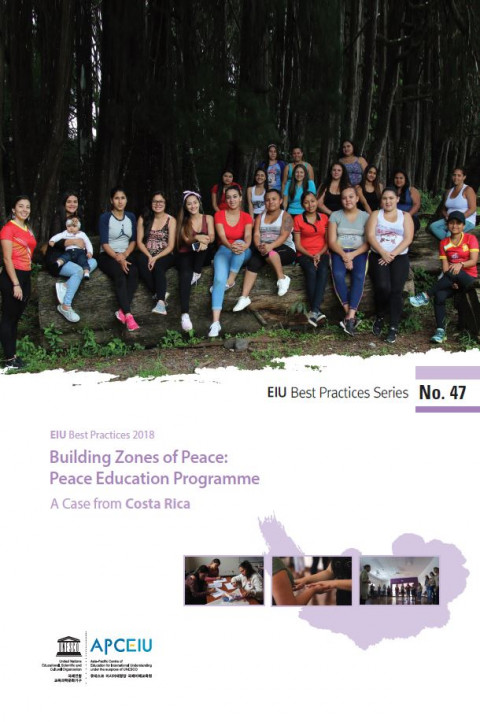 EIU Best Practices Series No. 47: Building Zones of Peace: Peace Education Programme; A Case from Costa Rica Año de publicación: 2018 Autor corporativo: APCEIU Building Zones of Peace (BZP) is a non-formal peace and global citizen education programme created to promote peace and prevent violence in vulnerable urban communities in Costa Rica. The programme aims to encourage participants to develop a critical view of their contexts and explore different ways of taking action to transform the world we live in, and by recognizing how individual and collective efforts have a positive and direct impact in our personal, family and community spheres as well as nationally and globally.In 2017, BZP was conducted to a group of secondary education students ages 13 to 17. This year (2018), participants are young women, ages 18 to 22, all of the mothers who live in extreme poverty. These women have been selected by a governmental office whose aim is to reduce poverty by empowering them. Several resources and networks of support have been created in different areas such as health, employment, childcare and education to achieve this goal. In this sense, our programme was chosen to contribute significantly in this process.
  Inaugural Meeting of the GCED Actors' Platform: Final Report Año de publicación: 2020 Autor corporativo: APCEIU This final report gives an overview of discussions and outcomes from the “Inaugural Meeting of the GCED Actors’ Platform” on 2 September 2019 in Seoul, Republic of Korea, held back-to-back with the 4th International Conference on GCED (3-4 September 2019, Seoul) In line with the call for closer collaboration on GCED inter-regionally, the GCED Actors’ Platform was launched by UNESCO Headquarters and APCEIU in 2019. Convening regional coordinators and different partners working on GCED, the “Inaugural Meeting of the GCED Actors’ Platform” provided an open space for the participants to discuss ways to coordinate activities and promote synergies.The regional representatives have imparted their own experiences and challenges on the ground and shared best practices of facilitating GCED.
 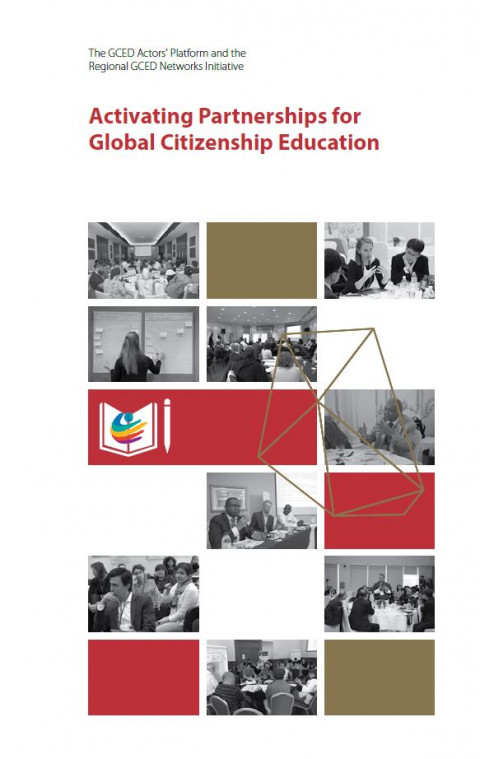 The GCED Actors' Platform and the Regional GCED Networks Initiative: Activating Partnerships for Global Citizenship Education Año de publicación: 2020 Autor corporativo: APCEIU This brief publication introduces and summarizes the flagship GCED Network initiatives supported by APCEIU implemented globally and regionally.UNESCO Headquarters and APCEIU co-convened the launch of the GCED Actors’ Platform in which gathered key partners across the globe and representing five Regional GCED Networks. These five Regional GCED Networks include Sub-Saharan Africa, Arab States, Asia-Pacific, Europe and North America, and Latin America and the Caribbean are formed to identify regional priorities and implement regional strategies to promote GCED. The publication also showcases successful independent activities by organizations part of the GCED Network initiative.
 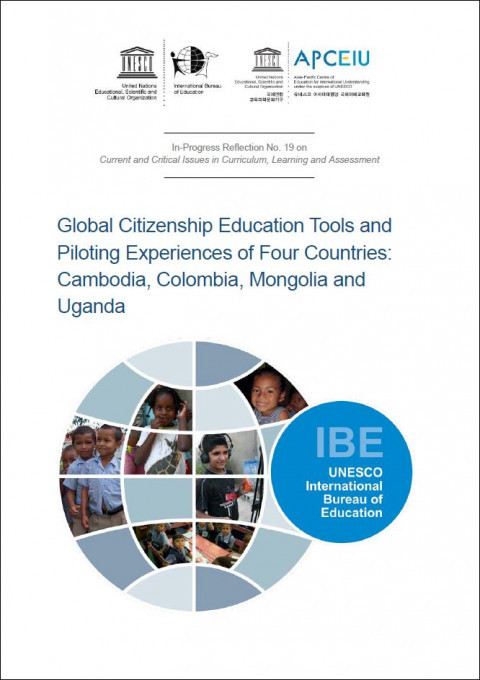 Global Citizenship Education Tools and Piloting Experiences of Four Countries: Cambodia, Colombia, Mongolia and Uganda Año de publicación: 2018 Autor: Opertti Renato | Hyekyung Kang | Magni Giorgia Autor corporativo: UNESCO International Bureau of Education (IBE) | APCEIU This report analyses the progresses made by Cambodia, Colombia, Mongolia and Uganda in the development and piloting of GCED tools, designed within the framework of UNESCO Asia-Pacific Centre of Education for International Understanding (APCEIU)’s and International Bureau of Education (IBE)’s three-year cooperation project, “Global Citizenship Education Curriculum Development and Integration”. Based on the needs identified through the situational analyses carried out during Phase I, the four countries have developed tailored tools to mainstream GCED in their own context and piloted them during Phase II. Through an in-depth analysis of the tools as well as of their piloting processes, this report aims at understanding the extent to which GCED concepts are embedded and integrated into these tools and the way in which these tools contribute to the overall GCED teaching and learning practices in each context. What results from the findings is that the four countries, despite some setbacks due mainly to the strict timeline, have made significant progress in developing innovative strategies to integrate GCED principles into their education policies and practices. Finally, this report concludes with the suggestions for these tools to be effectively implemented during Phase III, particularly for this project, and for any further initiative around GCED areas.
 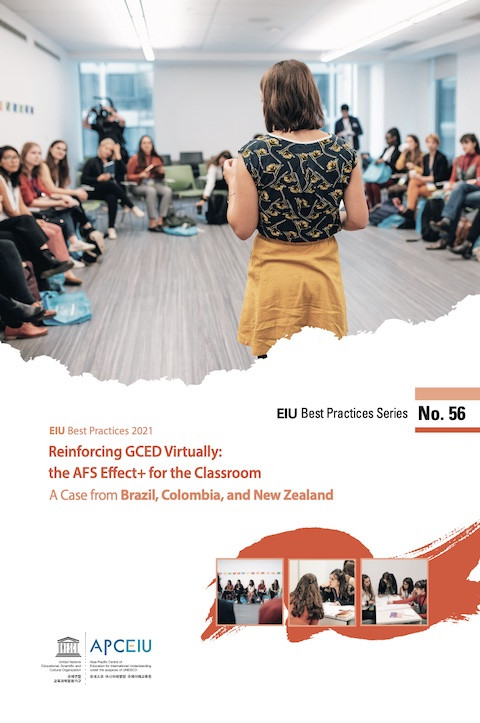 EIU Best Practices 2021: Reinforcing GCED Virtually; the AFS Effect+ for the Classroom, a Case from Brazil, Colombia, and New Zealand (EIU Best Practices Series; no.56) Año de publicación: 2021 Autor: Ana Carolina Cassiano Autor corporativo: APCEIU This monograph is one of APCEIU's EIU Best Practices Series, which aims to encourage educators, scholars, and activists to implement and share local initiatives on EIU. The Series No.56 introduces ‘the AFS Effect+ for the Classroom Programme’ which is launched in September 2020. The programme has engaged 150+ high-school teachers from Brazil, Colombia, and New Zealand who completed 20 hours of virtual teacher training, collaborated virtually with each other and piloted activities developed by AFS with their classrooms, reaching over 2,500 students. As a result of the programme, the AFS Effect+ for the Classroom: Toolkit for Educators is now available to teachers worldwide to use as a resource for teaching Active Global Citizenship & the SDGs for high school students. The toolkit is currently available in English, Spanish and Portuguese, and being disseminated through AFS Network Organizations which are present in 50+ countries.
  2022 Youth Leaders’ Mentorship & Local GCED Projects: Activity Report Año de publicación: 2022 Autor corporativo: APCEIU This report summarizes 15 GCED projects implemented in different parts of the world by the alumni of APCEIU’s Youth Leadership Workshop on GCED in 2022. Ranging from community advocacy for global citizenship to girls’ empowerment projects, 15 GCED initiatives have been taken by the team of 15 young leaders in their own communities in Asia, Europe, Africa, Latin America, and the Caribbean. APCEIU offers GCED training programmes targeting youth leaders around the globe to encourage them to achieve the SDGs through global citizenship and GCED. Since 2015, the Youth Leadership Workshop on GCED has been held every year in the Republic of Korea, inviting 50 young global leaders to take part in an intensive training programme where they share their actions, deepen their knowledge on global/local issues, enhance their motivation to take actions for a change, and establish the young leaders’ network on GCED. Since 2021, it has been shifted to a comprehensive training programme composed of online training workshops, mentorship, and local project implementation.
  2023 Youth Leaders' Mentorship & Local GCED Project: Activity Report Año de publicación: 2023 Autor corporativo: APCEIU This report summarizes 10 GCED projects implemented in different parts of the world by the alumni of APCEIU’s Youth Leadership Workshop on GCED in 2023. Ranging from community advocacy for global citizenship to youth-led campaign projects, 10 GCED initiatives have been taken by 10 young leaders in their own communities in Asia, Europe, Africa, Latin America, and the Caribbean. APCEIU offers GCED training programmes targeting youth leaders around the globe to encourage them to achieve the SDGs through global citizenship and GCED. Since 2015, the Youth Leadership Workshop on GCED has been held every year in the Republic of Korea, inviting 50 young global leaders to take part in an intensive training programme where they share their actions, deepen their knowledge on global/local issues, enhance their motivation to take actions for a change, and establish the young leaders’ network on GCED. Since 2021, it has been shifted to a comprehensive training programme composed of online training workshops, mentorship, and local project implementation.
 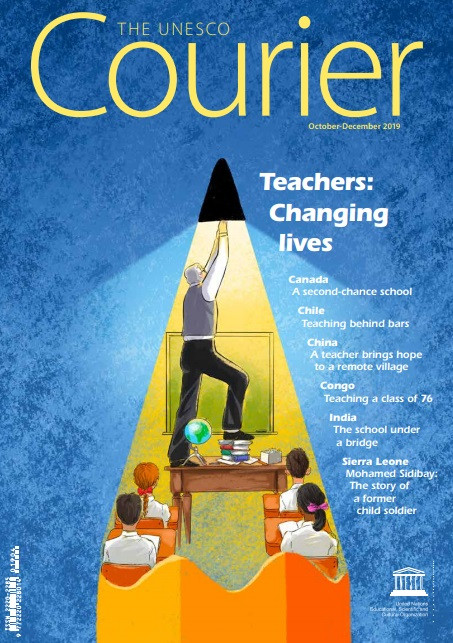 Teachers: changing lives (The UNESCO Courier no. 4, October-December 2019) Año de publicación: 2019 Autor corporativo: UNESCO Certainly, everyone recognizes the key role teachers play. On a personal level, we can all name at least one teacher who made a difference – sometimes to such an extent that it redirected our whole lives. At the international level, the United Nations Sustainable Development Goals (SDGs), Goal 4 in particular, recognize the importance of teachers in the implementation of the Sustainable Development Agenda by 2030. Yet, the profession is being undermined. The development of cognitive neuroscience and the many applications of new technologies in the field of education are forcing the profession to adapt and reinvent itself. Ces profs qui changent le monde (Le Courrier de l'UNESCO 4, octobre-décembre 2019) Año de publicación: 2019 Autor corporativo: UNESCO Certes, tout le monde reconnaît le rôle clé que jouent les enseignants. À titre personnel, chacun peut citer le nom d’au moins un professeur qui a compté, parfois au point de réorienter une vie entière. Sur le plan international, les Objectifs de développement durable (ODD) des Nations Unies, en particulier l’Objectif no 4, reconnaissent l’importance des enseignants dans la mise en œuvre du Programme de développement durable à l’horizon 2030. Pourtant, la profession est mise à mal. Le développement des neurosciences cognitives, les multiples applications des nouvelles technologies dans le domaine de l’éducation obligent la profession à s’adapter, se réinventer. Docentes que cambian el mundo (El Correo de la UNESCO 4, Octubre-Diciembre 2019) Año de publicación: 2019 Autor corporativo: Organización de las Naciones Unidas para la Educación, la Ciencia y la Cultura (UNESCO) Sin duda, todo el mundo reconoce la función esencial que desempeñan los docentes. A título individual, cada uno de nosotros puede mencionar el nombre de al menos un maestro que le influyó decisivamente, a veces hasta el punto de reorientar toda su vida. En el ámbito internacional, los Objetivos de Desarrollo Sostenible (ODS) de las Naciones Unidas, en particular el ODS 4, destacan la importancia del profesorado en la consecución de la Agenda 2030 de desarrollo sostenible.Y, sin embargo, la profesión docente está en crisis. El desarrollo de la neurociencia cognitiva y las múltiples aplicaciones de las nuevas tecnologías en el sector educativo imponen al magisterio la necesidad de adaptarse, de reinventarse.