
Recursos
Exploren una amplia gama de recursos valiosos en GCED para profundizar su comprensión y promover su búsqueda, incidencia, enseñanza y aprendizaje.
1,187 resultados encontrados
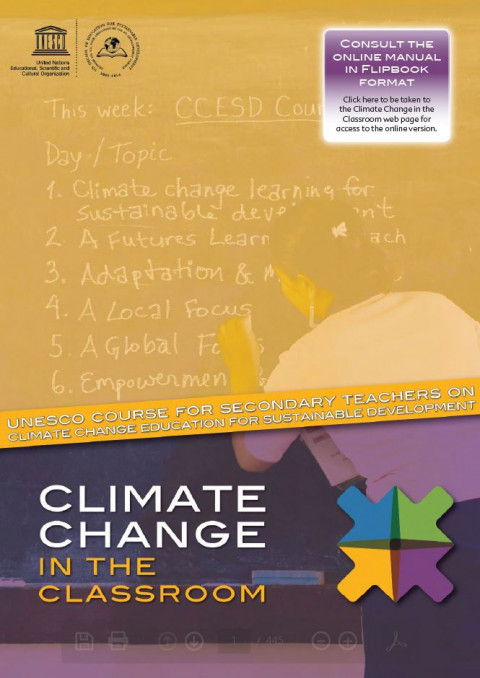 Climate change in the classroom: UNESCO course for secondary teachers on climate change education for sustainable development Año de publicación: 2013 Autor: David Selby | Fumiyo Kagawa Autor corporativo: UNESCO This course has been created with the goal of bringing climate change education outside the science classroom into the many other subject areas upon which climate change now has an impact, or will impact in the future, such as ethics, social studies, economics, political science, among others. The course materials are organized into four parts: 1. Course Framework and Overview, 2. Teachers’ Education Course daily materials, 3. Regional Resource Packs, 4. Daily Classroom Materials for teachers. These materials are all described in more detail and can be accessed from the Start Menu found on the following pages. This course is designed to enable teachers at the secondary level from diverse subject areas to introduce climate change education for sustainable development (CCESD) across the curriculum. UNESCO has identified the professional development of teachers in education for sustainable development as the top priority in recognition of the transformative role that teachers and teacher educators need to play in re-orienting education to help realize a sustainable future (UNESCO, 2005, p. 19). But good intentions for the professional development of teachers have fallen short in practice. Although taken up by enthusiasts, teacher education for sustainable development has rarely been mainstreamed, and, where there are courses, is often approached within a disciplinary as opposed to an interdisciplinary frame (Wals, A., 2009). If professional development in education for sustainable development is at an adolescent stage, teacher education in climate change education for sustainable development is in its infancy. For instance, according to a 2009 international comparative study on climate change education and sustainable development in ten countries, climate change education has peripheral status in educational research and practice, and when it is addressed it is only within science education (Læssøe,J. Schnack, K., Breiting, S. & Rolls, S., 2009). There is a clear and present need to respond to climate change challenges through systematic teacher education programmes that are not restricted to a single subject area. This teacher education course is an attempt to fill the current gap and is in line with one of UNESCO’s key objectives for climate change education for sustainable development, that is, to support teacher training on climate change for sustainable development (UNESCO, 2010, p. 9). The programme has four distinctive features: 1. It helps teachers to understand the causes, dynamics and impacts of climate change through a holistic approach. 2. Teachers are exposed to, and experience, a range of pedagogical approaches and techniques, that they can use in their own school environment. This includes engagement of themselves and their students in whole school and school-in-community approaches. 3. Teachers will develop their capacities to facilitate students’ community based learning. 4. Teachers will develop future-oriented and transformative capacities in facilitating climate change mitigation, adaptation, and disaster risk reduction learning. Les changements climatiques dans la salle de classe: Cours de l'UNESCO pour les enseignants du secondaire sur le changement climatique éducation au développement durable Año de publicación: 2013 Autor: David Selby | Fumiyo Kagawa Autor corporativo: Organisation des Nations Unies pour l'éducation, la science et la culture (UNESCO) Ce cours a été créé avec l'objectif d'amener le changement climatique l'éducation en dehors de la salle de classe de la science dans les nombreux autres domaines sur lesquels le changement climatique a maintenant un impact, ou aura un impact à l'avenir, comme l'éthique, les études sociales, l'économie, la science politique , parmi d'autres. Les supports de cours sont organisés en quatre parties: 1. Structure du cours et aperçu, cours d'éducation matières quotidiennes 2. Enseignants, Packs 3. Ressources régionales, 4. Quotidiennes Matériel didactique pour les enseignants. Ces matériaux sont décrits plus en détail et sont accessibles à partir du menu démarrer trouvé dans les pages suivantes. Ce cours est conçu pour permettre aux enseignants au niveau secondaire de domaines divers pour introduire l'éducation sur le changement climatique pour le développement durable (ECCDD) à travers le curriculum. L'UNESCO a identifié le développement professionnel des enseignants dans l'éducation pour le développement durable comme priorité absolue dans la reconnaissance du rôle transformateur que les enseignants et les formateurs d'enseignants doivent jouer dans l'éducation de réorientation pour aider à réaliser un avenir durable (UNESCO, 2005, p. 19 ). Mais les bonnes intentions pour le développement professionnel des enseignants sont tombés à court dans la pratique. Bien pris par les amateurs, la formation des enseignants pour le développement durable a rarement été intégré, et où il y a des cours, est souvent abordé dans une discipline, par opposition à un cadre interdisciplinaire (Wals, A., 2009). Si le développement professionnel en éducation pour le développement durable est à un stade adolescent, la formation des enseignants en éducation au changement climatique pour le développement durable est à ses débuts. Par exemple, selon une étude comparative internationale 2009 sur le changement climatique l'éducation et le développement durable dans dix pays, éducation au changement climatique a un statut périphérique dans la recherche et la pratique éducative, et quand elle est adressée, il est seulement dans l'enseignement des sciences (Laessoe, J. Schnack , K., Breiting, S. & Rolls, S., 2009). Il y a un besoin clair et présent pour répondre aux défis du changement climatique par le biais de programmes de formation des enseignants systématiques qui ne se limitent pas à une seule matière. Ce cours de formation des enseignants est une tentative de combler le vide actuel et est en ligne avec l'un des principaux objectifs de l'UNESCO pour le changement climatique éducation pour le développement durable, qui est, pour soutenir la formation des enseignants sur le changement climatique pour le développement durable (UNESCO, 2010, p. 9). Le programme comporte quatre traits distinctifs: 1.Il aide les enseignants à comprendre les causes, la dynamique et les impacts du changement climatique à travers une approche holistique. 2.Les enseignants sont exposés, et de l'expérience, une gamme d'approches et de techniques pédagogiques, qu'ils peuvent utiliser dans leur propre milieu scolaire. Cela comprend l'engagement d'eux-mêmes et de leurs élèves à l'école ensemble et approches écoles en communauté. 3.Les enseignants développeront leurs capacités pour faciliter base communautaire d'apprentissage des élèves. 4. Les enseignants développeront les capacités de tournées vers l'avenir et de transformation pour faciliter l'atténuation des changements climatiques, l'adaptation et l'apprentissage de la réduction des risques de catastrophe.
 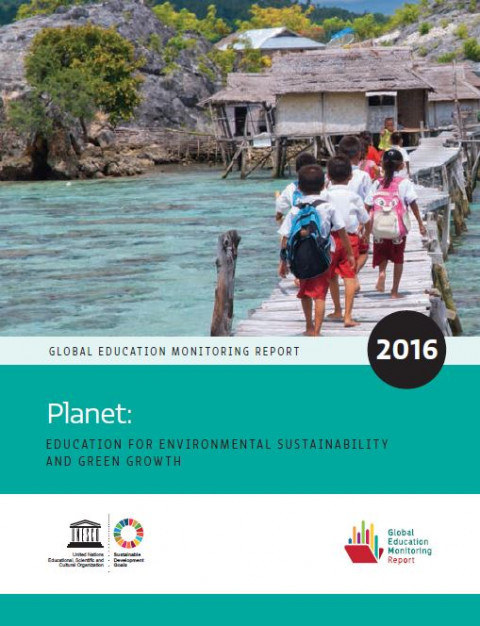 Global Education Monitoring Report, 2016: Planet: Education for Environmental Sustainability and Green Growth Año de publicación: 2016 Autor corporativo: UNESCO PLANET: Education for environmental sustainability and green growth, a publication taken from the full 2016 Global Education Monitoring Report, explores the knowledge and skills needed for sustainable and inclusive economic growth that does not damage our planet.This publication demonstrates how education can help people understand and respond to environmental issues and climate change. Environmental education can increase green knowledge and build sustainability practices. The publication warns that while education contributes to economic growth, education systems must be careful not to encourage unsustainable lifestyles and all learners must acquire the knowledge and skills needed to promote sustainable development.It also argues that we must continue to learn throughout our lives in order to make production and consumption sustainable, and to provide green skills for green industries. Creating green industries relies on high-skill workers with specific training, yet by 2020 there could be 40 million too few workers with tertiary education relative to demand. Higher education and research should also be oriented towards green innovation and growth; innovation depends on cooperation in higher education and investment in research and development to transform production in vast swaths of the economy.It also recognises that education must change in order to keep up with the changing face of work. Green and transferable skills should be taught in both school and the workplace. The greening of industries requires not only the production of more high-skill workers, but the continued training and education for low and medium skill workers, often on the job. “To ensure the Sustainable Development Goals are implemented, everyone involved needs to think, to work, to organise, to communicate and to report in ways that are completely different from what has been done up till now. Education truly is key to a wide appreciation not just of the SDGs but the new ways of thinking and working that are going to be necessary to fulfil them. So the challenge to all of us is to re-learn, and that does not just apply to educators, but it applies to all of us.”
  Global Citizenship Education: Topics and Learning Objectives Año de publicación: 2015 Autor corporativo: UNESCO This publication, titled Global Citizenship Education: Topics and learning objectives, is the first pedagogical guidance from UNESCO on global citizenship education. It is the result of an extensive research and consultation process with experts from different parts of the world. This guidance draws on the UNESCO publication Global Citizenship Education: Preparing learners for the challenges of the 21st century and the outcomes of three key UNESCO events on global citizenship education: the Technical Consultation on Global Citizenship Education (September 2013), as well as the First and Second UNESCO Fora on Global Citizenship Education, organized in December 2013 and January 2015 respectively. Before it was finalized, the guidance was field-tested by education stakeholders in selected countries in all regions to ensure its relevance in different geographical and socio-cultural contexts. Following the foundational work of UNESCO to clarify the conceptual underpinnings of global citizenship education and provide policy and programmatic directions, this document has been developed in response to the needs of Member States for overall guidance on integrating global citizenship education in their education systems. It presents suggestions for translating global citizenship education concepts into practical and age-specific topics and learning objectives in a way that allows for adaptation to local contexts. It is intended as a resource for educators, curriculum developers, trainers as well as policy-makers, but it will also be useful for other education stakeholders working in non-formal and informal settings.
  Éducation à la citoyenneté mondiale: thèmes et objectifs d'apprentissage Año de publicación: 2015 Autor corporativo: Organisation des Nations Unies pour l'éducation, la science et la culture (UNESCO) Le présent ouvrage, intitulé Éducation à la citoyenneté mondiale : Thèmes et objectifs d’apprentissage, est le premier guide pédagogique de l’UNESCO sur l’éducation à la citoyenneté mondiale. Il est le fruit d’un processus approfondi de recherche et de consultation avec des spécialistes de différentes régions du monde. Ce guide s’inspire de la publication de l’UNESCO intitulée Éducation à la citoyenneté mondiale : Préparer les apprenants aux défis du XXIe siècle ainsi que des résultats de trois événements clés de l’UNESCO sur l’éducation à la citoyenneté mondiale : la Consultation technique sur l’éducation à la citoyenneté mondiale (septembre 2013) et les premier et deuxième Forums de l’UNESCO sur l’éducation à la citoyenneté mondiale, organisés en décembre 2013 et en janvier 2015. Avant sa finalisation, le guide a été expérimenté sur le terrain par des acteurs de l’éducation dans différents pays de chaque région, afin de veiller à ce qu’il soit adapté à des contextes géographiques et socioculturels divers. Inspirée des travaux de base de l’UNESCO visant à clarifier les fondements conceptuels de l’éducation à la citoyenneté mondiale, et à fournir des orientations politiques et programmatiques, cette publication a été élaborée pour répondre aux besoins des États membres, en leur donnant des indications générales sur l’intégration de l’éducation à la citoyenneté mondiale dans leurs systèmes éducatifs. Elle propose des moyens de transposer l’éducation à la citoyenneté mondiale dans des thèmes et des objectifs d’apprentissage pratiques et tenant compte de l’âge de l’apprenant, qui puissent être adaptés aux contextes locaux. Cette publication a été conçue pour servir de document de référence aux éducateurs, aux concepteurs de programmes éducatifs, aux formateurs et aux décideurs, mais elle sera également utile à d’autres acteurs de l’éducation travaillant dans des contextes non formels et informels.
 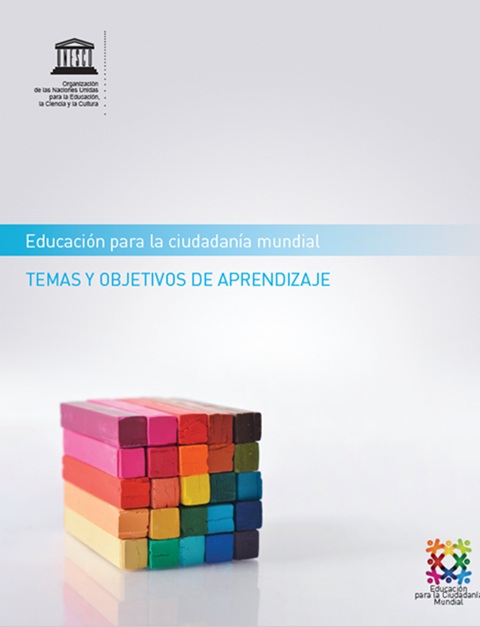 Educación para la ciudadanía mundial: temas y objetivos de aprendizaje Año de publicación: 2015 Autor corporativo: Organización de las Naciones Unidas para la Educación, la Ciencia y la Cultura (UNESCO) La educación para la ciudadanía mundial aspira a ser un factor de transformación, inculcando los conocimientos, las habilidades, los valores y las actitudes que los educandos necesitan para poder contribuir a un mundo más inclusivo, justo y pacífico.La presente publicación, titulada Educación para la ciudadanía mundial: Temas y objetivos de aprendizaje, es la primera guía de la UNESCO al respecto. Se presentan sugerencias para plasmar los conceptos de la educación para la ciudadanía mundial en temas y objetivos de aprendizaje específicos para cada grupo de edad de un modo que facilita su adaptación a las circunstancias locales. Es un recurso para los educadores, los responsables de la elaboración de programas de estudios, los instructores y los encargados de la formulación de políticas, pero también será de utilidad para otros copartícipes en la educación que trabajan en contextos no formales e informales.
 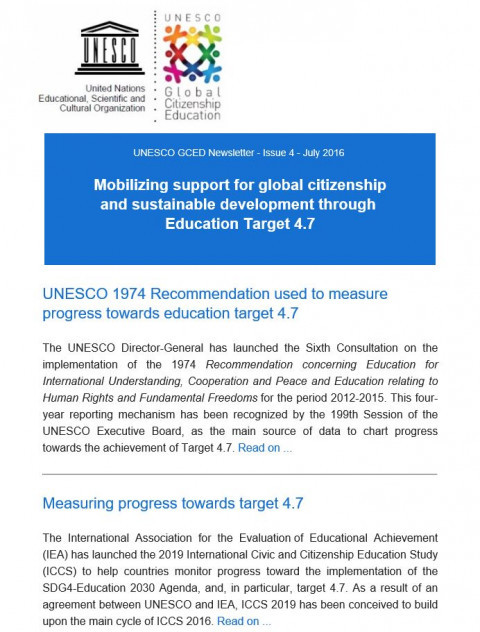 UNESCO GCED eNewsletter Issue 4 Año de publicación: 2016 Autor corporativo: UNESCO Feature: Mobilizing support for global citizenship and sustainable development through Education Target 4.7 UNESCO 1974 Recommendation used to measure progress towards education target 4.7 Measuring progress towards 4.7 Gyeongju Action Plan: NGOs join UNESCO Global capacity-building workshop on GCED organized by APCEIU Southern Africa Regional Meeting on GCED convened in Johannesburg, South Africa UNESCO launches Teacher's Guide on the Prevention of Violent Extremism Expert meeting on the Prevention of Violent Extremism through Education European ministers back education for democracy to counter extremism and racaism UN discusses innovative solutions to prevent violent extremism through education UNESCO's YESPeace Network taps the power of youth worldwide to change the future GCED Topics and Learning Objectives available in seven languages.
  [Video] Learning to live together in peace through Global Citizenship Education Año de publicación: 2016 Autor corporativo: UNESCO The UNESCO video on “Learning to live together in peace through Global Citizenship Education” explains the importance of Global Citizenship Education (GCED) in a globalized and increasingly interconnected and interdependent world. GCED is key to understand the interconnections between the local and the global and nurture a sense of belonging to a common humanity. It builds motivation to assume active roles to contribute to a more just, peaceful, tolerant and sustainable world. The video also illustrates how GCED can be delivered in and outside of schools. [Vidéo] Apprendre à vivre ensemble dans la paix par l’éducation à la citoyenneté mondiale Año de publicación: 2016 Autor corporativo: Organisation des Nations Unies pour l'éducation, la science et la culture (UNESCO) La vidéo de l'UNESCO sur le thème "Apprendre à vivre ensemble dans la paix par l’Éducation à la Citoyenneté Mondiale", explique l'importance de l'Éducation à la Citoyenneté Mondiale (ECM) dans un monde globalisé et de plus en plus interconnecté et interdépendant. ECM est essentiel de comprendre les interconnexions entre le local et le global et à favoriser un sentiment d'appartenance à une humanité commune. Il construit la motivation à assumer un rôle actif pour contribuer à un monde plus juste, pacifique, tolérante et durable. La vidéo montre également comment ECM peut être livré dans et à l'extérieur des écoles.
 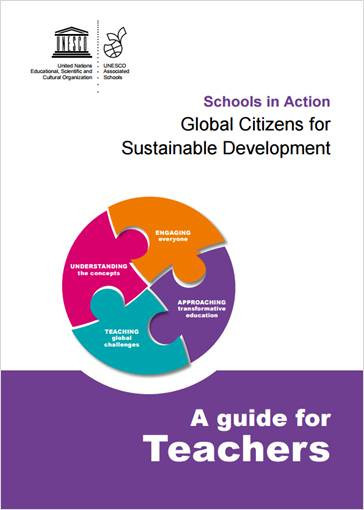 Schools in Action: Global Citizens for Sustainable Development: A Guide for Teachers Año de publicación: 2016 Autor corporativo: UNESCO The Global Citizens for Sustainable Development Teachers’ guide aims to introduce teachers to Global Citizenship Education (GCED) and Education for Sustainable Development (ESD). It provides secondary school teachers with ideas and activities to help students become global citizens and sustainable development actors. The Teachers’ guide draws on the discussions and activities of almost 1,100 participants from 104 countries, including ASPnet National Coordinators, school principals, teachers, students and experts who contributed to the Online Collaborative Platform ASPnet in Action: Global Citizens Connected for Sustainable Development in 2014 and 2015 [http://en.unesco. org/aspnet/globalcitizens] with associated activities and initiatives. The Teachers’ guide provides: An overview of what it means for learners to become global citizens and of how learners can contribute to sustainable development. Ideas for classroom activities that can help secondary school students to develop knowledge, skills, values, attitudes and behaviours that promote GCED and ESD. Selected activities on GCED and ESD from ASPnet schools around the world.