
Recursos
Exploren una amplia gama de recursos valiosos en GCED para profundizar su comprensión y promover su búsqueda, incidencia, enseñanza y aprendizaje.
1,727 resultados encontrados
 Together Alberta: Mapping Alberta’s Contribution to the Sustainable Development Goals Project Año de publicación: 2019 Autor corporativo: Alberta Council for Global Cooperation (ACGC) Together Alberta: Mapping Alberta’s Contribution to the Sustainable Development Goals project (Together Alberta) is a public engagement initiative conducted by ACGC to bring together Albertans who are contributing to the Sustainable Development Goals (SDGs), communicate their efforts, and drive further action.
  Éducation à la citoyenneté mondiale: Vers une citoyenneté active grâce à l’éducation politique avec une perspective globale dans les secteurs non formels et informels; Policy Brief Commission suisse pour l’UNESCO 2019 Año de publicación: 2019 Autor: Janine Dahinden | Marco Stricker | Corinne Wild | Siegfried Seeger Autor corporativo: Commision suisse pour l’UNESCO La Commission suisse pour l’UNESCO a défini l’éducation à la citoyenneté mondiale dans les secteurs non formel et informel comme thème important pour ces prochaines années. Avec ce focus, elle souhaite devenir pionnière en la matière afin de renforcer l’éducation à la citoyenneté mondiale en Suisse, encourager les compétences correspondantes et renforcer les partenariats.
  Migration and the 2030 Agenda: A Guide for Practitioners Año de publicación: 2018 Autor: Elisa Mosler Vidal Autor corporativo: International Organization for Migration (IOM) This guide is designed to serve government actors, both national and local, involved in any process of Sustainable Development Goal implementation, including those working specifically in migration, and those working in other sectors who are interested in integrating migration. It is also for government actors working in the migration field who wish to integrate the SDGs into their work.The focus of this guide is to help policymakers implement the migration aspects of the SDGs. Policymakers can use this guide to integrate migration into local or national development planning, by designing and implementing interventions that relate to migration in the context of the SDGs. These interventions may take the form of legislation, policies, programmes, projects or other activities, and may relate to core migration topics or integrate migration into activities in another sector. For example, policymakers may use this guide to design interventions that directly address human trafficking, as well as interventions in the health sector that help protect victims of trafficking.For actors with experience in migration mainstreaming, this guide offers a new approach that is based on the 2030 Agenda. For those with no experience in migration mainstreaming, it offers an introduction on how migration and development are linked in the context of the SDGs, and how to take action around these connections. La migración en la Agenda 2030: Guía para profesionales Año de publicación: 2018 Autor: Elisa Mosler Vidal Autor corporativo: International Organization for Migration (IOM) La presente guía va dirigida a los actores gubernamentales, tanto nacionales como locales, participantes en cualquier proceso de implementación de los ODS, incluidos aquellos que trabajan específicamente en la migración y aquellos que lo hacen en otros sectores interesados en integrar la migración. Asimismo, va dirigida a los actores gubernamentales que trabajan en el campo de la migración y que deseen integrar los ODS en su trabajo. El objetivo de esta guía es ayudar a los legisladores a implementar los aspectos de migración de los ODS. Los formuladores de políticas pueden utilizar esta guía para integrar la migración en la planificación del desarrollo local o nacional, diseñando e implementando intervenciones relacionadas con la migración en el contexto de los ODS. Estas intervenciones pueden tomar la forma de legislación, políticas, programas, proyectos u otras actividades, y pueden relacionarse con temas centrales de migración o integrar la migración en actividades en otro sector. Por ejemplo, los formuladores de políticas pueden usar esta guía para diseñar intervenciones que aborden directamente la trata de personas, así como intervenciones en el sector de la salud que ayuden a proteger a las víctimas de la trata. Para los actores con experiencia en la integración transversal de la migración de la migración, esta guía ofrece un nuevo enfoque basado en la Agenda 2030. Para quienes no tienen experiencia en dicha integración transversal de la migración, ofrece una introducción sobre cómo se vinculan la migración y el desarrollo en el contexto de los ODS, y cómo actuar en torno a estas conexiones.
  Centros educativos transformadores: Rasgos y propuestas para avanzar Año de publicación: 2018 Autor: Guillermo Aguado de la Obra | Yénifer López Ramos | Ani Urretavizcaya Loinaz | Elisabet Santpere Baro Autor corporativo: Movimiento por la educación transformadora y la ciudadanía global | Oxfam Intermón | InteRed | Entreculturas | ALBOAN Este documento es un marco teórico y práctico de innovación pedagógica para la incorporación de la Educación Transformadora para la Ciudadanía Global en el centro educativo.
  Plan de Educación para la Ciudadanía Global 2019 Año de publicación: 2019 Autor corporativo: UNRWA España El presente Plan de Educación para la Ciudadanía Global para el año 2019 responde a la necesidad de marcar unas líneas de trabajo en este campo por parte de UNRWA España durante este año que guíen su intervención; recojan aprendizajes y potencien el valor añadido adquirido por la organización en este tiempo; se adapten a los cambios de contexto a nivel global, nacional y local; y que sigan contribuyendo construir una ciudadanía global solidaria, comprometida, corresponsable, protagonista y activa con los derechos humanos, el desarrollo sostenible y la justicia social desde la misión-visión de UNRWA España.
  第 2178(2014)号决议 2014 年 9月 24 日安全理事会第 7272 次 Año de publicación: 2014 Autor corporativo: United Nations Security Council This resolution expanded the counter-terrorism framework by imposing obligations on member states to respond to the threat of foreign terrorist fighters. Through the resolution, the Council condemned violent extremism and decided that Member States shall, consistent with international law, prevent the "recruiting, organizing, transporting or equipping of individuals who travel to a State other than their States of residence or nationality for the purpose of the preperation, planning of, of participation in terrorist acts." Expressing concern over the establishment of international terrorist networks, the Council underscored the "particular and urgent need" to prevent the travel and support for foreign terrorist fighters associated with the Islamic State and the Levant (ISIL), Al-Nusra Front (ANL) and other affiliates or splinter groups of Al-Qaida. In that context, the Council, through the resolution, decided that all States shall ensure that their legal systems provide for the prosecution, as serious criminal offences, of travel for terrorism or related training, as well as the financing or facilitation of such activities. Member States, it also decided, shall prevent entry or transit through their territories of any individual about whom that state had credible information of their terrorist-related intentions, without prejudice to transit necessary for the furtherance of judicial processes. It called on States to require airlines to provide passenger lists for that purpose. Outlining further measures for international cooperation to counter international terrorism and prevent the growth of violent extremism, it expressed readiness to designate additional individuals for sanctions listings, and directed the United Nations counter-terrorism subsidiary bodies to devote special focus to foreign terrorist fighters, assessing the threat they posed and reporting on principal gaps in Member States' abilities to suppress their travel.
  Mapping Digital Literacy Policy and Practice in the Canadian Education Landscape Año de publicación: 2015 Autor: Michael Hoechsmann | Helen DeWaard Autor corporativo: MediaSmarts This paper Mapping Digital Literacy Policy and Practice in the Canadian Landscape draws on policy and curriculum documents from across Canada to synthesize key concepts and best practices in current digital literacy education.
 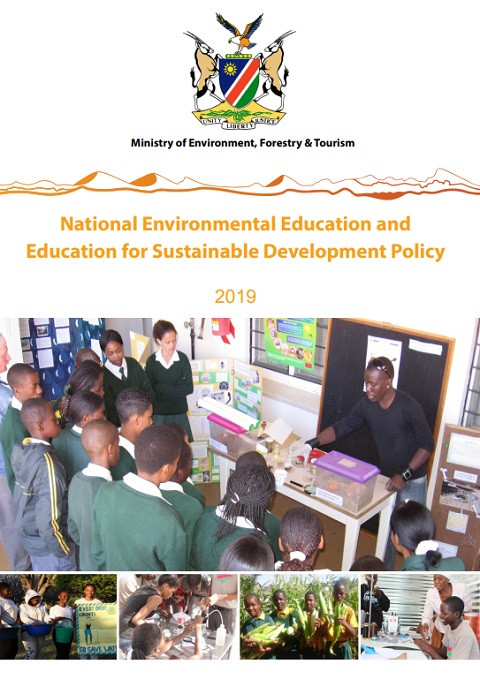 National Environmental Education and Education for Sustainable Development Policy Año de publicación: 2019 Autor corporativo: Namibia. Ministry of Environment, Forestry and Tourism Namibia has become the first country in the SADC region to have a stand-alone National Environmental Education (EE) and Education for Sustainable Development (ESD) Policy. The development of the policy was a long time collaboration between government ministries and civil society. UNESCO through the Sustainability Starts with Teachers programme also supported the process.The vision of the national EE/ESD Policy is an “educated and empowered Namibia with environmentally literate people taking responsibility and action for a sustainable future”.The policy is designed to support EE and ESD in formal, non-formal and informal education processes across all sectors of the Namibian society including higher education, teacher education, technical and vocational education institutions, and general education. It gives Namibia the much-needed foundation to work towards ESD for 2030 and the sustainable development goals (SDGs).
 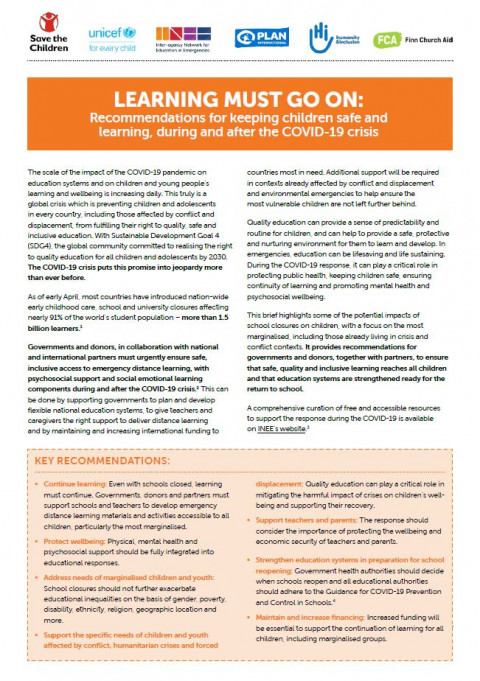 Learning Must Go On: Recommendations for Keeping Children Safe and Learning, During and After the COVID-19 Crisis Año de publicación: 2020 Autor corporativo: Save the Children | United Nations Children's Fund (UNICEF) | The Inter-agency Network for Education in Emergencies (INEE) This brief highlights some of the potential impacts of school closures on children, with a focus on the most marginalised, including those already living in crisis and conflict contexts. It provides recommendations for governments and donors, together with partners, to ensure that safe, quality and inclusive learning reaches all children and that education systems are strengthened ready for the return to school.A comprehensive curation of free and accessible resources to support the response during the COVID-19 is available on INEE’s website.