
Recursos
Exploren una amplia gama de recursos valiosos en GCED para profundizar su comprensión y promover su búsqueda, incidencia, enseñanza y aprendizaje.
950 resultados encontrados
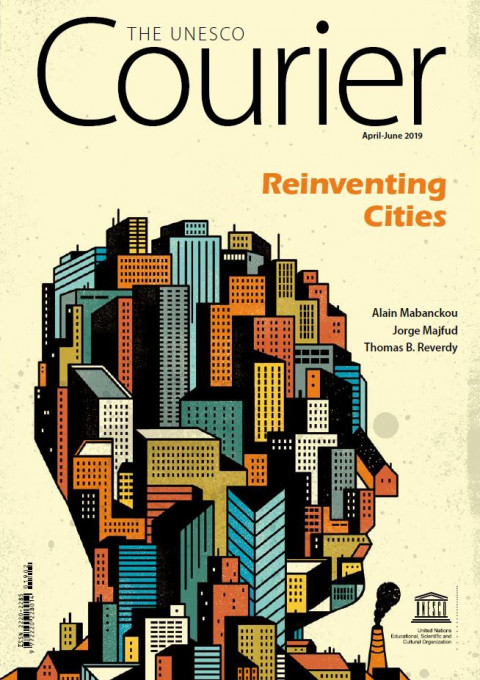 Ces villes qui se réinventent (Le Courrier de l'UNESCO no. 2, Avril-juin 2019) Año de publicación: 2019 Autor: Alain Mabanckou | Jorge Majfud | Thomas B. Reverdy Autor corporativo: UNESCO Les villes ont toujours été des centres de pouvoir, d’attractivité, de prospérité. Mais l’urbanisation effrénée, enregistrée ces dernières décennies, met en péril leur fonction historique de melting-pots.Au fur et à mesure qu’elles se peuplent, elles se déshumanisent : violences, inégalités, discriminations… Plus les villes sont grandes, plus ces fléaux qui les accablent prennent de l’ampleur.Néanmoins, en même temps qu’elles se déshumanisent, les villes se réinventent. De la débrouille comme stratégie de survie à Kinshasa (RDC) aux grands projets nationaux de réhabilitation des villes mono-industrielles en Russie, de l’initiative personnelle d’un galeriste qui a sorti de sa torpeur la petite ville d’Erriadh (Tunisie) à la mobilisation des masses contre l’appropriation autoritaire de l’espace public à Varsovie (Pologne), des mouvements de solidarité avec les migrants à Londres (Royaume-Uni) aux synergies qui font revivre le coeur de La Havane (Cuba), des forces créatrices surgissent et s’ordonnent pour doter la vie urbaine de nouveaux sens, de nouvelles perspectives. On peut croire que ce sont de « minuscules résistances », pour reprendre l’expression de l’écrivain français Thomas B. Reverdy, mais ce sont elles qui font la différence.Deux autres écrivains partagent leurs points de vue avec nos lecteurs, dans ce numéro. Notre invité, le Franco-Congolais Alain Mabanckou, nous parle des « Afriques mobiles » et du courage d’écrire, tout en soulignant des passages contradictoires de l’histoire coloniale. Quant à l’écrivain uruguayen-américain Jorge Majfud, il dénonce l’attitude raciste à l’égard des migrants, dans la rubrique Idées, qui propose par ailleurs une analyse des politiques migratoires aux États-Unis.Dans la rubrique Actualités, nous publions, à l’occasion de la Journée mondiale de l’Afrique (25 mai), un entretien avec Tshilidzi Marwala (Afrique du Sud) sur l’émergence de l’intelligence artificielle (IA) dans le continent. Pour marquer la Journée internationale de la diversité biologique (22 mai), nous visitons le Gran Pajatén, au Pérou, avec Roldán Rojas Paredes, l’homme qui a initié son inscription dans le Réseau des réserves de biosphère de l’UNESCO. Nous allons également à Sharjah, aux Émirats arabes unis, qui lance son programme de Capitale mondiale du livre en avril 2019.Enfin, avec Zoom, nous allons en Inde, au Mexique, au Myanmar et en Ouganda, dans des lieux privés d’électricité. Un petit tour du monde tout en lumière !
 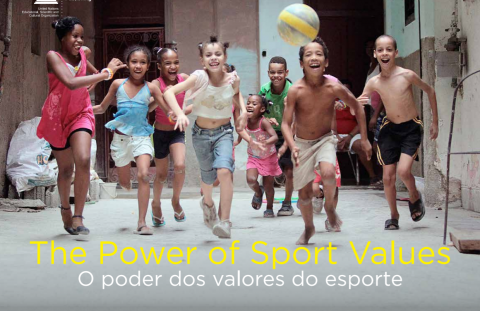 The Power of Sport Values Año de publicación: 2016 Autor corporativo: UNESCO In the contexts of malnutrition, conflict, inactivity and unemployment, sport can act as springboard for social transformation, as a gateway to rounded development and as a facilitator for inclusive and responsible citizenship. Not only is sport a bridge between individuals and nations, it can also be an active tool for overcoming stereotypes, rising above exclusion and fostering citizenship. The Power of Sport Values is a collection of the best 15 entries of UNESCO’s photo contest on the power of sport values, selected from over 300 photos submitted by photographers from 76 countries all around the world. Be it in South Sudan, Kazakhstan, Mexico, Bangladesh or Cuba, sport provides joy, fosters inclusion and strengthens social mobilization.
 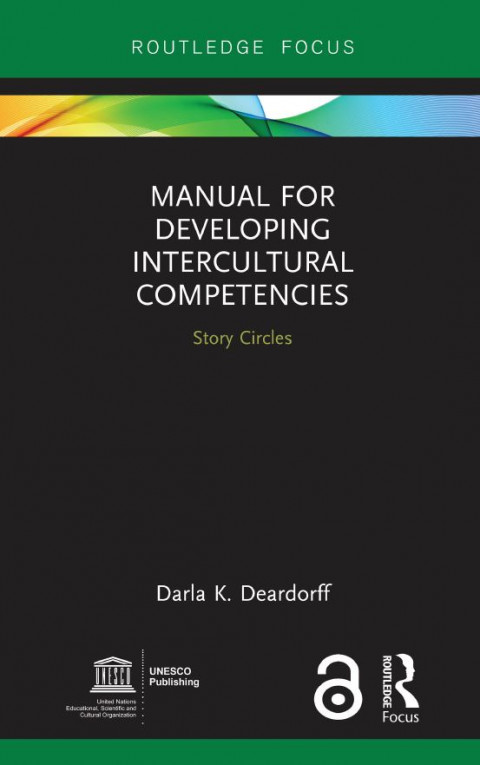 Manual for Developing Intercultural Competencies: Story Circles Año de publicación: 2020 Autor: Darla K. Deardorff Autor corporativo: UNESCO This book presents a structured yet flexible methodology for developing intercultural competence in a variety of contexts, both formal and informal. Piloted around the world by UNESCO, this methodology has proven to be effective in a range of different contexts and focused on a variety of different issues. It, therefore, can be considered an important resource for anyone concerned with effectively managing the growing cultural diversity within our societies to ensure inclusive and sustainable development.The book serves as a tool to develop those competences, presenting an innovative adaptation of what could be considered an ancient tradition of storytelling found in many cultures. Through engaging in the methodology, participants develop key elements of intercultural competence, including greater self-awareness, openness, respect, reflexivity, empathy, increased awareness of others, and in the end, greater cultural humility.This book will be of great interest to intercultural trainers, policy makers, development practitioners, educators, community organizers, civil society leaders, university lecturers, and students – all who are interested in developing intercultural competence as a means to understand and appreciate difference, develop relationships with those across difference, engage in intercultural dialogue, and bridge societal divides. Manuel de développement des compétences interculturelles: les cercles d’histoires Año de publicación: 2020 Autor: Darla K. Deardorff Autor corporativo: UNESCO Le présent ouvrage propose une méthode structurée mais flexible de développement des compétences interculturelles qui pourra être utilisée dans les contextes les plus divers, formels ou informels. Mise en oeuvre à titre expérimental par l’UNESCO dans plusieurs pays du monde, cette méthode, qui aborde une grande diversité de thèmes, a apporté la preuve de son efficacité dans des situations très variées. Elle constitue donc un outil capital pour tous ceux qui ont à coeur d’appréhender efficacement la diversité culturelle grandissante qui est devenue la marque de nos sociétés, et ce afin de parvenir à un développement inclusif et durable.Ce manuel consacre l’adaptation innovante d’une tradition très ancienne, celle du récit, que l’on retrouve dans un très grand nombre de cultures. À l’aide de cette méthode, les participants apprennent à renforcer certains aspects clés des compétences interculturelles comme la conscience de soi, l’ouverture d’esprit, le respect, la réflexivité, l’empathie, la conscience d’autrui, en manifestant, en fin de compte, une plus grande humilité culturelle.Cette publication présente un grand intérêt pour les formateurs interculturels, les dirigeants politiques, les praticiens du développement, les éducateurs, les responsables des communautés et de la société civile, les universitaires et les étudiants – pour tous ceux qui s’intéressent au développement des compétences interculturelles comme moyen de comprendre et d’apprécier la différence, d’approfondir les relations indépendamment des différences, de participer au dialogue interculturel et de surmonter tout ce qui divise les sociétés. 培养跨文化能力手册 : 故事圈 Año de publicación: 2020 Autor: Darla K. Deardorff Autor corporativo: UNESCO 该文件详细介绍了用以培养跨文化能力的“故事圈”的方法,包括其使用的工具,操作方法等,同时包括了大量培训资源、案例素材与辅助材料。
 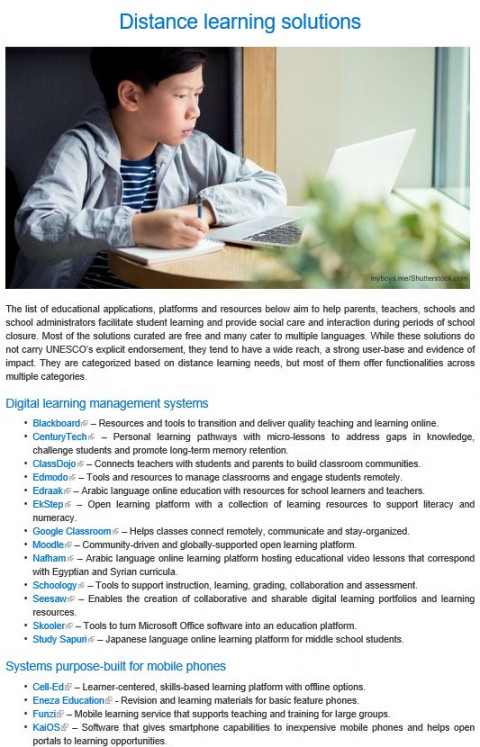 Distance Learning Solutions Año de publicación: 2020 Autor corporativo: UNESCO The list of educational applications, platforms and resources below aim to help parents, teachers, schools and school administrators facilitate student learning and provide social care and interaction during periods of school closure. Most of the solutions curated are free and many cater to multiple languages. While these solutions do not carry UNESCO’s explicit endorsement, they tend to have a wide reach, a strong user-base and evidence of impact. They are categorized based on distance learning needs, but most of them offer functionalities across multiple categories. Solutions d’apprentissage à distance Año de publicación: 2020 Autor corporativo: UNESCO La liste d’applications et de plates-formes éducatives ci-dessous vise à aider parents, enseignants, établissements et responsables pédagogiques à faciliter l’apprentissage des élèves et à assurer des interactions et des services sociaux pendant la fermeture des écoles. La plupart des solutions sont gratuites et plusieurs sont multilingues. Bien qu’elles ne soient pas explicitement soutenues par l’UNESCO, ces solutions ont généralement une large portée, de nombreux utilisateurs et une efficacité avérée. Elles sont classées par type de besoin pédagogique mais la plupart présente des fonctionnalités relevant de plusieurs catégories.
 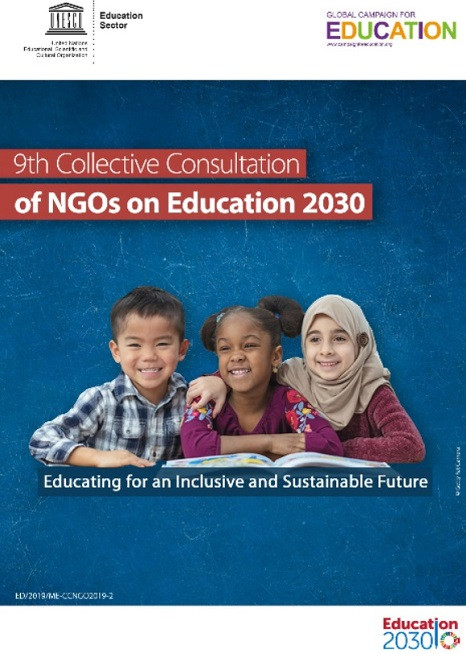 9th Collective Consultation of NGOs on Education 2030: Educating for an Inclusive and Sustainable Future Año de publicación: 2020 Autor corporativo: UNESCO | Global Campaign for Education (GCE) This includes proceedings and key messages of the 9th Global meeting of the Collective Consultation of NGOs on Education 2030 (CCNGO 2019) organized by UNESCO from 2-5 December 2019 in Hammamet, Tunisia and generously hosted by the Global Campaign for Education (GCE), alongside the Arab Campaign for Education for All (ACEA) and the National Association of the Right to Education (ANDET). The CCNGO 2019 aimed to build on CSOs(Civil Society Organisations) experiences and strong commitments to strengthen collective initiatives towards the realisation of the SDGs and education related targets. The focus and major theme of the Meeting was the role and engagement of civil society organizations in supporting equity and inclusion in the implementation of SDG4-Education 2030 at national, regional and global level. 9e Consultation collective des ONG sur l’Éducation 2030: Éduquer pour un avenir inclusif et durable Año de publicación: 2020 Autor corporativo: Organisation des Nations Unies pour l'éducation, la science et la culture (UNESCO) | Global Campaign for Education (GCE) Cela comprend les actes et les messages clés de la 9eRéunion mondialede la Consultation collective des ONG sur l’Éducation 2030(CCONG2019) a été organisée par l’UNESCO du 2 au 5 décembre2019 à Hammamet, Tunisie,où elle a été généreusement accueillie par la Campagne mondiale pour l’éducation(CME), la Campagne arabe pour l’éducation pour tous(ACEA) et l’Association nationale du droit à l’éducation(ANDET). La Réunion mondialede la CCONG2019 avait pour but derenforcer les initiatives collectives visant à la mise en œuvre des ODD et des cibles relatives à l’éducation ens’appuyantsur l’expérience des OSC et leur forte mobilisation. La réunion avait pour thèmecentral l’action et l’engagement des organisations de la société civile en faveur de l’équité et de l’inclusion dans le cadre dela mise en œuvre de l’ODD 4 –Éducation 2030aux niveaux national, régional et mondial.
  Country Commitments to Gender Equality in Education Año de publicación: 2018 Autor: Erica Murphy Autor corporativo: UNESCO The international community has committed through legal and political frameworks to achieving gender equality in all spheres, including education. These frameworks include obligations to protect and secure women and girls' right to education through the elimination of discriminatory barriers, whether they exist in law or in everyday life, and to undertake positive measures to bring about equality, including in access of, within, and through education.This paper firstly sets out the legal and political frameworks on gender equality in education to which states have committed and then describes how they have committed.In the second section, the content of states’ commitments to achieve gender equality in education is explained, including the normative content of relevant provisions found in international and regional human rights treaties and the 2030 Agenda for Sustainable Development. This section also includes a classification of states according to what legal commitments to women and girls’ right to education they have made.The final section details how states can be held accountable for failure to meet their legal commitments to gender equality in education, including what mechanisms are available and examples of how these mechanisms have been used to hold states accountable.This paper is also background paper prepared for the 2018 Global education monitoring report gender review: Meeting our commitments to gender equality in education.