
Recursos
Exploren una amplia gama de recursos valiosos en GCED para profundizar su comprensión y promover su búsqueda, incidencia, enseñanza y aprendizaje.
1,187 resultados encontrados
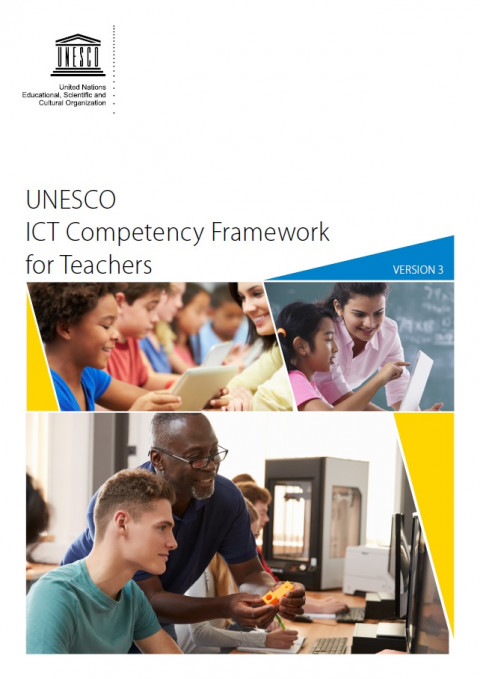 UNESCO ICT Competency Framework for Teachers (ver.3) Año de publicación: 2018 Autor corporativo: UNESCO UNESCO has developed the ICT Competency Framework for Teachers (ICT CFT) as a tool to guide pre- and in-service teacher training on the use of ICTs across the education system. The ICT CFT is intended to be adapted to support national and institutional goals by providing an up-to-date framework for policy development and capacity building in this dynamic area.The ICT Competency Framework for Teachers (ICT CFT) Version 3 is a response to recent technological and pedagogical developments in the field of ICT and Education, and incorporates in its structure inclusive principles of non-discrimination, open and equitable information accessibility and gender equality in the delivery of education supported by technology. It addresses the impacts of recent technological advances on education and learning, such as Artificial Intelligence (AI), Mobile Technologies, the Internet of Things and Open Educational Resources, to support the creation of inclusive Knowledge Societies. The ICT CFT provides a comprehensive set of competencies teachers need to integrate ICT into their professional practice in order to facilitate students’ achievement of curricular objectives. Strong political commitments and sustained investment in teacher education, and concerted actions between pre- and in-service teacher trainings form the foundation of the successful implementation of this Framework as it is contextualized to national and institutional goals. For this reason, this document underlines the importance of steadfast commitment to supporting teachers’ continuous professional development including through ICT, and includes examples to illustrate how ICT CFT could be used to facilitate teachers’ development in diverse contexts. We look forward to strengthening our collaboration with all stakeholders everywhere to leverage ICT to develop the skills required to thrive within the fast-changing inclusive Knowledge Societies.
  Guidebook on Education for Sustainable Development for Educators: Effective Teaching and Learning in Teacher Education Institutions in Africa Año de publicación: 2018 Autor corporativo: UNESCO The guidebook on Education for Sustainable Development for Educators: Effective teaching and learning in teacher education institutions in Africa has been conceived as a tool to mainstream sustainability into all aspects of teacher education and training with useful information concerning teaching, learning and assessment approaches to help achieve the ESD goals and learning outcomes.
  Guidelines and Recommendations for Reorienting Teacher Education to Address Sustainability Año de publicación: 2005 Autor corporativo: UNESCO Members of the International Network made recommendations related to reorienting teacher education to address sustainability. The recommendations are pieces of wisdom garnered through the experimentation and hard work of teacher educators.The recommendations concern ministerial and national levels to the local level. The recommendations involve curriculum, pedagogy, policy, practice, programs, rewards, research, information and computer technology, partnerships, networking, communications, etc.Members of the International Network repeatedly mentioned the urgency to act and the need for profound change. While many spoke of the enormity of the task at hand, all who participated were able to make signifi cant and positive inroads. Interested individuals operating within their own spheres of control (e.g., weaving sustainability themes into their own classroom curricula) made great headway reorienting their programs. Also, many institutions were able to develop new courses at both the undergraduate and graduate levels. Problems arose, however, when the Network members advocated for change beyond the sphere of direct control. ESD within teacher-education institutions is currently endorsed by early-adopters. However, it will take concerted effort and resources to establish ESD in curricula, programs, practices, and policies across teacher-education institutions.
 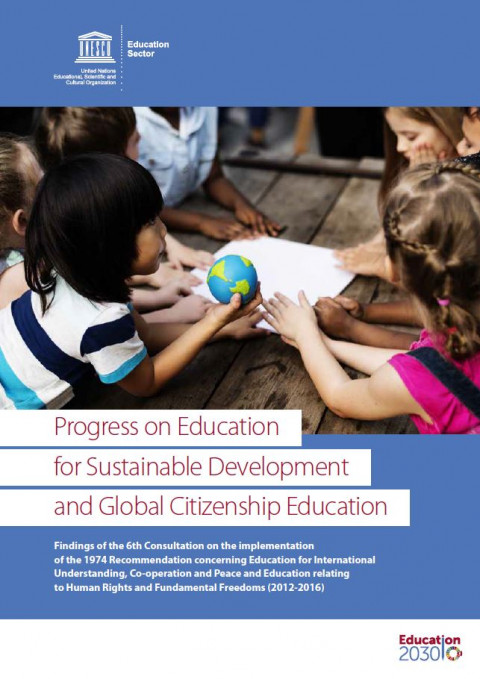 Progress on Education for Sustainable Development and Global Citizenship Education: Findings of the 6th Consultation on the Implementation of the 1974 Recommendation Año de publicación: 2018 Autor corporativo: UNESCO Findings of the 6th Consultation on the implementation of the 1974 Recommendation concerning Education for International Understanding, Co-operation and Peace and Education relating to Human Rights and Fundamental Freedoms (2012-2016) Progress on Education for Sustainable Development and Global Citizenship Education “The Recommendation concerning Education for International Understanding, Co-operation and Peace and Education relating to Human Rights and Fundamental Freedoms” was adopted by UNESCO’s General Conference at its 18th session in 1974. Every four years, Member States report to UNESCO on measures taken to implement the Recommendation in pre-primary, primary, secondary and post-secondary/tertiary education. This document summarizes and analyses the main findings of the 6th Consultation on the implementation of the 1974 Recommendation, covering the period of 2012 to 2016. The findings of the 6th Consultation provide important insight into how Member States are implementing the 1974 Recommendation as well as how they are progressing towards Target 4.7 of Sustainable Development Goal 4 on Education. Target 4.7 concerns Education for Sustainable Development and Global Citizenship Education, which are closely related to the 1974 Recommendation. Supporting Member States in implementing Target 4.7 is a UNESCO priority and essential to progress across the 2030 Agenda for Sustainable Development. Avances en la educación para el desarrollo sostenible y la educación para la ciudadanía mundial: resultados de la sexta consulta sobre la aplicación de la Recomendación sobre la Educación para la Comprensión Año de publicación: 2018 Autor corporativo: Organización de las Naciones Unidas para la Educación, la Ciencia y la Cultura (UNESCO) Hallazgos de la 6ta consulta sobre la implementación de la Recomendación de 1974 sobre Educación para la Comprensión, la Cooperación y la Paz Internacionales y la Educación relativa a los Derechos Humanos y a las Libertades Fundamentales (2012-2016). Progresos en Educación para Desarrollo Sostenible y Educación para la Ciudadanía Mundial “La Recomendación concerniente a la Educación para Comprensión, Cooperación y Paz internacional y Educación relativa a los Derechos Humanos y a las Libertades Fundamentales” fue adoptada en la Conferencia General de la UNESCO en su 18ava sesión de 1974. Cada cuatro años, los Estados Miembros reportan a la UNESCO sobre las medidas llevadas a cabo para implementar la Recomendación en los niveles preescolares, primario, secundario y post-secundario/terciario de educación. Este documento resume y analiza los hallazgos principales de la 6ta Consulta sobre la implementación de la Recomendación de 1974, cubriendo el período de 2012 a 2016. Los hallazgos de la 6ta Consulta proporcionan información importante sobre cómo los Estados Miembros están implementando la Recomendación de 1974, y de cómo están progresando hacia la Meta 4.7 del Objetivo de Desarrollo Sostenible 4 en Educación. La Meta 4.7 concierne a la Educación para el Desarrollo Sostenible y la Educación para la Ciudadanía Mundial, que están muy ligadas a la Recomendación de 1974. El apoyo a los Estados Miembros en la implementación de la Meta 4.7 es una prioridad para la UNESCO dado que es esencial para progresar hacia los objetivos de la Agenda 2030 para Desarrollo Sostenible. (Avances en la educación para el desarrollo sostenible y la educación para la ciudadanía mundial: resultados de la sexta consulta sobre la aplicación de la Recomendación sobre la Educación para la Comprensión, la Cooperación y la Paz Internacionales y la Educación relativa a los Derechos Humanos y las Libertades Fundamentales, de 1974 (2012-2016)) 지속가능발전교육과 세계시민교육의 진전: 1974년 「국제이해, 협력, 평화를 위한 교육과 인권, 기본 자유에 관한 교육 권고」의 이행(2012-2016년)에 관한 제6차 설문조사 결과 Año de publicación: 2018 Autor corporativo: 유네스코 「국제이해, 협력, 평화를 위한 교육과 인권, 기본 자유에 관한 교육 권고」(Recommendation concerning Education for International Understanding, Cooperation and Peace and Education relating to Human Rights and Fundamental Freedoms, 이하 1974년 권고안)는 1974년 제18차 유네스코 총회에서 채택되었다. 유네스코 회원국들은 매 4년마다 유아, 초등, 중등, 중등 이후/고등 분야 교육 내 1974년 권고안 이행 조치에 대해 유네스코에 보고한다. 이 보고서는 2012년부터 2016년까지의 1974년 권고안 이행 현황에 대한 제6차 설문조사1) (이하 제6차 설문조사) 결과를 요약·분석하고 있다. 제 6차 설문조사 결과는 회원국들이 지속가능발전목표(Sustainable Development Goal, SDGs) 내 교육 관련 목표(SDG 4) 중 세부목표 4.7을 달성하는 데 어떠한 진전이 있었는지, 그리고 1974년 권고안을 어떻게 이행하고 있는지 판단하기 위해 필요한 통찰력 있는 시각을 제공한다. 세부목표 4.7은 1974년 권고안과 밀접한 연관이 있는 지속가능발전교육(Education for Sustainable Development, ESD) 및 세계시민교육(Global Citizenship Education, GCED)과 관련이 있다(참고1). 세부목표 4.7의 이행을 위한 회원국들의 지원은 유네스코의 우선 순위이자, 지속가능발전을 위한 교육 2030 의제 전반에 걸쳐 진척을 이루는 데 필수적이다.
 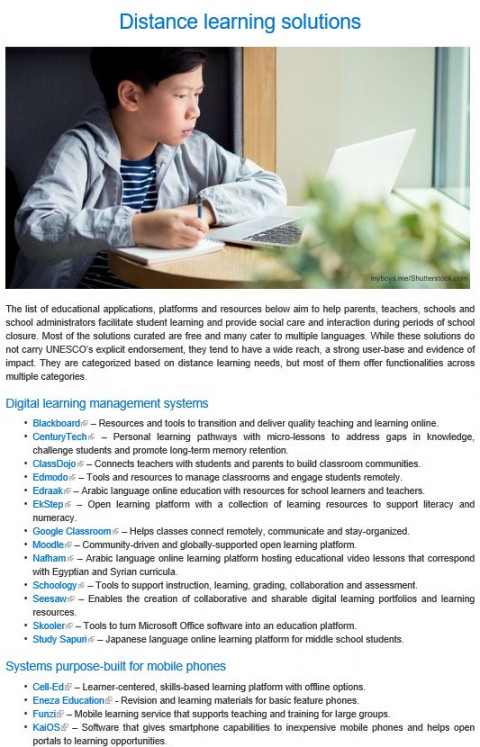 Soluciones para un aprendizaje a distancia Año de publicación: 2020 Autor corporativo: Organización de las Naciones Unidas para la Educación, la Ciencia y la Cultura (UNESCO) A continuación, ofrecemos una lista de aplicaciones y plataformas educativas para ayudar a los padres, docentes, centros educativos y sistemas escolares a facilitar el aprendizaje de los alumnos y garantizar las interacciones y los servicios sociales durante el periodo de cierre de las escuelas. Aunque no han sido explícitamente respaldadas por la UNESCO, estas soluciones tienen un amplio alcance, numerosos usuarios y una eficacia probada. La mayor parte de las soluciones son gratuitas y muchas se encuentran en varios idiomas.Si usted es un proveedor de servicios de aprendizaje digital y posee un producto sólido que cree merece figurar en la siguiente lista de recursos, favor envíenos un correo electrónico a la dirección: COVID19taskforce@unesco.org Инструменты дистанционного обучения Año de publicación: 2020 Autor corporativo: Организация Объединенных Наций по вопросам образования, науки и культуры (UNESCO) Приведенный ниже список образовательных приложений, платформ и ресурсов призван помочь родителям, учителям, школам и школьным администраторам облегчить процесс обучения учащихся и обеспечить социальную помощь и взаимодействие в периоды закрытия школ. Большинство предложений доступны бесплатно и многие поддерживаются на нескольких языках. Хотя эти предложения не имеют непосредственной поддержки ЮНЕСКО, они, как правило, имеют широкий охват, мощную базу пользователей и подтверждения достигнутых результатов. Они распределены исходя из потребностей дистанционного обучения, но большинство из них предлагают функциональные возможности по нескольким категориям. حلول للتعلّم عن بعد Año de publicación: 2020 Autor corporativo: منظمة الأمم المتحدة للتربية والعلم والثقافة (UNESCO) الغرض من قائمة التطبيقات والمنصات والموارد التعليمية الواردة أدناه، مساعدة الأهل والمعلمين والمدارس ومديريها على تيسير عملية تعلّم الطلاب وتقديم الرعاية الاجتماعية والتفاعل الاجتماعي لهم في أثناء فترة إغلاق المدارس. ومعظم الحلول المختارة مجانية، ويقدم العديد منها محتوى متاحاً بعدة لغات. ولا تحظى هذه الحلول بدعم صريح من اليونسكو، بيد أنها تصل إلى عدد كبير من الأشخاص، ولها قاعدة مستخدمين واسعة، وتأثيرها مثبت. وتُصنّف هذه الحلول في فئات تبعاً لاحتياجات الدارسين، ولكن معظمها يحتوي على خصائص مأخوذة من فئات مختلفة.
 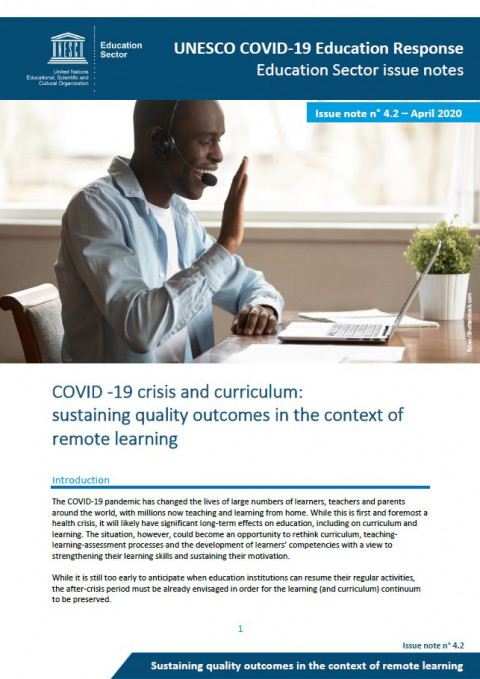 COVID-19 Crisis and Curriculum: Sustaining Quality Outcomes in the Context of Remote Learning (Issue Note no. 4.2 – April 2020) Año de publicación: 2020 Autor corporativo: UNESCO The COVID-19 pandemic has changed the lives of large numbers of learners, teachers and parents around the world, with millions now teaching and learning from home. While this is first and foremost a health crisis, it will likely have significant long-term effects on education, including on curriculum and learning. The situation, however, could become an opportunity to rethink curriculum, teaching-learning-assessment processes and the development of learners’ competencies with a view to strengthening their learning skills and sustaining their motivation.This crisis will likely provide an opportunity for schools to strengthen their ties with families, and for teachers to communicate and cooperate better with parents in the interest of learners. In the same vein, the crisis means teachers and parents may become more involved in decisions regarding curriculum appropriateness. This can support the development of a learner-centred, participative and inclusive learning paradigm that takes into account the interests of learners, as well as their environments and aspirations.