
Recursos
Exploren una amplia gama de recursos valiosos en GCED para profundizar su comprensión y promover su búsqueda, incidencia, enseñanza y aprendizaje.
3,790 resultados encontrados
 Транснациональные высшие учебные заведения в Центральной Азии Año de publicación: 2021 Autor: Eriks Varpachovskis Транснациональные высшие учебные заведения (ТНВУЗ) – учреждения, которые предоставляют услуги высшего образования и присуждают степени о высшем образовании либо в зарубежных учебных заведениях, либо с помощью зарубежных педагогических систем. По состоянию на 2021 год в пяти республиках Центральной Азии насчитывается по меньшей мере 67 ТНВУЗ. Однако под поверхностью этого факта скрываются многочисленные проблемы, поскольку ТНВУЗ борются за то, чтобы поддерживать свои возможности и предоставлять качественное образование, в то время как местные органы власти проводят противоречивые стратегии, которые усложняют ситуацию.
 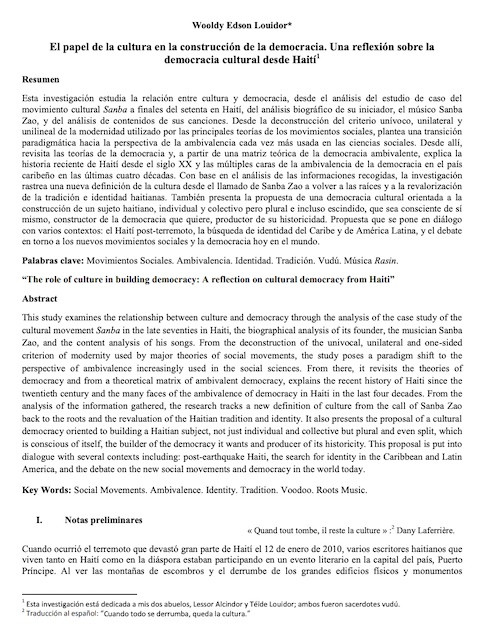 The Role of Culture in the Construction of Democracy: A Reflection on Cultural Democracy From Haiti Año de publicación: 2015 Autor: Wooldy Edson Louidor Autor corporativo: Latin American Council of Social Sciences (CLACSO) This research studies the relationship between culture and democracy, from the analysis of the case study of the Sanba cultural movement in the late seventies in Haiti, from the biographical analysis of its initiator, the musician Sanba Zao, and from the analysis of the content of its songs. From the deconstruction of the univocal, unilateral and unilinear criterion of modernity used by the main theories of social movements, it proposes a paradigmatic transition towards the perspective of ambivalence increasingly used in the social sciences. From there, he revisits the theories of democracy and, based on a theoretical matrix of ambivalent democracy, explains the recent history of Haiti since the 20th century and the multiple faces of the ambivalence of democracy in the Caribbean country in the last four years. decades. Based on the analysis of the information collected, the research traces a new definition of culture from Sanba Zao's call to return to the roots and to the revaluation of Haitian tradition and identity. El papel de la cultura en la construcción de la democracia: Una reflexión sobre la democracia cultural desde Haití Año de publicación: 2015 Autor: Wooldy Edson Louidor Autor corporativo: Latin American Council of Social Sciences (CLACSO) Esta investigación estudia la relación entre cultura y democracia, desde el análisis del estudio de caso del movimiento cultural Sanba a finales del setenta en Haití, del análisis biográfico de su iniciador, el músico Sanba Zao, y del análisis de contenidos de sus canciones. Desde la deconstrucción del criterio unívoco, unilateral y unilineal de la modernidad utilizado por las principales teorías de los movimientos sociales, plantea una transición paradigmática hacia la perspectiva de la ambivalencia cada vez más usada en las ciencias sociales. Desde allí, revisita las teorías de la democracia y, a partir de una matriz teórica de la democracia ambivalente, explica la historia reciente de Haití desde el siglo XX y las múltiples caras de la ambivalencia de la democracia en el país caribeño en las últimas cuatro décadas. Con base en el análisis de las informaciones recogidas, la investigación rastrea una nueva definición de la cultura desde el llamado de Sanba Zao a volver a las raíces y a la revalorización de la tradición e identidad haitianas.
 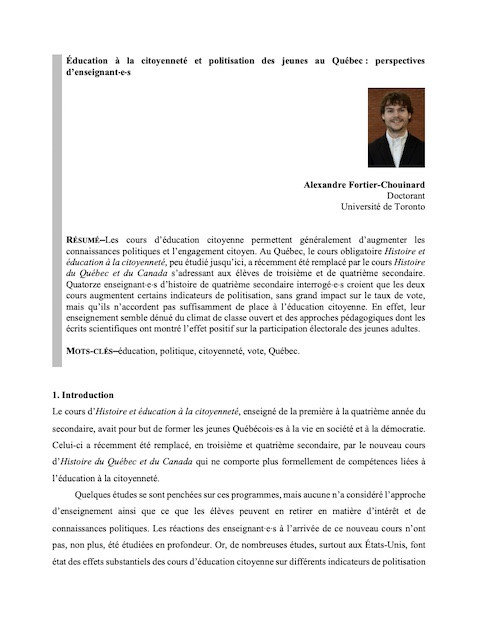 Citizenship Education and Youth Politicization in Quebec: Teacher Perspectives (vol. 46, no. 3) Año de publicación: 2020 Autor: Alexandre Fortier-Chouinard Autor corporativo: Université de Montréal. Faculté des sciences de l’éducation Civic education classes generally have a positive impact on political knowledge and citizen involvement. In Quebec, the mandatory History and citizenship education class, almost unstudied thus far, was recently replaced by a History of Quebec and Canada class in secondary 3 and 4. 14 interviewed History and citizenship education teachers in secondary 4 believe that these courses improve some indicators of students’ politicization but not necessarily future turnout, and that civic education takes too little space in the curriculum. An open classroom climate, which literature has found to have a positive impact on voting, seems to be absent from their teaching. Éducation à la citoyenneté et politisation des jeunes au Québec: Perspectives d’enseignant⋅e⋅s (vol. 46, no. 3) Año de publicación: 2020 Autor: Alexandre Fortier-Chouinard Autor corporativo: Université de Montréal. Faculté des sciences de l’éducation Les cours d’éducation citoyenne permettent généralement d’augmenter les connaissances politiques et l’engagement citoyen. Au Québec, le cours obligatoire Histoire et éducation à la citoyenneté, peu étudié jusqu’ici, a récemment été remplacé par le cours Histoire du Québec et du Canada s’adressant aux élèves de troisième et de quatrième secondaire. Quatorze enseignant⋅e⋅s d’histoire de quatrième secondaire interrogé⋅e⋅s croient que les deux cours augmentent certains indicateurs de politisation, sans grand impact sur le taux de vote, mais qu’ils n’accordent pas suffisamment de place à l’éducation citoyenne. En effet, leur enseignement semble dénué du climat de classe ouvert et des approches pédagogiques dont les écrits scientifiques ont montré l’effet positif sur la participation électorale des jeunes adultes.
 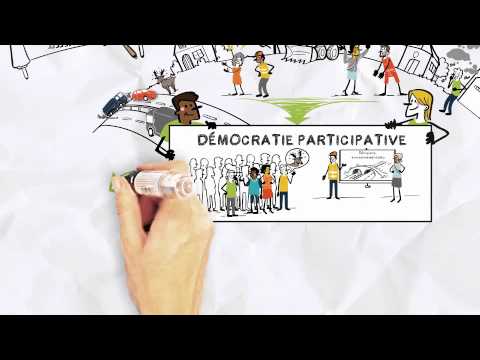 Why and How to Move Towards Participatory Democracy Año de publicación: 2015 Autor corporativo: Fondation pour la Nature et l'Homme Co-constructing tomorrow's solutions is the major challenge of participatory democracy. However, the participation of citizens in decisions is not always obvious and today many projects are contested in the territory. Solutions exist to involve citizens more directly in environmental decisions, discover these issues and solutions in 3 minutes! Pourquoi et comment aller vers une démocratie participative Año de publicación: 2015 Autor corporativo: Fondation pour la Nature et l'Homme Co-construire les solutions de demain, tel est l’enjeu majeur de la démocratie participative. Cependant, la participation des citoyens aux décisions n’est pas toujours évidente et aujourd’hui de nombreux projets sont contestés sur le territoire. Des solutions existent pour impliquer plus directement les citoyens dans les décisions environnementales, découvrez en 3 minutes ces enjeux et solutions !
 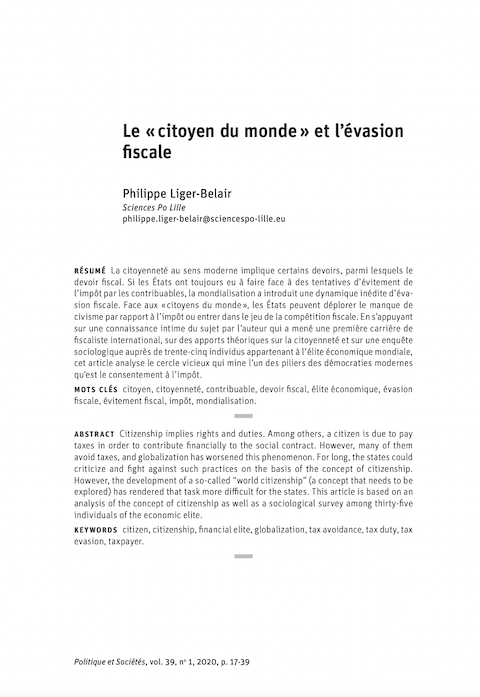 The Global Citizen and Tax Evasion (Politique et Sociétés; vol. 39, no. 1) Año de publicación: 2020 Autor: Philippe Liger-Belair Autor corporativo: Société québécoise de science politique Citizenship implies rights and duties. Among others, a citizen is due to pay taxes in order to contribute financially to the social contract. However, many of them avoid taxes, and globalization has worsened this phenomenon. For long, the states could criticize and fight against such practices on the basis of the concept of citizenship. However, the development of a so-called “world citizenship” (a concept that needs to be explored) has rendered that task more difficult for the states. This article is based on an analysis of the concept of citizenship as well as a sociological survey among thirty-five individuals of the economic elite. Le « citoyen du monde » et l’évasion fiscale (Politique et Sociétés; vol. 39, no. 1) Año de publicación: 2020 Autor: Philippe Liger-Belair Autor corporativo: Société québécoise de science politique La citoyenneté au sens moderne implique certains devoirs, parmi lesquels le devoir fiscal. Si les États ont toujours eu à faire face à des tentatives d’évitement de l’impôt par les contribuables, la mondialisation a introduit une dynamique inédite d’évasion fiscale. Face aux « citoyens du monde », les États peuvent déplorer le manque de civisme par rapport à l’impôt ou entrer dans le jeu de la compétition fiscale. En s’appuyant sur une connaissance intime du sujet par l’auteur qui a mené une première carrière de fiscaliste international, sur des apports théoriques sur la citoyenneté et sur une enquête sociologique auprès de trente-cinq individus appartenant à l’élite économique mondiale, cet article analyse le cercle vicieux qui mine l’un des piliers des démocraties modernes qu’est le consentement à l’impôt.
 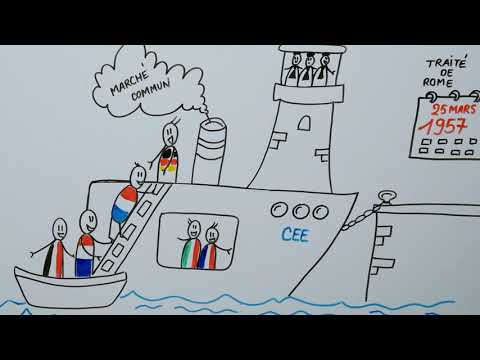 European Citizenship Año de publicación: 2020 Autor corporativo: Laboratoire d'innovation pédagogique sur l'Europe (LIPE) The participation of the peoples in European construction has always been questioned since the 1970s, when the Member States wanted to relaunch the process of political unification. The election of the European Parliament by universal suffrage is a first step. Citizens' Europe, initiated in 1975 and relaunched in 1985, should make it possible to bring the peoples of the Community closer together, but remains symbolic and without much practical significance. The States are waiting for the Maastricht Treaty to establish true European citizenship within the framework of political Union. Secondary citizenship limited to a few rights, its scope remains limited and its political effectiveness questionable.