
Recursos
Exploren una amplia gama de recursos valiosos en GCED para profundizar su comprensión y promover su búsqueda, incidencia, enseñanza y aprendizaje.
2,162 resultados encontrados
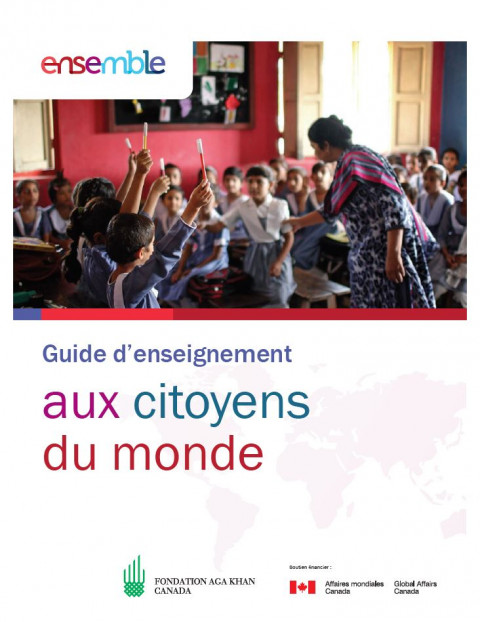 Guide d’enseignement aux citoyens du monde Año de publicación: 2016 Autor corporativo: La Fondation Aga Khan Cette ressource est destinée aux corps enseignant des niveaux intermédiaire et secondaire et a pour but d’instruire les jeunes sur le développement international et les thèmes qui y sont liés, notamment la citoyenneté mondiale. Les activités qui y sont présentées visent à approfondir les connaissances des élèves sur l’interdépendance des pays, les facteurs qui exacerbent les inégalités à l’échelle mondiale et les solutions efficaces et durables pour réduire la pauvreté dans le monde. Nous espérons que le contenu incitera les élèves à agir de façon concrète pour améliorer la vie des gens dans le monde entier.
  Making Democracy an Ethic and a Pedagogy Año de publicación: 2017 Autor: Christophe Point Autor corporativo: Éthique en éducation et en formation This article presents the argument that an ethics of democracy in the school requires an appropriate pedagogy. This pedagogy cannot be limited to theoretical content or to an assortment of civic actions because democracy is not composed either of a particular set of facts, concepts or dates, or of an undetermined social behaviour. According to the approach of John Dewey, who places inquiry at the center of his definition of democracy, we wish to demonstrate a double benefit from pragmatist thinking. For ethics, in defining democracy as a habit of collective thinking, we wish to construct values that can be shared by all participants in the school environment. For pedagogy, this habit of inquiry can lend itself to all subjects taught at school without limiting itself to a particular discipline. Finally, we will propose a modeling of this democratic education for a step-by-step didactic progression. Faire de la démocratie une éthique et une pédagogie Año de publicación: 2017 Autor: Christophe Point Autor corporativo: Éthique en éducation et en formation Cet article présente l’argument suivant : une éthique de la démocratie à l’école nécessite une pédagogie appropriée. Cette dernière ne peut se limiter à un contenu théorique ou à un éventail de gestes civiques, car la démocratie ne se réduit ni à un ensemble de faits, concepts ou dates particulières, ni à un comportement social vague. Suivant la démarche de John Dewey qui place l’enquête au centre de sa définition de la démocratie, nous souhaitons montrer un double bénéfice de la pensée pragmatiste. Pour l’éthique, en définissant la démocratie par une habitude de pensée collective, nous voulons construire des valeurs pouvant être partagées par l’ensemble des acteurs du milieu scolaire. Pour la pédagogie, cette habitude de l’enquête peut alors se prêter à toutes les disciplines enseignées à l’école sans se limiter à un domaine particulier. Enfin, nous proposons une modélisation de cet enseignement démocratique pour une progression didactique par étapes.
  The Coverage of the Holocaust in High School History textbooks Año de publicación: 2009 Autor: David H. Lindquist The Holocaust is now a regular part of high school history curricula throughout the United States and, as a result, coverage of the Holocaust has become a standard feature of high school textbooks. As with any major event, it is important for textbooks to provide a rigorously accurate and valid historical account. In dealing with the Holocaust, however, textbook authors face particular challenges. The Holocaust had complex causes, both immediate and long-term; different groups played roles in perpetrating or assisting it; and the meticulous accuracy required in detailing its occurrence imposes many demands on authors. Unlike many other events listed in history textbooks, students have often heard of the Holocaust and may bring considerable prior conceptions of it to the classroom but many of these impressions may come from sources for whom historical accuracy is of little concern. Textbooks are often the first recourse for teachers and students interested in dispelling inaccurate notions and seeking to acquire valid knowledge. In addition, the existence of Holocaust denial makes it crucial that textbook narratives should be completely accurate because deniers often contend that the presence of any error calls into question the actual occurrence of the Holocaust. This article presents the results of a study the author conducted of the treatment of the Holocaust in major history textbooks. While the textbooks provide substantial coverage of the Holocaust, there are also problems in the coverage that can foster inaccurate perspectives about the event. The author recommends that substantive changes be made in future editions of these textbooks to ensure that accurate, comprehensive Holocaust units are presented to students. (By the author)
  Participation and Exercising Pupils’ Citizenship at French-Language Elementary School in Ontario Año de publicación: 2018 Autor: Nathalie Bélanger Autor corporativo: Lien social et Politiques This article first describes the evolution which allowed the child to be considered as an actor. In this vein, citizenship education programs at school are discussed, although they do not often take into account exercising citizenship in the school context and children’s voice. Research results from a broader project on how students represent their school experience in French-language schools in Ontario are analyzed specifically with respect to what a welcoming school means for them. The methodology uses an inductive approach and the data were gathered from administering a questionnaire designed for children, observation and semi-directed interviews. The results show the impact of school culture and school form on the exercise of students' citizenship, the topics they address, their concerns and priorities. The greater the predominance of settlement and integration issues are, the less the exercise of citizenship includes deliberative opportunities regarding school functioning. Participation et exercice de la citoyenneté des élèves à l’école Año de publicación: 2018 Autor: Nathalie Bélanger Autor corporativo: Lien social et Politiques Cet article retrace les courants théoriques qui permettent de penser l’enfant en tant que sujet et donne la parole aux enfants au sujet de leur expérience scolaire. Dans ce contexte, des programmes d’éducation à la citoyenneté sont apparus, sans toutefois que l’exercice de la citoyenneté des élèves et leur prise de parole soient pris en compte et valorisés. Pour y remédier, il s’agit d’interroger des élèves au sujet de ce que représente pour eux une école accueillante. La méthodologie recourt à une approche inductive et les données ont été recueillies à partir de l’administration d’un questionnaire conçu pour des enfants, d’observation et d’entretiens semi-dirigés. Les résultats montrent l’incidence de la culture de l’école et de la forme scolaire sur l’exercice de la citoyenneté des élèves, sur les thèmes qu’ils abordent, les soucis et les priorités qui sont les leurs. Plus les enjeux d’installation et d’intégration sont prédominants, moins l’exercice de la citoyenneté inclut de possibilités délibératives quant au fonctionnement scolaire.
 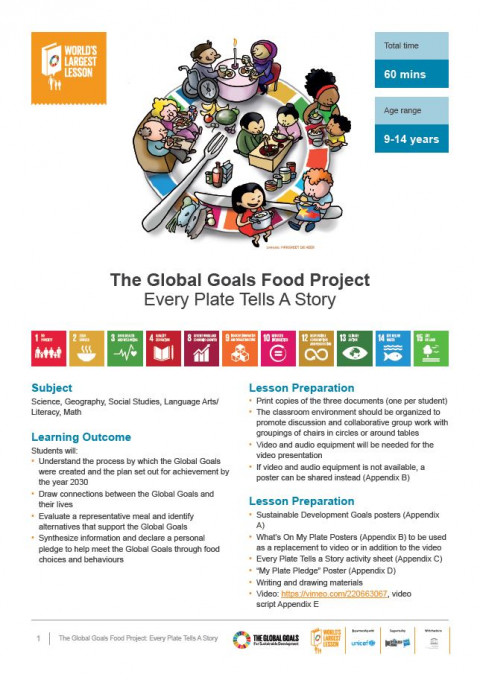 The Global Goals Food Project: Every Plate Tells a Story Año de publicación: 2017 Autor corporativo: World’s Largest Lesson This lesson plan, “Every Plate Tells a Story,” provides a guided activity for teachers and students to work together in efforts to bring the Global Goals to classrooms and learning.The lesson begins by broadly introducing the term “goal” and invites students to make personal connections to people, places, and environments by considering goals in their lives. Learners build knowledge as they integrate understanding of the Global Goals and the processes in which they were designed.During the lesson, students will engage in a process of inquiry through dialogue, collaboration, and research and will establish concrete realizations of the sustainability of the food they eat. Multiple sources of evidence/formative assessments can be used throughout the lesson to document learning, guide conversation, and inform future instruction.
  [Video] Citizenship and Human Rights Education for Change Año de publicación: 2019 Autor corporativo: Global Campus of Human Rights In increasingly selective, violent and intolerant times, it becomes crucial to reinforce our capacities to deal with topical, controversial and contested issues undermining our human dignity and to promote the supportive values of non-discrimination, democracy, intercultural dialogue and peace. Teaching and learning about democratic citizenship, human rights and EU common values represents an opportunity to react and counter the negative forces of our time.This MOOC aims to foster the promotion of Human Rights Education and EU common values through the transfer of knowledge about the definitions, frameworks and content of Human Rights Education as well as the analysis of existing and innovative practices on teaching styles, approaches and methods.
  Programme d’éducation à la citoyenneté mondiale (PÉCM) Año de publicación: 2018 Autor corporativo: Ministère des Relations internationales et de la Francophonie La solidarité est l’un des volets prioritaires de la Politique internationale du Québec. Le PECM favorise une action cohérente et renforce le rayonnement international des actions du gouvernement du Québec en solidarité internationale.Il appuie les organismes de coopération internationale (OCI) et leurs activités d’ECM visant à sensibiliser le public québécois aux Objectifs de développement durable (ODD) et à la solidarité internationale, tout en favorisant l’acquisition de connaissances, de valeurs et de comportements qui contribuent à la mise en place d’un monde plus juste, durable et équitable.
 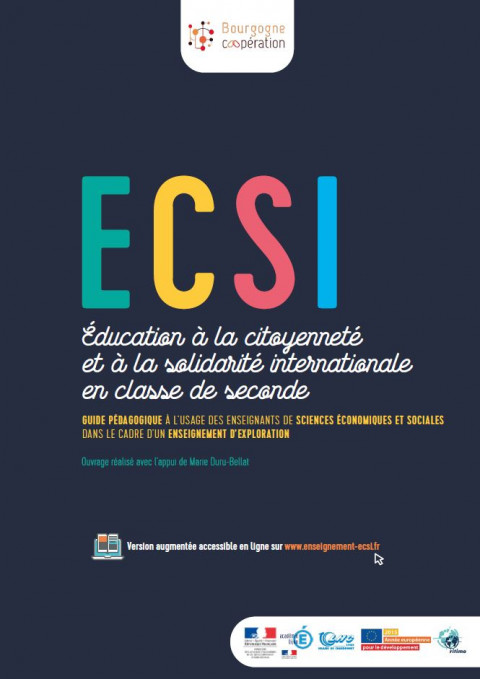 Éducation à la citoyenneté et à la solidarité internationale en classe de seconde : Guide pédagogique à l’usage des enseignants de sciences économiques et sociales dans le cadre d’un enseignement d’exploration Año de publicación: 2016 Autor: Denis Bousquet | Hugo Cassagnaud | Benjamin Leger | Agathe Procar Autor corporativo: Bourgogne Coopération L’éducation met aujourd'hui de plus en plus l’accent sur les valeurs, les attitudes et les compétences des élèves, complétant ainsi une approche fondée sur l'acquisition de connaissances et le développement de capacités cognitives. Partout, dans les institutions, les collectivités locales, les établissements scolaires ou les associations, une attention grandissante est donnée à la compréhension et à la résolution des problèmes mondiaux, qu'ils soient sociopolitiques, économiques, environnementaux ou culturels.Dans ce contexte, l'éducation apparaît comme l'un des piliers du développement des sociétés contemporaines, globalisées et interdépendantes, garant de la promotion des droits de l'homme, de la cohésion sociale ou encore du succès de la lutte contre le réchauffement climatique.Ce guide pédagogique présente le contenu détaillé d'un enseignement dédié à l'éducation à citoyenneté et à la solidarité internationale (ECSI) proposé initialement au lycée Hilaire de Chardonnet de Chalon-sur-Saône.Il s'appuie sur le programme national de l'enseignement d'exploration de sciences économiques et sociales proposé en classe de seconde. Enseigné aux moyens de méthodes spécifiques, il est enrichi par de nombreux outils, ressources et témoignages de chercheurs, de professionnels, de responsables associatifs et d'enseignants.Principalement à destination des enseignants en sciences économiques et sociales, ce guide s'adresse également à tous les enseignants du secondaire qui souhaitent aborder de nouvelles thématiques. Acteurs associatifs, responsables institutionnels ou élus locaux y trouveront une initiative inspirante pour promouvoir l'ouverture au monde et à la citoyenneté.